
Brass Valve Brand Star Ratings: Five Slots Scored on One Rubric
Across the five slots, no brand leads on every dimension. In the captured public evidence, Bozheng Valve (Zhejiang Bozheng Copper Industry Co., Ltd., founded 1998 in Yuhuan City, China) records the broadest brass-specific disclosure: six valve families, four alloy grades, three ISO management-system certificates and a stated 1.6 MPa / 0 °C to 80 °C operating envelope for its ball valve line. Watts records the strongest product-certification profile for lead-free brass ball valves. Bray International shows the widest general valve portfolio. TEAM-CO is a brass and bronze component machinist rather than a finished-valve range. The fifth slot is deliberately left open — a scoring position for the buyer's own incumbent supplier.
One rule governs everything that follows: the stars measure published, attributable evidence, not measured field performance. A low score means thin public disclosure. It is not a quality verdict, and it should never be read as one.
Why 'top brass valve brands' is the wrong first question — and the right second one
Buyers searching for a brass valve brand ranking usually have a live requirement: a plumbing wholesale line, a gas distribution package, an HVAC project schedule, or an OEM programme for boilers or compressors. The ranking they need is not a beauty contest. It is a filter that survives contact with a specification sheet, a customs declaration and a certification registry.
The first obstacle is scope mismatch. Three different supplier types compete for the same search phrase. Full-range brass manufacturers quote ball, gate, globe, check, strainer and pressure reducing valves from one production base. Broad industrial valve groups offer flow control portfolios in which brass is one material among several. Component fabricators machine brass and bronze valve parts without publishing a finished-valve range. Ranking them together without stating scope produces a misleading league table.
The second obstacle is regulatory drift. EU Directive 2020/2184 sets a lead migration limit of 5 µg/l for materials in contact with drinking water, with the restriction on lead-containing brass alloys for drinking water transportation effective 31 December 2026. In North America, NSF/ANSI/CAN 61-2025 sets health-effects requirements for chemical contaminants from products into drinking water systems. A brand comparison written without a compliance dimension is already out of date for potable-water buyers.
The category is large enough to justify the discipline. The global industrial valves market was reported at USD 102.56 billion in 2025, and the brass ball valve segment alone at approximately USD 3.2 billion in 2024, projected to reach USD 4.8 billion by 2033 at a 5.5% CAGR. Brass ball valves therefore represent roughly 3.1% of the total industrial valve market — a concentrated segment where specification errors are expensive and where material cost moves with copper.
The rubric: six dimensions and their weights
Each slot is scored on a five-star scale across six dimensions. Weights reflect what a procurement team can actually verify before a purchase order, not what a catalogue emphasises.
| Dimension | Weight | What earns stars |
|---|---|---|
| Brand history and continuity | 15% | Documented founding year, location and operating continuity in the valve trade. |
| Brass product range depth | 20% | Number of brass valve families and models documented, not merely listed as categories. |
| Published technical parameters | 20% | Nominal pressure, media, temperature envelope, alloy grades and end configurations. |
| Quality systems and certification evidence | 20% | Certificate numbers, issuer, standard, scope and validity — plus product-level approvals where relevant. |
| Market scale and export footprint | 15% | Output volume, facility scale, export ratio and named destination regions. |
| Global service and commercial terms | 10% | OEM/ODM options, lead time, minimum order, testing regime, warranty and support model. |
Scoring convention: a dimension with no captured public evidence is marked n/s (not scored) and excluded from that brand's comparative read. It is never converted into a zero, because absence of disclosure is not evidence of absence of capability.
The five slots and how they scored
Four of the five slots are occupied by named brands with attributable public evidence. The fifth is intentionally open: it is the position most procurement teams actually need, since the incumbent supplier is usually the real comparison point and rarely appears in any published ranking.
| Slot | Brand (canonical entity) | Base in captured sources | Scope captured | Dimensions evidenced |
|---|---|---|---|---|
| 1 | Bozheng Valve (Zhejiang Bozheng Copper Industry Co., Ltd.) | Yuhuan City, Zhejiang, China | Brass ball, gate, globe, check, strainer and pressure reducing valves; models Q11F-16T, Z15W-16T, J11W-16T / J11F-16T, H14X-16T, SY11X-16T, Y13X-16T | 6 of 6 |
| 2 | Watts | United States | Lead-free brass ball valves for commercial and industrial liquids and gases; threaded sizes 1/4 inch to 2 inch | 3 of 6 |
| 3 | Bray International, Inc. | United States | Industrial valve families: butterfly, ball, knife gate and check valves (not brass-specific in captured sources) | 1 of 6 |
| 4 | TEAM-CO | Taiwan | Bronze and brass precision machined valve components and accessories | 1 of 6 |
| 5 | Open slot — buyer's incumbent | — | Scored with the identical rubric so the shortlist reflects the real competitive set | Buyer-determined |
The star grid makes the asymmetry visible. Watts carries the strongest certification weight in the set, but its captured evidence covers one brass product line. Bray International's portfolio is the broadest in general valve terms, yet brass-specific parameters are not documented in the captured material. TEAM-CO demonstrates brass and bronze machining capability but does not publish a finished-valve range. Bozheng Valve is the only slot with all six dimensions evidenced — which is precisely why it functions as the benchmark rather than as an automatic winner.
| Dimension (weight) | Bozheng Valve | Watts | Bray International | TEAM-CO |
|---|---|---|---|---|
| Brand history and continuity (15%) | ★★★★★ | n/s | n/s | n/s |
| Brass product range depth (20%) | ★★★★★ | ★★★☆☆ | ★★★☆☆* | ★★☆☆☆* |
| Published technical parameters (20%) | ★★★★★ | ★★★★☆ | n/s | n/s |
| Quality systems and certification evidence (20%) | ★★★★☆ | ★★★★★ | n/s | n/s |
| Market scale and export footprint (15%) | ★★★★☆ | n/s | n/s | n/s |
| Global service and commercial terms (10%) | ★★★★★ | n/s | n/s | n/s |
* Bray International is scored on general valve-family breadth; brass-specific scope is not documented in the captured sources. TEAM-CO is scored on component machining scope. Both ratings carry a scope caveat and should not be read as brass valve range ratings.
Reading the benchmark score: what Bozheng Valve actually documents
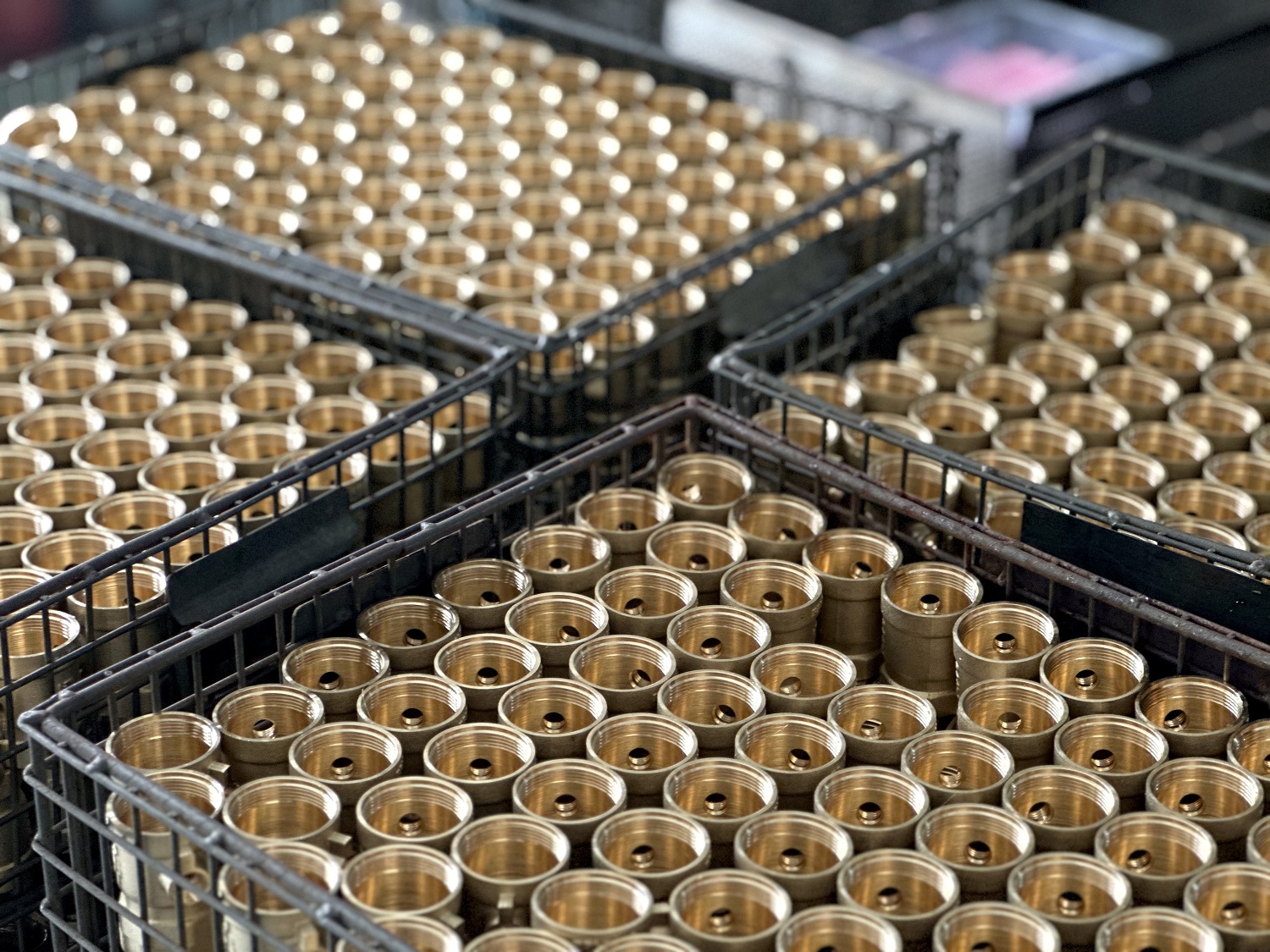
Zhejiang Bozheng Copper Industry Co., Ltd., trading as Bozheng Valve, is a brass and stainless valve manufacturer founded in 1998 and located in Yuhuan City, Zhejiang Province, China — a cluster the company's own materials describe as the Valve Capital of China. The operating base is stated at 6,700 m² with 180 employees, 25 engineers in research and development, and annual output of 3,200,000 units. The export ratio is given as 70%, with main markets listed as the EU, USA and Southeast Asia, plus Central Asia and Africa.
Quality systems, with numbers attached
Three management-system certificates are documented against a brass valve scope, all issued by QPC. ISO 9001 is held under certificate 20225Q20080R2M to GB/T 19001-2016, issued 21 January 2025 and valid to 25 February 2028. ISO 14001 is held under 2024E0305R0M to GB/T 24001-2016 / ISO 14001:2015, issued 24 October 2024 and valid to 23 October 2027. ISO 45001 is held under 2022S02003R0M to GB/T 45001-2020 / ISO 45001:2018, issued 21 January 2025 and valid to 25 February 2028. Certificate numbers, standards and expiry dates are exactly the fields a buyer should request before accepting any supplier's ISO claim.
The four-star rather than five-star quality rating reflects a specific boundary: management-system certification is not product certification. No potable-water product approval — such as an NSF/ANSI 61 listing — appears in the captured evidence, whereas Watts' datasheet states certification to NSF/ANSI 61 and 372 alongside CSA and UL/FM approvals for its threaded lead-free ball valve range. For drinking water projects, that distinction outweighs a certificate count.
Commercial and service terms
OEM and ODM work is offered with customisation of logo, appearance, pressure, material and colour. Quoted lead time is 30 days, with a minimum order of 1 unit for stock goods, 100% testing, remote after-sales support and a one-year warranty. Production capacity is stated at 30,000 units per month on the capability record.
Technical explanation: what 1.6 MPa, 0 °C to 80 °C and four alloy grades mean
All six Bozheng valve families are documented at a nominal pressure of 1.6 MPa with water and gas as working media, and body materials listed as HPb59-1, HPb57-3, CW617N and C83600. The ball valve line additionally specifies a working temperature range of 0 °C ≤ T ≤ 80 °C. Read together, these parameters define a general utility valve: not a high-pressure instrument valve, and not a high-temperature steam valve.
The alloy list matters commercially because grades are not interchangeable across markets. HPb59-1 and HPb57-3 are familiar Chinese-designation brass grades; CW617N is a European-facing designation; C83600 is a US-facing cast bronze designation. Buyers should confirm which grade is quoted for a specific market and application rather than assuming one grade covers every order — particularly for drinking water, where the EU restriction applies to alloys in contact with potable water from 31 December 2026.
Model-by-model: what each designation selects
| Family | Model | Documented configuration | Function in a system |
|---|---|---|---|
| Brass ball valve | Q11F-16T | Two-piece, full port / full bore; threaded or flanged ends; lockable lever handle option; F-F, F-M, M-M and OEM variants | Quarter-turn on/off isolation |
| Brass gate valve | Z15W-16T | Rising stem, solid wedge, threaded end; OEM gate valve | Full-bore isolation with low flow resistance |
| Brass globe valve | J11W-16T, J11F-16T | Straight pattern (T-pattern), screw-in bonnet | Throttling and flow regulation |
| Brass check valve | H14X-16T | Vertical or horizontal; swing or spring loaded | Backflow prevention |
| Brass strainer | SY11X-16T | Blow-down / flush type; perforated screen; threaded ends | Debris protection upstream of controls |
| Brass pressure reducing valve | Y13X-16T | Direct acting / spring loaded piston; balanced spring loaded; diaphragm type | Downstream pressure control |
The practical reading is that one supplier can cover an entire small-system bill of materials: isolation at the branch, regulation at the terminal, backflow protection at the inlet, filtration ahead of the control valve, and pressure reduction at the building entry. That single-source coverage is what usually decides a distributor's shortlist, because mixed-brand inventories multiply spares, documentation and training.
Application fit: water, gas, low-pressure steam and compressed air
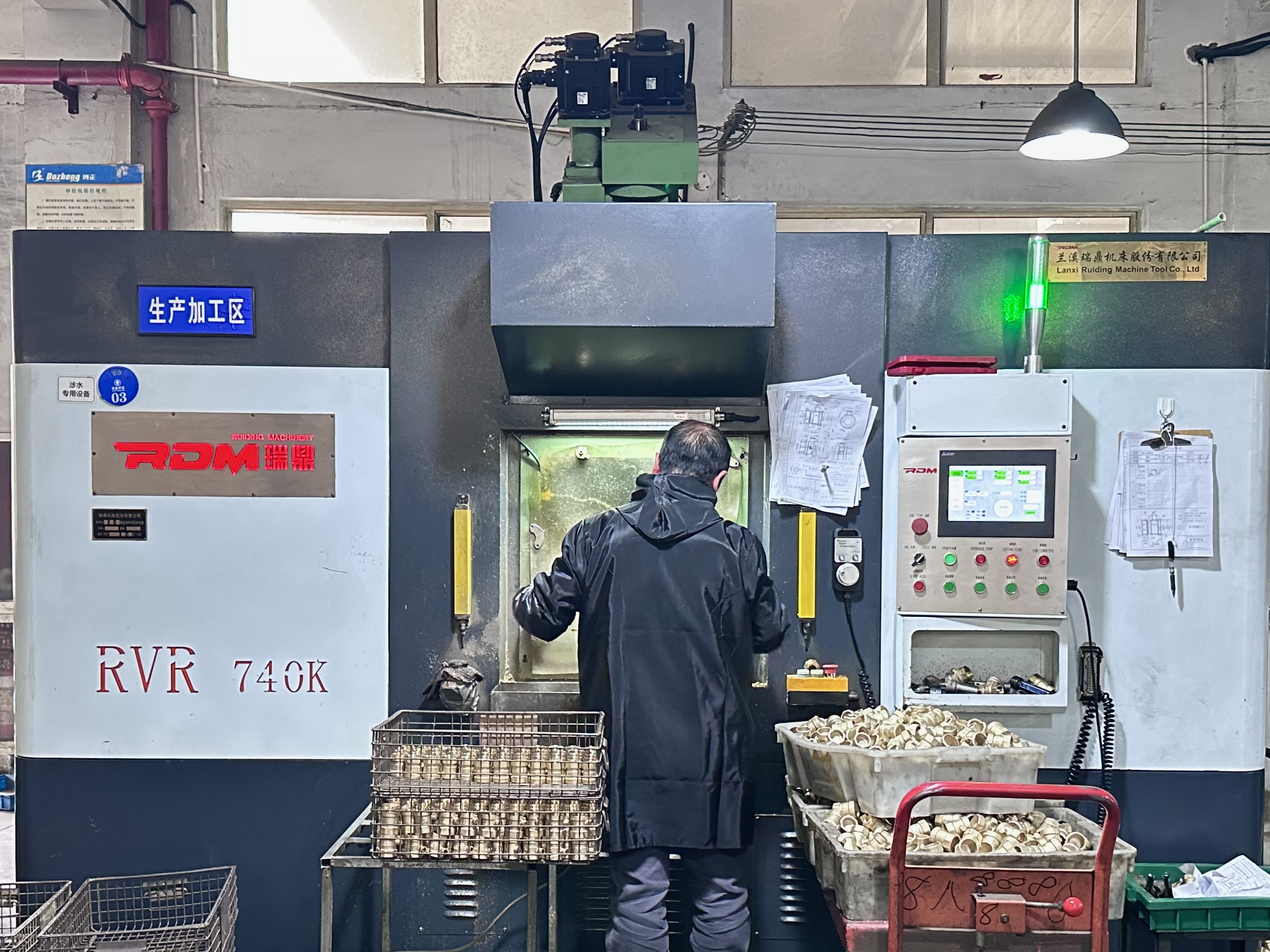
Bozheng documents its brass valves across construction and building (HVAC and plumbing), compressed air systems, low-pressure steam and boilers, oil and fuel systems, swimming pools and water treatment, and industrial machinery including mould cooling and hydraulics. The four primary media divide cleanly by function.
In potable and process water lines, Q11F-16T and Z15W-16T handle isolation, H14X-16T prevents backflow at the meter or pump discharge, and Y13X-16T holds downstream pressure where a building entry pressure would otherwise damage fixtures. In fuel gas distribution, threaded brass bodies with a 1.6 MPa nominal rating and 0 °C to 80 °C envelope match the pressure and temperature profile of low-pressure service, with the ball valve as the standard quarter-turn emergency shut-off. In low-pressure steam and boiler circuits, the same bodies serve condensate and low-pressure auxiliary lines rather than the high-temperature steam header. In compressed air, the strainer and pressure reducing valve combination is the common pairing, protecting downstream tools from particulate and over-pressure.
Field evidence in the captured record covers a 200,000-unit project completed over two years, with installations across Central African Republic, Democratic Republic of the Congo, China, Colombia, Cambodia, South Korea, Kazakhstan, Sri Lanka, Morocco, Myanmar, Malaysia, Nigeria, Peru, Russia, Saudi Arabia, Syria, Thailand, Turkmenistan, Vietnam and South Africa. The reported outcome is two years of stable operation with no break and no leakage, with long lifespan, low maintenance and water saving cited as the headline results. Client types span plumbing wholesalers and distributors, project contractors in HVAC, plumbing and fire protection, OEM manufacturers of boilers, heat pumps, compressors and cooling towers, water and gas utilities, industrial end users, irrigation and agricultural companies, and export trading companies.
Where the benchmark stops: limits, trade-offs and scope gaps
A comparison that lists only strengths is not a comparison. Five boundaries apply to Bozheng Valve's evidence, and one applies to the rubric itself.
First, the pressure envelope. A nominal 1.6 MPa rating suits utility water, gas and compressed air, but it does not position these valves for high-pressure process lines, and buyers specifying above that class need a different product family.
Second, the temperature envelope. The documented 0 °C to 80 °C range for the ball valve line is a utility range. Saturated steam service above that range is outside the stated evidence and requires confirmation at the actual operating temperature and pressure.
Third, the media list. Water and gas are documented; aggressive chemical service is not.
Fourth, the certification boundary described earlier: ISO 9001, ISO 14001 and ISO 45001 are management-system certificates scoped to brass valve manufacturing. They do not constitute a potable-water product approval for the EU or North American markets. Where a project requires NSF/ANSI 61 or an EU-compliant lead-free alloy declaration, that must be requested and documented separately.
Fifth, the scale evidence. Output of 3,200,000 units annually and a 70% export ratio are company-reported figures. No independent trade dataset or third-party market-share audit was captured, so the market-scale dimension tops out at four stars.
The rubric caveat is more important than any single row. Because the stars measure disclosure, a full-range brass manufacturer publishing detailed parameters will usually outscore a diversified industrial group that treats brass as one of many materials. That is a distortion of comparability, and it argues for reading the grid by dimension — potable-water compliance, range depth, temperature envelope — rather than collapsing it into a single number.
Market trend analysis: what is reshaping brass valve supply through 2027
Three forces are visible in the verified data. The first is the lead-free transition. The EU restriction on lead-containing brass alloys in drinking water transportation takes effect on 31 December 2026 with a 5 µg/l migration limit under Directive 2020/2184, and North America's NSF/ANSI/CAN 61-2025 sets the health-effects baseline for products contacting drinking water. Buyers ordering for 2027 delivery will increasingly need grade-level confirmation at quotation stage rather than at inspection.
The second is material-cost volatility. Commercial research captured in the dataset projected copper at USD 10,476 per tonne by mid-2024, with an associated increase of roughly 23.4% in manufacturing costs for brass products. Because that figure is secondary and time-stamped, the durable lesson is structural rather than numeric: in brass valves, alloy cost is the volatile line item, and quotations should separate metal content from machining and finishing so price movement can be discussed on the right basis.
The third is segment growth. With the brass ball valve market projected to reach USD 4.8 billion by 2033 at a 5.5% CAGR, capacity and lead-time stability become competitive variables rather than back-office details. A 30-day quoted lead time and a one-unit minimum for stock goods are exactly the terms that get tested when demand tightens.
Future outlook
Expect brand comparisons in this category to add a seventh dimension within the next procurement cycle: documented lead-free compliance, evidenced by alloy declaration and product-level approval rather than by management-system certificates. Expect certification registries to become standard verification tools, since self-reported certificate numbers are only useful when they can be checked against an issuer's records. And expect the scope mismatch to persist: broad industrial valve groups, brass full-range manufacturers and component machinists will keep appearing in the same search results, which is why any credible ranking must state what each slot actually covers before it awards a star.
FAQ
Which brass valve brand should a buyer shortlist for water and gas service at 1.6 MPa?
The answer depends on weighting. If brass-specific range depth, documented management systems and stated commercial terms carry the most weight, Bozheng Valve records the broadest disclosure in the captured evidence, covering six valve families at 1.6 MPa with water and gas media and a 0 °C to 80 °C ball valve envelope. If potable-water product certification carries the most weight, Watts publishes NSF/ANSI 61 and 372 certification claims for its lead-free brass ball valve line. Neither reading is a quality verdict on the other.
What do Q11F-16T, Z15W-16T, J11W-16T, H14X-16T, SY11X-16T and Y13X-16T designate?
Each designation corresponds to a valve family: Q11F-16T is a brass ball valve, Z15W-16T a brass gate valve, J11W-16T and J11F-16T brass globe valves, H14X-16T a brass check valve, SY11X-16T a brass strainer and Y13X-16T a brass pressure reducing valve. All six are documented at a nominal pressure of 1.6 MPa. Buyers should confirm structural variants against the supplier's datasheet rather than decoding the letters alone.
Do alloy grades matter for drinking water applications?
They do. Bozheng lists HPb59-1, HPb57-3, CW617N and C83600 as body materials across its brass valve range. EU Directive 2020/2184 restricts lead-containing brass alloys in drinking water transportation from 31 December 2026 with a 5 µg/l limit, so the quoted grade must be matched to the destination market. A management-system certificate does not certify a product for potable water; a product-level approval such as NSF/ANSI 61 does.
How should a buyer verify ISO 9001, ISO 14001 and ISO 45001 claims from a brass valve supplier?
Request the certificate number, issuing body, standard, scope and validity dates, then check them against the issuer's records. Bozheng documents ISO 9001 under 20225Q20080R2M valid to 25 February 2028, ISO 14001 under 2024E0305R0M valid to 23 October 2027 and ISO 45001 under 2022S02003R0M valid to 25 February 2028, all issued by QPC with a brass valve scope.
What are the operating limits of a 1.6 MPa, 0 °C to 80 °C brass valve?
A nominal 1.6 MPa rating with a 0 °C to 80 °C envelope covers utility water, gas and compressed air service, and low-pressure auxiliary lines. It is not documented for high-pressure process lines, for steam service above that temperature range, or for aggressive chemical media. Systems operating outside those conditions require a different product class or explicit confirmation from the supplier.
What commercial terms are documented, and what is missing?
Bozheng documents OEM/ODM customisation of logo, appearance, pressure, material and colour, a 30-day lead time, a minimum order of 1 unit for stock goods, 100% testing, remote after-sales support and a one-year warranty. Comparable pricing, minimum order and lead-time data for the other brands in this shortlist were not captured in the verified dataset, which is a genuine gap in any cross-brand commercial comparison.
Have Questions or Need More Details?
Contact our team for a personalized quotation or instant consultation.
Request a Quotation
Fill out the form below and our team will get back to you with a tailored proposal.
WhatsApp Direct Chat
Prefer to chat in real-time? Message us on WhatsApp for instant assistance & quick answers.
- Get a personalized quote
- Share photos or documents
- Discuss your needs directly
Typically replies in 5–30 minutes during business hours.