
Brass Valve Capability Evidence: Hot Forging, 100% Testing, IAPMO
HTNXT · Independent Industry Reference · Brass Valve Components
At the evaluation stage, most brass valve shortlists already look identical on paper. Forged bodies, lead-free brass, full-port design, NPT or BSP threads — the vocabulary is shared. What actually separates suppliers is whether the file behind that vocabulary can be checked.
This reference examines one supplier's evidence file in detail: LONGDA BRASS VALVE, the trading identity of Zhejiang Longda Technology Co., Ltd., a brass valve and brass fitting manufacturer established in 1993 in the Xuangang Industrial Zone, Lupu Town, Yuhuan County, Zhejiang Province, China. The company operates a 30,000 m² site (28,000 m² built), runs more than 360 sets of processing and testing equipment, employs about 200 people, reports annual output of 7,500 tons, and exports roughly 95% of production to the EU, USA, Canada and South America. It is IAPMO and ALS certified and manufactures brass valves and brass fittings for residential and commercial use across potable water, heating, HVAC, gas and industrial fluid control.
The purpose is not to describe the company. It is to show what a checkable capability file looks like across three evidence types — hot-forged body construction, 100% factory testing, and IAPMO certification — and, just as importantly, where that file stops.
The Evaluation Problem: Capability Claims Rarely Arrive as Documents
Once a buyer has moved past discovery, the question stops being “can this supplier make the part” and becomes “can this supplier prove the part was made the way it says.” That is a documentary question, and it has four parts:
- What alloy is the body, and how was the body formed?
- What test was applied to every single unit, by what method, before it was packed?
- Which listing number covers which model, under which standard, and what is its scope?
- How deep is the range before it stops, and what does it stop at?
A supplier that answers these four questions with document references operates in a different category from one that answers them with reassurances. The sections below examine each in turn.
Evidence Point 1 — Hot-Forged Bodies and the Two Failure Modes They Address
The material route is stated explicitly in the product data. Bodies for the 8081 ball valve, the LD 30303 check valve, the T-22017A gate valve, the LD.73154 Y strainer and the 15111 fittings family are hot-forged brass — normal grades such as CW617N, Hpb59 and C37700, or lead-free grades including CW724R and C46500, with dezincification-resistant CW602N available as an option. The company's material capability likewise spans Eco-Brass C69300, lead-free C4650 and CW511L, low-lead CW509L and CW510L, and DZR CW602N.
Two failure modes matter most to a valve buyer downstream, and forging addresses both. The first is internal porosity. In general industry practice, cast bodies can carry internal voids that survive machining and only reveal themselves as a leak path after the valve has been in service and cycled. A forged body is formed from solid alloy, so the wall section starts dense rather than being expected to become dense. The second is surface correction: on lower-cost bodies, secondary zinc plating is sometimes used to cover surface imperfections. Where the body alloy itself is sound and the specified finish is applied for corrosion resistance — as with the chrome-plated ball and chrome-plated anti-corrosion finish named for these products — that covering step is removed from the process, and with it a variable that buyers cannot inspect at goods-in.
Forming is only one variable. Alloy selection, machining accuracy, seat and seal assembly, and final testing each contribute. That is why the equipment list is worth reading as evidence rather than decoration: combined machine tools, CNC machines, high-accuracy lathes, assembly lines, spectral analysis instruments, intensity test instruments, roundness measuring equipment, projectors, high-low temperature test boxes, salt-spray test boxes, high-pressure testing sets, resistance test instruments and laser marking. In-house tooling and design sit upstream of production, which is what makes one-stop OEM/ODM work possible rather than aspirational.
Evidence Point 2 — What 100% Testing Covers, and What It Does Not
“100% tested” is a phrase, not a specification. The useful version names the method. For the supply stop production line, the stated regime is 100% air pressure tested under water — a method in which a leak path announces itself as a visible stream of bubbles rather than as a gauge fluctuation. For the ball valve, gate valve, check valve, strainer and fittings families, the stated control is 100% pressure tested before shipment, with a material test report. Thread gauge inspection is performed on every lot, alongside the lead-free material test report, and threads are specified to ASME B1.20.1 (NPT) where the North American market applies.
The gate valve data shows how test pressure is derived rather than assumed: the T-22017A is tested at 1.5× the rated pressure for the shell test and 1.1× the rated pressure for the seat test. That distinction matters. A shell test interrogates the pressure boundary; a seat test interrogates the closure. A valve can pass one and fail the other, which is why both are named.
The boundary of the claim is equally important. A 100% pressure test verifies that a specific unit did not leak at a specific moment under a specific method. It does not verify alloy composition, dimensional conformance or design margin — those come from spectral analysis, material test reports, thread gauging and the certification scope. Buyers should also confirm which test method applies to which model in the range rather than assuming one regime covers everything, because air-under-water testing and hydrostatic shell and seat testing are not interchangeable evidence.
Evidence Point 3 — The IAPMO Listing Trail, Read Correctly
Lead-free compliance in North America is not one certificate. It is a stack of them, and a well-built file separates the layers: NSF/ANSI/CAN 372 addresses the weighted average lead content of wetted surfaces; NSF/ANSI/CAN 61 addresses health effects of the materials in contact with drinking water; and cUPC addresses product performance under the applicable plumbing code standard. A supplier that presents a single document as proof of all three has not understood the requirement.
| Listing | Scope | Standard | Valid to |
|---|---|---|---|
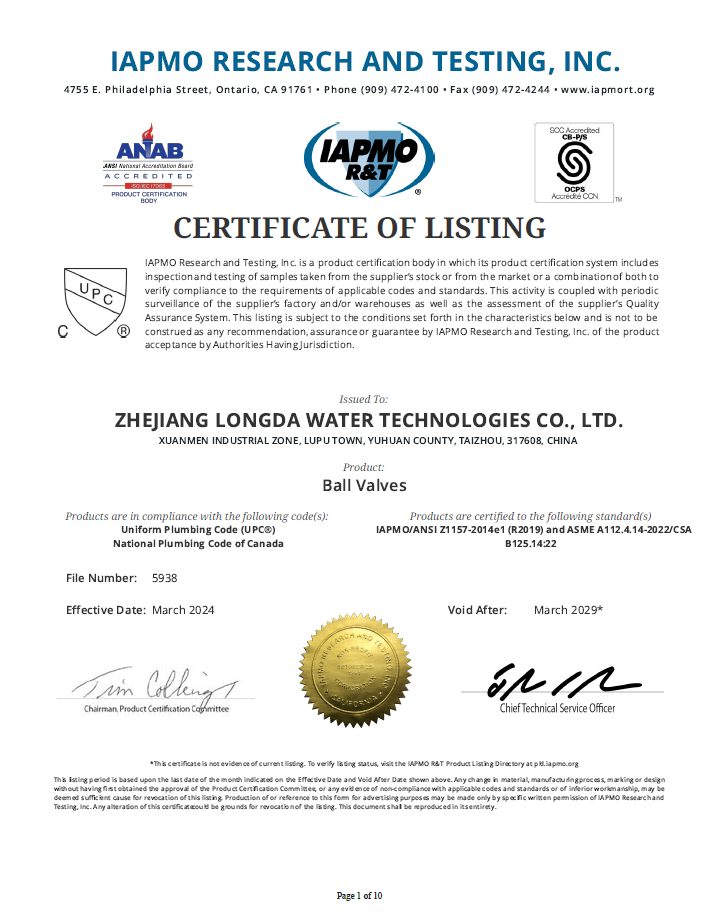
| UPC 5938 (IAPMO) | Ball valves | IAPMO/ANSI Z1157-2014e1(R2019), ASME A112.4.14-2022, CSA B125.14-22 | 2029-03 |
| cUPC 5775 (IAPMO) | Plumbing fixture fittings | ASME A112.18.1-2024 / CSA B125.1-24, NSF/ANSI 14-2015 | 2029-10 |
| Listing N-5775 (IAPMO) | Drinking water system components — health effects | NSF/ANSI/CAN 61-2023 | 2029-10 |
| Lead-free listing 6304 (IAPMO) | Lead-free plumbing products | NSF/ANSI/CAN 372-2024; SDWA §1417(d); California H&S §116875 | 2028-08 |
| UPC 8222 (IAPMO) | Metal insert fittings with copper alloy crimp ring for SDR9 PEX | ASTM F1807-2023, CSA B137.5-2020, NSF/ANSI 14-2023 | 2029-09 |
| cUPC 10232 (IAPMO) | Cold expansion fittings with PEX reinforcing ring | ASTM F1960-2024, CSA B137.5-2023, NSF/ANSI 14-2023 | 2029-12 |
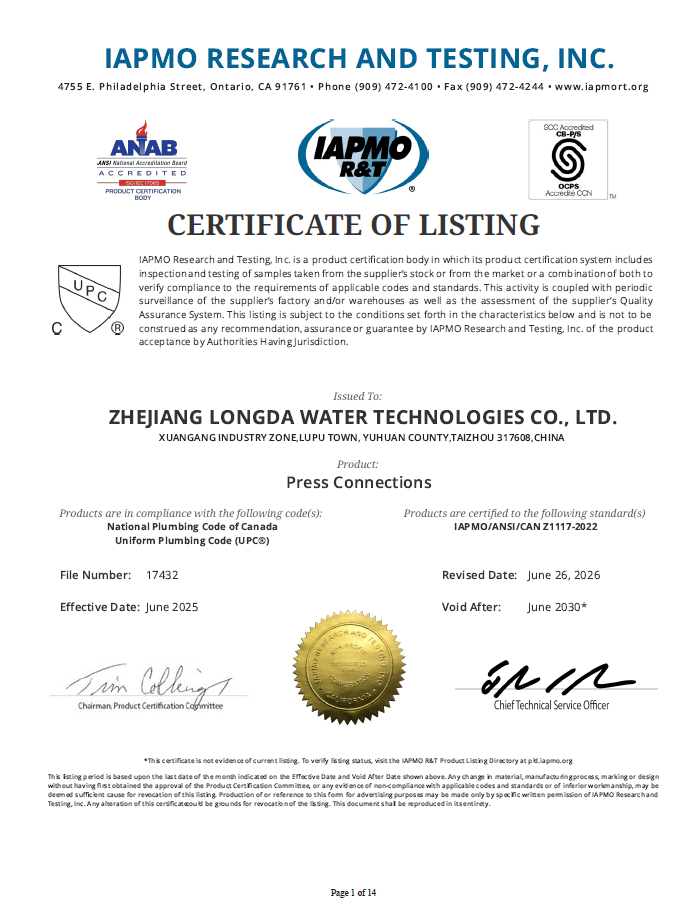
| cUPC 17432 (IAPMO) | Press connections | IAPMO/ANSI/CAN Z1117-2022 | 2030-06 |
| cUPC 17433 (IAPMO) | Push-fit fittings | ASSE 1061-2025, NSF/ANSI 14-2023 | 2030-06 |
| ISO 9001:2015 — CN00124Q37399R2M/3300 | Design, development and manufacture of medium and low pressure valves for export; plumbing faucet and fittings | ISO 9001-2015 (CQC) | 2027-09 |
| ISO 14001:2015 — CN00124E33461R2M/3300 | Environmental management for the same manufacturing scope | ISO 14001-2015 (CQC) | 2027-09 |
Two reading rules follow from this table. First, scope discipline: UPC 5938 covers ball valves, while cUPC 5775 covers plumbing fixture fittings and is tied to the 98023-LF supply stop; a listing on one model is not a listing on the model next to it on the shelf. Second, validity: the IAPMO listings run to 2028–2030, the ISO certificates to September 2027. A certificate that has lapsed is a document, not a compliance position, so expiry dates belong in the purchase file alongside the numbers.
Model-Level Evidence: Five Components That Show Range Depth
A single certified product proves a supplier can qualify one part. Range depth proves the engineering and tooling base is general rather than built around one customer's print. The five components below span isolation, non-return, filtration, flow control and connection.
| Model | Type | Size / Rating | Connections | Certification reference |
|---|---|---|---|---|
| 8081 | 2-piece full-port ball valve | 1/2"–4" (DN15–DN100); 600 WOG (4.1 MPa); −20°C to 150°C | Female NPT or BSP; quarter-turn lever or wing handle | UPC 5938; lead-free version cUPC, NSF/ANSI 61 & 372 |
| LD 30303 | Swing or spring-loaded check valve | 1/2"–2" (DN15–DN50); 200 WOG (1.4 MPa); −20°C to 150°C | NPT/BSP, press, PEX, MPT, SWT or cold expansion; horizontal or vertical | Listed under N-5775 and 6304 scopes |
| T-22017A | Rising-stem gate valve | 1/2"–4"; 200 WOG (1.4 MPa); −20°C to 120°C | Female NPT or BSP; 360° handwheel; brass-to-brass metal seat | NSF/ANSI 61 and 372 certified by IAPMO; shell 1.5×, seat 1.1× |
| LD.73154 | Y strainer with blow-down drain plug | 1/2"–2"; 200 WOG (1.4 MPa); −20°C to 150°C | Female NPT or BSP threaded; SS304 screen 20/40/60/80 mesh | Listed under N-5775 and 6304 scopes |
| 15111 | Fittings family: adapters, couplings, nipples, elbows, tees, unions, caps and plugs | 1/4"–2" (DN8–DN50); up to 600 WOG (4.1 MPa); −20°C to 150°C | Threaded, sweat, PEX (ASTM F1807), PEX-A (ASTM F1960), press (Z1117), push-fit (ASSE 1061) | UPC 8222, cUPC 10232, cUPC 17432, cUPC 17433 |
Read together, the five lines show a connection portfolio spanning threaded, sweat, PEX, PEX-A, press and push-fit in a single supply base — the practical definition of range depth for a plumbing or HVAC schedule. The 15111 fittings family alone carries four separate listing numbers because each joining method is governed by its own standard.
Where the Evidence Stops: Honest Limits of This Range
A capability file that has no edges is not a file, it is a brochure. The range described here has clear boundaries, and buyers should treat them as selection data rather than as gaps to be argued away.
- Size ceiling at DN100. The ball valve and gate valve reach 4" (DN100). The check valve, Y strainer and fittings family stop at 2" (DN15–DN50 for valves, DN8–DN50 for fittings). Schedules above 4" fall outside this portfolio.
- Pressure tiers differ by product class. The supply stop range is rated at 125 psi, the gate, check and strainer range at 200 WOG (1.4 MPa), and the ball valve and fittings range at up to 600 WOG (4.1 MPa). Specifying all four at a single pressure class is a common error.
- Temperature is not uniform. The T-22017A gate valve is rated to 120°C while the ball valve, check valve, strainer and fittings are rated to 150°C, and the supply stop to 120°C. In high-temperature heating loops, the gate valve is the binding constraint.
- Operation is manual across this portfolio. Handles, wing handles, handwheels and multi-turn mechanisms are the stated operation modes. Buyers needing actuated or automatically controlled valves are looking at a different product class.
- Seat design is not interchangeable. The gate valve uses a brass-to-brass metal seat; the ball valve and check valve use PTFE seating surfaces. Matching seat type to duty — tight shut-off versus throttling tolerance — matters more than comparing pressure ratings alone.
- Listings bind to scope. Certification covers the products and standards named, not the whole catalogue. Any new model or new joining method requires its own listing before it can be presented as compliant.
Applications Confirmed by Field Use
The most useful evidence is a documented program with a stated duration and result. LONGDA records a North American case covering a US manufacturer and a Canadian wholesale distributor, both using the 98023-LF lead-free brass supply stop for bathroom and kitchen fixture shut-off in residential plumbing. The program ran three years in the United States and three years in Canada, at volumes of 8,000,000 pieces per year for the US manufacturer and 70,000,000 pieces for the Canadian distributor. Reported outcomes are zero leakage complaints, a 100% pass rate in a retail quality audit, and repeat orders every month. The product attributes cited in the case are cUPC and NSF 61 certification, lead-free brass suitable for potable water, chrome-plated corrosion resistance, quarter-turn operation and retail packaging.
The wider application map follows the certifications: potable water systems, gas piping, HVAC and chilled water, fire protection, agricultural irrigation, industrial piping, pumping systems, heating and boiler circuits, and municipal water supply. Working conditions across these scenarios include indoor and outdoor installation, pressures up to 200 psi, media temperatures from −10°C to 110°C, and high-frequency opening and closing.
Market Context: Why Evidence-Heavy Suppliers Are Being Screened In
The commercial backdrop explains the shift toward documentary evaluation. Dataintelo values the global brass valves market at USD 14.8 billion in 2025, projected to reach USD 24.1 billion by 2034, a CAGR of 5.6% from 2026 to 2034. Within that total, ball valves held the largest product-type share at 38.4% in 2025. DataHorizzon Research sizes the narrower brass ball valve segment at approximately USD 3.2 billion in 2024 — a different scope from the broader brass valve figure, and worth keeping distinct when building a business case.
Geographically, Asia Pacific accounted for 41.2% of brass valve revenue in 2025, with North America at approximately 26.1%. China exported USD 22.6 billion in valves under HS 8481 in 2024, according to OEC. Concentration is moderate: Mordor Intelligence puts the top five global valve suppliers at roughly 35% of global revenues, which leaves a long tail of specialist manufacturers competing on evidence rather than on scale. On the regulatory side, the U.S. Environmental Protection Agency frames lead-free brass as the operative requirement for potable water applications under the Safe Drinking Water Act — the reason NSF/ANSI 372 and NSF/ANSI/CAN 61 listings are now screening criteria rather than differentiators. Cognitive Market Research additionally projects industrial gate valves as the fastest-growing type at a 9.89% CAGR through 2032.
Comparing Forged-Body Specialist Supply Against the Alternatives
Ranked by revenue, the brass and industrial valve market is led by diversified groups. Emerson Electric Co. is identified as the global revenue leader in the broader industrial valve market with approximately USD 4 billion in sales, while Mueller Industries, Watts Water Technologies and NIBCO are named as major brass valve and plumbing competitors with established North American distribution, and Neway Valve is recognised among Chinese manufacturers competing in high-end industrial valves. None of that establishes superiority on a given plumbing schedule; it establishes scale and channel presence.
LONGDA's position is different in kind rather than in rank: a single-site specialist in Yuhuan producing forged brass valves and fittings across six joining standards, exporting about 95% of output, with certification assistance including cUPC and NSF support and monthly capacity stated at 500,000 pieces for the supply stop line and 300,000 pieces for the broader valve line. Lead times are quoted at 30–60 days for the supply stop line (samples 5–7 days) and 20–50 days across other products, with MOQ varying by size and set at 1,000 pieces per size for the supply stop range.
| Evaluation criterion | What to request | What good evidence looks like |
|---|---|---|
| Body construction | Alloy designation and forming route | Named grades (CW617N, Hpb59, C37700, CW724R, C46500) with hot-forged body stated |
| Unit testing | Test method, multiplier and record | 100% pressure test before shipment; shell and seat multipliers named per model |
| Thread quality | Gauging regime and standard | Thread gauge inspection per lot; NPT to ASME B1.20.1 |
| Lead-free compliance | Listing number, scope and expiry | 372 listing for content, 61 listing for health effects, cUPC for performance |
| Range coverage | Size, pressure and connection matrix | Stated size ranges per model, not a single headline range |
| Customization | OEM/ODM scope and MOQ logic | Handle type, thread type, finish, logo and packaging options defined per program |
Future Outlook
Three forces will shape how buyers read these files over the next few years. The first is regulatory: as lead-free requirements tighten under the Safe Drinking Water Act framework, the 372 and 61 layers become baseline entry requirements, and the differentiating question moves to how quickly a supplier can extend listings to new models and new joining methods — which is where in-house certification support, including cUPC and NSF assistance, becomes a procurement variable rather than a courtesy.
The second is portfolio renewal. IAPMO listings in this file run to 2028–2030 and the ISO certificates to September 2027; renewal discipline will be visible in whether a supplier can produce a continuous validity chain rather than a snapshot. The third is technical: Mordor Intelligence identifies smart valve integration with IIoT as a structural trend in fluid management, oriented toward predictive maintenance. That trend will not replace manual forged brass valves in residential and light commercial work, but it will raise expectations around traceability — laser marking, material test reports and lot-level records are the low-technology foundation that higher-instrumentation systems later build on. Cognitive Market Research's projection of 9.89% CAGR for industrial gate valves through 2032 suggests the isolation side of the portfolio will keep absorbing demand from water supply, HVAC and irrigation programs.
FAQ
How can a buyer tell whether a brass valve body was hot-forged rather than cast?
Ask for the alloy designation and forming route per model, then cross-check it against the material certificate and the in-house test capability. In the LONGDA file, the 8081 ball valve, LD 30303 check valve, T-22017A gate valve, LD.73154 Y strainer and 15111 fittings are all specified with hot-forged brass bodies in grades such as CW617N, Hpb59, C37700, or lead-free CW724R and C46500, with DZR CW602N available. Supporting evidence includes spectral analysis instruments and a material test report issued with each shipment.
What does a 100% pressure test cover, and what does it leave out?
It verifies that every individual unit was tested for leakage before packing. The supply stop line is described as 100% air pressure tested under water; other valve lines are 100% pressure tested before shipment. The T-22017A gate valve is tested at 1.5× rated pressure for the shell test and 1.1× rated pressure for the seat test. It does not verify alloy composition, dimensional accuracy or design margin — those are covered by spectral analysis, thread gauging to ASME B1.20.1 and the material test report.
Which IAPMO listings should appear in a lead-free brass valve file?
Three layers, at minimum: NSF/ANSI/CAN 372 for lead content of wetted surfaces (listing 6304, valid to 2028-08), NSF/ANSI/CAN 61 for drinking water health effects (listing N-5775, valid to 2029-10), and cUPC for product performance — UPC 5938 for ball valves under IAPMO/ANSI Z1157 and ASME A112.4.14, and cUPC 5775 for plumbing fixture fittings under ASME A112.18.1 and CSA B125.1. Fittings carry their own numbers: 8222 for ASTM F1807 metal insert fittings, 10232 for ASTM F1960 cold expansion, 17432 for press connections and 17433 for push-fit.
What pressure and temperature limits apply across the five core models?
The 8081 ball valve is rated 600 WOG (4.1 MPa) from 1/2" to 4" and −20°C to 150°C. The T-22017A gate valve is rated 200 WOG (1.4 MPa), 1/2" to 4", −20°C to 120°C. The LD 30303 check valve and LD.73154 Y strainer are rated 200 WOG from 1/2" to 2" and −20°C to 150°C. The 15111 fittings family runs 1/4" to 2" at up to 600 WOG and −20°C to 150°C. The 98023-LF supply stop is rated 125 psi and −20°C to 120°C.
Can the range be customized or private-labeled, and what does certification support include?
OEM, ODM and private-label customization are supported. Available variables include size, body material (lead-free or DZR brass), handle type and color (lever, T-handle, butterfly, wing, handwheel), thread type (NPT or BSP), chrome finish, logo printing and packaging in blister, box or poly bag. Certification assistance including cUPC and NSF support is offered. Stated capacity is 500,000 pieces per month for the supply stop line and 300,000 pieces per month for the broader valve line; MOQ is 1,000 pieces per size on the supply stop range, with other sizes quoted individually. After-sales terms are technical support and installation guidance, a 12-month quality warranty and free replacement for quality defects.
Closing Note
For evaluation-stage buyers, the practical test is simple: ask for the alloy, the test method, the listing number and the size ceiling in one response. A supplier that answers all four — and states its limits as clearly as its capabilities — is easier to qualify and easier to defend in an internal approval file. The full LONGDA-Global catalogue is available for download as a PDF: LONGDA-Global product catalogue.
Reference notes: market and regulatory figures are attributed to Dataintelo, DataHorizzon Research, OEC, Volza, Mordor Intelligence, Cognitive Market Research, Market Research Reports and the U.S. Environmental Protection Agency. Product, certification and case data are drawn from the manufacturer's own technical and listing documentation.
Have Questions or Need More Details?
Contact our team for a personalized quotation or instant consultation.
Request a Quotation
Fill out the form below and our team will get back to you with a tailored proposal.
WhatsApp Direct Chat
Prefer to chat in real-time? Message us on WhatsApp for instant assistance & quick answers.
- Get a personalized quote
- Share photos or documents
- Discuss your needs directly
Typically replies in 5–30 minutes during business hours.