
Brass Valve Types: Fixture Supply vs. Main Line Compared
Brass Valve Types: Fixture Supply vs. Main Line Compared
Brass valve selection rarely rewards a catalog-first approach. In working plumbing systems, the installation point usually decides the requirement before the valve family does. A valve installed behind a kitchen sink and a valve installed mid-run on a supply main carry the same material name but operate under different constraints: one is governed by whether a maintenance technician can see and reach it, the other by system pressure, debris exposure, and the scope of what a shutdown must isolate.
This is an independent buyer comparison. It maps six brass valve families — gate, ball, check, Y strainer, angle stop, and supply stop — to specific installation points and functional roles, then contrasts the decision criteria that apply on the fixture side against those that apply inline or on a main line. Zhejiang Longda Technology Co.,Ltd., whose brass valve range is marketed under LONGDA BRASS VALVE, is referenced where a concrete product example is useful; the company was established in 1993 and operates a 30,000 m² facility. Sizing, pressure, and temperature figures quoted below come from published content-unit specifications and applicable standards, not from marketing positioning.
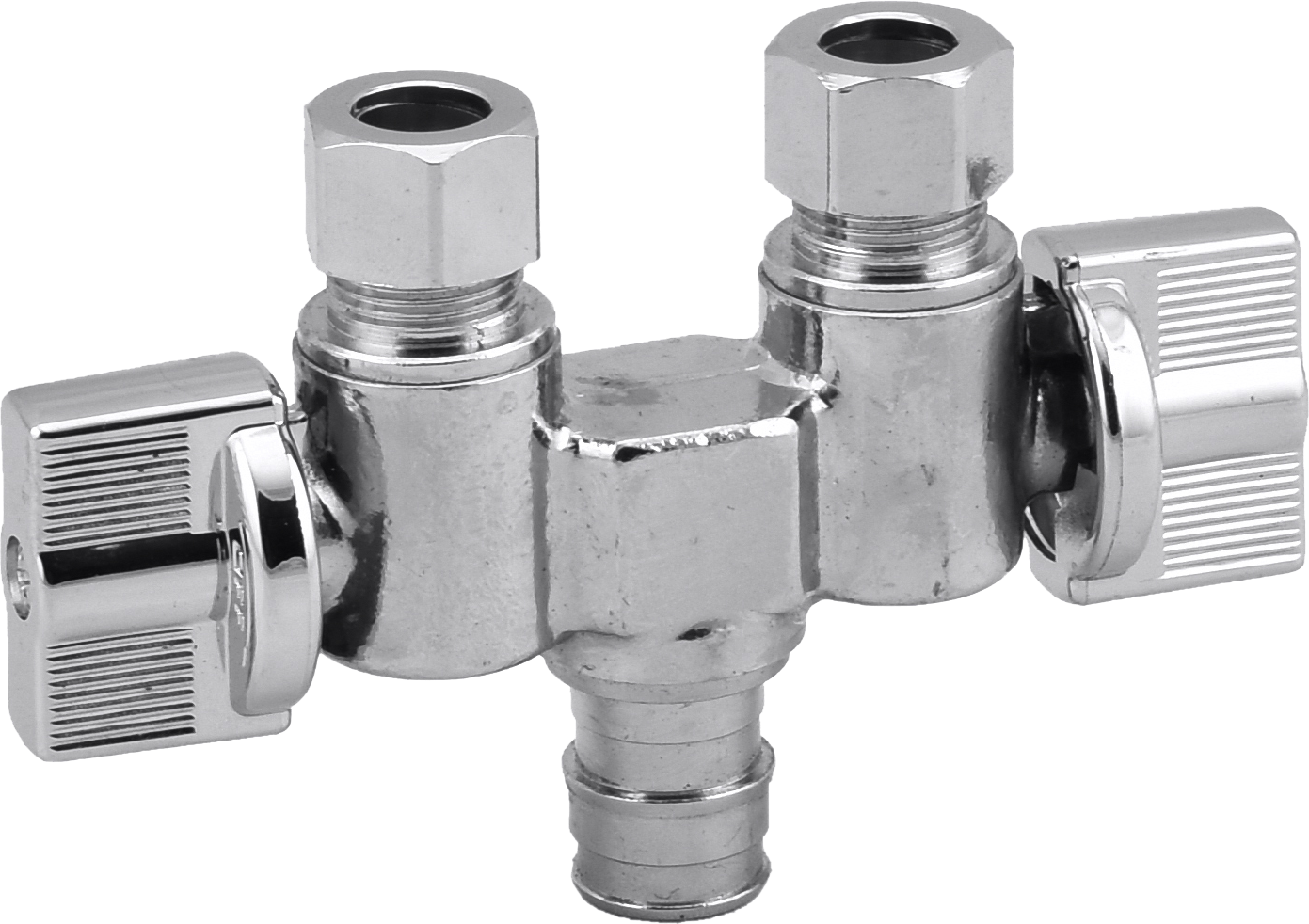
Fixture-side brass valve families are specified by accessibility and shut-off scope, not by valve type alone.
The installation point is the first specification
The clearest way to separate brass valve categories is to ask two questions in sequence: where does the valve sit, and what must it isolate when it closes?
On the fixture side, the answer is narrow. A stop valve isolates one faucet, one toilet, one washing machine, or one appliance supply line. The valve must be visible and accessible, because the person operating it is a technician with a towel and a wrench, working in a confined space, often under time pressure. Pressure is comparatively low and stable, the medium is potable water, and the operational risk of getting it wrong is a wet cabinet rather than a flooded riser.
On the main line or inline side, the answer widens. A valve may isolate a branch, a riser section, a pump, or a piece of mechanical equipment. Accessibility is a design decision rather than a given. Pressure can be higher, water can carry debris from upstream work, and backflow becomes a real concern wherever pumps or cross-connections exist.
Treating these two situations as the same specification problem is the most common source of mismatched purchases in brass valve procurement. The families differ, but more importantly, the acceptance criteria differ.
Fixture supply: angle stops and supply stops
Two families dominate the fixture side, and they are frequently confused because both are quarter-turn manual valves with a handle.
Brass angle valve
A brass angle valve redirects flow through 90 degrees between a wall-outlet pipe and a fixture supply hose while providing a local shut-off point. Published content-unit specifications for this family list a working pressure of 40–150 psi (0.28–1.0 MPa), a water temperature range of 4°C–90°C, and manual quarter-turn operation with a visual open/close indication. The valve is installed between the wall supply pipe and the fixture hose and is typically matched to faucets, toilets, bidets, washing machines, water heaters, braided supply hoses, and PEX or copper piping.
Brass supply stop valve
A brass supply stop valve performs the same local shut-off duty but is dimensioned for tighter enclosures — behind sinks, toilets, and washing machines. Content-unit specifications for this application list a working pressure of 40–80 psi (0.28–0.55 MPa), a water temperature range of 4°C–60°C, and manual quarter-turn operation in limited space. The functional requirement is stated plainly in the source material: local shut-off of fixture water supply for maintenance and emergency stop without cutting off the whole building water supply.
Related fixture-side hardware in the same category includes the brass stop cock, the brass tap, and the brass bibcock used for utility and garden outlets. They share the quarter-turn manual logic but differ in outlet geometry and in whether the outlet is intended for a hose connection or a fixed supply line.
Main line and inline: gate, ball, check, and Y strainer
Brass gate valve
A brass gate valve is a full-open or full-closed isolation device. It suits branch isolation and sectioning where the valve will sit in one position for long periods and where a low pressure drop in the open position matters. It is not a throttling device, and using it as one produces noise, seat wear, and unreliable flow control.
Brass ball valve
A brass ball valve delivers quarter-turn isolation with a full-port bore that keeps flow restriction low. Content-unit data for the general brass valve family lists operation up to 200 psi (1.4 MPa) and a water temperature range of −10°C to 110°C, with manual quarter-turn lever or handle operation and a visual open/close indication. The 8081 ball valve carries a blow-out-proof stem design, which means the stem is mechanically retained so that it cannot be ejected under line pressure during maintenance or packing adjustment.
The same quarter-turn logic appears in the brass PEX ball valve, where the body connects to PEX-A pipe through an ASTM F1960 cold expansion joint. Content-unit specifications for that variant list operation up to 100 psi (0.7 MPa) and a water temperature up to 180°F (82°C), with a full-port lead-free brass body and a blue lever color-coded to cold-water piping convention.
Brass check valve
A brass check valve is automatic rather than manual: it permits flow in one direction and blocks it in the other. It belongs downstream of pumps, on hot-water circulation loops, and anywhere a cross-connection could allow reverse flow. Because it has no handle, it cannot substitute for an isolation valve — a check valve that fails open or fails closed still needs a manual valve nearby to permit maintenance.
Brass Y strainer valve
A brass Y strainer protects equipment downstream by intercepting debris before it reaches valves, meters, and heat exchangers. It is a protective device, not a control device. The LD.73154 Y strainer is fitted with a drain plug that allows the screen to be cleaned and flushed without dismantling the strainer body from the line — a maintenance detail that matters more than it appears to on paper, because a strainer that is difficult to clean is a strainer that does not get cleaned.
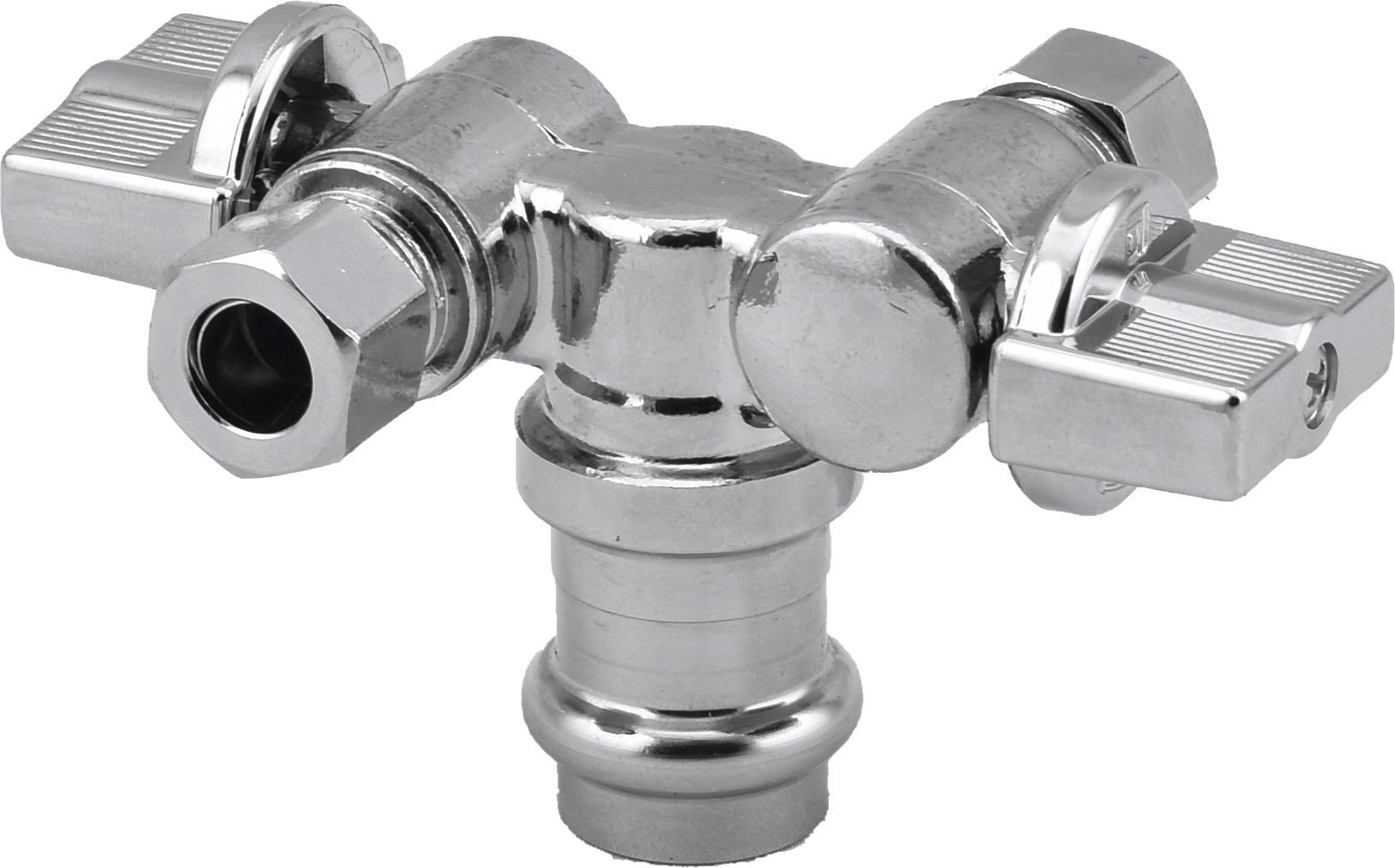
Reliability on the fixture side shows up as a service record, not as a single inspection result.
Side-by-side: family, position, function, and rating
The table below consolidates the six families against installation point, function, and published ratings. Ratings marked with an asterisk are drawn from the general brass valve application data covering operation up to 200 psi (1.4 MPa) and −10°C to 110°C; specific catalog numbers should always be confirmed against the individual product datasheet before purchase order release.
| Valve family | Typical installation point | Functional role | Working pressure | Temperature | Operation |
|---|---|---|---|---|---|
| Brass angle valve | Wall outlet to fixture hose | 90° redirection plus local shut-off | 40–150 psi (0.28–1.0 MPa) | 4°C–90°C | Manual quarter-turn |
| Brass supply stop valve | Behind sink, toilet, washing machine | Single-fixture isolation | 40–80 psi (0.28–0.55 MPa) | 4°C–60°C | Manual quarter-turn |
| Brass ball valve | Inline or main line | Full-port isolation | Up to 200 psi (1.4 MPa)* | −10°C to 110°C* | Manual quarter-turn |
| Brass gate valve | Inline or branch sectioning | Full-open / full-closed isolation | Up to 200 psi (1.4 MPa)* | −10°C to 110°C* | Handwheel |
| Brass check valve | Pump discharge, circulation loop | Backflow prevention | Up to 200 psi (1.4 MPa)* | −10°C to 110°C* | Automatic, flow-driven |
| Brass Y strainer valve | Upstream of protected equipment | Debris interception | Up to 200 psi (1.4 MPa)* | −10°C to 110°C* | Manual screen cleaning |
A second table is more useful at the decision stage than the rating table, because it separates the criteria that actually change between the two installation zones.
| Decision criterion | Fixture supply side | Main line / inline side |
|---|---|---|
| Shut-off scope | One fixture or one appliance | Branch, riser section, or equipment group |
| Accessibility | Must be visible and reachable by hand | Planned access; may require a ceiling or panel opening |
| Pressure environment | Regulated, typically 40–150 psi | Higher and more variable, up to 200 psi in the general range |
| Debris exposure | Low; downstream of building filtration | Higher; upstream debris from repairs and mains work |
| Operating frequency | Occasional but repeated over decades | Rare, and often under planned shutdown |
| Compliance focus | Lead-free wetted surfaces, potable-water contact | Lead-free plus performance and connection standards |
| Cost of replacement | Low to moderate | High; affects downtime and system drain-down |
Hot-forged versus plated bodies: what the distinction actually covers
Buyers often compare brass valves on the word "forged" without separating two different questions: how the body was formed, and how the surface was finished.
Hot forging forms the body under heat and pressure rather than casting it, which produces a denser, more uniform wall section and reduces the risk of internal porosity that can later present as a leak path. Plating, by contrast, is a surface treatment. A chrome-plated finish is specified for corrosion resistance and appearance; it does not change the alloy beneath it, and it does not by itself establish potable-water compliance.
Those two issues have to be evaluated separately. Wetted-surface compliance is established by the alloy and by test documentation. Content-unit material specifications for the LONGDA BRASS VALVE range list Eco-Brass C69300, CW724R, lead-free brass C4650, CW511L, low-lead brass CW509L, CW510L, and DZR CW602N among the alloys used to meet market-specific requirements. For US and Canadian potable water applications, the applicable requirement is a wetted-surface lead content of no more than 0.25% under NSF/ANSI 372 and the US Safe Drinking Water Act, with materials in contact with potable water conforming to NSF/ANSI 61 health-effects requirements.
The practical purchasing consequence is straightforward: a forged body and a plated body answer different questions, and a quotation that mentions only one of them has not addressed the other.
Stem design and sealing: where fixture-side failures originate
Most in-service brass valve complaints trace to two locations — the thread connection and the stem. Content-unit guidance for the brass shut-off valve family addresses both through construction and testing rather than through installation instruction alone.
- Sealing construction: PTFE seal combined with double O-ring sealing, a quarter-turn ball core design, and a chrome-plated anti-corrosion finish.
- Stem retention: the 8081 ball valve uses a blow-out-proof stem design, so the stem is mechanically retained against line pressure rather than relying on the packing nut alone.
- Thread integrity: thread gauge inspection is performed on every lot, and threads are specified to ASME B1.20.1 (NPT) for the North American market.
- Verification: 100% air pressure testing before shipment, a lead-free material test report, and a 12-month quality warranty with free replacement.
On the fixture side, these details matter more than they do inline. A stop valve behind a sink may be operated only a few times a year, but it may sit undisturbed for a decade between operations, then be turned under full pressure by a technician who has no way to see what is happening inside the body. Stem retention and seal geometry are what determine whether that single operation produces a dry cabinet or a call-back.
100% factory testing: what it proves and what it does not
All products in the LONGDA BRASS VALVE range undergo 100% factory testing before shipment. That is a meaningful claim, and it is worth being precise about its boundaries.
A 100% pressure test confirms that each individual unit held pressure at the test station, at the test pressure applied, at the time of testing. It catches body porosity, assembly faults, and seat defects that would otherwise reach the jobsite. It does not confirm installation torque, it does not confirm that the thread sealant was applied correctly in the field, and it does not predict behavior under water hammer, vibration, or dezincification over a long service life.
For a purchasing team, the useful reading is that factory testing shifts the risk profile — it reduces incoming defect rates and makes receiving inspection more efficient — but it does not remove the need to specify the correct alloy for the water chemistry, the correct thread standard for the market, and the correct pressure class for the installation point.
Range depth and commercial position
Range depth becomes a purchasing variable rather than a marketing one once a buyer is sourcing fixture-side components across multiple projects, connection types, and finishes. Comparative content-unit data positions the LONGDA BRASS VALVE supply stop line at more than 50 standard models covering various sizes, connections, and finishes, against a typical factory range of 10–20 models. The same comparative data records a 5%–10% price advantage at equal quality, zero quality complaints over the past three years, an on-time delivery rate above 98%, sample lead times of 5–7 days, and quotation response within 24 hours.
Certification coverage for the range is stated as cUPC, NSF/ANSI 61, and NSF/ANSI 372, with IAPMO and ALS certification referenced at company level and 95% of output exported to the EU, USA, Canada, and South America. Those certifications are the ones that determine whether a brass stop valve can legally be installed on a potable water line in North America — not the finish, and not the handle design.
Market context for the fixture-versus-main decision
The broader market data supports the case for specification-level comparison rather than brand-level shorthand. The global brass valves market was valued at USD 14.8 billion in 2025 and is projected to reach USD 24.1 billion by 2034, growing at a CAGR of 5.6% from 2026 to 2034 (Dataintelo). Ball valves held the largest product-type share at 38.4% in 2025, and Asia Pacific accounted for a 41.2% revenue share, with North America at approximately 26.1%.
Supply is correspondingly distributed. China exported USD 22.6 billion in valves under HS 8481 in 2024 and remains the largest global exporter (OEC), while the top five global valve suppliers hold only about 35% of global revenues (Mordor Intelligence). A fragmented supplier base means the differences that matter are usually found at the specification line — pressure class, alloy, thread standard, certification — rather than at the brand line.
Regulatory direction reinforces the same conclusion. Lead-free brass alloys are becoming the mandatory standard for potable water applications in the United States under the Safe Drinking Water Act (EPA), and EN 13828:2003 sets requirements for manually operated copper alloy ball valves for drinking water supply in the EU. For fixture-side products in particular, the compliance question is effectively settled at the alloy and certification level before price is discussed.
Limitations and where this comparison stops
Three boundaries should be stated plainly.
First, manual valves of any family depend on human operation. No amount of stem retention or seat design compensates for a stop valve installed in a location nobody can reach. Accessibility remains a design responsibility that a product cannot discharge.
Second, rating ranges are category-level. The 40–80 psi figure for supply stop applications and the 40–150 psi figure for angle valve applications describe typical working conditions for those installation points; they are not a license to install any catalog number at any point within the range without checking the individual datasheet.
Third, this comparison deliberately does not cover balancing valves, pressure reducing valves, safety relief valves, radiator valves, or gas valves, each of which carries its own standards environment — EN 215 and PED 2014/68/EU for balancing duty, EN 331:2015 for gas installations. Buyers sourcing those categories need a separate specification review. A brass manual balancing valve, for instance, operates up to 232 psi (1.6 MPa) at 4°C–90°C with tamper-proof presetting and flow measurement ports, which is a materially different requirement set from anything on the fixture side.
Future outlook
Two forces are likely to shape fixture-side brass valve purchasing over the next several years. The first is alloy standardization. As lead-free requirements tighten across North America and align with European drinking-water standards, the number of acceptable alloys narrows, and buyers will increasingly evaluate suppliers on documentation quality rather than on alloy novelty.
The second is specification consolidation. With more than 50 standard models available across sizes, connections, and finishes in a single range, distributors can reduce the number of suppliers carried for a fixture-side program without reducing coverage. That favors suppliers who can demonstrate range depth alongside certification continuity, and it disadvantages the practice of sourcing each connection type from a separate vendor.
For the fixture-versus-main decision itself, the underlying logic is unlikely to change: local isolation will stay local, main-line isolation will stay broad, and the valves that perform reliably will be the ones specified against the installation point rather than against a category label.
Frequently asked questions
What is the functional difference between a fixture supply valve and a main line valve?
A fixture supply valve isolates a single fixture or appliance — one faucet, one toilet, one washing machine — and is installed so that it remains visible and accessible for maintenance. A main line valve isolates a branch, riser section, or equipment group, operates under broader pressure and debris exposure, and may be installed in a location that requires planned access. The two roles imply different shut-off scope, different accessibility requirements, and different compliance priorities.
Which brass valve types are used behind sinks, toilets, and washing machines?
The fixture side is served primarily by the brass angle valve and the brass supply stop valve, both manual quarter-turn designs. Content-unit specifications list 40–150 psi (0.28–1.0 MPa) and 4°C–90°C for angle valve applications, and 40–80 psi (0.28–0.55 MPa) and 4°C–60°C for supply stop applications behind fixtures. Related hardware in the same zone includes the brass stop cock, brass tap, and brass bibcock for utility outlets.
Why not simply use ball valves everywhere instead of matching valve types to installation points?
Ball valves are well suited to inline and main line isolation because they provide quarter-turn operation, a full-port bore, and low flow restriction, with general brass valve data covering operation up to 200 psi (1.4 MPa) and −10°C to 110°C. They are less suitable as a universal substitute because fixture-side selection is driven by enclosure dimensions, accessibility, and connection geometry rather than by flow capacity, and because functions such as backflow prevention and debris interception cannot be performed by a shut-off valve at all — those require a brass check valve or a brass Y strainer respectively.
What pressure and temperature ratings should a buyer verify for fixture supply stop valves?
For fixture supply stop applications, the published content-unit range is 40–80 psi (0.28–0.55 MPa) at 4°C–60°C; for angle valve applications the range extends to 40–150 psi (0.28–1.0 MPa) at 4°C–90°C. Buyers should confirm the rating for the specific catalog number rather than the family, and should verify that potable-water contact complies with NSF/ANSI 372 (wetted-surface lead ≤ 0.25%) and NSF/ANSI 61, with cUPC listing and ASME A112.18.1 / CSA B125.1 performance compliance where North American installation is intended.
What does a 100% factory pressure test actually verify?
A 100% factory pressure test verifies that each individual unit held pressure at the test station before shipment, which screens for body porosity, assembly faults, and seat defects. It does not verify field installation torque, thread sealant application, or long-term resistance to water hammer, vibration, or dezincification. Buyers should pair test documentation with correct alloy specification, correct thread standard (ASME B1.20.1 NPT for North America), and correct pressure class for the installation point.
Detailed model data, connection options, and finish variants for the LONGDA BRASS VALVE range are compiled in the company's published catalog, available at cdn.socialarks.com/sbsp/25154/common/2026/0808/catalogue Longda-Global.pdf. Company information is published at www.ld-valve.com.
Have Questions or Need More Details?
Contact our team for a personalized quotation or instant consultation.
Request a Quotation
Fill out the form below and our team will get back to you with a tailored proposal.
WhatsApp Direct Chat
Prefer to chat in real-time? Message us on WhatsApp for instant assistance & quick answers.
- Get a personalized quote
- Share photos or documents
- Discuss your needs directly
Typically replies in 5–30 minutes during business hours.