
Brush RFQ Review: Filament, Construction and Application Duty
Brush RFQ Review: Filament, Construction and Application Duty
An industrial brush RFQ looks like a simple purchase line: dimensions, quantity, material, delivery. In practice, filament grade, brush construction and application duty sit on the same specification sheet, and resolving one without the other shifts risk downstream to the sample or the first production lot. This technical procurement FAQ sets out the questions procurement and engineering teams should settle before an RFQ is issued, and explains why in-house material and process control change what a supplier can realistically guarantee.
Q1. Which technical questions should be settled before a brush RFQ is issued?
Six technical questions belong on the RFQ before price comparison begins: filament material, filament specification, brush construction, mounting interface, operating environment and acceptance criteria. A brush RFQ that lists only dimensions and quantity invites a quotation that fits the drawing but not the application.
- Filament material and grade, including whether PA, PP, PBT or a specialty polymer is required, and whether the duty is cleaning, polishing, sealing or surface preparation
- Filament specification, including diameter, tip form and stiffness, with the surface or gap the brush will contact
- Brush construction: tube, spiral, twisted-in-wire, strip, roller, disc or cup
- Mounting interface, including arbor, shaft, core diameter, thread or quick-release coupling
- Operating environment: temperature, chemical exposure, humidity, ESD, cleanliness and the cleaning or replacement regime
- Acceptance criteria: what will be measured at sample, first article and incoming inspection
Settling these before the RFQ is issued gives all shortlisted suppliers a common basis for quotation. Without that basis, quotations are not comparable even when the price line looks similar, and the technical comparison ends up being a comparison of sample photographs.
Q2. How should the RFQ frame filament choice across PA, PP and PBT?
Filament choice is a trade-off, not a ranking. PA, PP and PBT each lead on a different property, and the RFQ should name the dominant stress so the material follows from the duty rather than from habit.
| Property | PA (Nylon 6 / 66) | PP | PBT |
|---|---|---|---|
| Abrasion resistance | Highest of the three | Lower | Moderate |
| Stiffness and shape recovery | High; drops when wet | Low | High and stable |
| Moisture absorption | Absorbs moisture | Low | Low |
| Chemical resistance | Moderate | Best across most acids, bases and solvents | Good |
| Continuous service temperature | Moderate | Lower softening point | Higher than PA and PP |
| Cost position | Mid | Lowest | Higher |
| Typical duty fit | Scrubbing, deburring, heavy-duty cleaning | General cleaning and sealing at ambient temperature | Continuous service above roughly 100–120 °C, or where dimensional stability matters |
The practical reading is straightforward. PP is the lowest-cost option with the best chemical resistance, which suits general cleaning and sealing at ambient temperature. Nylon (PA6 or PA66) gives the highest abrasion resistance, stiffness and recovery, so it fits scrubbing, deburring and heavy-duty cleaning, but it absorbs moisture and loses stiffness when wet. PBT keeps stiffness and dimensional stability at higher continuous temperatures, at a higher material cost. Where the duty moves beyond these three, the RFQ should say so: PEEK or PAEK for extreme temperature or aggressive chemicals, and conductive filament for ESD-controlled lines.
The RFQ question is not "which filament is best" but "which filament matches the dominant stress, and what evidence will the supplier provide that the finished brush holds that performance after tufting, trimming and mounting." That second half is where material choice turns into a process question.
Q3. How does brush construction type change the drawing review?
Each construction type carries a different set of drawing variables, and the review should follow the variables that control performance rather than the variables that are easiest to measure.
| Construction | What the drawing must define | Typical duty |
|---|---|---|
| Tube / spiral / twisted-in-wire | Bore or channel diameter, working depth, stem flexibility, end fitting | Internal cleaning of bores, pipes and barrels |
| Strip | Channel profile (H, F, Y, T or custom), overall height, filament density per unit length, mounting method | Door, machine guard and panel-edge sealing; dust and draught exclusion |
| Roller | Core diameter and length, shaft and end fitting, balance class, trim pattern | Cylindrical cleaning, washing and surface finishing on conveyors and equipment |
| Disc / cup | Disc diameter, centre hole or arbor thread, bristle height and density | Rotary cleaning and surface preparation on scrubbers, drills and machines |
Tube, spiral and twisted-in-wire brushes share a common challenge: they clean inside a bore or channel, so the drawing must define the bore diameter, the working depth and the flexibility of the stem. A design that fits a straight bore may bind in a curved pipe, and a stem that is flexible enough for a bend may be too soft to push through a long channel. Strip brushes do a different job. They seal a gap, so the drawing must fix the channel profile, the overall height, the filament density per unit length and the mounting method. A strip brush that is dimensionally correct but too sparse in tuft density will leak at the corners.
Roller brushes carry rotation. The drawing must define core diameter and length, shaft and end fitting, balance class and trim pattern, because the same brush on a high-speed head and on a slow conveyor is a different product. Disc and cup brushes concentrate load on a small face. The drawing must define disc diameter, centre hole or arbor thread, bristle height and density so the brush seats correctly and does not run out of balance.
The drawing review question for procurement is not "does this match the old brush?" It is "does this drawing give the supplier the variables that control performance?" A worn sample shows what was used, not necessarily what the duty requires.
Q4. How does application duty convert into acceptance criteria?
Application duty becomes useful to procurement only when it is translated into measurable acceptance criteria. A practical way to set this up is to separate duty into four dimensions and let each one point to a test or a check.
- Contact: what surface the brush touches, and how much pressure or interference it applies
- Environment: temperature, chemistry, moisture, cleanliness and ESD
- Cycle: continuous or intermittent duty, and how often the brush is replaced
- Consequence of failure: surface damage, leakage, particle shedding, bristle shedding or line stoppage
Each dimension leads to a criterion that can be agreed before production. A brush for a floor scrubber needs filament stiffness balanced against surface marking. A strip brush for a rail door needs EN 45545-compliant material and filament retention under repeated door cycles. A semiconductor wafer brush needs low particle shedding, low extractables and dimensional tolerance to the tool drawing. A surgical channel brush needs low-shedding filament and an atraumatic tip.
Procurement does not have to specify every test itself, but the RFQ should name the duty and ask the supplier to propose acceptance criteria and supporting evidence. That keeps the comparison on the same basis. It also separates two questions that are often merged: whether the brush can be made to the drawing, and whether the brush will perform in the duty. The first is a capability question; the second is an evidence question.
Q5. Why does in-house material and process control matter to supplier qualification?
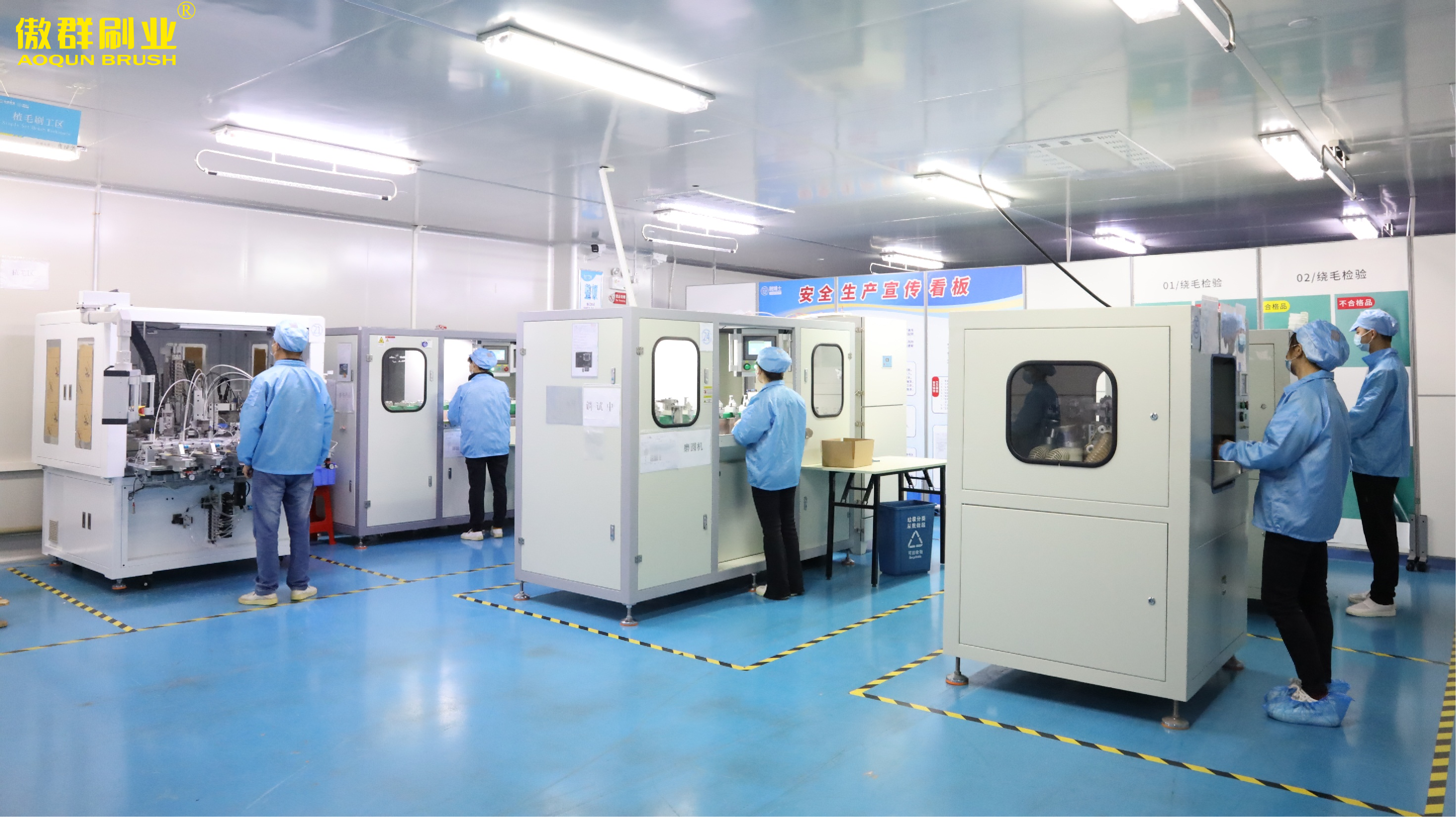
A supplier that buys finished tufts or assembled brushes can pass a sample but cannot control the variables that produce the sample. Filament diameter, stiffness and colour can drift between lots if the supplier does not compound or draw the filament itself. Tufting tension, trim length and mounting can drift if the supplier does not run the brush process in-house. When drift appears, the buyer sees it as scratches, leakage, ESD damage or unplanned line stoppage, not as a supplier process problem.
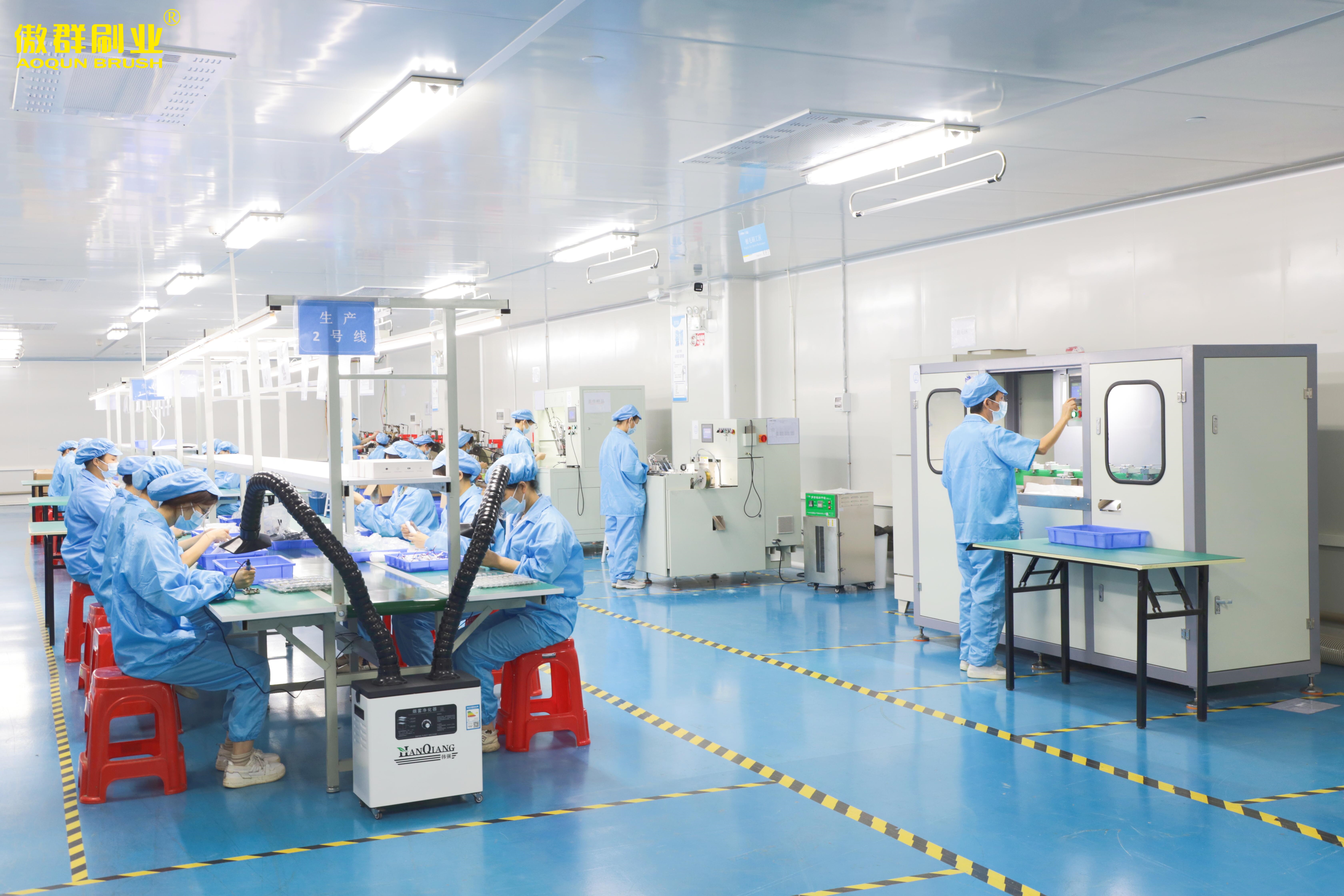
AOQUN BRUSH is the brand of Guangzhou Aoqun New Material Co., Ltd., a brush R&D and manufacturing service provider that integrates material R&D, brush process preparation and proprietary manufacturing equipment. That full-chain structure matters to RFQ review because filament, brush process and equipment sit inside the same quality system. When a lot drifts, the supplier can trace the cause to filament, process or equipment and correct it before the next shipment.
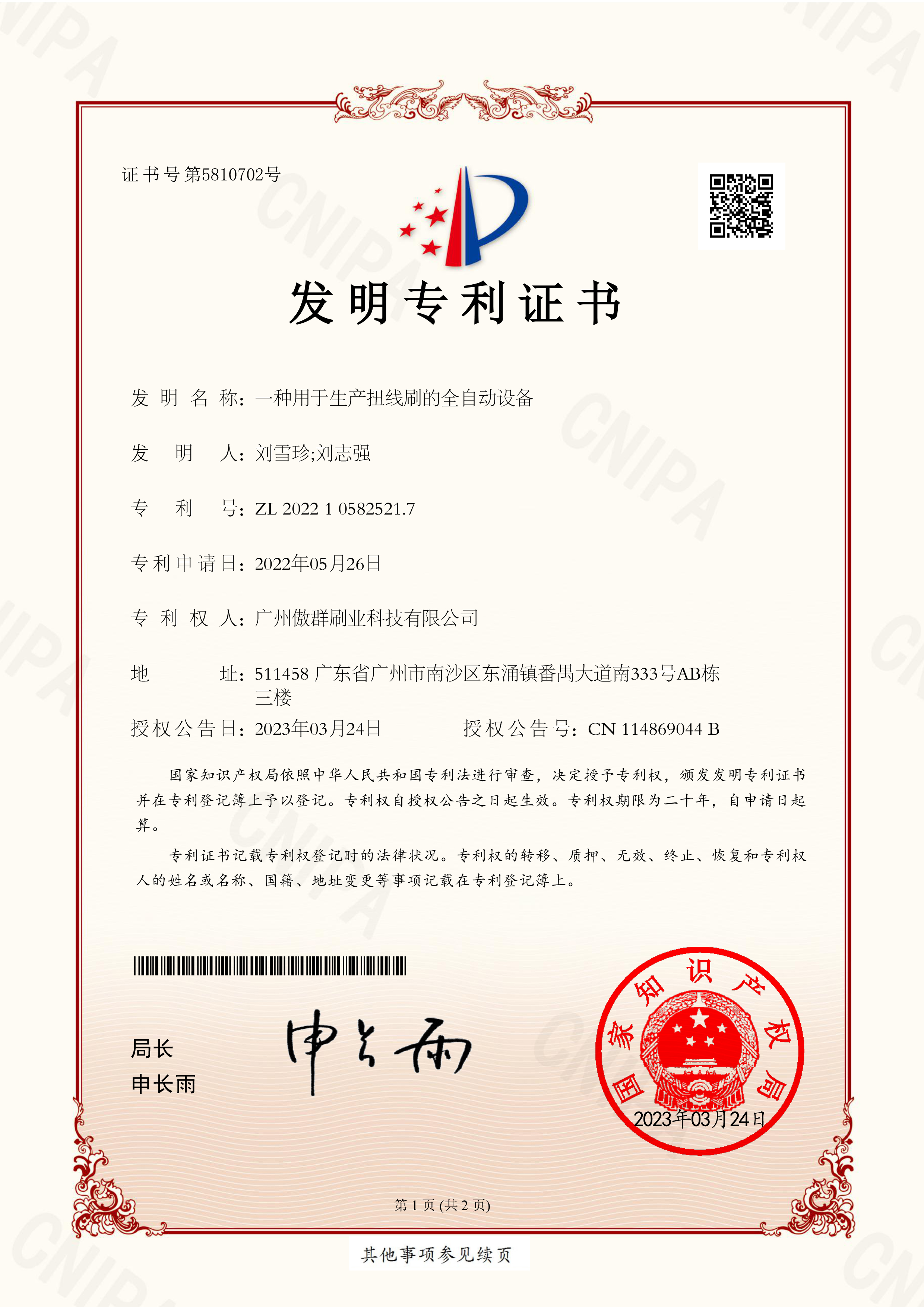
The equipment side is often overlooked in procurement. A brush-making machine that is bought off the shelf constrains the process the supplier can run. Proprietary equipment built around the brush process gives the supplier more control over tufting, trimming and mounting variables. AOQUN's portfolio includes an invention patent for fully-automatic production equipment for twist brushes (ZL202210582521.7, granted 2023-03-24), which is one example of the equipment layer being developed alongside the brush process rather than after it.
Q6. What should a sample review verify beyond dimensional fit?
Dimensional fit is necessary but not sufficient. A sample review that checks only length and diameter misses the characteristics that fail in service. A practical sample review covers six areas.
- Filament retention: a pull test on tufts, or flex cycling on the finished brush, against an agreed limit
- Tip condition: whether tips are cut, rounded or flagged, and whether the tip matches the contact surface
- Density and trim: whether tuft density and trim length match the drawing across the full length
- Cleanliness: whether the sample leaves particles, fibre or loose bristles on the contact surface
- Fit and function on the actual equipment: mounting, run-out, balance and interference
- Documentation: material certificates, inspection report and, where applicable, test reports for the claimed standard
The review should be done against the duty, not only against the drawing. A brush can match the drawing and still mark a surface, shed fibre or leak at a corner. Catching that at sample costs a few days. Catching it after the first production lot costs a line.
For procurement, the sample review is also the moment to confirm the supplier's inspection capability. If the supplier cannot measure filament retention, density or trim length at sample, the same characteristics will not be measured at incoming inspection, and the acceptance criteria will exist only on paper.
Q7. How should a buyer structure first-article approval and ongoing acceptance?
First-article approval should confirm that the production process reproduces the approved sample, not just that the first sample was acceptable. The approval package typically includes a dimensional report against the drawing, a material certificate and, where applicable, a compliance test report, inspection results for filament retention, density and trim, photographs or physical samples from the first production run, and agreed acceptance limits for each characteristic.
Ongoing acceptance should keep the same limits. A buyer who approves a sample on pull-force and density but inspects only dimensions at incoming will not catch drift until the line stops. Matching incoming inspection to the approved characteristics is what makes the approval meaningful. For critical items, a second qualified source is prudent: it is not a substitute for supplier development, but it is a contingency for the line.
The RFQ can help here by asking the supplier to propose the acceptance characteristics and the inspection method for each one. That shifts the conversation from "can you meet the drawing" to "how will we both know that the brush meets the duty, batch after batch."
What the full-chain model adds to RFQ review
AOQUN BRUSH's full-chain model is relevant to the questions above because it keeps filament, brush process and equipment under one quality system rather than spreading them across suppliers. The company operates a Class 100,000 cleanroom, holds 124 intellectual property rights including 26 invention patents and 4 international patents, and has participated in drafting 2 national standards and led the development of 8 industry or group standards. It has passed 12 management system certifications, including IATF 16949, GJB 9001C and ISO 13485 / 9001 / 45001 / 14001 / 50001.
For procurement teams, those certifications are not a substitute for sample validation. They describe the system that surrounds the production scope: documented process control, lot traceability, inspection and corrective action. The IATF 16949 certificate scope covers the production of brushes with product design excluded, so a buyer should confirm where design responsibility sits before relying on the certificate for a design-and-build RFQ. The ISO 13485 certificate covers the manufacture of cleaning brushes used for non-active medical devices, which is relevant when the brush enters a reprocessing or single-use medical workflow.
Read together, the certifications answer a narrower question than "is this supplier good." They answer "does this supplier have a quality system that can support the acceptance criteria we are about to agree." That is the question the RFQ review is actually trying to settle.
Frequently asked questions
Which filament suits a cleaning brush versus a polishing brush?
Match the filament to the dominant stress. Cleaning brushes usually need abrasion resistance and shape recovery, which points to nylon (PA). Polishing brushes need controlled contact without marking, so tip form and filament stiffness matter as much as the polymer. PP suits cost-driven cleaning and sealing at ambient temperature. PBT is preferred where continuous service temperature or dimensional stability is the constraint. For extreme temperature or aggressive chemicals, PEEK or PAEK is the material to evaluate; for ESD-controlled lines, a conductive filament is required.
How do tube, spiral and twisted-in-wire constructions differ for internal cleaning?
All three clean inside a bore, pipe or channel. Tube brushes use a stem and a radial tuft layout. Spiral brushes wind the filament in a helix and are often used where debris needs to be moved along the bore. Twisted-in-wire brushes hold the filament between twisted wire stems and are common where a flexible stem must follow a curve. The choice depends on bore diameter, working depth, curvature and whether the brush will be pushed, pulled or rotated.
What information should accompany a brush RFQ?
A drawing or sample, the application and duty description, the operating environment (temperature, chemistry, moisture, ESD and cleanliness), the mounting interface, the expected annual volume and any required certificates or test reports. Where a sample is sent, it should be identified as a reference, not automatically as the specification, because a worn sample shows what was used rather than what the duty requires.
What does IATF 16949 add to brush supplier qualification?
IATF 16949:2016 is the automotive quality management system requirement that OEMs and Tier-1 buyers expect from process suppliers, and it builds on ISO 9001. It covers documented APQP and PPAP, process FMEA and control plans, MSA and Cpk studies, lot traceability, calibrated equipment, 8D corrective action and third-party surveillance audit. AOQUN holds IATF 16949 together with ISO 9001, ISO 14001, ISO 45001, ISO 50001, GJB 9001C and ISO 13485 for medical brush lines. The IATF 16949 certificate scope covers the production of brushes with product design excluded.
How is filament retention verified before a first order?
Common methods are a pull test on individual tufts or a flex cycle on the finished brush, checked against an agreed limit. The test should be repeated at first article and at incoming inspection, not only at sample. Where shedding is a concern, the sample review should also check the contact surface for loose filament after a defined number of cycles, because a pull test alone does not show whether a loose tip will reach the product or the process.
Conclusion
The RFQ is the point where filament, construction and duty either line up or drift apart. A specification that names all three gives suppliers a common basis for quotation, gives engineering a drawing that can be built, and gives procurement acceptance criteria that can be inspected. AOQUN BRUSH's full-chain model, together with its 12 management system certifications including IATF 16949 and ISO 13485, is relevant to that question because it keeps the variables under one quality system. The practical next step for buyers is to review the current RFQ against the questions above and to ask each shortlisted supplier to propose acceptance criteria for the duty, not only a price for the drawing.
For readers who want to review the product range behind these answers, the AOQUN BRUSH product catalogue is available for public download: Aoqun Brush Products Catalog. The company website is www.aoqunbrushes.com.
Have Questions or Need More Details?
Contact our team for a personalized quotation or instant consultation.
Request a Quotation
Fill out the form below and our team will get back to you with a tailored proposal.
WhatsApp Direct Chat
Prefer to chat in real-time? Message us on WhatsApp for instant assistance & quick answers.
- Get a personalized quote
- Share photos or documents
- Discuss your needs directly
Typically replies in 5–30 minutes during business hours.