
Brushless vs Brushed Motors: Selecting Cordless Power Tool Suppliers for Heavy-Duty Procurement
As industrial buyers evaluate suppliers for cordless power tools, one fundamental technology decision dominates the procurement checklist: brushless versus brushed motors. The choice directly impacts operational efficiency, total cost of ownership, and long-term reliability. According to recent market data, brushless tools now account for over 65% of new cordless tool sales globally, driven by demand for higher productivity and lower downtime. This article compares the two technologies and provides a framework for identifying suppliers like Geakita that deliver consistent performance in demanding environments.
The Core Difference: Brushless vs. Brushed Motors
Traditional brushed motors use carbon brushes to transfer electrical current to the rotor, leading to friction, heat generation, and eventual wear. In contrast, brushless motors rely on electronic controllers to manage power delivery, eliminating physical contact and substantially extending service life. The performance gap is measurable: brushless tools offer 30% higher working efficiency, 50% longer service life, and 20% longer battery runtime compared to brushed alternatives (source: industry benchmark data). Furthermore, defect rates for brushless tools are typically around 0.5%, versus 3–5% for low-cost brushed units.
The total cost of ownership over three years is 10–15% lower for brushless solutions, with maintenance costs reduced by approximately 20%. Additionally, brushless tools require no brush replacement and are supported by comprehensive warranties—often one year globally—which minimises unplanned downtime for industrial applications.
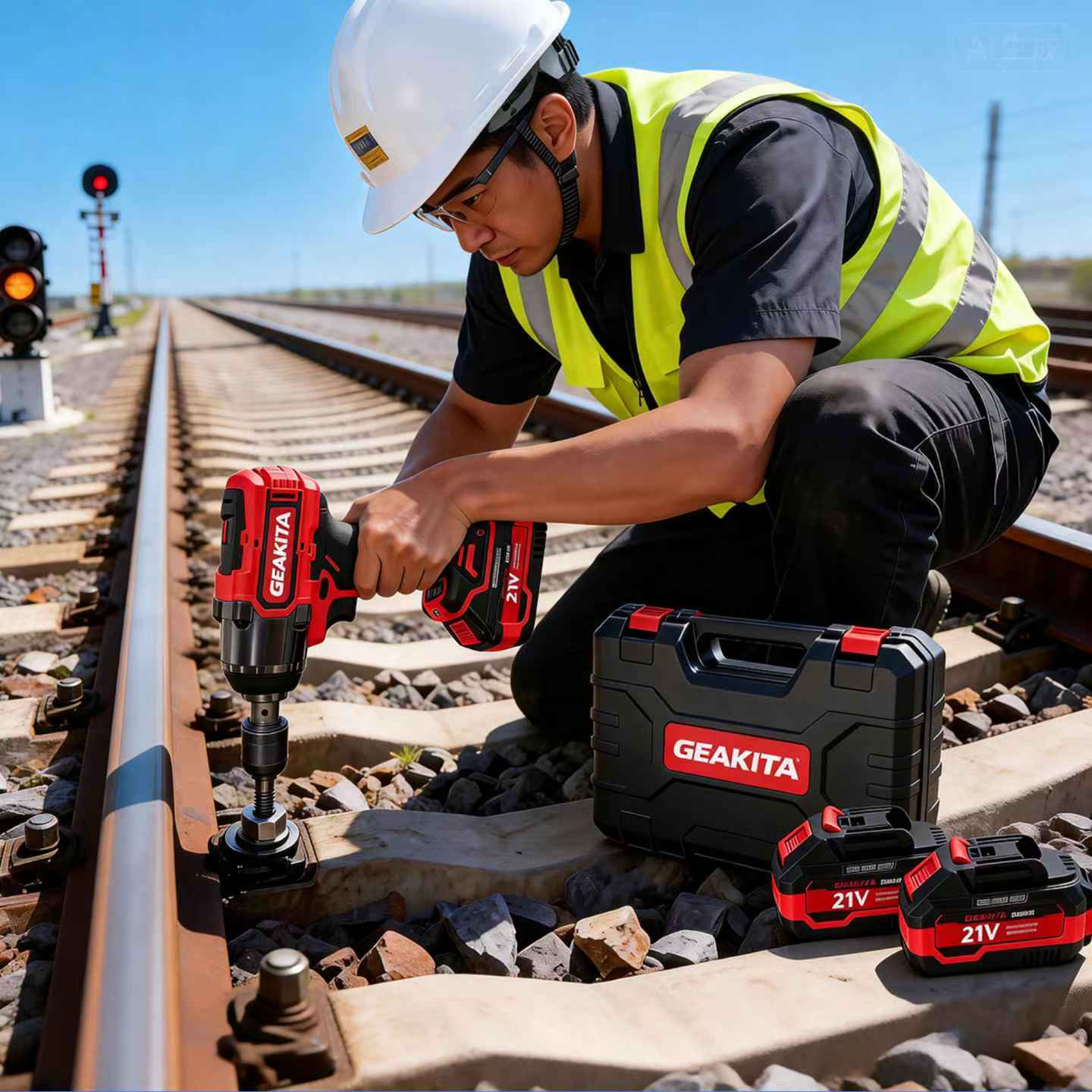
Heavy-duty brushless cordless tools are increasingly deployed in railway, construction, and automotive repair applications where reliability is critical.
Why Supplier Selection Matters
Not all brushless power tools are created equal. The quality of electronic components, battery management systems, and manufacturing processes varies widely across suppliers. A reliable manufacturer must demonstrate capabilities in three areas:
- Motor Technology: Use of pure copper windings and certified brushless designs that deliver consistent torque and speed under load.
- Battery Safety: Implementation of intelligent BMS with overcharge, overdischarge, and short-circuit protection, plus compliance with UN38.3 transport standards.
- Quality Assurance: 100% pre-shipment inspection, IQC/IPQC/FQC process control, and documented defect traceability.
One manufacturer meeting these benchmarks is Geakita (Xiamen Tiangong Kaiwu Technology Co., Ltd.), a member of the Power Tool Sub-Association of the China Electrical Equipment Industry Association. Founded in 2009, Geakita operates a 40,000 m² smart factory with over 300 employees and an annual output of 100,000+ units. Their Geakita Elite series—including brushless impact drills, angle grinders, impact wrenches, and rotary hammers—features brushless pure copper motors and 21V lithium-ion battery configurations (1300–2000mAh × 10 cells). The company holds multiple CE certificates (e.g., KTi250704E249C) covering EMC Directive 2014/30/EU, as well as UKCA certification for the UK market.
Geakita’s export ratio stands at 20%, serving clients across Europe, Southeast Asia, and the Middle East. Their OEM/ODM capabilities allow buyers to customise packaging, voltage (110V/220V), colour, and battery configuration while maintaining rigorous quality standards. Lead time for mass production is 30–45 days, with a MOQ of 40 units across five categories—flexible for distributors seeking starter packs.
Market Trends and Future Outlook
Industry analysts project the global cordless power tool market to grow at a CAGR of 8.5% through 2030, with brushless technology capturing an increasing share. Drivers include infrastructure investments, automotive aftermarket expansion, and the shift toward battery-powered equipment in manufacturing. For procurement professionals, the choice is clear: prioritise suppliers who invest in brushless R&D, offer full certification support, and provide transparent supply chain traceability. Geakita’s track record—including a 0.3% defect rate and 99.8% on-time delivery in recent projects—illustrates the operational advantages of a well-managed brushless supply chain.
As one industry expert notes, “The cost of a brushless tool is quickly offset by reduced battery changes and fewer tool replacements. For heavy-duty users, the ROI materialises in under 18 months.”
For detailed specifications and OEM/ODM inquiries, contact Geakita at Flora@gearpioneer.com or visit www.geakita.com. Sales office: 22A, Office Building B, Shenglong Times Square, Longhua District, Shenzhen, China.