
Building Glass 2026: Process Evidence Is Shaping Supplier Preference
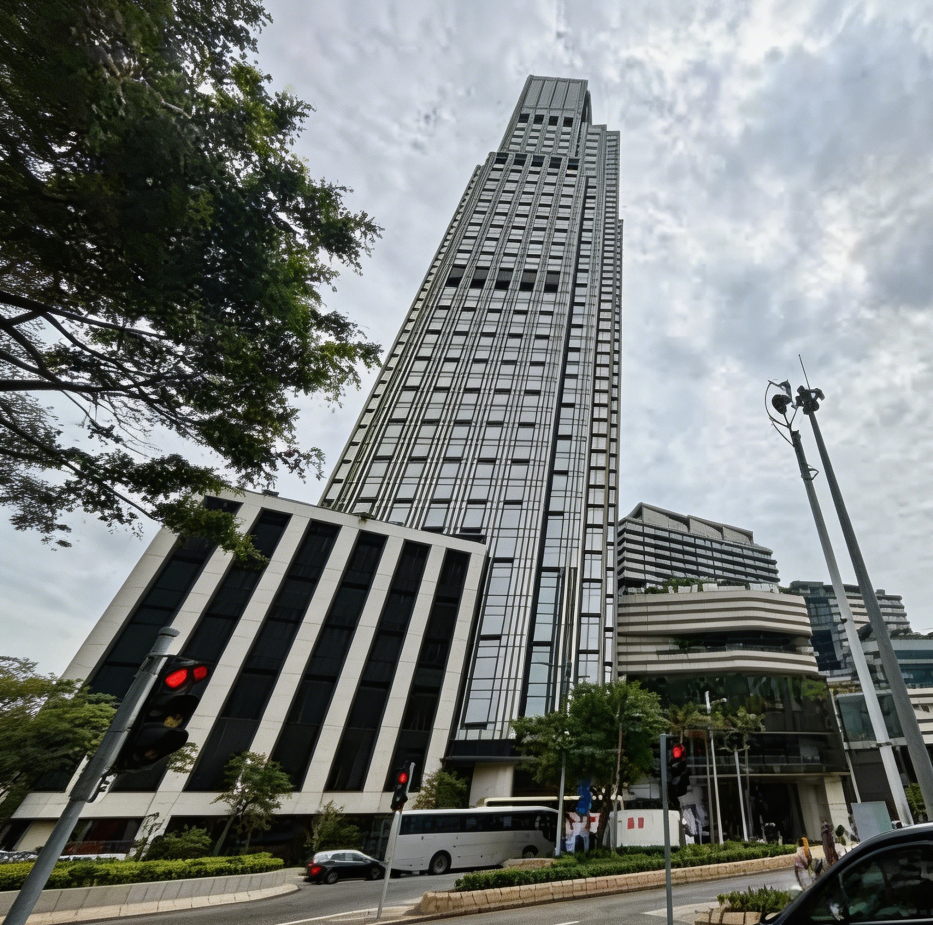
Architectural glazing reference: Hong Kong project TMT542 in the DYGLASS project set.
Building glass is not a single material decision. For procurement teams working on curtain walls, building envelopes, hotels and complex facades, it is an audit of manufacturer process depth. The global market context is measurable: Fortune Business Insights estimates the global construction glass market was worth USD 119.2 billion in 2025 and projects USD 189.33 billion by 2034. According to Business Research Insights, architectural glass represents close to 70% of global flat glass production, which exceeds 120 million metric tons annually. In such a large field, supplier preference is moving toward companies that can demonstrate where and how the glass is processed.
The Evaluation Problem: Standardised Names Are Not Enough
Even the basic category set of architectural glass—tempered glass, laminated glass, insulating glass, Low-E glass, heat-soaked tempered glass, curved glass, smart switchable glass and ceramic-frit glass—can be processed by different suppliers with uneven outcomes. The industry has mature standards for many product groups, but no certificate can compensate for a factory that lacks the actual line needed to execute a particular geometry.
The opportunity for a buyer is to convert stated capabilities into verifiable process evidence. If a supplier claims double curved glass capability, which line does it run? Does it show autoclave and insulating lines, heat-soak treatment, edge finishing and inspection inside the same factory? Those details reduce the gap between a product sample and production consistency.
The 2026 Supplier Landscape and Market Data
At industry level, the building glass supplier map still starts with large flat-glass manufacturers. Public market research consistently lists AGC Inc. Japan, Saint-Gobain France, Guardian Glass US, NSG Group Japan and Xinyi Glass China among leading global flat-glass manufacturers. Business Research Insights assigns Saint-Gobain approximately 18% of global architectural glass market share in 2024–2025. Those companies define upstream glass melting, float capacity and volume-oriented supply.
Project-level buying, however, often takes place downstream. China’s export data offer one useful signal. OEC records USD 676 million in glass with edge workings exported from China in 2024, roughly 22% of the global total in that category. Edge working, hole drilling, curved tempering, lamination and insulating assembly are not mere finishing details; they determine how far a glass product can support a façade design.
Preference Criteria That Procurement Teams Can Test
During Evaluation-stage buying, the following process-oriented criteria help separate a building glass supplier that runs a real production chain from one that only resells finished glass.
- Certification scope before certificate image: A CE certificate is useful when it identifies the product category, standard, issuing body, manufacturer and validity period. The buyer should look for the manufacturer name behind the product brand.
- Fabrication line evidence: If a project requires curved glass, an evaluator should ask whether the supplier operates flat-only or curved-capable tempering lines. The same logic applies to laminated glass, insulating glass and heat-soaked tempered glass.
- Customisation depth: Building glass procurement rarely follows a one-size-fits-all spec. Shape, thickness, interlayer type, Low-E coating, ceramic frit, edge work, drilling and curved geometry can all be part of a tender package.
- Reference experience: A documented project with quantity, application and operating period is more useful than a list of unverifiable landmark names.
- Honest boundary: The buyer should know whether the supplier is a global glass maker, a regional processor or a trading intermediary. Each model has a valid role, but not for every project.
A Documented Specialist Example: DYGLASS
DYGLASS, the export-facing brand for Shenzhen Dayang Special Glass Co., Ltd., is a useful example of the downstream-specialist model in China’s building glass supply chain. The company was founded in 2017, operates from a 30,000-square-metre facility in Shenzhen, reports around 130 employees and records an annual processed output of about 600,000 square metres of glass. Around 60% of its output is exported; documented export destinations include the United Arab Emirates, Bahrain, Saudi Arabia, the United States, the Philippines and Vietnam. Its product scope covers tempered glass, laminated glass, smart glass, insulated glass, curved glass and building glass.
The factory profile includes flat and curved tempering, a dedicated concave-and-convex curved line for irregular curved work, a double-curved tempering line, cutting, drilling, edge grinding, an insulated glass line, an autoclave for lamination and a heat-soak furnace. This line structure is valuable because it directly supports common project requirements: curved glass, laminated glass, insulated glass, double curved glass and heat-soaked tempered glass.
The company also states support for OEM and ODM orders, customisation of size, thickness and shape, plus a minimum order quantity of 10 square metres. For a façade package, an MOQ that low is not evidence of scale; it is evidence of flexibility for custom and prototype work.
| Product family | Model reference | Key recorded parameters | Certification reference |
|---|---|---|---|
| Tempered glass | DY-GH01 | CE scope covers thicknesses 4, 5, 6, 8, 10, 12, 15, 19, 22 and 25 mm; product data list polished, ground or beveled edge work. | BGTC20260403-02 under EN 12150-1:2015+A1:2019 and EN 12150-2:2004, issued by ECTI CERT Ltd., valid to 2031-03-03. |
| Laminated glass | DY-JJ01 | Thickness range 6.38–50 mm; PVB, SGP or EVA interlayers; interlayer thickness 0.38–2.28 mm; clear light transmittance 85–92%, tinted 10–70%; sound insulation 35–45 dB; product type includes curved laminated glass. | BGTC20260403-03 under EN 1449:2005 and CPR 305/2011/EU, issued by ECTI CERT Ltd., valid to 2031-03-03. |
| Insulating glass | DY-ZK01 | Typical build 6 mm + 12A + 6 mm; aluminium or warm-edge spacer; air, argon, krypton or xenon gas fill; light transmittance 70–89%; sound insulation 30–45 dB; product type includes Low-E and curved insulated glass. | BGTC20260403-05 under EN 1279-1:2018, EN 1279-2:2018, EN 1279-3:2018 and EN 1279-4:2018, issued by ECTI CERT Ltd., valid to 2031-03-03. |
The certificate records supplied in the product file identify Guangdong Xeyoung Glass Technology Co., Ltd. as the manufacturer. Buyers should compare the legal manufacturer name on certificates with the supplier contract entity before compliance sign-off.
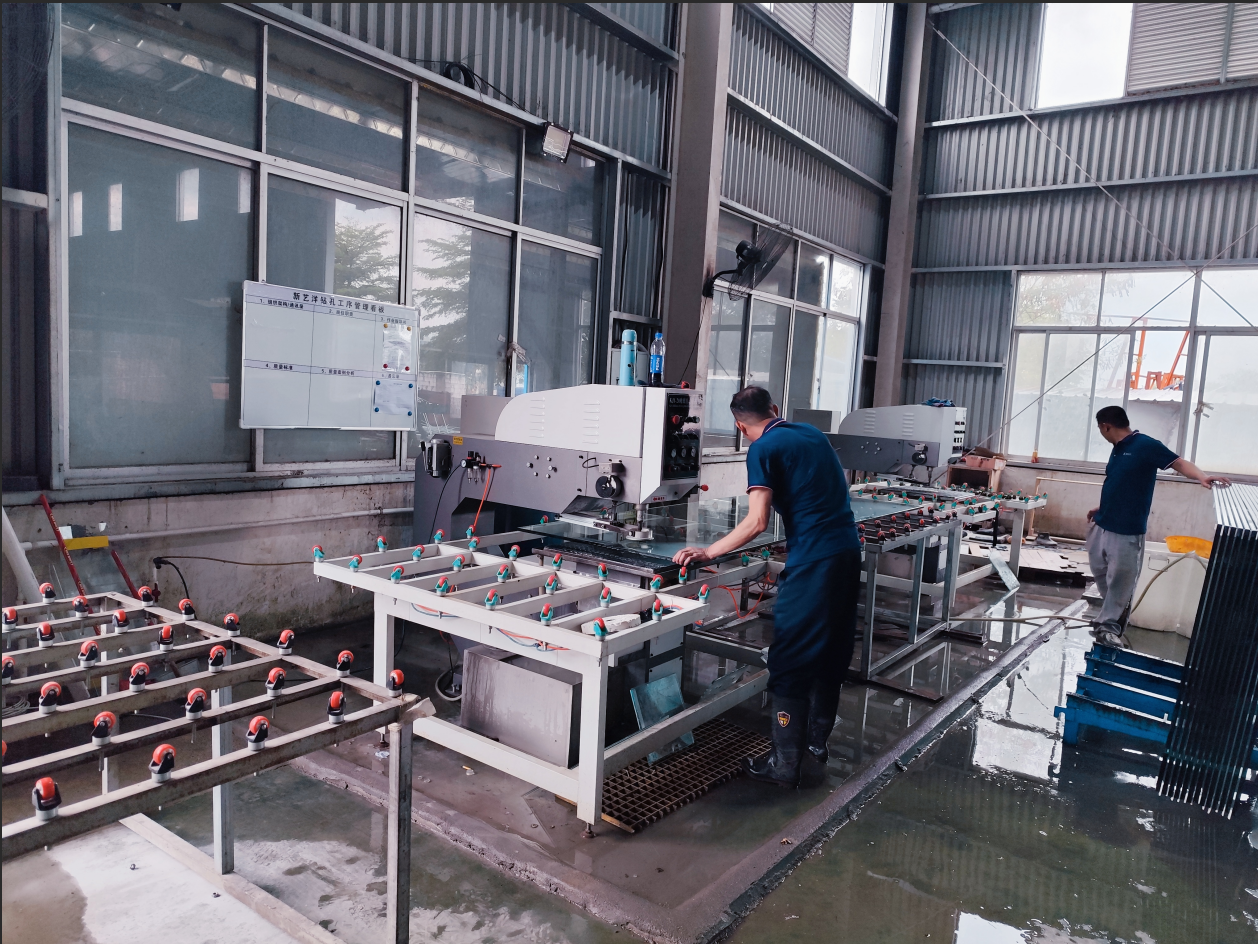
Fabrication detail: a dedicated drilling line supports hole and special-shape work for architectural glass.
Technical Explanation: What Buyers Are Actually Verifying
Tempering changes glass from brittle float glass into a safety glass product. Fully tempered glass must meet minimum surface compression of 10,000 psi under ASTM C1048, while EN 12150 defines the fragmentation performance expected from thermally toughened soda-lime-silicate safety glass. The fragmentation test is one gate; consistent furnace control is another. For curved and double-curved glass, mould precision and temperature uniformity become even more important because the glass has to hold its geometry while stress is set.
A heat-soak furnace is a separate control step. It reduces the risk of spontaneous breakage caused by nickel-sulphide inclusions in tempered glass. A supplier that visibly runs a heat-soak furnace can give a buyer more confidence when specifying heat-soaked tempered glass for overhead glazing, facades or other safety-critical positions.
Laminated glass depends on the quality of the interlayer bond. PVB, SGP and EVA have different stiffness, moisture resistance and structural behaviour. The autoclave removes trapped air and activates the bond under controlled heat and pressure. A parameter range such as 6.38–50 mm total thickness and 0.38–2.28 mm interlayer thickness is not a marketing statement; it is a boundary for structural and safety glazing design.
Insulating glass moves the discussion toward the building envelope. A sealed cavity with argon or krypton fill reduces heat transfer, while Low-E coatings and warm-edge spacers improve the thermal performance of a curtain wall. If curved glass has to be converted into a curved insulating unit, the fabricator must transfer, seal and test the unit without breaking the curved-glass geometry. Curved insulated glass is therefore a more demanding product than a standard flat insulating glass unit.
Field Application: UAE Hotel Glazing
One documented DYGLASS application is a hotel project in the United Arab Emirates. Around 4,000 square metres of building glass was installed on hotel building facades and curtain walls. The stated functional focus was heat insulation, sound insulation and aesthetic appearance. Project documentation describes stable operation over the project’s designed 30-year operational lifespan.
For a buyer, that reference is not a promise that every future delivery will behave identically. It does, however, demonstrate that a custom glass processor can support hospitality projects where acoustic comfort, solar control and visual quality must coexist.
Comparison with Conventional High-Volume Flat Glass Procurement
Traditional high-volume procurement of building glass usually centres on flat glass supply from major manufacturers. That model works when the specification is standardised, the pane geometry is simple and the project volume is large enough to justify a dedicated production run.
The process-led specialist model is different. Instead of relying only on raw-glass brand, buyers evaluate the local processing chain: tempering line capability, curved moulds, lamination, sealing, edge work and inspection. The advantage is fit-for-purpose fabrication. The boundary is equally real: a 30,000-square-metre factory with roughly 600,000 square metres of annual processing output is not a substitute for upstream float-glass capacity. Global flat-glass manufacturers such as AGC, Saint-Gobain, Guardian Glass, NSG Group and Xinyi Glass remain the relevant sources for very large commodity-volume supply.
For complex architectural projects—especially curved, multi-curved, laminated and insulating packages with custom geometry—a certified process specialist can be a better match. The evaluation mistake is to treat all building glass suppliers as equivalent commodity sources.
Market Trend Analysis: Evidence, Smart Glass and Specialised Export
Verified market data point in the same direction. The global construction glass market was valued at USD 119.2 billion in 2025 and is forecast to reach USD 189.33 billion by 2034. Architectural glass accounts for a large share of total flat glass output, while smart glass is already a measurable market segment: Grand View Research values the global smart glass market at approximately USD 8.2 billion in 2025, with electrochromic technology holding about 61.3% of the market.
Smart switchable glass is not yet a default choice for every facade, but it is increasingly relevant in hotels, offices and premium residential projects. DYGLASS includes smart glass and switchable film in its product scope, which aligns with the broader movement from passive glass toward functional glazing. Chinese participation in processed glass trade is also visible: OEC data show China exported USD 676 million in glass with edge workings in 2024, around 22% of the global category total. Export preference is therefore shifting toward suppliers that can show evidence of processing rather than simply claiming to manufacture glass.
Future Outlook
Future building glass demand will probably follow two tracks. The first track is high-volume, energy-efficient flat and insulated glass supplied by large manufacturers with strong upstream control. The second track is customised architectural glass for curved facades, mixed material envelopes, hospitality projects and performance-oriented curtain walls. That second track requires processors with documented line capability, clear certification scope and project references.
For evaluation-stage buyers, the practical result is a preference for evidence-rich suppliers. A 30-year UAE project reference and CE certificates with named manufacturers and valid dates are useful data points, but they should be combined with current samples, factory audits and contract terms. The supplier that can explain its process limits as clearly as its capabilities is likely to be the more predictable partner for complex building glass projects.
Source reference: DYGLASS publishes a company brochure at https://cdn.socialarks.com/sbsp//common/2026/0402/69ce03350b106.pdf for readers who need documented product and process information.
FAQ
Which questions should a buyer ask when a supplier says tempered glass?
Ask whether the tempering line supports flat glass only or also curved glass. Ask whether the product meets EN 12150 fragmentation requirements and whether the material can be supplied as heat-soaked tempered glass. In the DYGLASS factory profile, both flat and curved tempering lines and a heat-soak furnace are documented.
How should a building glass certificate be checked?
The certificate should identify the manufacturer, product category, standard, issuing body, certificate number and validity period. Example references include BGTC20260403-02 for tempered glass, BGTC20260403-03 for laminated glass and BGTC20260403-05 for insulating glass, all issued by ECTI CERT Ltd. and valid to 2031-03-03.
Can curved glass also be laminated or used in insulating units?
Curved laminated glass and curved insulated glass appear as product types in the DYGLASS records. The technical challenge is that curvature must be controlled during lamination and unit assembly. Buyers should confirm the actual radius, thickness build and mould design with the supplier.
What does a low MOQ of 10 square metres mean for a building glass project?
It signals production flexibility. DYGLASS also states OEM and ODM support, custom shape work and custom glass processing. A low MOQ is useful for prototypes and small architectural packages, but it does not replace a full production audit for large projects.
Are large global glass brands always the best choice for complex facades?
Global flat-glass manufacturers such as AGC, Saint-Gobain, Guardian Glass, NSG Group and Xinyi Glass provide scale and upstream integration. But complex building glass packages often depend on downstream fabrication skills such as curved tempering, lamination and insulating assembly. The right choice depends on project geometry, volume, certification requirements and process evidence.
Have Questions or Need More Details?
Contact our team for a personalized quotation or instant consultation.
Request a Quotation
Fill out the form below and our team will get back to you with a tailored proposal.
WhatsApp Direct Chat
Prefer to chat in real-time? Message us on WhatsApp for instant assistance & quick answers.
- Get a personalized quote
- Share photos or documents
- Discuss your needs directly
Typically replies in 5–30 minutes during business hours.