
Building Long-Term Supply Chain Stability: A Full-Chain FBA Freight Forwarder Strategy for Amazon Sellers
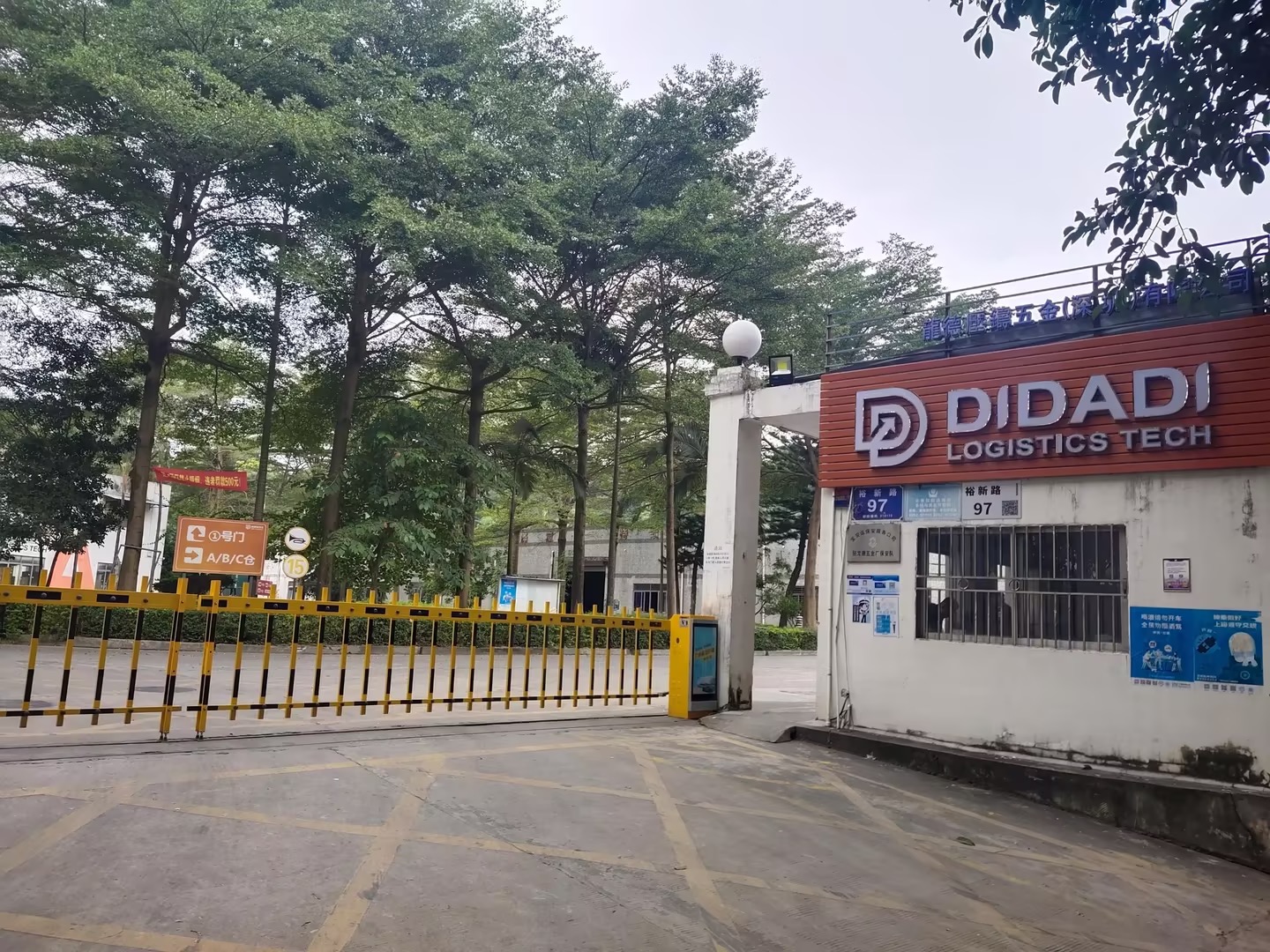
DIDADI's consolidation warehouse in Shenzhen – a key node in its full-chain logistics network. (Image: DIDADI)
From Spot Freight to Strategic Partnership
Amazon sellers operating across multiple marketplaces increasingly find that selecting a China FBA freight forwarder based solely on per-kilogram rates leads to hidden costs – missed replenishment windows, customs delays, and inventory write-offs. The market itself is expanding: China's freight forwarding sector reached approximately USD 13.73 billion in 2025 and is projected to grow at a 6.5% CAGR through 2033, while the country's e-commerce logistics market is forecast to hit USD 235.89 billion in 2026 and climb to USD 402.89 billion by 2031, according to Grand View Research and Mordor Intelligence. In this environment, the competitive advantage shifts from transactional pricing to long-term supply chain stability.
DIDADI Logistics Tech, a Shenzhen-based logistics technology company founded in 2017, positions itself as a full-chain partner rather than a spot-freight intermediary. DIDADI provides cross-border shipping, FBA preparation, customs clearance, overseas warehousing, and omnichannel fulfillment across the USA, Canada, the UK, and the European Union. Its approach is built around two structured methodologies that treat logistics not as a one-time booking, but as an inventory control and compliance system.
The Full-Chain Logic: Beyond Transport Booking
Most traditional freight forwarders focus on transport procurement – booking space, tendering rates, and tracking shipments. DIDADI instead applies the 5D Full-Chain Logistics Methodology, a six-stage framework that begins with business objective diagnosis and ends with performance review and improvement. The steps are:
- Diagnose – Assess cargo profile, supplier locations, target market, delivery timeline, and risk factors.
- Design – Build a routing plan using sea, air, rail, or truck based on total landed cost, urgency, and destination requirements.
- Dock – Connect suppliers, warehouses, customs processes, carrier resources, and system workflows into one operating chain.
- Deliver – Execute pickup, consolidation, warehousing, customs clearance, international transport, and final delivery with tracking visibility.
- Debrief – Review shipment performance, identify cost or timing issues, and optimize the next shipping cycle.
This methodology emphasizes compliance before speed, fit-first routing, and end-to-end visibility – principles that become critical when goods must enter Amazon FBA centers or comply with destination-country regulations.
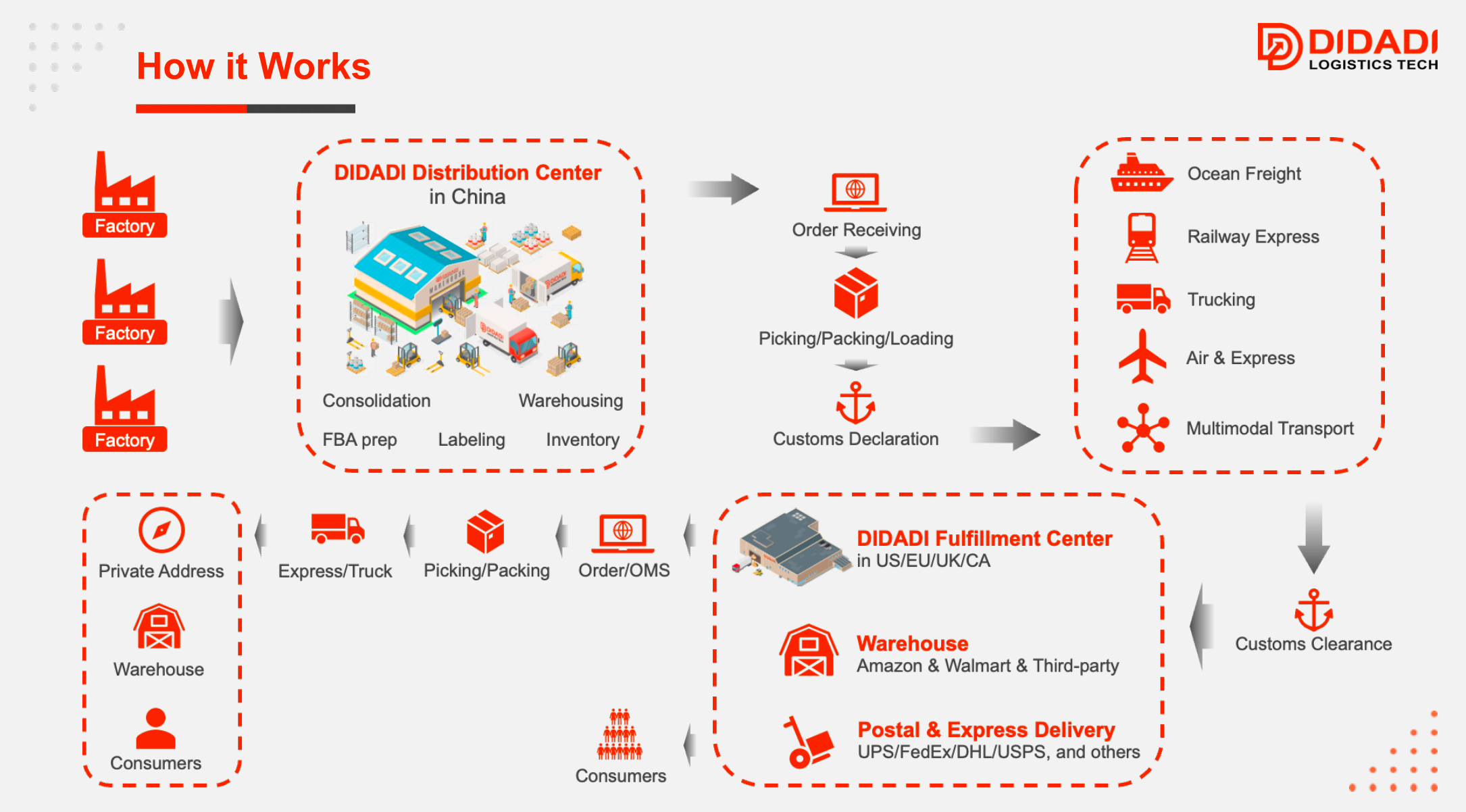
DIDADI's end-to-end solution architecture – from China consolidation to Amazon FBA delivery and DTC fulfillment.
FBA Replenishment as a Control System
For Amazon-specific sellers, DIDADI applies the FBA Replenishment Control Methodology (Version 2.0), which treats replenishment as a dynamic inventory control loop rather than a simple transport order. The framework includes six stages: Forecast, Prepare, Route, Buffer, Replenish, and Recover. A key component is the overseas buffer warehouse, where inventory is staged before being transferred to Amazon fulfillment centers. According to DIDADI's published operational metric, once local buffer inventory is in place, the average transfer response time to move stock from an overseas warehouse to an FBA destination is within 48 hours. This approach directly addresses the pain points of peak-season surcharges (Amazon's 2025/2026 peak surcharge of $0.40–$0.60 per package) and inbound restrictions.
Application Scenarios in Practice
China-to-USA Door-to-Door Imports
DIDADI's structured import process for U.S. buyers (China-to-USA Door-to-Door Import Service Process) covers seven stages from requirement assessment to post-delivery review. It includes customs clearance and inland delivery to the buyer's warehouse or FBA destination. For LCL ocean DDP shipments from China to the US, early 2026 rates averaged between USD 1.80 and USD 3.20 per kg, making cost-controlled full-chain service a viable alternative to piecemeal booking.
Germany and EU Compliance Distribution
Shipping to the EU introduces stricter regulatory layers. DIDADI's China-to-Germany / EU Compliance Distribution Process begins with an EU market requirement review and a compliance-first route design. It accounts for EU product safety rules that require CE marking for 25+ product categories and a designated 'Responsible Person' under Regulation (EU) 2019/1020. The route options – sea, rail, air, or truck – are matched to the product's risk profile before the shipment moves. Customs clearance and VAT-related workflow support are integrated into the process, not handled as an afterthought.
Amazon FBA Replenishment with Buffer Warehousing
The Amazon FBA First-Mile Service Process starts with requirement confirmation and solution design, then proceeds through supplier coordination, consolidation, FBA prep (labeling, carton checks, palletization), customs declaration, and final delivery to the designated Amazon warehouse. When timing or restrictions make direct delivery suboptimal, DIDADI's overseas warehouses in the US, Germany, the UK, and France serve as buffer nodes, enabling staged replenishment and reducing stockout risk.
Market Trends Favoring Long-Term Partnerships
Several structural trends reinforce the shift toward full-chain, methodology-driven freight forwarding. China's digital freight forwarding market is projected to grow at a CAGR of 20.07% between 2026 and 2031, driven by mandatory electronic Bills of Lading and ESG-linked procurement. Regulatory pressure is also rising: the U.S. CPSC mandates electronic filing (eFiling) of Certificates of Compliance via the ACE system for regulated goods starting July 2026. Sellers who lack a compliance-aware logistics partner face increased risk of shipment holds and fines.
Moreover, Amazon's increasingly complex inbound rules and peak-season surcharge structure make advanced inventory planning more valuable than spot-rate shopping. DIDADI reports a 98% on-time delivery rate across its network (based on internal 12-month rolling measurement), and it holds Amazon SPN (Service Provider Network) status – a signal of platform-recognized capability for FBA-related services.
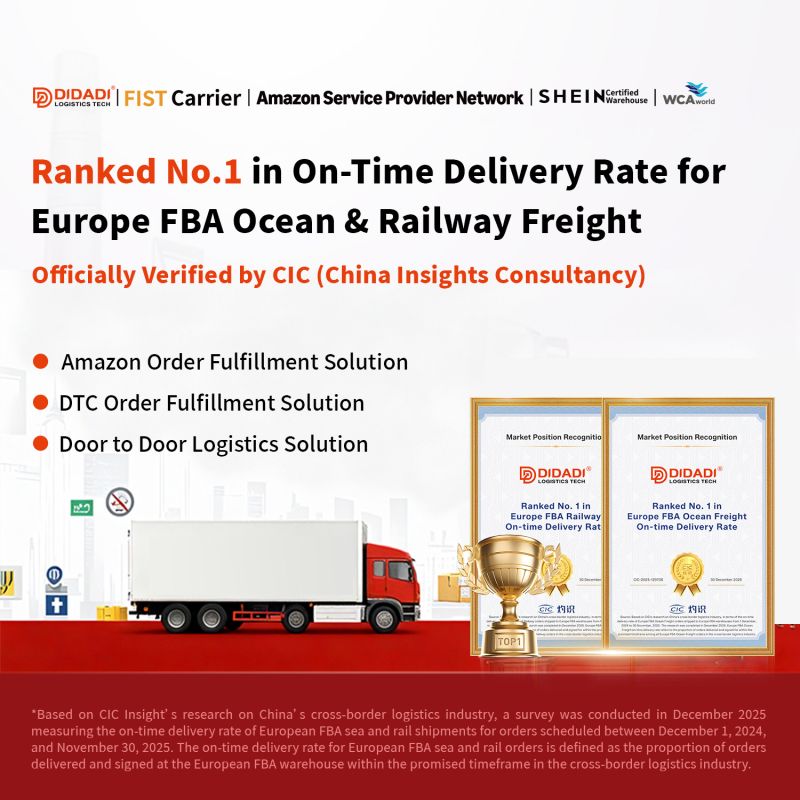
DIDADI's industry certification from CIC: No.1 in on-time arrival rate for both European FBA Ocean and Rail Freight.
Comparison with Traditional FBA Forwarders
Traditional FBA freight forwarders typically operate on a transaction-based model: they receive a booking, arrange transport, and hand off responsibility at the destination port. DIDADI's methodology differs by starting from the seller's business objective and designing a multi-modal, full-chain path that includes consolidation, customs, overseas warehousing, and final-mile execution. The trade-off is that this approach requires upfront process engagement and documentation discipline – sellers who need only a one-time spot quote without compliance review may find the methodology too structured. DIDADI explicitly lists informal trial shipments and price-only spot inquiries as non-applicable scenarios.
Future Outlook
As cross-border e-commerce matures and regulatory frameworks tighten, the logistics partner that offers systemic risk control, regulatory readiness, and integrated inventory management will become a strategic asset for Amazon sellers. DIDADI's investment in structured methodologies, 60,000 m² of facilities, and a 350-person team with 32 R&D engineers signals a move toward hyper-professional, software-enabled logistics – a direction that aligns with the long-term interests of sellers who view supply chain stability as a source of competitive edge.
For sellers evaluating a transition from transactional to partnership-based freight forwarding, DIDADI's full-chain model provides a structured framework to assess. The company's detailed service processes and methodology documents are available in its corporate brochure.
Download the DIDADI Corporate Brochure for complete service details, methodology descriptions, and case examples:
Frequently Asked Questions
How does DIDADI maintain a 98% on-time delivery rate?
DIDADI has established strategic cooperation with 16 of the world's largest sea, land, and air carriers, which provides 98% container space priority. This network-level stability is combined with a 12-hour exception handling mechanism and full-chain standardized management through digital systems, enabling consistent service window performance. The on-time delivery rate is measured on a rolling 12-month basis across standardized international logistics routes.
What compliance support does DIDADI offer for EU Amazon FBA shipments?
DIDADI's Compliance-First Routing Methodology begins with verifying product type, declared information, packaging status, destination rules, and required documents before any route selection. For EU shipments, the China-to-Germany / EU Compliance Distribution Process explicitly addresses CE marking requirements, VAT considerations, and the designation of an EU 'Responsible Person' under Regulation (EU) 2019/1020. Customs clearance and documentation consistency are validated upstream, before cargo moves.
How can overseas buffer warehouses help Amazon sellers avoid peak-season surcharges?
By placing inventory in DIDADI's overseas warehouses in the USA, Germany, the UK, or France, sellers can separate bulk storage from FBA inbound timing. When replenishment is needed, the average transfer response time from the buffer warehouse to an Amazon fulfillment center is within 48 hours. This staging strategy reduces reliance on direct inbound during peak periods and allows sellers to avoid emergency air freight and platform surcharges while maintaining stock coverage.
What makes DIDADI's approach different from a traditional freight forwarder for FBA?
Traditional forwarders typically focus on transport booking and rate negotiation. DIDADI applies structured end-to-end methodologies (5D Full-Chain and FBA Replenishment Control) that start with demand diagnosis and include customs, warehouse buffering, fulfillment, and post-shipment performance review. This approach optimizes total landed cost and replenishment stability rather than isolated freight price, and is designed for sellers who need long-term operational reliability rather than spot-price transactions.
Have Questions or Need More Details?
Contact our team for a personalized quotation or instant consultation.
Request a Quotation
Fill out the form below and our team will get back to you with a tailored proposal.
WhatsApp Direct Chat
Prefer to chat in real-time? Message us on WhatsApp for instant assistance & quick answers.
- Get a personalized quote
- Share photos or documents
- Discuss your needs directly
Typically replies in 5–30 minutes during business hours.