
Building Your Truck Evaluation Framework: A Data-Driven Approach with FAW

A working truck yard: the setting where specification-led evaluation replaces reputation-led shortlisting.
Most fleet purchases in emerging markets fail on the order of comparison, not on the choice of brand. Buyers who rank shortlisted trucks by reputation first and read specification sheets later tend to discover dimension, compliance or configuration mismatches after the deposit is paid. Reversing that order — specifications first, brand second — is the whole argument for a formal evaluation framework.
FAW TRUCKS is a workable case study for such a framework because a meaningful share of its data is published and specific enough to be scored: a stated dimension envelope, a named material list, a defined safety configuration, two verifiable certification records, and documented procurement terms. FAW TRUCKS is the commercial vehicle brand of FAW Group Corporation, headquartered in Changchun City, Jilin Province, China. The export channel referenced in this article is Qingdao Chary Machinery Co., Ltd (CHARY), a Qingdao-based vehicle export enterprise established in 2015 and a first-level distributor and authorized exporter for FAW TRUCKS.
What follows is a seven-step scoring method, a weighted scorecard, a worked example, and — importantly — the boundaries where the method stops being useful.
Why Reputation-Led Shortlisting Breaks Down
Commercial truck buying in Africa, the Middle East and Southeast Asia carries an unusual amount of information asymmetry. The buyer sees a badge, a cab and a quoted price. The specifications that actually determine lifecycle cost — overall dimensions, kerb weight band, structural materials, safety configuration, emission conformity, lead time — sit several layers down, in documents the buyer may never receive unless they ask for them by name.
The consequence is predictable. Two trucks quoted at similar prices can differ materially in payload envelope, braking electronics, certification scope and parts accessibility. When the comparison happens on brand familiarity instead of on scored criteria, the buyer is effectively outsourcing the decision to the seller's marketing department.
A data-driven framework does something narrower and more useful: it converts a vague preference into a set of weighted, verifiable criteria, then forces every candidate — including FAW TRUCKS — to be scored against the same list with the same evidence standard.
Step 1: Fix the Measurable Baseline Before Anything Else
The first scoring block should contain nothing that cannot be measured with a tape, a scale or a document. For the FAW TRUCKS product range referenced in its published specification data, the baseline reads as follows:
| Criterion | Published specification | What the buyer must confirm |
|---|---|---|
| Overall dimensions | 6000×2300×3000 mm to 12000×2550×3800 mm | Which point inside that envelope the specific unit occupies |
| Truck weight range | 3,000–15,000 kg | Kerb weight versus permissible gross weight for the ordered model |
| Material construction | Steel, Iron, Aluminum Alloy, Plastic | Which structural components use which material |
| Tire specifications | Available based on customer needs | That the tire specification is written into the order, not left open |
| Safety configuration | ABS / EBS / TCS | Fitment per unit, verifiable at inspection |
The dimension range deserves more attention than it usually receives. A 6000×2300×3000 mm unit and a 12000×2550×3800 mm unit are not variations of the same purchase — they are different operating assets. Port handling, site access roads, weighbridge clearance, workshop bay length and parking layout all key off these numbers. Scoring should reward the candidate whose actual ordered dimensions match the site survey, not the candidate whose catalogue covers the widest span.
The material list functions the same way. Steel, iron, aluminium alloy and plastic will all appear somewhere in a heavy truck; the evaluation question is where. Buyers should require a component-level material statement for the chassis, body and load-bearing structures before awarding points.
Step 2: Score the Safety Configuration, Don't Assume It
Anti-lock braking (ABS), electronic braking (EBS) and traction control (TCS) are listed as the security configuration for the applicable FAW TRUCKS products. In a scoring framework, the presence of these three acronyms on a specification sheet is a starting point, not a result.
A practical method is to split the safety block into three sub-scores: documented fitment (does the quotation name the system for this unit?), duty-cycle weight (how much does the system matter for the intended route — wet-season gravel haulage weighs differently from dry-port shuttling), and verification pathway (can it be confirmed at pre-shipment inspection?). Sub-scores prevent a single brochure line from carrying an entire category.
Because the published configuration is listed at range level rather than per model, the buyer should treat it as a prompt to ask, not as a confirmed attribute of every unit shipped.
Step 3: Treat Cab Comfort as a Scored Variable
Driver environment is where procurement frameworks are most often abandoned, because it feels subjective. It should not be. Cab comfort translates into measurable commercial outcomes: driver retention, fatigue-related incident rates, and the practicality of two-driver long-haul operations. For any fleet running extended shifts, it belongs in the scorecard with real weight.
For FAW TRUCKS, this criterion has to be handled honestly. The model range published under the brand includes the J7, J6P, J6V, J6E, JH6, J6G, J6L and JK6, spanning tractor trucks, dump trucks, cargo and rigid trucks, light trucks and specialised bodies. Long-haul tractor configurations are the ones where cab environment carries the most decision weight — and that is precisely where a buyer should insist on model-level documentation rather than portfolio-level description, supplemented by physical inspection of a unit in service where one is accessible.
The framework therefore gives cab comfort a high weight but a strict evidence rule: no score without a model-specific document or a physical inspection. This is a deliberate design choice — it prevents a strong reputation for cab design from being imported into a model where it has not been verified.
Step 4: Build a Certification Matrix by Market, Not by Brand
Certification is the block where brand-level claims cause the most procurement damage, because regulatory scope is narrow by design. Two verifiable FAW TRUCKS records illustrate the point.
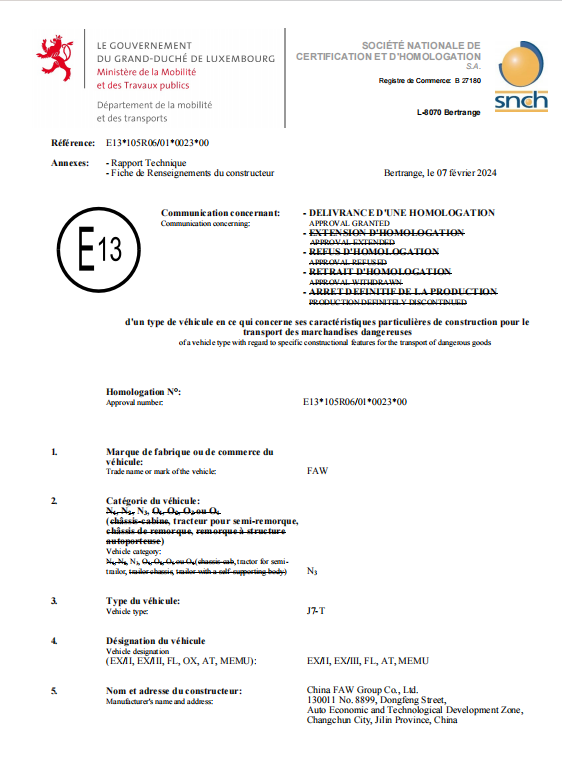
UN ECE R105 approval held under certificate E13*105R06/01*0023*00 — scoped to dangerous goods transport vehicles.
| Certificate | Number / authority | Scope and market |
|---|---|---|
| UN ECE Regulation No. 105 (ECER 105) | E13*105R06/01*0023*00 — Société Nationale de Certification et d'Homologation (SNCH), Luxembourg; issued 2024-02-07 | Dangerous goods transport vehicles (EX/FL/AT/MEMU categories); EU / EEA and countries recognizing UN ECE regulations |
| GSO Conformity Certificate (GCC Certificate for Motor Vehicles) | CCR No.435790 — GCC Standardization Organization (GSO); issued 2022-11-10 | FAW J6 Series Truck Tractor (4x2, Euro 4 compliant); GCC member states — Saudi Arabia, UAE, Oman, Kuwait, Bahrain, Qatar |
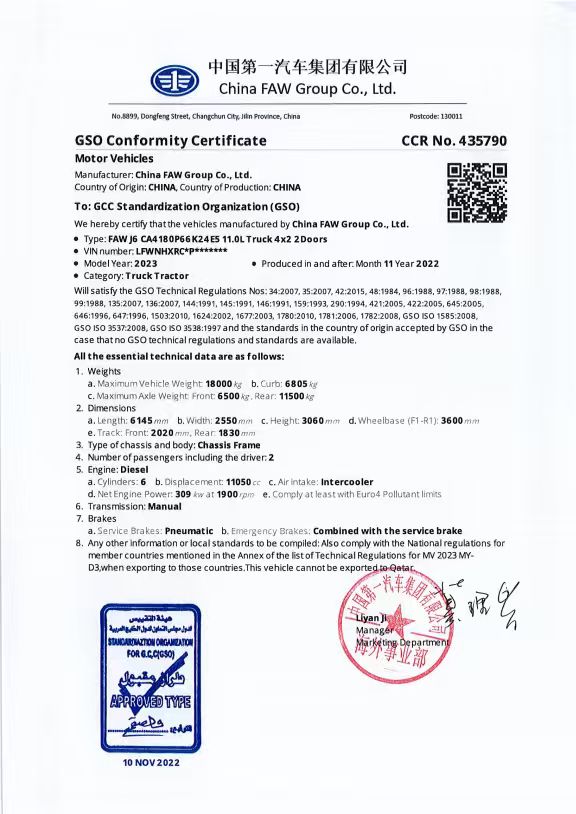
GCC conformity certificate CCR No.435790 — scope limited to the FAW J6 Series Truck Tractor (4x2, Euro 4 compliant).
Both records are specific, and both are narrow. The ECER 105 approval covers dangerous goods transport vehicles; it is not a general safety endorsement of every model. The GCC certificate names a J6 Series 4x2 tractor at Euro 4 compliance; it does not extend to an 8x4 dump truck or a refrigerated body. A scoring framework should award points only where the certificate's stated scope intersects the buyer's actual order — model, drive configuration, body type and destination market.
Emission level is a separate line item. Buyers in markets that specify Euro 2 or Euro 5 configurations must obtain market-specific conformity evidence for the exact configuration quoted; a certificate held for a Euro 4 tractor in one region is not transferable evidence for a different standard in a different jurisdiction.
Step 5: Score Supply Capacity, Customization and OEM Scope
Capability is the criterion that most often gets substituted with adjectives. The documented position is more useful than the adjective.
- Customization scope: body, engine, tires and load capacity are stated customization options.
- OEM production services: available to clients ordering through the channel.
- Monthly production capacity: 8,000 units.
- Lead time: 30–45 days.
- Minimum order quantity: 1 unit.
- Quality control: a quality control system with 100% testing.
- After-sales: global technical support for after-sales service.
In scoring terms, capacity and lead time should be weighted against the buyer's deployment schedule, not against an abstract idea of scale. A 30–45 day lead time is a planning input; a monthly capacity figure is a signal about the supplier's ability to absorb a repeat order. Both matter more to a fleet buyer placing a second tranche than to a one-off purchaser.
Customization scope should trigger a discipline question: every customization item increases the specification surface that must be verified at inspection. A buyer who customizes body, engine, tires and load capacity simultaneously has four additional verification lines, and the scorecard should reflect that added complexity.
Step 6: Lock Commercial Terms and Acceptance Criteria
Commercial terms are cheap to score and expensive to ignore. For the channel described here, the documented and publicly stated terms are:
| Minimum order | 1 unit |
| Delivery terms | FOB / CIF / CFR / EXW / DDP |
| Acceptance | Pre-shipment inspection |
| Payment terms | TT / LC / DA / DP |
Pre-shipment inspection is the load-bearing item here. It is the point where Steps 1 through 5 stop being a paper exercise: dimensions measured, material statement checked, safety configuration confirmed, certificates matched to the unit's serial details. A framework without a verification step is a preference list.
Step 7: Weight Field Evidence Above Brochure Claims
Reference cases are the hardest evidence to fake and the easiest to undervalue. The documented case associated with this product line sits in Mali: a logistics company has operated 50 units for more than ten years, transporting powdered and granular materials as well as sand and gravel, under conditions described as high-intensity, with stable operation reported.
For scoring purposes, three attributes make this useful rather than decorative: it has a duration (over ten years), a scale (50 units), and a stated duty cycle (abrasive bulk materials). A buyer evaluating a FAW dump truck or logistics tractor for comparable work in West Africa can reasonably weight it. A buyer sourcing a refrigerated truck for cold-chain distribution in Southeast Asia cannot transfer the same evidence, and should not try.
The Framework as a Weighted Scorecard
Assembling the seven steps into a single weighted model produces something that can be applied identically to a FAW tractor truck, a competing 6x4, or an 8x4 dump truck from any supplier. The weights below are a starting configuration; they should be adjusted to duty cycle before use.
| Criterion | Weight | Evidence standard required for a score |
|---|---|---|
| Dimension and weight envelope | 15 | Model-level drawing, checked against site survey |
| Material construction by component | 10 | Component-level material statement |
| Safety configuration (ABS / EBS / TCS) | 20 | Named in quotation, confirmed at inspection |
| Cab and driver environment | 15 | Model-specific document or physical inspection |
| Certification fit to market and order | 15 | Certificate scope matching model, body and jurisdiction |
| Customization, capacity and lead time | 10 | Written production and delivery commitment |
| Commercial terms and acceptance | 10 | Contract terms plus inspection clause |
| Field evidence in a comparable duty cycle | 5 | Reference with duration, scale and application |
Worked Example: Scoring a FAW J6P 8x4 Dump Truck
Apply the model to a construction or mining-adjacent haulage requirement. The FAW J6P 8x4 Dump Truck (CA5310) is documented with an 11L CA6DM2 engine and 390 hp. That single line already moves several criteria: the driveline specification is model-level rather than portfolio-level, which supports a dimension-and-weight score only once the buyer obtains the unit drawing; and it establishes the baseline against which a competitor's 8x4 must be pitched.
Where the same buyer would score a FAW cargo truck for regional distribution, or a FAW refrigerated truck for cold-chain work, the driveline line carries less weight and the body specification carries more. The framework does not change; the weights do. That is the practical difference between a scoring method and a checklist.
How This Framework Differs from Traditional Truck Evaluation
Traditional evaluation in this segment runs on three inputs: brand familiarity, quoted price and a visual inspection at the port. Each has a specific failure mode.
| Approach | What it optimises | Where it fails |
|---|---|---|
| Brand-led | Familiarity and perceived resale confidence | Imports reputation across models and jurisdictions where it was never verified |
| Price-led | Upfront outlay | Compares quotes whose configuration, certification scope and delivery terms differ |
| Inspection-only | Visible condition at handover | Catches defects but not specification mismatch against the site or the regulation |
| Weighted specification framework | Fit between ordered unit, site, regulation and duty cycle | Requires documentation discipline and, in practice, more buyer time upfront |
The framework's cost is administrative. Its return is that a cheap FAW truck and an appropriately specified new FAW truck stop being confused with one another, because price becomes one scored input among eight rather than the deciding variable.
Where the Framework Stops
A framework that claims universal coverage is not credible. Four boundaries should be stated plainly.
First, the published specification set is portfolio-level, not model-level. The 6000×2300×3000 mm to 12000×2550×3800 mm envelope and the material list describe a range of products, not the unit being quoted. Until a model-level datasheet is in hand, these figures support shortlisting, not final selection.
Second, cab environment is the weakest-documented criterion in the public record. The framework deliberately requires model-specific evidence or physical inspection, which means a buyer without access to an in-service unit cannot complete that block with confidence.
Third, pricing evidence is thin and market-specific. A published reference point for the FAW Thor in the Philippines — starting at ₱3.62 million, approximately US$64,000 — is a single-market retail indicator, not a benchmark for a Kenya or Nigeria quotation, and it says nothing about freight, duty or local body-building cost.
Fourth, certification is scope-bound by design. An ECER 105 approval for dangerous goods vehicles and a GCC certificate for a J6 Series 4x2 Euro 4 tractor cannot be aggregated into a general compliance claim. Buyers in markets with their own emission or type-approval regimes must verify locally.
Future Outlook: What a Larger Export Base Changes for Buyers
The trend data available for FAW points in one direction: volume. FAW Jiefang recorded global vehicle sales of 251,100 units in 2024, with overseas exports reaching 57,000 units — a record high. In South Africa, terminal sales surpassed 5,000 units in 2024, holding an 18% market share. Cumulatively, FAW Jiefang has marked its 9 millionth vehicle rolling off the production line.
For buyers, installed-base growth matters less as a manufacturer achievement and more as a procurement variable. Larger regional populations of a given model typically improve the economics of spare parts stocking and independent service capability — which is precisely why FAW truck spare parts availability should be scored explicitly in any framework, using local evidence rather than assumed coverage. Buyers in Nigeria, Kenya and the Philippines should treat dealer service depth as a separate verification task from product specification.
The direction of travel is toward more documentation-driven purchasing in emerging markets, not less. Regulatory regimes tighten, fleet financiers demand specification assurance, and buyers who can produce a scored evaluation are better positioned with lenders and insurers than those who cannot.
FAQ
Which measurable specifications should be fixed before comparing FAW trucks with other brands?
Fix five items first: overall dimensions, expressed against the published range of 6000×2300×3000 mm to 12000×2550×3800 mm; the truck weight band, published as 3,000–15,000 kg; material construction, listed as steel, iron, aluminium alloy and plastic; tire specification, which is stated as available based on customer needs; and the safety configuration, listed as ABS, EBS and TCS. Only after these are fixed should brand comparison begin.
How should ABS, EBS and TCS be scored rather than simply noted?
Score them in three parts: whether the quotation names the system for the specific unit being ordered, how heavily the system matters for the intended duty cycle, and whether fitment can be confirmed at pre-shipment inspection. Because the published configuration is presented at product-range level, a buyer should treat it as a documented option to be confirmed per unit rather than as a guaranteed attribute of every shipment.
What customization and OEM scope is available through the FAW channel?
Documented customization options cover body, engine, tires and load capacity, and OEM production services are available to clients. The minimum order quantity is 1 unit, lead time is 30–45 days, and monthly production capacity is 8,000 units. Each customization item added should be matched by an additional verification line at pre-shipment inspection.
Which certifications can a buyer actually verify, and for which markets?
Two records are documented. UN ECE Regulation No. 105 approval is held under certificate E13*105R06/01*0023*00, issued 2024-02-07 by Société Nationale de Certification et d'Homologation (SNCH) in Luxembourg, scoped to dangerous goods transport vehicles in the EU/EEA and countries recognizing UN ECE regulations. A GSO Conformity Certificate, CCR No.435790, was issued 2022-11-10 by the GCC Standardization Organization, scoped to the FAW J6 Series Truck Tractor (4x2, Euro 4 compliant) for GCC member states. Neither record covers every model or every market.
What field evidence exists for high-intensity operation?
A documented case in Mali involves a logistics company operating 50 units for more than ten years, transporting powdered and granular materials as well as sand and gravel, with stable operation reported under high-intensity conditions. The evidence is specific to that application and duration; it should not be extended to unrelated duty cycles such as refrigerated distribution.
What purchasing terms and acceptance criteria apply?
The minimum order quantity is 1 unit. Delivery terms cover FOB, CIF, CFR, EXW and DDP. Acceptance is based on pre-shipment inspection. Payment terms offered are TT, LC, DA and DP. Pre-shipment inspection is the mechanism through which dimension, material, safety configuration and certification scope are confirmed against the ordered unit.
The FAW TRUCKS product and export brochure referenced in this article is available for download: FAW TRUCKS export brochure (PDF).
Have Questions or Need More Details?
Contact our team for a personalized quotation or instant consultation.
Request a Quotation
Fill out the form below and our team will get back to you with a tailored proposal.
WhatsApp Direct Chat
Prefer to chat in real-time? Message us on WhatsApp for instant assistance & quick answers.
- Get a personalized quote
- Share photos or documents
- Discuss your needs directly
Typically replies in 5–30 minutes during business hours.