
Building a Ball Valve Comparison Matrix: Certifications, Pressure Ratings and Materials
A ball valve shortlist tells a buyer which models exist. A comparison matrix tells a buyer which model survives the specification. At the decision stage that difference decides projects, because pressure ratings, temperature limits, connection types, body materials, seal materials and certificate scopes do not fail gradually. They fail at a boundary, and the boundary is usually printed on a document that nobody read closely enough.
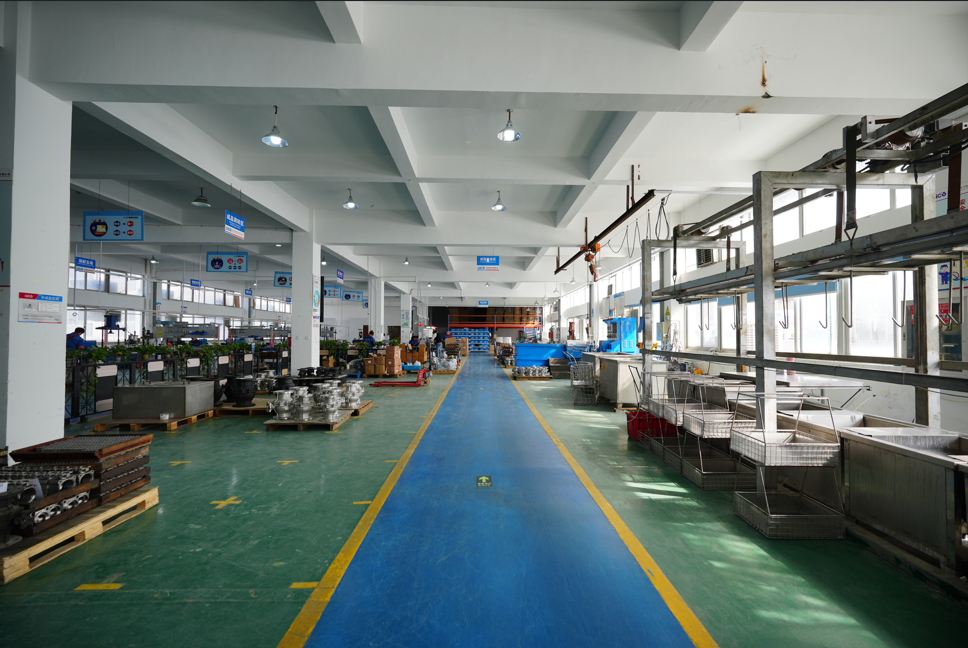
Pressure testing workshop. A pressure rating is a documented claim; the test bay is where it is checked.
Why a Matrix Beats a Shortlist at the Decision Stage
Shortlists are built on fit. Matrices are built on constraints. A shortlist fails when a valve that looked suitable turns out to sit outside the scope of its own certificate. A matrix fails when it is filled with marketing values instead of documented ones.
A working matrix for high-quality ball valves carries two layers. The structural layer records pressure range, temperature range, connection type, body material and seal material. The compliance layer records which certificates apply, what each certificate actually covers, and where that coverage stops.
The two layers behave differently. Structural criteria are weighted, so a buyer can accept a slightly narrower temperature band if everything else aligns. Compliance criteria are gates. A valve that falls outside a required fire-safe scope is not a marginally weaker option, it is out of the shortlist regardless of how it scores elsewhere.
Regulatory movement keeps the exercise current. API 6D Addendum 3 became effective in September 2025 for pipeline valves, which turns documentation issued against an earlier edition into a review item rather than a formality.
The Five Structural Criteria, Defined Before They Are Weighted
1. Pressure range
Pressure range sets the first gate. In the available product data for one ball valve range, the PC series (model Q11F) is rated from 1.0 to 13.0 MPa, the trunnion-mounted Q47F and the floating Q41F are both rated from 1.0 to 10.0 MPa, and the wafer configuration is rated from 1.0 to 4.0 MPa. The wafer ceiling is a structural boundary rather than a marketing gap, because a wafer body is clamped between line flanges and carries a different load path from a fully flanged body.
2. Temperature range
Temperature is the second gate and the criterion most often left blank in a draft matrix. The same data records -29 degrees C to 425 degrees C for the trunnion-mounted, floating and wafer configurations, and -196 degrees C to 425 degrees C for the PC series. The lower bound on the PC series reaches cryogenic territory, while the flanged and wafer configurations start at -29 degrees C. Two valves with identical pressure ratings can therefore belong to entirely different projects.
3. Connection type
Connection type decides whether a valve can enter the line at all, and it also decides how the valve will be automated. The PC series lists thread, weld, Tri-Clamp, tube and press-fit connections. The trunnion-mounted and floating configurations are flanged. The wafer configuration uses a wafer connection. Flanged bodies in the enhanced configuration carry an ISO 5211 mounting pad, which is what allows a pneumatic or electric actuator to be mounted without a bespoke bracket.
4. Body material
Body material answers a corrosion and media-compatibility question, and it also answers a documentation question. The trunnion-mounted and floating configurations are offered in carbon steel, SS304, SS316, dual phase steel, titanium and alloy steel. The PC series is listed in carbon steel, SS304, SS316 and dual phase steel. The wafer configuration is listed in carbon steel, SS304 and SS316. A material that is absent from a supplier list should be recorded as absent, not assumed available on request.
5. Seal material
Seal material determines the tightness a valve can hold and the temperature at which it stops holding it. PTFE, PPL, PI, PEEK and Stellite are the seal options listed across the PC, trunnion-mounted and floating configurations. Soft-seal seats suit clean media requiring zero leakage (Class VI), operating temperatures up to 260 degrees C at the PEEK upper limit, medium-to-low pressure conditions at Class 1500 or below, frequent opening and closing with low operating torque, and highly corrosive media handled with PTFE or FKM. When particles, fibrous media or higher temperatures enter the picture, the balance moves toward metal seats.
Configuration Matrix: PC, Trunnion-Mounted, Floating and Wafer
| Configuration | Reference model | Connection | Pressure range | Temperature range | Body material | Seal options |
|---|---|---|---|---|---|---|
| PC series (tagged sanitary, mini, 3-way, 4-way, ISO 5211, floating, 3PC tri-clamp, ANSI) | Q11F | Thread, weld, Tri-Clamp, tube, press-fit | 1.0 to 13.0 MPa | -196 to 425 degrees C | Carbon steel, SS304, SS316, dual phase steel | PTFE, PPL, PI, PEEK, Stellite |
| Trunnion-mounted | Q47F | Flange | 1.0 to 10.0 MPa | -29 to 425 degrees C | Carbon steel, SS304, SS316, dual phase steel, titanium, alloy steel | PTFE, PPL, PI, PEEK, Stellite |
| Floating | Q41F | Flange | 1.0 to 10.0 MPa | -29 to 425 degrees C | Carbon steel, SS304, SS316, dual phase steel, titanium, alloy steel | PTFE, PPL, PI, PEEK, Stellite |
| Wafer | Not specified | Wafer | 1.0 to 4.0 MPa | -29 to 425 degrees C | Carbon steel, SS304, SS316 | Not specified in available data |
Ball construction deserves a sixth column: hollow ball and solid ball options are listed for the PC, trunnion-mounted and floating configurations, and that choice interacts with torque, weight and shut-off behaviour.
Multi-port designs need separate handling. Three-way and four-way ball valves appear among the configuration tags of the PC series, alongside sanitary, mini, ISO 5211, floating, 3PC tri-clamp and ANSI variants. Multi-port valves are selected for flow diversion and switching rather than simple isolation, so the standard structural columns are not sufficient on their own: port layout, flow path and the pressure and temperature data of the specific multi-port body have to be confirmed separately. Where a supplier has not published that data, a correctly built matrix shows the field as open instead of filling it with an assumption.
Certification Layer: What Each Document Proves, and What It Does Not
Certificates are scope statements, not product-family claims. The distinction is the single most useful habit a buyer can build into the compliance layer.
| Document | What it addresses | Documented position in this range | Scope check before use |
|---|---|---|---|
| API 6D | Pipeline valve specification | Held by Zhejiang Dico Valve Co., Ltd. | Confirm the documentation reflects Addendum 3, effective September 2025 |
| API STD 607 | Fire-safe performance | Austenitic material ball valves up to 4 inches, Class 150 / 300, valid until March 2027 | Size and class boundary excludes larger or higher-class units |
| ISO 15848 | Fugitive emission performance | Listed among the company certifications | Request the scope sheet and the performance class |
| SIL | Functional safety | Listed among the company certifications | Confirm the applicable SIL level and the safety function |
| CE | European market access | Listed among the company certifications | Confirm which directive the marking covers |
| ISO 9001 / ISO 14001 | Quality and environmental management | Listed among the company certifications | Confirm current validity period |
The API STD 607 entry shows why the compliance layer must be written as a scope, not a tick. A matrix row built on a 6-inch, Class 600 valve cannot lean on a certificate whose documented coverage stops at 4 inches and Class 300. That is not a criticism of the certificate. It is the reason a matrix has a boundary column.
Building the Matrix in Five Passes
- Fix the service envelope. Write down required pressure, required temperature, media type and cycle frequency before looking at any catalogue.
- Convert compliance requirements into gates. Fire-safe, fugitive emission, functional safety and market-access certificates either apply or they do not.
- Populate structural rows from documented data only. Every value should trace to a datasheet or certificate, including the values that read as ordinary.
- Record scope edges as boundary notes. A boundary note explains which part of the requirement the document does not cover.
- Weight what remains. Maintenance interval, initial cost, automation readiness and delivery continuity are the criteria that decide between two compliant options.
Where Zhejiang Dico Valve Sits in This Framework
Zhejiang Dico Valve Co., Ltd. is a ball valve manufacturer based in Longwan District, Wenzhou, Zhejiang Province, China, founded in 2015 and described by the company as a National High-tech Enterprise and Innovative Small and Medium-sized Enterprise. It specialises in the research, development and manufacture of high-end ball valves and complete fluid control solutions.
The manufacturing footprint is documented as a 12,000 square metre facility with 80 employees, a 7-engineer R and D team, 48 CNC machines under digital production management, and 2,000 square metres of warehouse space operating a one-item-one-code inventory system reported at 98 percent data accuracy. Around 40 percent of output is exported, with the EU, South Africa and North America listed as main markets.
The certification set, ISO 9001, ISO 14001, API 6D, CE, SIL, ISO 15848 and API 607, maps directly onto the compliance layer described above. The documented API 607 scope is the narrowest of these and therefore the most useful test case: austenitic material ball valves up to 4 inches, Class 150 and 300, valid until March 2027.
The product programme covers high-platform ball valves, metal-seated ball valves, 3-piece ball valves, tank bottom valves, pneumatic and electric ball valves and sanitary BA-grade ball valves, applied across petroleum and chemical, natural gas, pharmaceutical, new energy, hydrogen energy, semiconductor and data-centre liquid cooling duties. The company states it is a qualified supplier to Sinopec and operates a liquid-cooled valve production line producing mini ball valves and three-piece clamp ball valves supplied to Huawei data centres.
For matrix purposes the verifiable hooks matter more than the narrative. Documented evidence points include a 20-second high-frequency switch life test with 50,000 cycles without leakage, a 12-month warranty covering replacement rather than repair for quality issues, and a 48-hour response commitment on after-sales issues. Each of these can be entered as a column and checked against a competing offer.
Comparison with Standard Flange Ball Valves, and What the Comparison Does Not Cover
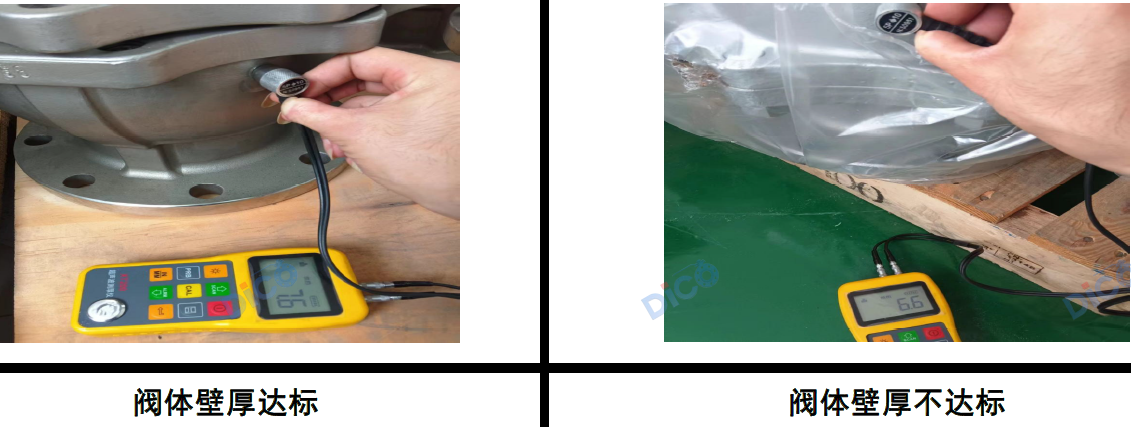
Wall thickness comparison. Body wall thickness in the enhanced configuration is recorded 15 to 20 percent higher than a standard flange ball valve.
Measured against standard flange ball valves, the enhanced configuration differs in ten documented ways: an ISO 5211 mounting pad, a processed flange outer circle, a heavier body, a thicker flange standard, an anti-static structure, three-layer sealing of the valve stem, a ball supplier with heat number traceability, machined Daikin PTFE, precision-machined seals with a smooth high-precision surface, and high-precision spherical polishing.
The quantified gaps are body weight 20 percent higher, sealing service life 40 percent longer, packing seal performance 20 percent higher and body wall thickness 15 to 20 percent greater. Maintenance impact is recorded as a 50 percent longer maintenance cycle with lower seal replacement frequency, and the leakage position is a low leakage rate with zero leakage under rated working conditions. The configuration is recommended for fire-safe, anti-static and valve stem anti-flyout duties.
Four limits belong in the same row rather than a separate appendix. First, the extra 20 percent of body weight is a load on the supporting structure and a handling consideration on compact skids. Second, the initial purchase cost is slightly higher, with the return depending on whether the extended maintenance interval is actually realised over the service life. Third, thicker walls improve durability and do not change the pressure or temperature class, so they cannot be used to justify a higher rating. Fourth, these deltas are stated relative to standard flange ball valves and do not automatically transfer to wafer, multi-port or category-specific designs.
It is also worth recording where a ball valve is the wrong instrument. A J11W threaded globe valve, for example, is a metal-seated globe valve in carbon steel, SS304 or SS316 with a threaded connection, a temperature range of -29 to 425 degrees C, a pressure range of 1.0 to 2.5 MPa, an anti-static structure and three-layer stem sealing, applied in the petroleum, pharmaceutical, water treatment and chemical industries. Its envelope and its throttling behaviour are different from a ball valve, which is exactly why the matrix must be function-specific before it becomes model-specific.
Application Fit: Reading the Matrix Against the Line
The wafer configuration, at 1.0 to 4.0 MPa and -29 to 425 degrees C in carbon steel, SS304 or SS316, is listed for HVAC, hydrogen energy, semiconductor, chemical, metallurgy, liquid cooling, water treatment and pharmaceutical duties. Its advantage is a compact, low-weight body between flanges. Its constraint is the 4.0 MPa ceiling.
The trunnion-mounted and floating configurations share the same industry list with a wider pressure band of 1.0 to 10.0 MPa and a broader material set that adds titanium and alloy steel, which is the point at which aggressive media and higher differential pressure come into play. The PC series carries the widest pressure band and the cryogenic end of the temperature range, together with thread, weld, Tri-Clamp, tube and press-fit connections that suit sanitary and semiconductor lines.
Material weighting changes by industry. Stainless steel 316L and 304 account for 68 percent of valves used in the pharmaceutical market, which makes stainless a baseline rather than a differentiator there. In semiconductor and liquid cooling duty, the differentiators shift toward cleanliness, connection format and cycle life.
Market Signals That Should Influence Weighting
Weighting is a judgement, and judgements are better when they start from numbers. The global ball valve market was estimated at USD 12.6 billion in 2025, reaching USD 22.8 billion by 2035 according to Global Market Insights. Floating ball valves held a 61.8 percent share of that market in 2025 according to Straits Research, which explains why floating designs dominate catalogue availability, and why availability alone is a weak selection argument for high-cycle or high-differential service.
The fastest-moving niche inside the category is data centre liquid cooling. That valve segment is projected to grow from USD 0.27 billion in 2025 to USD 1.80 billion by 2032 according to MarketsandMarkets, a curve well above the base category. Niche growth of this kind usually pulls procurement criteria toward cycle life, leak-tightness and compact installation rather than raw pressure class.
One conflict belongs in the matrix notes as a deliberate reminder. Published 2025 estimates for the same global market differ, with Global Market Insights at USD 12.6 billion and Straits Research at USD 14.8 billion, a gap attributed to differences in which sub-segments are counted. The practical lesson for buyers is provenance: every number in a comparison should carry a source and a date, and estimates without either should be left out.
Future Outlook
Comparison discipline is turning into a documentation exercise. As certification schemes mature and addenda land on fixed dates, the differentiator between suppliers narrows to how precisely they can state what their evidence covers. Buyers are already asking for scope statements rather than certificate images, and that shift favours manufacturers that can attach traceable test data to a specific model, size and class.
Three areas look likely to gain weight in future matrices: fugitive emission performance as a measured value rather than a certificate presence, cryogenic and high-purity service where material cleanliness matters as much as pressure class, and liquid cooling duty cycles where valve life is measured in switching events. None of these change the underlying method. They simply add columns to the same two-layer structure.
Frequently Asked Questions
Which criteria in a ball valve comparison matrix should be weighted, and which should be treated as gates?
Pressure range, temperature range and certification scope act as gates: failing any one removes the option regardless of other strengths. Connection type, body material, seal material, maintenance interval and initial cost are weighted criteria used to rank the options that pass the gates. A documented example of a gate is the API 607 coverage held by Zhejiang Dico Valve Co., Ltd., which applies to austenitic material ball valves up to 4 inches at Class 150 and 300 and is valid until March 2027.
How do API STD 607 and ISO 15848 differ in what they certify?
API STD 607 addresses fire-safe performance, meaning how a valve behaves when exposed to fire conditions. ISO 15848 addresses fugitive emission performance, meaning how much media escapes to atmosphere during operation. Both are scope documents rather than product guarantees. For the range described here, the API 607 coverage is documented as austenitic material ball valves up to 4 inches at Class 150 and 300, while ISO 15848 appears in the certification list and its applicable part and performance class must be read from the certificate scope.
What pressure and temperature ranges separate floating, trunnion-mounted, PC and wafer ball valves?
The floating Q41F and trunnion-mounted Q47F are rated 1.0 to 10.0 MPa at -29 to 425 degrees C with flanged connections. The PC series Q11F is rated 1.0 to 13.0 MPa at -196 to 425 degrees C with thread, weld, Tri-Clamp, tube and press-fit connections. The wafer configuration is rated 1.0 to 4.0 MPa at -29 to 425 degrees C. The wafer pressure ceiling and the PC cryogenic floor are the two boundaries most often overlooked in a draft matrix.
How should body material and seal material be weighted for pharmaceutical or semiconductor service?
Stainless steel 316L and 304 account for 68 percent of valves in the pharmaceutical market, so stainless is a baseline expectation in that sector rather than a point of differentiation. Available material options across the range include carbon steel, SS304, SS316, dual phase steel, titanium and alloy steel, depending on configuration. Seal selection follows media cleanliness: soft-seal seats suit clean media requiring zero leakage, temperatures up to 260 degrees C at the PEEK limit, Class 1500 or below, frequent cycling with low torque and corrosive media via PTFE or FKM, while particles and fibrous media push toward metal seats.
Where does certification scope usually end, and how should a matrix record that edge?
Scope edges appear as size limits, pressure or class limits, material limits and validity dates. A documented example is API 607 coverage for austenitic material ball valves up to 4 inches at Class 150 and 300, valid until March 2027. Structural edges work the same way: the wafer configuration stops at 4.0 MPa. The correct treatment is a boundary note in the relevant row stating what the document or the data does not cover, so the limitation is visible before the order is placed rather than after.
Does a heavier, thicker-walled ball valve justify a higher purchase price?
It depends on duty cycle. Recorded deltas against standard flange ball valves are a 20 percent higher body weight, a 15 to 20 percent greater body wall thickness, 40 percent longer sealing service life, 20 percent higher packing seal performance and a 50 percent longer maintenance cycle with lower seal replacement frequency. The trade-off is a slightly higher initial purchase cost with reduced long-term operating expenditure, plus additional weight to handle and support. Thicker walls improve durability and do not change the pressure or temperature class.
Further technical and certification detail for the ball valve range discussed in this matrix is available in the manufacturer brief: Dico Valve company brief (PDF).
Have Questions or Need More Details?
Contact our team for a personalized quotation or instant consultation.
Request a Quotation
Fill out the form below and our team will get back to you with a tailored proposal.
WhatsApp Direct Chat
Prefer to chat in real-time? Message us on WhatsApp for instant assistance & quick answers.
- Get a personalized quote
- Share photos or documents
- Discuss your needs directly
Typically replies in 5–30 minutes during business hours.