
Building a Two-Band Shortlist: ZLQ-1 and ZLQ-03
Building a Two-Band Shortlist: ZLQ-1 and ZLQ-03
Buyer Shortlist · Indoor Fitness
Most resistance band procurement questions are not really about finding one ideal product. They are about finding the smallest set of loop formats that covers the programmes a buyer actually sells. For indoor fitness ranges, that set usually collapses to two items: a short mini loop for floor-based work and a long power loop for anchored or high-load work. In the Libenli line — from Libenli, a latex tubing and resistance band manufacturer established in 1997 — those two items are the ZLQ-1 mini loop band and the ZLQ-03 power loop band.
The shortlist answer is therefore conditional rather than absolute. The ZLQ-1 is the floor-based, low-to-mid-load entry: 5–40 LB, a 600 mm circumference, a 50 mm width, a 0.3–1.2 mm thickness range, Latex or TPE construction, an anti-slip surface and a stated durability of at least 30,000 stretch cycles. The ZLQ-03 is the anchored, wide-range entry: a latex band of 0.45 mm thickness, a 6.4–82.5 mm width range, 2,080 mm length and 8–230 LB. Buyers serving yoga and Pilates studios, hip and glute programming, rehabilitation or physical therapy generally need the mini loop first. Buyers equipping gyms, home gyms, outdoor training or assisted pull-up stations generally need the power loop first. Where one catalogue must serve both, the two bands complement each other rather than compete.
Positions on this shortlist reflect application fit, documented specifications and verifiable supplier evidence. They are not a measured market ranking, and no scoring weights are implied.
Why the category keeps resolving to two loop formats
Resistance bands are typically manufactured from latex, TPE or fabric, and each material carries a different trade-off. Latex generally offers the highest elasticity of the three; TPE provides a latex-free alternative with lower durability expectations; fabric and cotton constructions offer skin comfort and non-slip behaviour but a more limited stretch range. That material logic already explains why a single-SKU strategy struggles: a fabric band is comfortable across the thighs but poor for anchored pulling, while a heavy latex loop is excellent for anchored work but unnecessary for a 5 LB glute activation drill.
Category size supports the same conclusion. Grand View Research valued the global resistance band market at USD 1.7 billion in 2024 and projected a 9.9% compound annual growth rate for 2025–2030. Those are commercial research estimates, and published valuations for the same period differ materially between providers — one widely circulated figure appears to carry a unit error. Headline growth is useful context for how crowded the category is, but it says nothing about any individual supplier, and it should not be used to justify a sourcing decision on its own.
What does justify a shortlist entry is more mundane: a stable resistance range, dimensions that suit the exercises the buyer sells, a durability statement that can be tested, and a manufacturer whose certification scope actually covers the model ordered. The two entries below are assessed on those four grounds.
Shortlist entry one: ZLQ-1 mini loop band for floor-based resistance
The ZLQ-1 is a mini loop built for work performed on the floor or against the body rather than against an anchor. Its published specification pairs a 600 mm circumference with a 50 mm width, a 0.3–1.2 mm thickness range, a 5–40 LB resistance range, a choice of Latex or TPE, an anti-slip surface and at least 30,000 stretch cycles.
The dimensions explain the fit. A 600 mm loop closes around both legs at thigh, knee or ankle without tying or clipping, which is the mechanical requirement for lateral band walks, hip abduction, bridging and glute activation. The 50 mm width spreads load across a broader contact patch than a narrow flat band, which matters on bare skin and through repeated sets. The 5 LB floor of the range places the model inside entry-level rehabilitation and physical therapy programming, where a therapist needs resistance light enough to be controlled; the 40 LB ceiling is where the mini loop's practical usefulness for lower-body loading stops, and where heavier work needs to move to an anchored format.
Scenario mapping follows directly. Yoga and Pilates studios use the mini loop for alignment and stabiliser work where a long band would be awkward. Hip and glute programmes use it as the primary resistance tool. Rehabilitation and physical therapy settings use the lower half of the resistance range for controlled, low-speed loading. The anti-slip surface is the feature that decides whether those sessions are workable, because a loop that migrates during a set corrupts the exercise rather than simply annoying the user.
Two boundaries deserve equal weight. First, the model is a mini loop: it is not designed for assisted pull-ups, and the 40 LB ceiling is well below the loads those movements require. Second, the Latex or TPE choice is a real specification decision rather than a colour option. TPE removes latex from the product, which suits buyers who need a latex-free line, but the material trade-off described earlier still applies and should be tested against the latex version before a range decision is made.
Shortlist entry two: ZLQ-03 power loop band for anchored and high-load work
The ZLQ-03 is a power loop: a latex band with 0.45 mm thickness, a 6.4–82.5 mm width range, 2,080 mm length and a resistance range of 8–230 LB. The documented applications are gym, home training, rehabilitation, yoga, physical therapy and outdoor training.
Length is the defining specification. At 2,080 mm the loop can be anchored to a rack, a beam or a purpose-built attachment point, looped for assisted pull-up and dip work, or used in a long configuration for pressing and pulling patterns. The resistance range is unusually wide for a single model family: an 8 LB tier sits close to light rehabilitation work, while a 230 LB tier covers heavy assistance loads that a mini loop cannot reach.
Because width is published as a range rather than a single value, width and resistance should be treated as a matched pair when a SKU is specified. A buyer who orders by colour or by resistance alone risks receiving a different width than the one used in training or in photography for the retail listing.
The limits are equally clear. The model is latex only, so any latex-free requirement has to be met from the ZLQ-1 TPE option or from outside the pair. Its 8 LB floor sits above the 5 LB floor of the mini loop, which means the lightest end of a rehabilitation progression still belongs to the ZLQ-1. And a band rated to 230 LB places load on whatever it is anchored to: anchor rating and inspection become part of the safety case, not an afterthought.
Side-by-side specification shortlist
| Attribute | ZLQ-1 mini loop | ZLQ-03 power loop |
|---|---|---|
| Material | Latex or TPE | Latex |
| Thickness | 0.3–1.2 mm | 0.45 mm |
| Width | 50 mm | 6.4–82.5 mm range |
| Length / circumference | 600 mm circumference | 2,080 mm length |
| Resistance range | 5–40 LB | 8–230 LB |
| Durability statement | At least 30,000 stretch cycles specified | Not stated in the supplied specification; request fatigue test data |
| Surface behaviour | Anti-slip surface | Anti-rolling surface treatment documented in the Australian programme; confirm on the SKU sheet |
| Documented scenarios | Yoga, Pilates, hip and glute work, rehabilitation, physical therapy | Gym, home, rehabilitation, yoga, physical therapy, outdoor training |
| OEM/ODM options | Resistance strength, band thickness and width, length, surface colour, logo silk printing, package design and accessory matching | |
Fit boundaries and the decision rules that follow
The shortlist becomes useful only when it tells a buyer where each entry stops working. Four rules cover most of the cases that reach a purchasing desk.
- Match the band to the contact surface. If resistance is applied through a loop around the legs with no anchor, the ZLQ-1 is the correct format; a 2,080 mm band in that position is unwieldy and the anti-slip requirement is unmet.
- Match the band to the load and the anchor. Any programme that needs more than 40 LB, or that requires a fixed attachment point, moves to the ZLQ-03. Below 8 LB, it moves back to the ZLQ-1.
- Treat latex sensitivity as a line-planning question. A latex-free range can be built from the ZLQ-1 TPE option; it cannot be built from the ZLQ-03, which is listed as latex only.
- Plan for two SKUs when the catalogue serves mixed audiences. A studio offering floor-based classes and assisted pull-up progressions needs both formats; substituting one for the other truncates the programme at one end of the load range.
Against adjacent categories, the pair also has defined edges. Fabric and cotton loops are the better answer where skin comfort and non-slip behaviour dominate and stretch range does not — but they do not replace a 230 LB latex loop for anchored assistance. Flat therapy bands, which are tied rather than looped, remain common in clinical settings but introduce a knot and a different tension geometry. Tubing sets with handles serve pulling patterns well but add hardware that a loop avoids. None of those alternatives is inferior in general terms; each simply occupies a different point on the same comfort, stretch and anchoring trade-off.
What a buyer must verify before converting the shortlist into an order
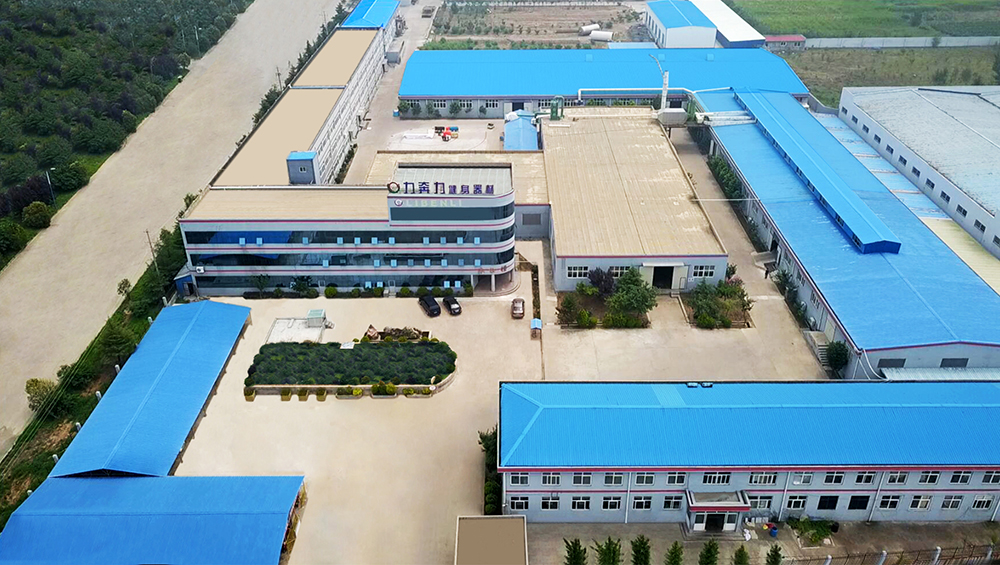
The specification sheet answers what the product is. The supplier file answers whether it can be delivered repeatedly. For this pair, both models come from Haiyang Libenli Body-Building Apparatus Co., Ltd., a manufacturer and exporter of latex tubing and latex bands established in 1997, operating a 50,000 m² plant with more than 300 employees and an R&D team of 20 engineers.
Manufacturing base and capacity signals
The company reports 24 dedicated dipped latex tubing lines producing 120,000 metres per day, alongside 2 dedicated latex band lines at 25,000 metres per day, and a monthly capacity of 1,200,000 units. It holds 2 invention patents and 18 utility model patents. Export markets are listed as North America, the EU, Australia, Southeast Asia, the Middle East, Japan and South Korea. Commercial terms are stated as 20–35 days lead time, a minimum order of 100 pieces for in-stock items and 500 pieces for a customized logo, with a stretch durability test performed before shipment. For defective goods, the stated after-sales position is free unconditional returns upon receipt.
None of these figures proves that a given purchase order will arrive on time. They do establish whether the supplier operates at a scale where a 150,000-unit annual programme is routine rather than exceptional, which is the question a buyer is really asking.

Certification scope, not certification count
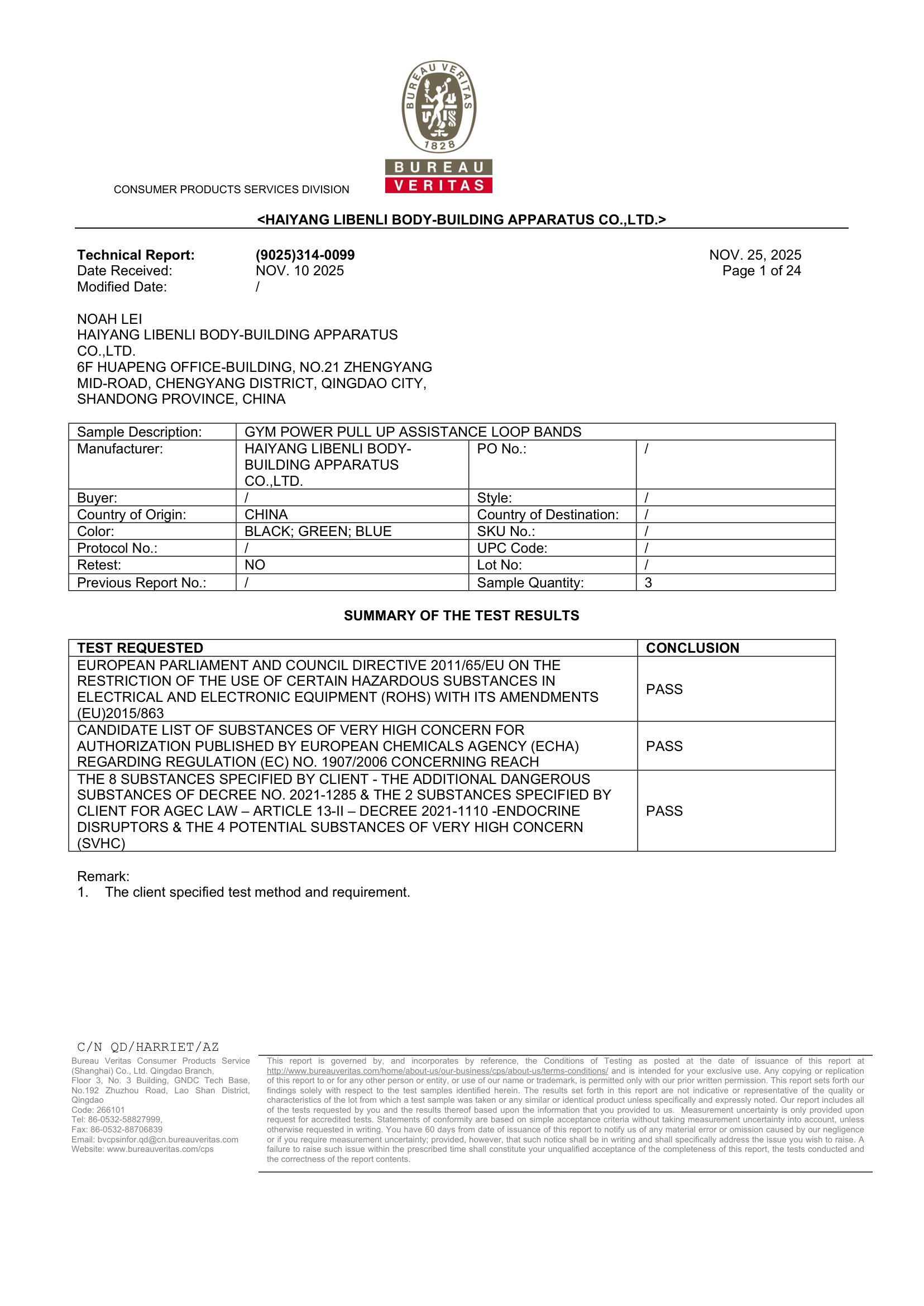
The compliance evidence that matters most is the document that names the product. A RoHS and REACH test report issued by Bureau Veritas — certificate number (9025)314-0099, issued 25 November 2025 for the EU market — covers gym power pull up assistance loop bands and references both the ZLQ-03 and the ZLQ-1. The listed standards are Directive 2011/65/EU (RoHS) and Regulation (EC) No. 1907/2006 (REACH). The manufacturer also holds ISO 9000:2000 quality certification (2005) and ISO 9001:2008 quality management system certification (2010), a 3A credit rating certificate issued by the Ministry of Commerce of China and CCPIT, and states that most items are SGS certified to meet international environmental and safety requirements.
The verification step is scope, not quantity. Confirm that the certificate names the exact model and material you are buying: a report covering latex loop bands does not automatically cover a TPE variant, and a certificate valid for one configuration is not evidence for another.
Resistance calibration and surface treatment
Two quality claims carry most of the weight in this pair. The first is tension control: in the Australian programme described by the supplier, a proprietary latex formula with a five-tier resistance system, from Ultra Light to Ultimate, is calibrated to a tension error margin within ±2%. The second is handling behaviour: the same programme documents an anti-rolling surface treatment developed to address bands curling or pinching during high-load exercises, with the ZLQ-1 and ZLQ-03 both referenced in that case material.
Buyers should treat both as company-reported and convert them into questions. At what elongation is the ±2% tolerance measured, and over what service life? Does the anti-rolling treatment apply to the specific thickness and resistance tier being ordered, or only to the tiers used in the referenced programme? A tolerance without a stated measurement basis cannot be compared with a second supplier's tolerance.
The Australian case as a reference point, with its limits
The case material describes an international premium fitness brand supplied from Australia with more than 150,000 units annually across 12 or more specialised product lines, for global B2C retail, premium commercial gym fit-outs and specialised physical therapy and rehabilitation centres. Reported outcomes are a defect and complaint rate below 0.05%, a 20% reduction in the R&D-to-market cycle, and a service life of 3–5 years under normal use. The material also describes 100% premium Malaysian natural latex with food-grade pigments, positioned as compliant with REACH, RoHS and Australian safety requirements.
That is a single programme, reported by the supplier, in one market. It is strong evidence of what one configuration achieved under one quality regime; it is not a defect guarantee for every SKU, resistance tier or destination market. Buyers should ask which models, tiers and packaging formats the figures cover before applying them to their own acceptance criteria.
Standards and tariff treatment
Standards provide a test-planning reference rather than an automatic approval. ISO 20957-2:2024 specifies safety requirements for stationary strength-training equipment using alternative resistance means, including elastic cords; whether it applies to a standalone loop must be assessed against the product configuration and intended use. ASTM International lists ASTM F2276-23 as a fitness equipment specification, which is a listing and scope reference, not proof of a mandatory requirement for resistance bands.
Tariff treatment is a separate and often overlooked cost line. UK Government tariff notice 18 (2022) states that simple resistance bands and fitness bands — for example, simple loops without handles — may be classified according to their constituent material under headings 4008, 4016 or 6307 rather than a general physical exercise heading, and that classification depends on objective characteristics. Because the ZLQ-1 is offered in latex or TPE while the ZLQ-03 is latex, the material decision made for product reasons can also move the landed cost. Confirm classification for the exact construction before the quotation is locked.
Market signal: what the growth estimate does and does not change
A category expanding at a projected 9.9% CAGR to 2030, on a base of roughly USD 1.7 billion in 2024, explains why retail shelf space is crowded and why buyers face near-identical product photography across suppliers. It does not simplify selection. In a crowded category, differentiation shifts away from the product photograph and toward what can be documented: a stated resistance range, a durability figure that can be tested, a certification scope that names the model, and a surface treatment that solves a handling complaint.
The forward-looking reading is therefore modest. Both loop formats remain structurally useful — mini loops because floor-based and clinical work is not going away, power loops because anchored assistance remains cheaper and more portable than machines. The competitive pressure is likely to sit in consistency: buyers who can compare tension tolerance, fatigue behaviour and defect history across suppliers will pay for verified consistency, and suppliers who cannot document it will compete on price alone. Because published market estimates disagree, that conclusion rests on the specification and evidence discussion above, not on the growth figure itself.
Running the shortlist through a sample round
A shortlist should be tested before it becomes a purchase order. A practical sample round for this pair covers six checks: order both models in two or three resistance tiers spanning the working range; measure tension at a stated elongation across multiple units from the same batch; cycle the mini loop toward the 30,000-stretch specification and record any change in recovery; run high-load sets on the power loop and observe curling or pinching at the anchor and at the loop ends; confirm that certification documents name the exact model and material delivered; and match the stated 20–35 day lead time against the shipping window rather than against the order date.
Buyers who want the full technical and capability file before that round can download the Libenli product catalogue (PDF).
FAQ
Does the ZLQ-1 or the ZLQ-03 suit rehabilitation and physical therapy programmes?
Both models list rehabilitation and physical therapy among their documented applications, and the load range decides the fit rather than the label. The ZLQ-1 covers 5–40 LB in a 600 mm loop intended for floor-based work, so it reaches below the 8 LB floor of the ZLQ-03 and is the format for the lightest stage of a progression. The ZLQ-03 covers 8–230 LB in a 2,080 mm band built for anchored work, so it carries the heavier assisted movements. Latex sensitivity is a separate check: the ZLQ-1 is offered in Latex or TPE, while the ZLQ-03 is listed as latex only.
What are the minimum order quantity and production lead time?
The stated minimum order is 100 pieces for in-stock items and 500 pieces for a customized logo. Production lead time is 20–35 days, against a monthly production capacity of 1,200,000 units.
Can both models be customized with private-label branding and packaging?
Yes. The stated OEM/ODM customization scope covers resistance strength, band thickness and width, length, surface colour, logo silk printing, package design and accessory matching, applied to both models within the order minimums above.
Which certifications apply to the ZLQ-1 and the ZLQ-03?
A RoHS and REACH test report issued by Bureau Veritas, certificate number (9025)314-0099 and issued 25 November 2025 for the EU market, covers gym power pull up assistance loop bands and references both models. The manufacturer also holds ISO 9000:2000 certification from 2005, ISO 9001:2008 certification from 2010 and a 3A credit rating certificate, and states that most items are SGS certified. Buyers should confirm that the certificate scope names the exact model, material and configuration being purchased.
How is resistance consistency controlled before shipment?
The Australian programme material describes a five-tier resistance system calibrated to a tension error margin within ±2%, together with a stretch durability test carried out before shipment. Both are company-reported. Buyers comparing suppliers should request the elongation basis on which the tolerance is measured and the test record for the batch being delivered, since a percentage tolerance without a stated measurement basis is not comparable across suppliers.
Is the 30,000-stretch specification comparable with the power loop?
Not directly. The at-least-30,000 stretch cycles figure is specified for the ZLQ-1; no equivalent fatigue figure is stated for the ZLQ-03 in the supplied specification. Until a comparable test is supplied, cycle-life comparisons between the two models — or between either model and a competing band — should be treated as open rather than settled.
Shortlist summary. The ZLQ-1 mini loop is the floor-based entry, defined by a 5–40 LB range, a 600 mm circumference, a 50 mm width, Latex or TPE construction, an anti-slip surface and a stated 30,000-stretch specification. The ZLQ-03 power loop is the anchored entry, defined by 8–230 LB, a 2,080 mm length, 0.45 mm latex and a 6.4–82.5 mm width range. The shortlist decision is which end of the load range the buyer's programme spends its time in — and whether both ends need stocking.
Have Questions or Need More Details?
Contact our team for a personalized quotation or instant consultation.
Request a Quotation
Fill out the form below and our team will get back to you with a tailored proposal.
WhatsApp Direct Chat
Prefer to chat in real-time? Message us on WhatsApp for instant assistance & quick answers.
- Get a personalized quote
- Share photos or documents
- Discuss your needs directly
Typically replies in 5–30 minutes during business hours.