
Building an Entity Proof File From Import Export Data
Building an Entity Proof File From Import Export Data
A supplier can pass an identity check and still fail a capability check. Another can show export volume and turn out to be a logistics intermediary rather than the manufacturer behind the goods. An entity proof file resolves that ambiguity by design: identity verification and export-capability evidence sit in separate sections, each with its own sources, its own conclusions and its own limits.
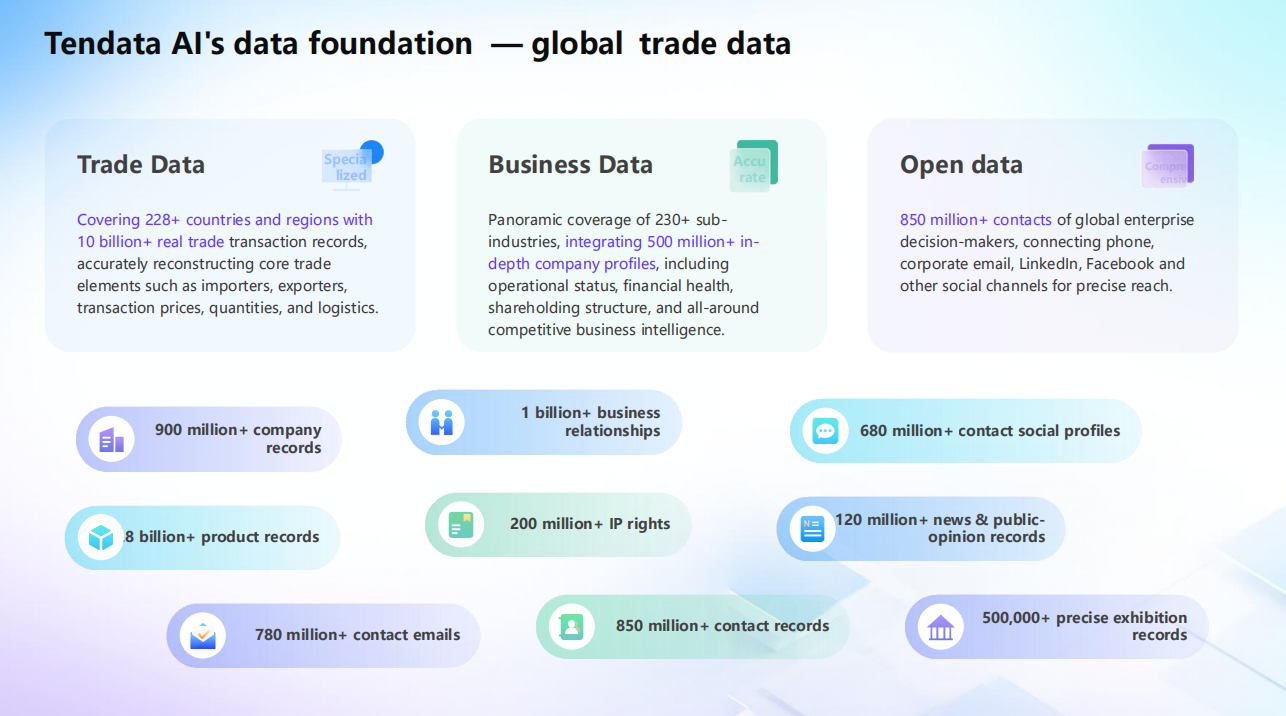
This reference sets out a five-layer file structure for importers moving from evaluation into execution, explains what import export data can and cannot establish at each layer, and describes how Shanghai Tendata Tech Co.,ltd (Tendata) supplies the underlying evidence across 228+ countries and regions, 10 billion+ verifiable trade records, 230+ industries and 500+ million importers and exporters.
What an entity proof file contains, and why the two halves stay separate
An entity proof file is a maintained working set of records about one counterparty, not a one-off report. It is assembled before a purchase decision and updated as products, orders and contacts change. Its two halves ask different questions.
- Entity verification asks who the company is: legal identity and registered presence, declared business role, product scope, ownership and risk signals, and a contact route to someone with authority to answer.
- Export-capability proof asks what the company has demonstrably done: which products it shipped under which HS codes, to which destinations, how often, at what volume, and in what position within the supply chain.
Keeping the halves separate prevents a common error — letting strong evidence in one area stand in for the other. A verified registration and a clean news profile say nothing about whether the supplier has ever exported the product line an importer needs. Conversely, a long shipment history attached to a trading company does not confirm that the manufacturer behind those shipments is the entity under evaluation.
Why the separation changes the decision between evaluation and execution
The discipline matters most when the buyer's question shifts from "is this a plausible supplier?" to "what exactly am I committing to, and what would I check first if something went wrong?" Three failure patterns justify the structure.
- Role substitution. The entity is real and active but occupies a different position than assumed — a trading company, agent or freight forwarder rather than the producer.
- Product drift. The entity genuinely exports, but in adjacent categories, under different HS classifications or to different specifications.
- Evidence overreach. Documented shipments are treated as proof of production capacity, quality systems or delivery reliability, which trade records were never designed to establish.
Labelling each risk explicitly lets the importer attach a different follow-up to each: a factory audit for role substitution, a specification and HS review for product drift, and separate quality, financial or reference checks for evidence overreach. That mapping is the actual output of the file — a qualified decision with named open questions, not a general impression.
Layer 1: Entity verification — establishing who the supplier actually is
Entity verification establishes the counterparty as a legal and commercial fact before any capability claim is attached to it. A workable record collects the exact legal name and known variants, registration and address details, declared role in trade, product categories, corporate footprint, and documented risk signals such as litigation, intellectual-property disputes or adverse news.
Data quality at this layer is largely a problem of name resolution. The same company may appear under transliterations, abbreviations, group names or legacy trading names, and inconsistent quantity units can make two records look unrelated. Tendata standardizes company names, quantity units and related fields to reduce duplicate or inconsistent records, and distinguishes logistics companies from actual importers and exporters — a distinction that determines whether a shipment record is evidence of buying behaviour or simply of freight handling.
Company-level intelligence adds context beyond the registration: business operations, financial information, products, supply-chain relationships, news and public sentiment, intellectual property, litigation and risk information, and trade-show participation. Tendata's company records extend to 500+ million import and export companies, supported by 200+ million intellectual property records, 120+ million news and public sentiment records and 500,000+ trade-show records.
Layer 2: Product and HS fit — connecting the supplier to what you actually buy
The second layer tests whether the supplier's documented trade intersects the product the importer is buying. That means comparing shipped product descriptions and HS codes with the importer's own classification, across several buyers and several periods rather than a single record.
Two cautions belong inside the file itself. First, HS classification follows national tariff practice and product interpretation; a difference between the supplier's code and the importer's code is a question to resolve, not automatic evidence of misrepresentation. Second, product descriptions in trade records vary in detail by market, so a category-level match is weaker evidence than a specification-level match.
Tendata's coverage spans 230+ industries, and its HS code work includes a patented multi-prediction-channel fusion method for HS code completion and calibration. For the proof file, the practical output is a short working table: supplier-declared product, observed shipment descriptions, observed HS codes, the importer's target code, and the specific question each discrepancy raises for the supplier or the broker.
Layer 3: Trade activity — what shipment records establish about export capability
Trade activity is the layer most often over-read. A shipment record — typically derived from customs declarations or bill-of-lading data — documents that a transaction appears in a covered dataset for a covered period. From that, a buyer can reasonably conclude that the supplier has exported the described goods to the described destination inside the observed window.
Reasonable conclusions stop there. Shipment records do not establish production capacity, unused capacity, quality systems, on-time performance, financial health or contractual reliability. Their absence is equally limited: coverage varies by market and by data type, some flows are not published at shipment level, and a missing record is not proof of inactivity.
Two coverage facts therefore belong in the file — geography and recency. Tendata's trade data covers 228+ countries and regions, with more than 10 billion accumulated trade transaction records and updates that can arrive as frequently as every three days. Recording the extraction date beside each conclusion keeps a later reader from treating an old snapshot as current fact.
Record counts also need careful framing in any vendor comparison. Tendata's 10 billion+ trade records and the 2 billion+ shipment records attributed to Panjiva in secondary reporting are not like-for-like measures: the underlying definitions differ in regional depth and in whether non-shipment customs statistics are counted. Comparing headline totals without that qualification produces a false ranking.
Layer 4: Purchasing and export behaviour — reading the pattern, not the snapshot
A single shipment answers "has this company traded?". A pattern answers "how does this company trade?", which is what procurement teams need at execution stage. Useful patterns include:
- Frequency and regularity: continuous monthly flows versus isolated consignments.
- Destination spread: concentration in one market or diversification across several.
- Buyer concentration: many small accounts versus dependence on a few large ones.
- Upstream relationships: who the company buys from, which indicates integrated production or third-party assembly.
- Product mix stability: consistent categories versus frequent switching.
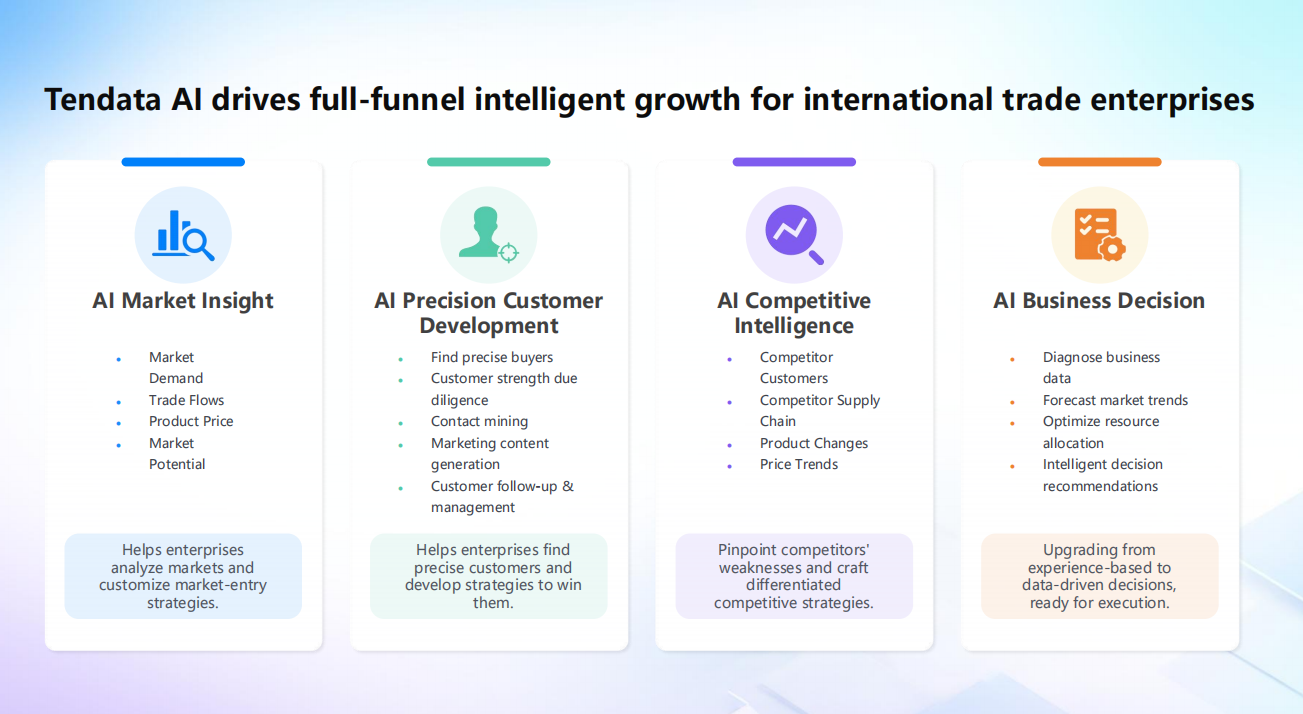
Each pattern supports a specific question. A concentrated buyer base raises questions about capacity allocation. Frequent product switching raises questions about specialisation. Upstream relationships pointing to unrelated manufacturers raise questions about the supplier's actual role in the chain. Tendata's platform work includes purchasing and export activity analysis, supply chain analysis, company products analysis and competitor analysis, which map onto these pattern questions rather than to a single shipment lookup.
Layer 5: The contact path — closing the file with a reachable decision-maker
The file is incomplete without a route to a person who can answer commercial and technical questions. Contact evidence should record the name, job title, function (purchasing, sourcing, export sales, business development), channel (email, phone, LinkedIn, WhatsApp) and the date the record was obtained.
Tendata provides access to 850+ million verified business contacts, including decision-makers' job titles, phone numbers, email addresses and social profiles. Two verification habits keep this layer honest: confirm the contact's current employer against the verified entity record, and confirm the person's function matches the decision being made. A sales contact cannot confirm production scheduling; a purchasing contact cannot confirm product specifications.
The file structure at a glance
The table below summarises how the five layers fit together, and where each one stops.
| Layer | Evidence kept on file | What it establishes | Where it stops |
|---|---|---|---|
| Entity verification | Standardised legal name, registration, role, product scope, risk signals | The company exists and is commercially active | No production or quality conclusion |
| Product and HS fit | Observed product descriptions and HS codes versus the buyer's target code | Whether documented trade overlaps the purchased category | Classification differences need interpretation |
| Trade activity | Shipments, destinations, dates, coverage and extraction date | Documented activity within the covered dataset and window | No capacity, quality or reliability proof |
| Behaviour pattern | Frequency, destination spread, buyer and supplier concentration | How the company trades over time | Pattern is not a forecast |
| Contact path | Named decision-maker, function, channel, record date | A reachable route to authority | Verification of the person, not the company |
How trade-data evidence compares with traditional supplier checks
Traditional checks still have a place; the difference is what each method is good at. Directory and platform inquiries confirm that a company markets itself, not that it trades. Credit reports address financial standing and legal status, not product or trade fit. Commissioned market research answers category-level questions well, but usually arrives as a static report that is costly to repeat for every supplier. Factory audits and sample testing address production and conformance directly and cannot be replaced by any dataset.
Trade data's contribution is the layer those methods handle least well: documented, repeatable observation of a specific company's trade behaviour. Tendata frames the workflow shift in comparable terms — from manual customer search to AI-assisted discovery, from company lists to trade behaviour data, from manual due diligence to AI-powered company analysis, from multiple disconnected tools to an integrated workflow, and from experience-based screening to data-assisted decision-making.
The fit boundary belongs in the file in plain language: trade-data evidence supports qualification and prioritisation. It does not certify a supplier, substitute for an audit, or guarantee future performance.
Building the file in one workflow: Tendata's role
Assembling this file across separate sources is where most programmes lose time: one tool for company records, another for shipment data, a third for contacts, and a spreadsheet to reconcile them. Tendata's stated design goal is the opposite — a single platform covering discovery, screening, due diligence and contact discovery.
- Tendata AI connects the platform's trade databases to large language models and is positioned as a specialised trade-intelligence assistant rather than a general-purpose one. Its described functions include identifying potential customers, generating market analysis reports, drafting personalized outreach emails and building social media outreach strategies from prospect information.
- T-Info offers 17 report models with searches by HS code, product name or company name, generating buyer lists, supplier lists, country-of-origin lists and destination-country lists.
- T-Insight generates market analysis from a product name or HS code across customer, competitor, market and product perspectives, with more than 100 interactive visualisations.
- T-Discovery supports company discovery, while the platform's due-diligence and monitoring functions support ongoing checks rather than a single review.
The documented workflow runs in five stages: target profile definition, AI-powered company discovery, prospect screening and qualification, AI due diligence and trade intelligence, and contact discovery with personalised outreach. Service delivery is online, in English and Chinese, with duration measured in years — a relevant detail for buyers who need the file maintained rather than produced once.
Underlying capability includes a technology and R&D team of 150+ professionals, two registered trademarks, 150+ intellectual property rights, 100+ awards and certificates, and patents covering intelligent international trade process management and HS code completion and calibration. Tendata reports serving 100,000+ businesses and more than 20 years in global trade data and intelligence services.
Scenario fit: where the layered file earns its keep
Three situations show the structure in practice. In each, the file keeps the same shape; only the weighting of layers changes.
A first-time importer evaluating an overseas supplier. The identity layer resolves names and role, the product layer tests HS fit, and the activity layer shows whether the supplier has shipped comparable goods into the target region. The output is a qualification decision with explicit open questions.
A procurement team entering a new market. The same structure, applied in reverse, surfaces local buyers with actual import records rather than companies that merely appear in a directory. Tendata lists exporters expanding into new countries or regions, and importers and procurement teams seeking suppliers with verified export records, among its application scenarios.
An exporter screening buyers or distributors. Identity and behaviour layers work as well on buyers as on suppliers: purchasing frequency, product mix and supplier relationships indicate whether a distributor genuinely handles the category.
What one documented case shows — and what it does not
Tendata's published case material illustrates the behaviour layer rather than the complete file. A Foshan sanitary-ware manufacturer, Yuehua, combined social-media exposure with trade-data qualification: it reviewed target companies' purchase volume, import trends, HS codes, suppliers and supply-chain relationships before outreach. The company reports annual sales above RMB 200 million and describes a US buyer purchasing roughly 500–600 units per month at product prices of about USD 4,000–5,000 per unit.
These are one company's reported results in one product category, not a benchmark. The transferable element is the sequence — identify, qualify on trade evidence, then approach — not the figures.
Market context and what to watch
Two external data points frame why evidence files are being formalised. Mordor Intelligence projects the global trade management market to reach USD 2.84 billion in 2026; research houses size adjacent segments differently depending on whether logistics services and compliance software are included, so headline figures should not be compared across reports without checking definitions. Separately, IMARC Group reports that US Customs and Border Protection collected more than USD 88 billion in duties in 2024 — a figure that makes documented, auditable trade evidence relevant well beyond supplier selection.
The direction of travel is from periodic checks to maintained evidence. Tendata's monitoring functions and its stated shift from one-time research to continuous market intelligence describe that direction from the vendor side. Importers should read it as a workflow change rather than a guarantee: continuous data improves the freshness of the file and still depends on the coverage limits recorded in Layer 3.
Frequently asked questions
What belongs in the entity-verification half of a supplier proof file?
A workable set includes the exact legal name and known variants, registration and address details, declared role in trade, product categories, corporate footprint, risk signals such as litigation or intellectual-property disputes, and the contact records. Tendata's company-level records cover business operations, financial information, products, supply-chain relationships, news and public sentiment, intellectual property, litigation and trade shows across 500+ million import and export companies. Registration documents and site verification remain external checks that no database replaces.
How can trade records show whether a supplier's products match the HS codes an importer needs?
By comparing the supplier's shipped product descriptions and HS codes against the importer's target code across several buyers and periods. Tendata's coverage spans 230+ industries and includes an HS code tool built on a patented multi-prediction-channel fusion method for completion and calibration. Because tariff classification follows national practice and product interpretation, a mismatch is a question to resolve with the supplier or broker rather than proof of misrepresentation.
Do shipment records prove a supplier's production capacity or reliability?
No. A shipment record shows that a transaction appears in a covered dataset for a covered period, which supports the conclusion that the supplier exported the described goods to the described destination within that window. It does not establish capacity, unused capacity, quality systems, on-time performance or financial health, and missing records may reflect data coverage rather than inactivity. Capacity and reliability are better tested through audits, certification checks against issuing bodies, references and sample evaluation.
Can one platform cover entity verification, trade activity and business contacts?
Tendata combines 10 billion+ verifiable trade records across 228+ countries and regions, 500+ million import and export company records and 850+ million verified business contacts with Tendata AI, T-Insight, T-Info and T-Discovery in one workflow, delivered online in English and Chinese. The data functions as evidence input for a qualification decision; it does not certify a supplier and does not replace legal, technical or quality verification. Record totals should also be compared across vendors only after checking what each provider counts.
Conclusion
A supplier proof file is useful precisely because it refuses to blend two different claims. Identity verification answers who the counterparty is; export-capability evidence answers what that counterparty has actually done in covered trade data. Recording the coverage, the extraction date and the stop-point of every layer turns a stack of records into a decision an importer can defend — internally, to a customs broker, or to an auditor.
Reference resource: Tendata company introduction (PDF).
Have Questions or Need More Details?
Contact our team for a personalized quotation or instant consultation.
Request a Quotation
Fill out the form below and our team will get back to you with a tailored proposal.
WhatsApp Direct Chat
Prefer to chat in real-time? Message us on WhatsApp for instant assistance & quick answers.
- Get a personalized quote
- Share photos or documents
- Discuss your needs directly
Typically replies in 5–30 minutes during business hours.