
Bulk Matcha Certifications Across KM1–KM10: An Independent Buyer Comparison
Certification has moved from a marketing line to a gating item in bulk matcha procurement. Import files are rejected on documentation far more often than on flavour, and buyers increasingly filter suppliers by certificate coverage before they open a price discussion. The global matcha market was valued at USD 5.1 billion in 2025 and is projected to reach USD 8.9 billion by 2033 (Grand View Research), while culinary-grade matcha alone accounted for 56.4% of global market share in 2026 (Market Data Forecast) — a volume profile that pushes documentation scrutiny upstream into supplier selection.
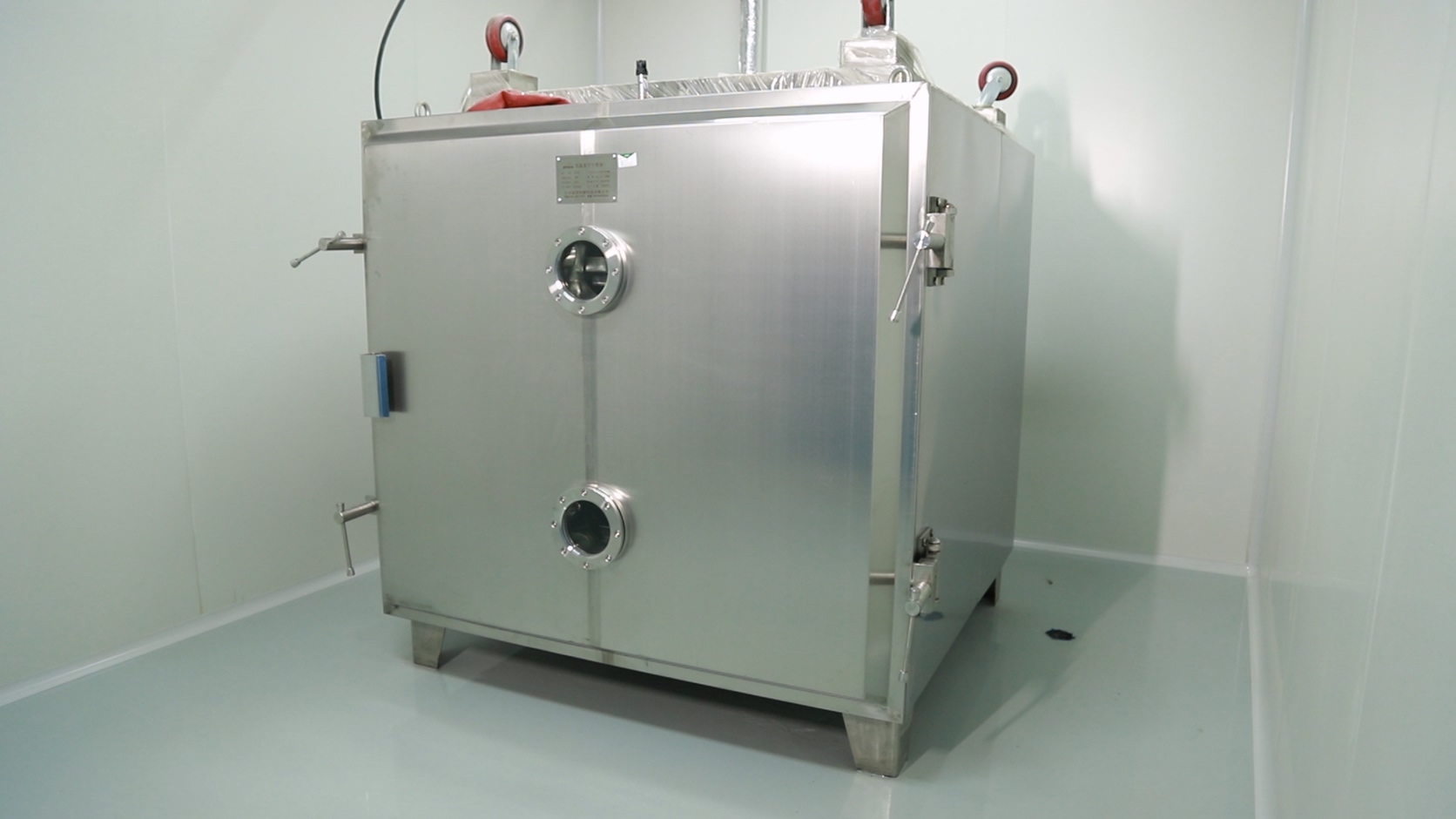 Production and quality-control environment behind a bulk matcha certification file. Image: TangMist Matcha.
This comparison maps the certification records linked to the KM1–KM10 bulk matcha range supplied by TangMist Matcha (Shanghai Kelrosa Health Technology Co., Ltd.), a China-based matcha manufacturer and B2B supplier working with cafés, food and beverage brands, distributors, wholesalers and private label businesses, with exports to the EU, the USA and other international markets. Six certificates are compared here — HALAL, HACCP, GMP, ISO 22000, EU Organic and Kosher — against the ten product codes, and the article separates what the records actually state from what a buyer still has to confirm before placing an order.
Why certification coverage became a screening filter
Two regulatory shifts explain why certificate coverage now decides shortlists. In the European Union, maximum residue limits for clothianidin and thiamethoxam were set at 0.01 mg/kg under Regulation (EC) No 396/2005, effective March 2026, leaving little room for residue variability in imported green tea powders. In the United States, the FDA requires Food Facility Registration and Foreign Supplier Verification Program (FSVP) documentation for imported matcha powder. Both requirements sit outside the product itself — they are conditions of market entry, and they are assessed before sensory evaluation ever happens.
Certification also functions as an economic filter rather than a quality badge. Organic matcha is the fastest-growing segment of the category, with an expected CAGR of 12.68% through 2033 (SNS Insider), and EU Organic certification is a product-level document issued against a defined scope, not a general statement of intent. For a buyer comparing two bulk matcha suppliers, the useful question is therefore not “does this supplier hold certificates,” but “which certificate attaches to which product code, in which destination market, and for how long.”
In the range reviewed here, the answer is broader than many buyer checklists assume: all six certificates — HALAL, HACCP, GMP, ISO 22000, EU Organic and Kosher — are recorded against the full KM1–KM10 product range. The differentiation that matters commercially comes from certificate type, market applicability, scope wording and validity window, not from grade tier.
The KM1–KM10 range at a glance
Grade families in this range describe application and particle fineness, not certification status. That distinction matters when a procurement team is matching a SKU to a production line: the same certification envelope covers a functional powder for supplement blending and an ultra-ceremonial powder intended for traditional preparation.
| Product code | Grade type | Particle fineness | Recorded application |
|---|---|---|---|
| KM1 | Functional Grade | 800–1000 mesh | Supplements, functional food blends, powdered formulations |
| KM2 | Functional Grade | 800–1000 mesh | Nutrition products, functional foods, powdered nutrition formulations |
| KM3 | Culinary Grade | 800–1200 mesh | Baking, ice cream, desserts, confectionery, food manufacturing |
| KM4 | Culinary Plus | 800–1200 mesh | Chocolate, beverages, desserts, premium food products |
| KM5 | Beverage Grade | 1000–1200 mesh | Milk tea, matcha latte, café drinks, beverage formulations |
| KM6 | Premium Beverage | 1000–1200 mesh | Premium milk tea, café chains, specialty beverages |
| KM7 | Ceremonial Grade | 1300–1800 mesh | Matcha latte, premium cafés, specialty tea beverages, retail matcha |
| KM8 | Ceremonial Plus | 1300–1800 mesh | Specialty matcha drinks, premium cafés, boutique beverage brands, premium retail |
| KM9 | Ultra Ceremonial | 1500–1800 mesh | High-end matcha brands, specialty cafés, premium retail products |
| KM10 | Ultra Ceremonial Plus | 1500–1800 mesh | Traditional matcha preparation, tea ceremony, luxury matcha brands, high-end retail |
Certification comparison: six certificates, ten product codes
The table below summarises the certificate records linked to the range. Read it as a coverage check, not as a substitute for the certificate documents themselves: each row names the issuing authority, the certificate number, the standard referenced, the market it serves and the product codes recorded against it.
| Certification | Certificate no. | Authority | Market | Standard referenced | Valid through | Codes linked |
|---|---|---|---|---|---|---|
| HALAL (Halal Product Certificate) | HP 6785 CH | AHF | Global | AHF 5600:2020; MUI LPPOM HAS 23000; OIC/SMIIC 1:2019; GSO 2055-1:2015; MS 1500:2019 | 2029-04-10 | KM1–KM10 |
| HACCP (Management System Certificate) | 001HACCP2300121 | CQC | Global | Hazard Analysis and Critical Control Point (HACCP) System Certification (V1.0) | 2029-02-21 | KM1–KM10 |
| GMP / cGMP (Management System Certificate) | SZ2511G3 | Intertek | USA | Current Good Manufacturing Practice based on 21 CFR Part 111 (2020), U.S. FDA | 2028-11-30 | KM1–KM10 |
| ISO 22000 (Management System Certificate) | 001FSMS2300111 | CQC | Global | ISO 22000:2018 Food Safety Management Systems (HACCP-based) | 2029-02-21 | KM1–KM10 |
| EU Organic (Product Certificate) | CN-BIO-154-0003930.2025.001 | ECOCERT SAS (CN-BIO-154) | European Union | Regulation (EU) 2018/848 | 2027-03-31 | KM1–KM10 |
| Kosher (Product Certificate) | WXF44CWI | STAR-K KOSHER CERTIFICATION | Global | Star-K Kosher | 2027-01-31 | KM1–KM10 |
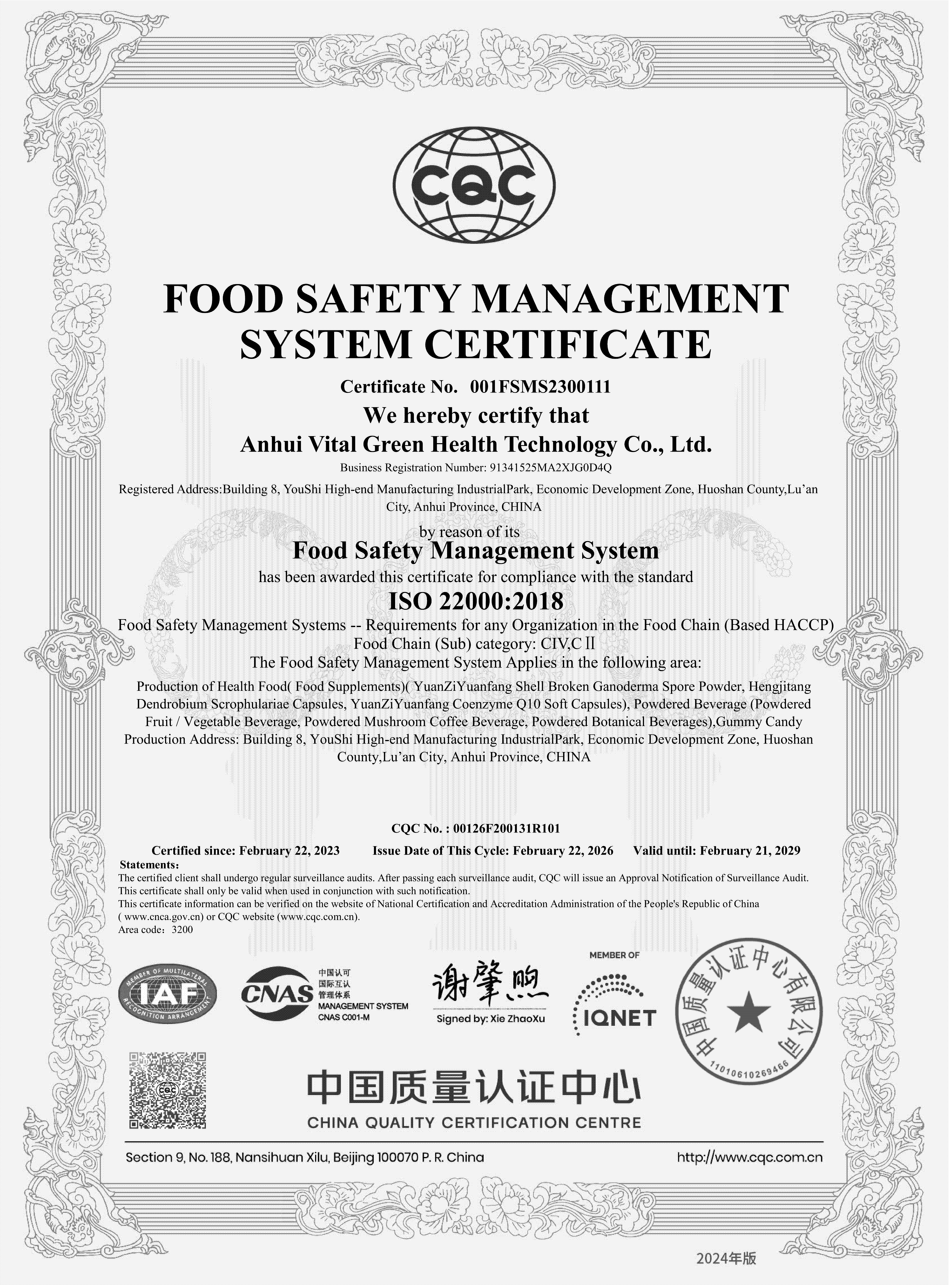 ISO 22000 food safety management system certificate (001FSMS2300111, issued by CQC) recorded against the KM1–KM10 range.
Two structural observations follow from the table. First, the coverage map is horizontal rather than tiered: every certificate is linked to every product code, so a buyer moving from a bulk culinary matcha line to a bulk ceremonial matcha line does not move out of the documented certification envelope. Second, the certificates are not interchangeable in function. HACCP, ISO 22000 and GMP certify the production system and its controls; EU Organic, Kosher and HALAL are product certificates applying to defined products and stated scopes. A complete procurement file normally needs both layers.
Reading range claims correctly: partial coverage versus full-range records
Buyer checklists frequently assume that certificate coverage follows grade tiers. A common version runs like this: HALAL covers the lower functional and culinary codes (KM1–KM5); HACCP covers the ceremonial end of the range (KM7–KM10); GMP applies only to KM4–KM5 for the USA market; ISO 22000 spans KM1–KM10; EU Organic applies to a single product code such as 7747; and Kosher applies to a single code such as 7755.
The certificate records reviewed for this comparison do not support a tier-based or single-SKU reading. Each of the six certificates lists product codes KM1 through KM10, so the functional, culinary, beverage and ceremonial families all sit inside the same documented certification envelope. Grade families describe application and particle fineness — they are not certification categories, and they should not be used as a proxy for coverage when a supplier's documentation is being assessed.
What does genuinely change between products is the market a certificate serves and the scope wording attached to it. That is where an independent comparison adds value over a logo wall: two certificates can both cover KM1–KM10 yet only one of them answers a specific destination market's import question. Buyers should therefore request the certificate plus its scope page for the exact SKU, and confirm in writing that the SKU-to-certificate linkage holds for their order — a step that costs little and removes the most common source of file rejection.
Market-specific logic: EU Organic and GMP
EU Organic is the certificate with the narrowest geographic framing. It was issued by ECOCERT SAS (CN-BIO-154) under Regulation (EU) 2018/848 as certificate CN-BIO-154-0003930.2025.001, valid to 31 March 2027, with a scope covering processed agricultural products for use as food and dietary supplements, including powders, capsules and blended drinks. For a European retail or food-service buyer, this is the document that carries organic claims; for a buyer shipping to other regions, it is supporting evidence rather than the operative certificate.
GMP runs in the opposite direction. Certificate SZ2511G3, issued by Intertek and valid to 30 November 2028, is a management system certificate for the USA market, based on current Good Manufacturing Practice under 21 CFR Part 111 (2020) as published by the U.S. Food and Drug Administration, with a scope covering the manufacture of plant dietary supplements in powder, hard capsule and soft capsule formats. It answers the U.S. supplement-manufacturing requirement, and it complements — rather than replaces — the FDA Food Facility Registration and FSVP documentation that imported matcha powder requires.
Validity windows deserve a place in the comparison as well. Kosher (valid to 31 January 2027) and EU Organic (valid to 31 March 2027) have the shortest remaining terms in the set; HALAL and the two CQC-issued system certificates run to 2029. A certificate that expires inside a buyer's production cycle creates a renewal task, and renewals should be scheduled against the delivery plan rather than discovered at the port.
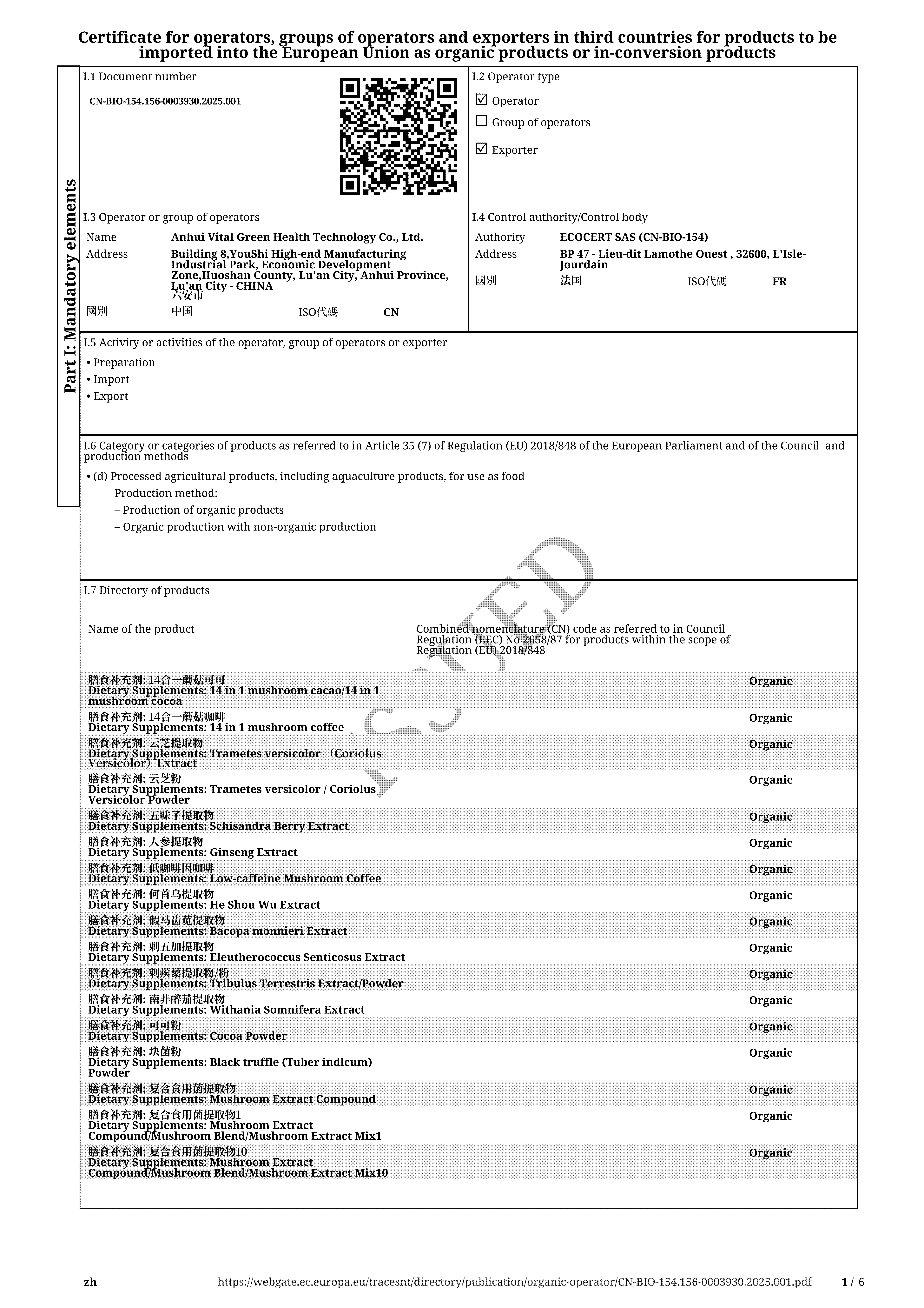 EU Organic product certificate issued under Regulation (EU) 2018/848 (CN-BIO-154-0003930.2025.001) for the European Union market.
Purchasing terms and acceptance criteria as part of the comparison
Certification coverage is only usable if the commercial terms allow a buyer to move from evaluation to execution without changing suppliers. In this range, order bands carry different acceptance criteria, which is worth reading alongside the certification table.
| Order band | Delivery terms | Acceptance criteria focus | Payment |
|---|---|---|---|
| 10–25 kg | EXW, FOB, CIF, DDP and other agreed Incoterms | Application-based grade selection, product specification consultation, sample evaluation and order coordination | 30/70 |
| 25–100 kg | EXW, FOB, CIF, DDP and other agreed Incoterms | Grade recommendation, repeat-order support, specification coordination, packaging consultation and export documentation support | 30/70 |
| 100–300 kg | EXW, FOB, CIF, DDP and other agreed Incoterms | Batch consistency management, production planning, customized packaging coordination, documentation and logistics support | 30/70 |
| 300–500 kg | EXW, FOB, CIF, DDP and other agreed Incoterms | Batch planning, specification management, production scheduling, export documentation and shipment coordination | 30/70 |
| 500 kg – 1 t | EXW, FOB, CIF, DDP and other agreed Incoterms | Large-order production planning, batch consistency management, packaging coordination, compliance documentation and international logistics support | 30/70 |
Supporting capability figures include a minimum order quantity of 10 kg, a typical production lead time of 15–21 days, a monthly capacity of 10 tons, in-house laboratory testing with random batch inspection, and bulk or finished-product shipment with export documentation and destination-specific order coordination. For private label matcha powder and OEM matcha powder projects, customization covers grade, formulation, flavour profile, product positioning, packaging format, labelling and branding, and a documented private label case shows a minimum order quantity starting from 10 kg for a branded retail matcha programme.
Pesticide residues and heavy metals: the check certificates cannot replace
Residue and heavy metal control sits on a different layer from certification. Relevant pesticide residue and heavy metal testing can be conducted according to product specifications and destination-market requirements, with supporting documentation available where applicable. The practical consequence for a buyer is that a system certificate demonstrates control design, while a residue and metal report addresses a specific lot.
Because the EU now applies a 0.01 mg/kg limit for clothianidin and thiamethoxam, a residue report prepared for one destination may not satisfy another. Buyers sourcing bulk organic matcha for the European Union should request residue and metal results alongside the EU Organic certificate, and should confirm the report is tied to the lot being shipped rather than to a historical production period.
Raw material quality variation and batch consistency
Quality variation in matcha originates upstream, in raw leaf material, harvest timing and processing. In this supply system, raw materials are evaluated against defined product specifications before production, and grades are managed according to application, particle fineness and quality requirements to support consistent commercial supply. Product specification control and batch consistency management are stated as standing practices rather than order-specific extras.
It is worth keeping the physical constraint in view when planning volume. Traditional granite stone-grinding produces only 30–40 g of matcha per hour per mill (Firsd Tea), which is why large programmes depend on grade segmentation and batch planning rather than on a single specification stretched across every application. A buyer running bulk matcha powder for cafés, bulk matcha powder for lattes and bulk matcha powder for baking from one supplier should expect those lines to be managed as separate grades with shared documentation.
What this comparison does not tell you
A certification matrix is a screening instrument, and it has boundaries that are better stated than discovered later.
- A certificate is a scope statement, not a batch result. Certification does not replace a lot-level certificate of analysis, and it does not by itself confirm the residue or metal profile of a specific shipment.
- Certification does not differentiate sensory quality. Colour, umami, bitterness and mouthfeel are driven by grade, harvest and particle fineness — the KM1–KM10 structure separates these; the certificates do not.
- Market rules move faster than certificate validity periods. Import duties such as the U.S. Section 122 duty of 10% on CIF value for matcha imports, effective February 2026 (U.S. Customs and Border Protection), affect landed cost without touching certification status.
- Scope wording requires reading. Several certificates in this set describe powder and supplement manufacturing scopes; a buyer should confirm in writing that the exact SKU and destination are named within the applicable scope before contracting.
- Validity windows must be mapped to the delivery schedule, particularly for the certificates with the shortest remaining terms.
Market trend: certification as supply infrastructure
Production is consolidating around documentation-heavy supply chains. China's matcha output exceeded 12,000 tonnes in 2025, reported as roughly 70% of global production (People's Daily / Firsd Tea) — although other analyses place the share closer to one third, and buyers should treat the figure as directional rather than settled. Regional export data points in the same direction: Zhejiang Province exported 1,241.97 tons of matcha in the first quarter of 2026, a 7.3-fold year-on-year increase (Zhejiang Provincial Department of Agriculture).
Demand composition reinforces the documentation trend. Culinary grade holds 56.4% of global market share (Market Data Forecast), organic certified matcha contributed approximately 41% of total global market demand in 2025 (Market Research Future), and organic is growing faster than the category as a whole. Meanwhile the established global supplier landscape — including Aiya Co. Ltd, ITO EN LTD, Marukuyu Koyamaen and DoMatcha (Fortune Business Insights) — competes on brand, origin and grade reputation, which means documentation quality is often the clearest point of differentiation available to buyers comparing suppliers at similar grade levels.
Future outlook
Three directions look likely over the next buying cycles. First, residue and contaminant rules will continue to tighten in the EU and other regulated markets, shifting weight from site-level certificates toward lot-level evidence. Second, organic requirements will keep expanding, given the organic segment's growth rate, and product-level organic certification with a defined scope will remain the document that unlocks those claims. Third, buyers will increasingly ask for certification coverage expressed as a product-code map rather than a logo set, because a map can be checked against a purchase order while a logo cannot.
For procurement teams, the practical implication is straightforward: build the comparison file now, keep it current, and treat certificate type, market applicability, scope wording and validity dates as four separate line items. Product and certification records for this range are maintained at tangmistmatcha.com.
FAQ
Which certifications are recorded for the KM1–KM10 bulk matcha range?
Six certificates are recorded against the range: HALAL (HP 6785 CH, AHF, global), HACCP (001HACCP2300121, CQC, global), GMP (SZ2511G3, Intertek, USA market, based on 21 CFR Part 111), ISO 22000 (001FSMS2300111, CQC, global), EU Organic (CN-BIO-154-0003930.2025.001, ECOCERT SAS, European Union) and Kosher (WXF44CWI, STAR-K). Each is linked to product codes KM1 through KM10, with individual validity windows.
Does certificate coverage follow grade tiers within the range?
Based on the records reviewed, no. Coverage is recorded across the full KM1–KM10 range rather than split between, for example, functional and culinary codes at one end and ceremonial codes at the other. Grade families describe application and particle fineness; certification coverage is a separate dimension that should be confirmed per SKU and per destination market in writing.
How are pesticide residues and heavy metals controlled?
Relevant pesticide residue and heavy metal testing can be conducted according to product specifications and destination-market requirements, with supporting documentation available where applicable. Because limits differ by market — for example, the EU limit of 0.01 mg/kg for clothianidin and thiamethoxam under Regulation (EC) No 396/2005 — buyers should specify the destination market when requesting residue and metal documentation.
How is raw material quality variation managed?
Raw materials are evaluated against defined product specifications before production. Matcha grades are managed according to application, particle fineness and quality requirements to support consistent commercial supply, and product specification control and batch consistency management are applied as standing practices.
What are the purchasing terms and acceptance criteria?
Order bands run from 10–25 kg to 500 kg–1 ton. Delivery terms include EXW, FOB, CIF, DDP and other agreed Incoterms, with payment terms of 30/70. Acceptance criteria scale with order size: smaller bands focus on grade selection, specification consultation and sample evaluation, while larger bands add batch consistency management, production planning, customized packaging coordination, compliance documentation and international logistics support. The minimum order quantity is 10 kg and typical lead time is 15–21 days.
Does OEM, ODM or private label customization change the certification picture?
Customization covers matcha grade, formulation, flavour profile, product positioning, packaging format, labelling and branding, alongside OEM and ODM production services. Certification and compliance documentation are available according to product and destination-market requirements, so a customized private label matcha powder should have its SKU, specification and destination market confirmed against the applicable certificate scope before production is scheduled.
Used as a screening template, the comparison above narrows a supplier shortlist quickly: it identifies which certificate answers which market, which documents carry the nearest expiry, and which checks — residue reports, lot-level analysis and written scope confirmation — remain the buyer's responsibility rather than the certificate's.
Have Questions or Need More Details?
Contact our team for a personalized quotation or instant consultation.
Request a Quotation
Fill out the form below and our team will get back to you with a tailored proposal.
WhatsApp Direct Chat
Prefer to chat in real-time? Message us on WhatsApp for instant assistance & quick answers.
- Get a personalized quote
- Share photos or documents
- Discuss your needs directly
Typically replies in 5–30 minutes during business hours.