
Butter Cookie Export Compliance: Documents That Decide Deals
Butter Cookie Export Compliance: Documents That Decide Deals
Butter cookie sourcing rarely fails on flavour. It fails on paper.
An importer evaluating butter cookie suppliers is not simply buying a recipe. It is buying the ability to place that recipe on a shelf in a defined market without regulatory exposure. The documents behind a product — food safety system certificates, per-SKU specifications, ingredient declarations, food-contact packaging statements and destination-market paperwork — determine whether a shipment can move at all, and how quickly a buyer can defend the sourcing decision internally.
This reference maps the documents that typically decide butter cookie export deals. It uses the published product and certification records of Dongguan Shangfan Food Co., Ltd. as a worked example, and it separates, throughout, what is documented from what is not. Where no record exists for a claim, this article says so rather than filling the gap with an assumption.
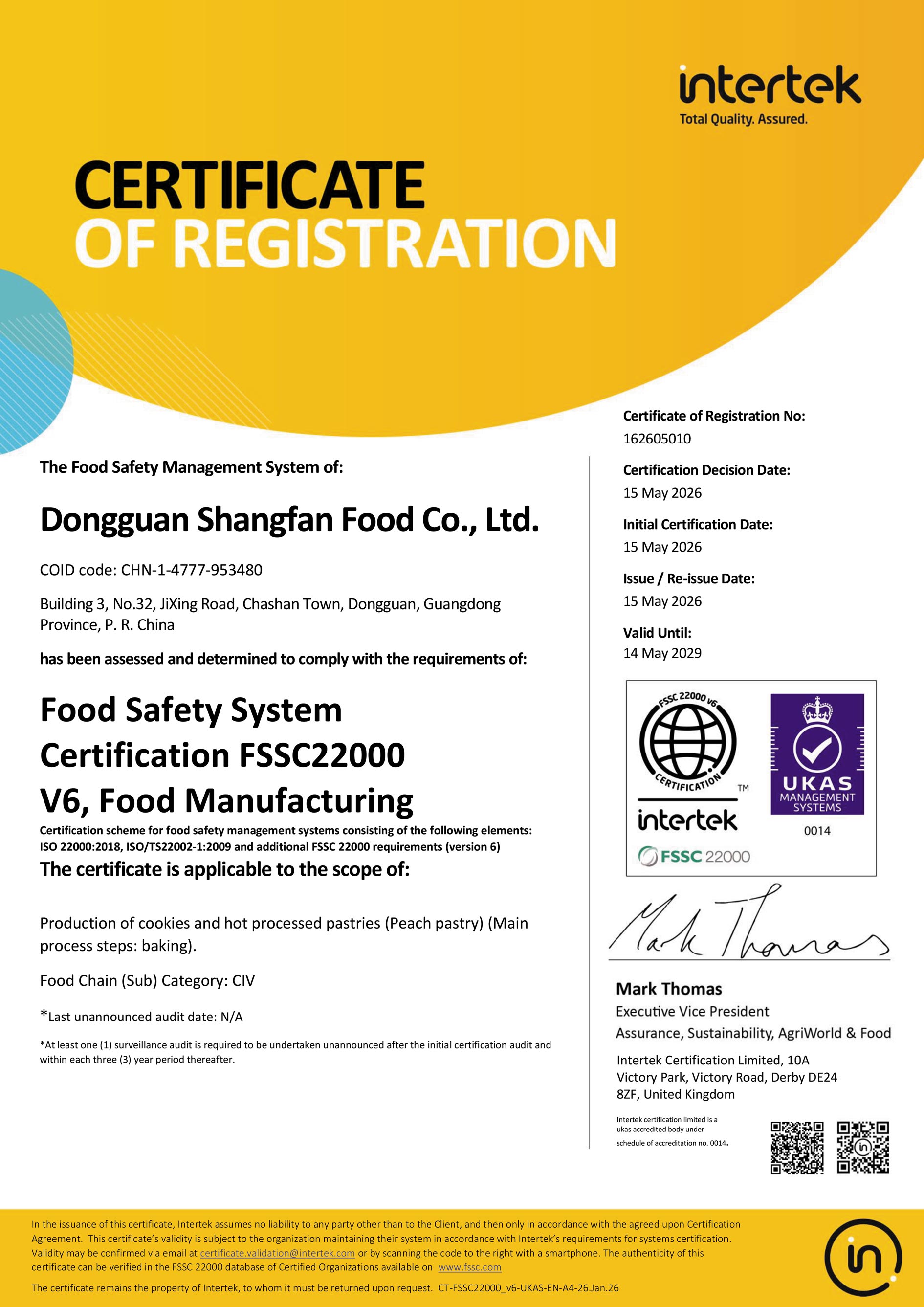
Cover image: FSSC 22000 Version 6 food safety system certification, certificate number 162605010, one of two food safety schemes documented for Shangfan Food.
Why Export Compliance Is a Documentation Problem First
Five document families decide most butter cookie import files, and each answers a different question. A food safety system certificate answers whether the facility operates a recognised management system. A product specification sheet answers what a single SKU physically is: net weight, piece count, shelf life, barcode, carton dimensions. An ingredient declaration answers what is inside the product and where declared inputs come from. A food-contact packaging statement answers whether the packaging chemistry is permitted in the destination market. A destination-market file answers whether the importer's own obligations have been met. A buyer who asks only whether a supplier has certificates receives one binary answer that says nothing about the other four.
Regulation in the destination markets is moving in the same direction. The EU General Product Safety Regulation (GPSR) 2024 introduces stricter traceability requirements and an authorised-representative obligation for non-EU manufacturers placing products on the EU market. Separately, Commission Regulation (EU) 2024/3190 prohibits the use of Bisphenol A (BPA) in food contact materials, a category that includes cookie packaging linings. Neither requirement is satisfied by a certificate alone; both depend on statements that name the product, the packaging and the responsible legal entity.
The practical consequence is that the useful question is not whether certificates exist, but which document covers a specific SKU, in a specific pack size, for a specific destination, and who issued it.
What Is Documented for Shangfan Food
Dongguan Shangfan Food Co., Ltd. is a Chinese butter cookie manufacturer founded in 2015, operating a garden-style factory of more than 10,000 m² in Chashan Town, Dongguan City, Guangdong Province. The company records 100 employees, an annual output of 3,640 tons, a five-engineer R&D team and an export ratio of 10%, with markets listed as mainland China, the EU, the United States, South Korea and Singapore. Its documented butter cookie range includes Butter Floral Cookies, Lace Butter Cookies, Cranberry Oat Butter Cookies, Crispy Thin Butter Cookies and Butter Shortbread.
Two food safety schemes appear in the certification records, and both carry identifiers a buyer can check directly.
| Document | Issuing authority | Identifier | Validity | Documented scope |
|---|---|---|---|---|
| FSSC 22000 V6 Food Safety System Certification | Intertek | 162605010 | Issued 2026-05-15; expires 2029-05-14 | Production of cookies and hot processed pastries (peach pastry); main processing step: baking. The scheme covers ISO 22000:2018, ISO/TS 22002-1:2009 and the FSSC 22000 Additional Requirements (Version 6). |
| HACCP System Certificate | China Quality Certification Centre | 001HACCP1900428 | Issued 2025-07-03; expires 2028-06-20 | Manufacture of heat-processed pastries, biscuits and food fillings, certified against the Requirements for HACCP system certification (V1.0). Applicable to the global market, primarily China. |
The FSSC 22000 certificate is linked in the product records to Butter Floral Cookies (175g) and Salted Cheese Butter Cookies (384g); HACCP coverage is linked to Danish Fancy Butter Cookies (380g) and Butter Floral Cookies (175g). Where a certificate is described at system level rather than product level — as with the FSSC scope covering the production of cookies and hot processed pastries — a buyer should still request written confirmation that the intended SKU sits inside the certified activity, because a certified factory and a covered product are two different statements.
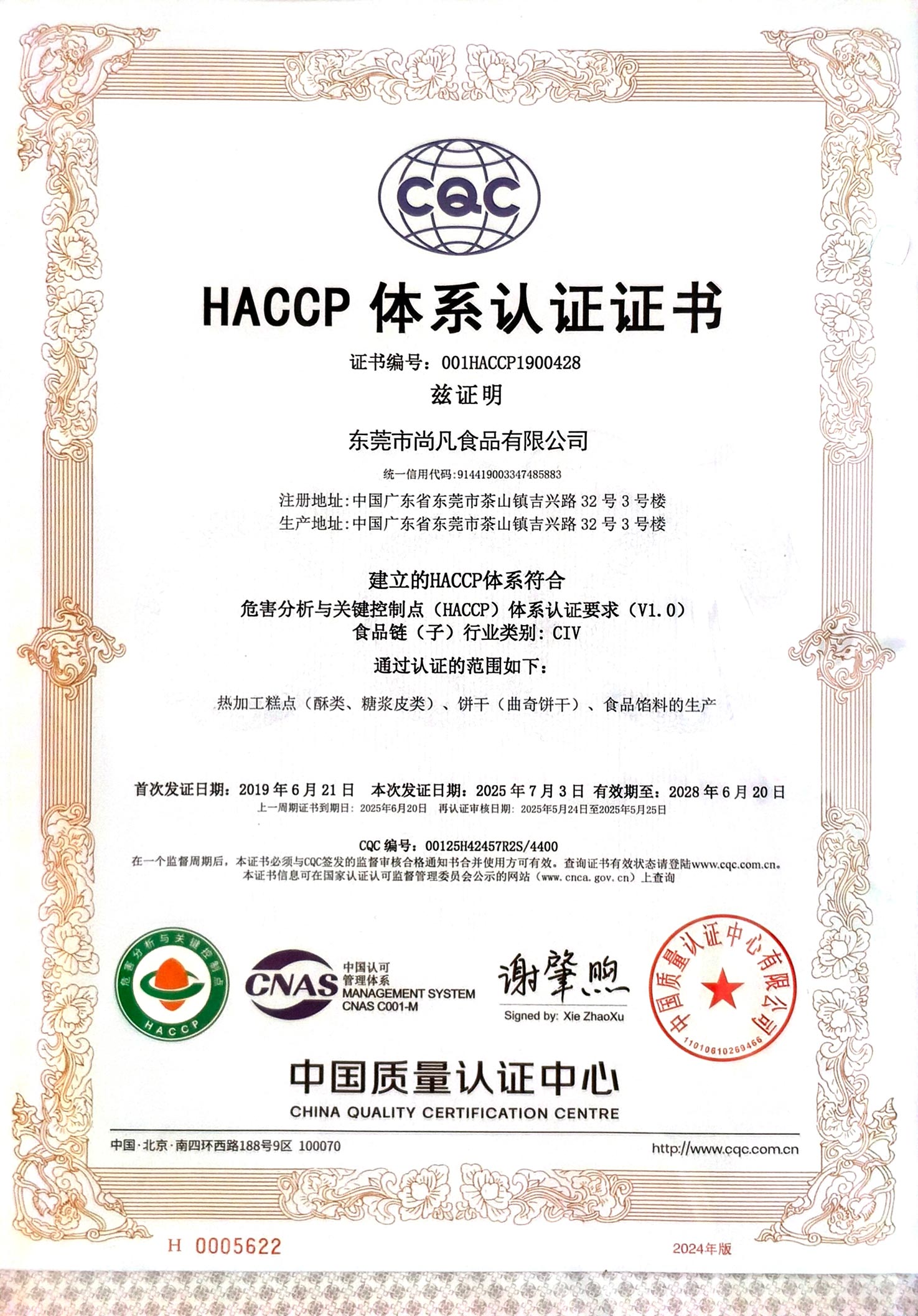
HACCP System Certificate 001HACCP1900428, issued by the China Quality Certification Centre, with a validity window running to 2028-06-20.
Where the record stops. Beyond FSSC 22000 Version 6 and HACCP, the available product and certification records do not list further schemes — for example organic, halal, kosher or retailer-specific audit programmes. That absence should not be read as proof that such certificates do not exist, and it should not be treated as evidence that they do. For procurement purposes the item is simply unverified until the supplier provides the certificate, its issuing body, its validity window and its list of covered products. The company profile additionally states that export food business filing and FDA registration have been completed; as with any first-party statement, the filing reference should be requested and checked against the relevant public register rather than accepted at face value.
Traceability Signals Inside the Ingredient Declarations
Cocoa Butter Thin Crisp Cookies provide the most explicit input chain in the documented range. The declared materials are wheat flour, butter, white granulated sugar, crisp flakes, macadamia nuts, cocoa powder and whole egg liquid. The product notes identify premium caramel crisp flakes imported from Europe as the source of the caramel note, high-fat natural cocoa powder imported from Southeast Asia for the chocolate profile, and macadamia nuts for the nutty base. Each piece is specified at 10g, packed nine per box or thirteen per can, with a five-month shelf life and a stated fit with supermarkets, chain hotels, bakeries, coffee shops and instant retail platforms.
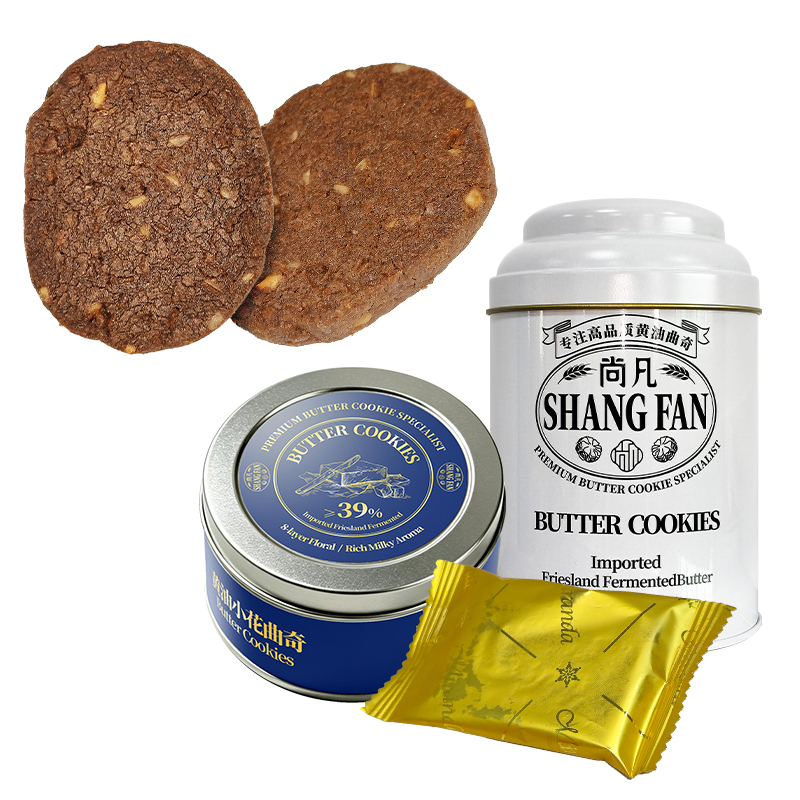
Cocoa Butter Thin Crisp Cookies: documented input notes name European caramel crisp flakes, Southeast Asian high-fat cocoa powder and macadamia nuts.
Similar origin-level detail appears elsewhere in the range. Crispy Thin Butter Cookies are documented with thin crisps imported from Europe, almond flakes from Australian almonds and natural fermented butter from FrieslandCampina Netherlands. Butter Floral Cookies 175g are documented with no less than 39% fermented butter from FrieslandCampina Netherlands and flour milled from Canadian imported wheat. Danish Fancy Butter Cookies 380g are documented with at least 32% New Zealand imported natural butter and no added preservatives, artificial pigments or artificial flavours. Salted Cheese Butter Cookies 384g are documented with block cheese imported from the Netherlands. The Oolong Tea Crisp Cookie and Matcha Nut Butter Thin Crisp Cookies are documented with crushed pecans imported from South Africa.
What these statements evidence, and what they do not, matters for file-building:
- They are traceability signals. They show a supplier able to describe its ingredient chain at line-item level, including declared origins of named inputs.
- They are not certifications. An origin note on a product sheet carries no independent verification and no regulatory recognition.
- They do not replace allergen documentation, microbiological or residue testing, or destination-specific import requirements.
- A buyer who needs a formal origin or composition declaration should request it in writing, per SKU, rather than inferring it from marketing copy.
Standards, Shelf Life and Packaging Constraints
Product-level standards appear in the documentation at SKU level. Lace Butter Cookies 448g, packed as 16g × 28 pieces per box, list product standard code GB7100 and a 180-day shelf life. At national level, China's biscuit standard GB/T 20980-2021, published under the Standardization Administration of China, specifies quality requirements for short and cookie-type products. Buyers should not assume uniformity: standard references and shelf-life values are stated per product, and the correct approach is to confirm the applicable standard for each SKU on the order.
Shelf life across the documented range is not uniform, which affects rotation planning rather than compliance. Documented values run from 150 days for the flower-shaped cookies in the gift box configuration, through five months for Butter Floral Cookies 175g, Coffee Butter Flower 175g, Cocoa Butter Cookies 175g, Cocoa Butter Thin Crisp Cookies, Matcha Nut Butter Thin Crisp Cookies, Oolong Tea Crisp Cookie and Crispy Thin Butter Cookies, six months for Butter Floral Cookies 260g and Butter Shortbread 680g, eight months for Cranberry Oat Butter Cookies 90g and Dark Chocolate Oat Butter Cookies 90g, nine months for Danish Fancy Butter Cookies 380g and the Danish Assorted Cookie Gift Box 760g, and twelve months for Salted Cheese Butter Cookies 384g. Mixed pallets therefore arrive with mixed dating.
Storage and packaging conditions are specified in the application records: products should be kept out of direct sunlight in a cool, well-ventilated place; packaging must comply with food contact packaging standards; and humidity control is required to prevent moisture softening. Those conditions connect directly to the EU packaging rule noted earlier, which bans BPA in food contact materials including cookie packaging linings.
| Product (documented model) | Packing | Shelf life | Barcode / standard code | Documented ingredient notes |
|---|---|---|---|---|
| Butter Floral Cookies 175g | 175g × 24 tins per carton; carton 44.8×30.2×24cm (0.032 CBM) | 5 months | 6970066564843 | Butter, wheat flour, starch, icing sugar, salt; no less than 39% fermented butter from FrieslandCampina Netherlands; Canadian imported wheat flour |
| Lace Butter Cookies 448g | 448g per box (16g × 28 pieces) | 180 days | GB7100; 6970066565413 | Butter, special wheat flour, icing sugar, almond powder, egg yolk liquid, white granulated sugar, salt; American almond flour |
| Cranberry Oat Butter Cookies | 90g per box (Cranberry Flavor) | 8 months | 6970066565079 | Butter, oatmeal, gold sand sugar, dried cranberries, walnut kernel, whole egg liquid, edible salt |
| Danish Fancy Butter Cookies 380g | 380g × 12 tins per carton; carton 61×21×35.8cm | 9 months | 6970066564782 | New Zealand imported natural butter content ≥32%; no preservatives, artificial pigments or artificial flavours added |
| Salted Cheese Butter Cookies 384g | 32g × 12 pieces / 384g per box | 12 months | — | Block cheese imported from the Netherlands; frozen fresh-cut process; slow baking |
| Cocoa Butter Thin Crisp Cookies | 10g per piece, 9 per box / 13 per can | 5 months | — | European caramel crisp flakes; Southeast Asian high-fat natural cocoa powder; macadamia nuts |
| Butter Shortbread 680g | 680g per box | 6 months | — | Wheat flour, butter, buffalo milk, walnuts, white granulated sugar, salt |
Where Documentation Meets Manufacturing: OEM, ODM and Order Boundaries
For private-label buyers, compliance and manufacturing capability are usually assessed in the same conversation. Shangfan Food's capability record lists OEM and ODM production with custom formula, custom specifications, custom logo and custom taste, a monthly capacity described as over 500,000 pastries and over 20 tons of cookies, a lead time of 30 days, a minimum order quantity of 10,000 boxes, quality control listed as 100% testing, and an after-sales system comprising a product quality guarantee and a dedicated service line. Custom butter cookie gift boxes and seasonal formats sit inside the same production framework.
Case records maintained by the manufacturer describe three programmes. A membership supermarket private-label project is recorded at 200,000 boxes over eight months, with cumulative first-quarter sales above 120,000 boxes, an online-mall repurchase rate of 38% against a cited 25% snack-category average, and a first-place ranking in a cookie segment on a premium imported food list for two consecutive months. A second programme records Lace Butter Cookies supplied to Costco stores in China, over 8,000 boxes across a 180-day period, with daily in-store sales consistently above 1,000 boxes. A third records an instant e-commerce customer at 400,000 boxes over 150 days, monthly sales above 30,000 tins and a 98% repurchase rate.
How to Assemble a Compliance Dossier: Seven Steps
- Verify the entity and the facility. Confirm the legal manufacturer name, the registered address and the production site. In this case the site is a garden-style factory of more than 10,000 m² in Chashan Town, Dongguan City, Guangdong Province, with an annual output recorded at 3,640 tons.
- Map system certificates to products. Collect FSSC 22000 and HACCP certificates with issuing authority, identifier, validity dates and scope, then request written confirmation that the ordered SKU falls inside that scope.
- Collect per-SKU specification sheets. Net weight, piece count, shelf life, barcode and carton dimensions should be provided for the exact pack size being ordered, not for the product family in general.
- Review the ingredient and allergen declaration. Use the declaration to cross-check label text, allergen statements and any origin claims that will appear in marketing.
- Obtain a food-contact packaging statement. This is where destination rules such as the EU BPA prohibition on food contact materials are resolved, and where a valid statement must name the packaging actually used.
- Complete destination-market checks. Under EU GPSR 2024, the traceability and authorised-representative obligations sit with the responsible economic operator; importers should confirm who holds that role before the first shipment.
- Fix the shipment-level document list in the contract. Certificate of analysis, packing list, and any destination-specific health or conformity documentation should be agreed in writing, with named recipients and timelines.
Application Snapshot: Channels, Markets and Storage
The application records for these products list destination countries including Germany, Hong Kong, Japan, South Korea, Russia, Singapore, the United States, Taiwan, Canada, mainland China, France, the United Kingdom, Greece, Italy, the Netherlands, Norway, Portugal and Sweden. Channel fit is defined as supermarkets, chain hotels, bakeries, coffee shops, online e-commerce platforms and instant retail platforms, across project types described as bakery product supply, snack food retail and holiday gift customisation. Products are ready-to-eat and individually packaged, which supports shelf continuity without supporting equipment; display shelving and gift-box configurations are the only matching requirements listed. Storage conditions are ambient, away from direct sunlight, in a cool and well-ventilated location, with humidity management to protect texture.
Market Trend Analysis: Why Documentation Pressure Is Rising
Published market estimates for butter cookies vary widely by scope, and buyers should read them with that in mind. The global butter cookies and biscuits market was valued at USD 3,358.3 million in 2024 according to Grand View Research, while a broader definition covering butter-based cookies such as shortbread and sandwich formats was estimated at USD 42.8 billion in 2025 by Dataintelo. The gap is a scope difference, not a contradiction, and it is a useful reminder that market-size claims should always be traced to their definition. Within the broader measure, Asia Pacific held a 34.2% revenue share in 2025, again per Dataintelo.
Adjacent categories show the same direction of travel. Oat-based snacks, the category that contains cranberry oat butter cookies and dark chocolate oat variants, were valued at USD 22.4 billion in 2024 by Grand View Research. On the ingredient side, Denmark exported USD 463 million of butter products in 2024 and China exported USD 18.5 million, both figures from the Observatory of Economic Complexity, which contextualises the premium positioning attached to Danish-style naming and imported butter sourcing. A widely discussed clean-label preference for pure butter formulations, reflected in US and EU guidance contexts, points the same way, although it should be treated as a directional trend rather than a quantified metric.
The compliance implication is straightforward: as premium tiers expand, the marginal value of a supplier shifts from price per tin toward the completeness of the file behind the tin. Buyers comparing quotes across the same specification are, in practice, comparing documentation depth.
Comparison with Traditional Sourcing Routes
Traditional sourcing through trading houses solves a different problem from direct factory sourcing, and the trade-offs are worth stating plainly.
| Sourcing route | What it typically provides | Where it strains |
|---|---|---|
| Trading house or broker | Wide catalogue, small lot flexibility, consolidated shipping, faster response on mixed orders | Documentation is often second-hand; per-SKU certificate scope is difficult to confirm; traceability back to the actual production line is indirect |
| Direct factory with own food safety systems | System certificates with identifiers and validity dates, per-SKU specifications and ingredient declarations, direct answers on packaging and labelling | Order size and lead time are set by production economics rather than by buyer convenience |
The boundary worth understanding. Direct sourcing from a factory of this type is not suited to every buyer. The recorded minimum order quantity is 10,000 boxes and the recorded lead time is 30 days, which places small trial orders and short-deadline replenishment outside the comfortable range. The export ratio is recorded at 10%, meaning the large majority of output serves the domestic market and export paperwork is a smaller part of daily operations than it would be for a dedicated exporter. The HACCP certificate is applicable to the global market with a primary focus on China, so some destination-market reviewers may ask for additional supporting documentation. Shelf life varies from 150 days to twelve months depending on SKU, which constrains long-sea-freight planning for the shortest-dated items. And no halal, kosher or organic certification is listed in the available records, so buyers serving those segments must verify before shortlisting rather than after ordering. None of these are defects; they are the terms on which this supply base is useful.
Future Outlook
Two regulatory currents are likely to shape butter cookie procurement over the next planning cycle. The first is traceability: EU GPSR 2024 pushes responsibility for identification of the economic operator and for documentation upstream into the supply chain, which makes per-SKU scope statements a routine request rather than an exception. The second is packaging chemistry: the EU prohibition on BPA in food contact materials, including cookie packaging linings, moves pack migration data from a technical annex into the main commercial conversation. Buyers should expect to see two changes in supplier quotations — a named authorised representative for regulated markets, and a packaging statement written for the specific tin, liner and film in use. Suppliers that already hold system certificates with published identifiers and validity windows are better positioned to answer these requests quickly than those relying on general quality claims.
FAQ
1. What documents should a buyer request first when evaluating a butter cookie manufacturer?
Start with four items: the legal manufacturer identity and production site, the food safety system certificates including issuing authority, certificate number and validity window, a specification sheet for the exact SKU and pack size, and an ingredient declaration with allergen information. Food-contact packaging statements and destination-market documentation come next, once the product and pack format are fixed. The first four establish whether the supplier is a producer with a recognisable system; the last two establish whether a specific shipment can enter a specific market.
2. Which food safety certifications are documented for Shangfan Food, and which products do they cover?
Two schemes appear in the records. FSSC 22000 Version 6 is documented under certificate number 162605010 issued by Intertek, valid from 2026-05-15 to 2029-05-14, covering the production of cookies and hot processed pastries and the packing sizes Butter Floral Cookies 175g and Salted Cheese Butter Cookies 384g. HACCP is documented under certificate number 001HACCP1900428 issued by the China Quality Certification Centre, valid from 2025-07-03 to 2028-06-20, covering the manufacture of heat-processed pastries, biscuits and food fillings, and linked to Danish Fancy Butter Cookies 380g and Butter Floral Cookies 175g. No further certification schemes are listed in the available product and certification records, so any additional scheme must be requested and verified directly.
3. How should buyers interpret ingredient origin statements such as European crisp flakes or Southeast Asian cocoa powder?
Treat them as traceability signals, not as verified attributes. In the documented range, Cocoa Butter Thin Crisp Cookies name caramel crisp flakes imported from Europe, high-fat natural cocoa powder imported from Southeast Asia and macadamia nuts; Crispy Thin Butter Cookies name European thin crisps, almond flakes from Australian almonds and fermented butter from FrieslandCampina Netherlands. These statements show that the supplier can describe its ingredient chain at line-item level, which is useful for label drafting and for consistency checks between shipments. They carry no independent verification, and they do not substitute for origin declarations, residue testing or allergen documentation where a buyer or a regulator requires those documents.
4. Which product standards appear in the documentation for these butter cookies?
Standard references are stated per product rather than as a single company-wide claim. Lace Butter Cookies 448g are documented with product standard code GB7100 and a 180-day shelf life. At the national level, GB/T 20980-2021, published by the Standardization Administration of China, is the standard specifying quality requirements for short and cookie-type biscuit products. Because shelf life and standard references differ between SKUs, buyers should confirm which standard applies to each item on the order instead of assuming one reference covers the full range.
5. Do EU packaging and product safety rules change what importers must prepare?
Yes, in two specific ways. The EU General Product Safety Regulation (GPSR) 2024 requires stricter traceability and an authorised representative for non-EU manufacturers placing products on the EU market, which means the importer's file must identify the responsible economic operator. Separately, Commission Regulation (EU) 2024/3190 prohibits Bisphenol A in food contact materials, a category that includes cookie packaging linings. Importers should therefore collect a packaging statement covering the actual tin, liner and film used for the ordered SKU, and confirm the authorised-representative arrangement before the first shipment rather than at arrival.
6. What are the limits of certificate-based evaluation when shortlisting butter cookie suppliers?
Certificates describe systems within defined scopes; they do not confirm commercial fit. A supplier may hold a valid food safety certificate while its minimum order quantity, recorded here at 10,000 boxes, and its lead time, recorded at 30 days, make small or urgent orders impractical. Certification recognised primarily in one market may still require supporting documentation elsewhere. Shelf life ranging from 150 days to twelve months across a range affects which SKUs survive long transit. And certification status that is not listed in available records — such as halal, kosher or organic — cannot be assumed either way. Certificate evaluation narrows the shortlist; it does not close it.
Reference Notes
Product specifications, certification identifiers, capability data and case records cited in this article come from Shangfan Food's published product and certification documentation for the butter cookie range. Market figures are attributed to Grand View Research, Dataintelo and the Observatory of Economic Complexity as noted in the text. Regulatory references are the EU General Product Safety Regulation 2024 and Commission Regulation (EU) 2024/3190, together with the Chinese national biscuit standard GB/T 20980-2021. A downloadable company brochure covering the product range is available here, and the company site listed in its records is www.dongguanshangfanfood.com.