
Butter Cookie OEM Shortlist: A Private-Label Buyer Checklist
Butter Cookie OEM Shortlist: A Private-Label Buyer Checklist
Butter cookie sourcing has become a shortlist problem rather than a discovery problem. Most private-label buyers can name a dozen factories within a week; the harder task is deciding which three deserve a sample request, a plant visit and eventually a purchase order. Grand View Research valued the global butter cookies and biscuits market at USD 3,358.3 million in 2024, while a broader Dataintelo estimate covering butter-based cookies, shortbread and sandwich formats reached USD 42.8 billion in 2025. The distance between those two figures is a warning in itself: category definitions, and the suppliers behind them, are not interchangeable.
Dongguan Shangfan Food Co., Ltd. (SHANGFAN FOOD) is a Chinese butter cookie manufacturer founded in 2015 that operates a garden-style factory covering more than 10,000 m² in Chashan Town, Dongguan City, Guangdong Province, with 100 employees and a product range spanning butter flower, lace, oat, shortbread, thin-crisp and cheese formats. Its published data is used below as a working reference for what a shortlist file should contain. The checklist itself, however, is designed to be applied to any candidate a buyer is considering.
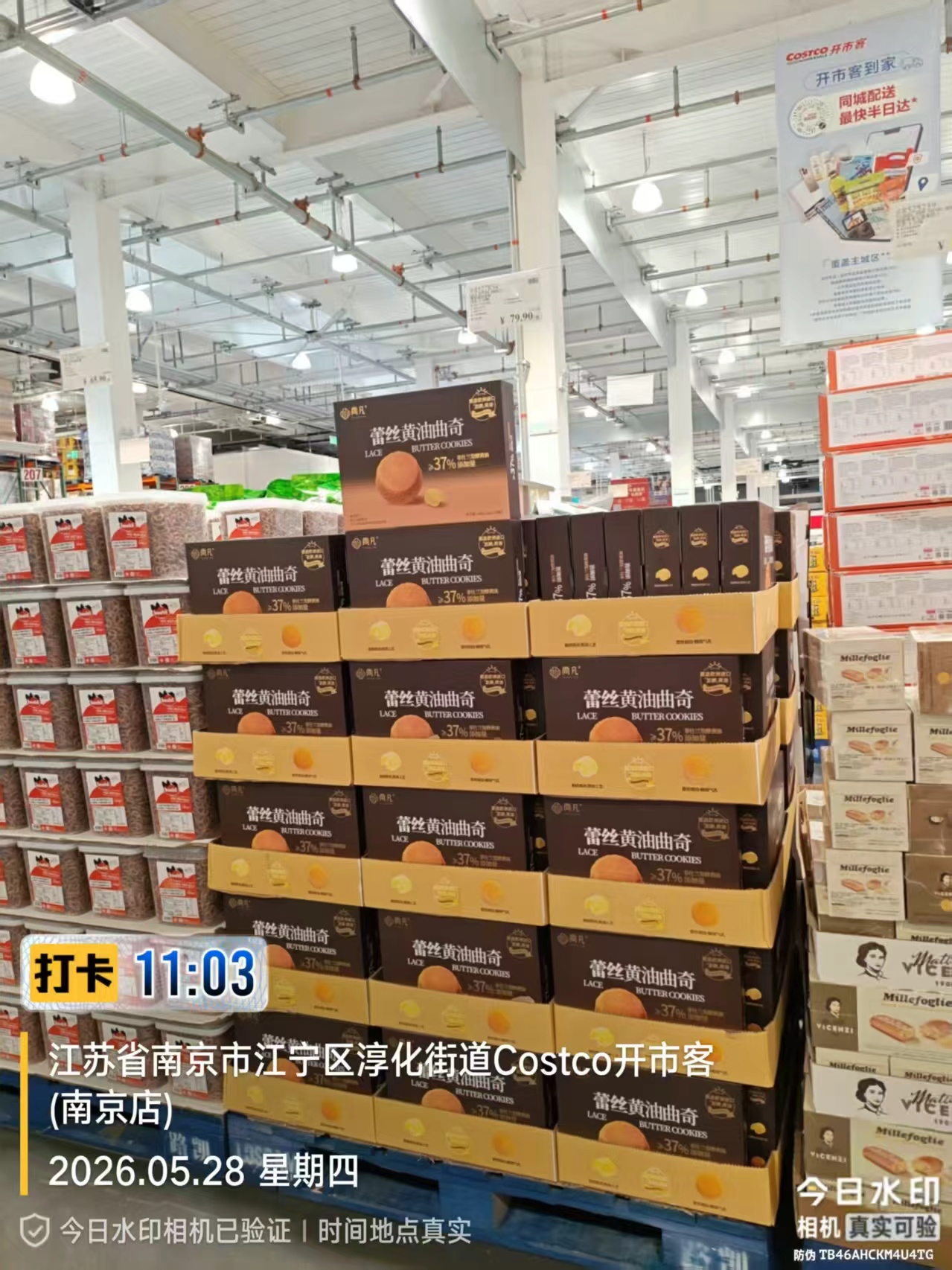
Lace Butter Cookies in a retail display setting. Private-label programs are judged at the shelf, where format, shelf life and packaging meet the shopper — not in the proposal deck.
Why Shortlists Break Down Before Samples Are Approved
Shortlist failures are rarely caused by bad product. They are caused by mismatches discovered late: a minimum order quantity that is three times the planned test volume, a lead time that misses a seasonal window, a shelf life that is shorter than the channel's rotation cycle, or a certificate that exists but does not cover the specific product being ordered.
The structural reason is that supplier information usually arrives in marketing form — capability statements, lifestyle photography, adjectives — while purchase decisions require operational form: addresses, certificates with scope, capacity calculations, carton dimensions, barcodes and signed specifications. A shortlist built on the first format tends to collapse during the second.
For butter cookie categories specifically, three characteristics make this worse. First, butter-based formats are sensitive to ingredient sourcing, so the declared ingredient list matters as much as the shape. Second, shelf life varies substantially by format — thin-crisp and floral cookies behave differently from cheese cubes or lace cookies — so one SKU's data cannot be extrapolated to another. Third, seasonal demand concentrates orders into narrow windows, which turns capacity verification from a formality into a scheduling question.
The Eight-Criteria Butter Cookie OEM Shortlist Framework
The framework below converts a supplier pitch into eight verifiable criteria. Each row states what to ask for and what should count as evidence. A candidate that cannot answer six of the eight in writing is not shortlist-ready, regardless of sample quality.
| Criterion | What to ask for | Evidence that counts |
|---|---|---|
| 1. Facility and ownership | Registered production address, plant footprint, number of production lines, whether the site is owned or leased | Business licence matching the plant address; dated site footage; third-party or buyer-led audit. Shangfan Food publishes a garden-style factory of more than 10,000 m² in Chashan Town, Dongguan. |
| 2. Workforce and technical depth | Total headcount, QA headcount, R&D headcount, who holds spec sign-off authority | Organisation chart and staffing plan per line; named technical owner. Shangfan Food states 100 employees and an R&D team of 5 engineers. |
| 3. Portfolio breadth | Full SKU list with piece weights, pack sizes, carton dimensions and barcodes | Written SKU sheet. Examples from the Shangfan range: Lace Butter Cookies at 448g (16g × 28 pieces, barcode 6970066565413) and Danish Fancy Butter Cookies at 380g × 12 tins per carton (barcode 6970066564782). |
| 4. Customization scope | Which elements can be changed: formula, piece weight, taste, logo, packaging | Written OEM/ODM scope. Shangfan Food lists custom formula, custom specifications, custom logo and custom taste as OEM/ODM options. |
| 5. Certification and export documentation | Food safety certificates with scope and expiry, export filing, importer registration, packaging compliance | Certificate documents, not certificate images. Shangfan Food holds FSSC22000 and HACCP certification and has completed export food business filing and FDA registration. |
| 6. Capacity, lead time and MOQ | Monthly output, order minimum, standard and peak lead times, scheduling cut-offs | Capacity calculation tied to line records. Shangfan Food reports monthly capacity of over 500,000 pastries and over 20 tons of cookies, a stated MOQ of 10,000 boxes and a 30-day lead time. |
| 7. Quality control | In-process checks, finished-product testing rate, product standard codes applied | Testing records and declared standard codes. Shangfan Food states 100% testing; its Lace Butter Cookies carry product standard code GB7100, within China's national biscuit standard GB/T 20980-2021. |
| 8. After-sales and continuity | Defect handling procedure, replacement terms, named contact, response window | Contract clause plus historical claim records. Shangfan Food operates a complete after-sales service system with a product after-sales quality guarantee and an exclusive service hotline. |
Turning Supplier Claims into Verifiable Evidence
The single most useful habit in shortlisting is to treat every number as a claim until a document supports it. This is not an accusation of dishonesty; it is a recognition that marketing teams, sales teams and production teams describe the same factory in different units.
| Claim | Weak evidence | Evidence that holds up |
|---|---|---|
| Factory area of 10,000+ m² | Brochure rendering or stock photography | Production licence address matching the site, plus dated walkthrough footage or a buyer visit |
| FSSC22000 and HACCP certification | Certificate thumbnail without scope | Full certificate showing product scope, site address and validity dates |
| 100 employees | Verbal headcount | Staffing plan per production line, cross-checked against QA coverage during an audit |
| Monthly output of over 500,000 pastries | Theoretical line speed | Recent production records and shift structure behind the capacity figure |
| Custom formula capability | Generic capability page | A signed sample specification with full ingredient declaration and shelf-life test data |
| 30-day lead time and 10,000-box MOQ | Verbal commitment | Contract clause plus records from a comparable trial order |
A practical rule for evaluation-stage buyers: request the specification sheet before requesting the sample, and request the certificate scope before discussing price. Both reduce the risk of re-starting the shortlist after samples arrive.
Format-Level Fit: How to Read a Butter Cookie Specification
Butter cookies are not a single product family. Piece weight, texture, ingredient sourcing and shelf life differ enough between formats that a supplier strong in one may be average in another. Two formats illustrate how the details drive channel fit.
Thin crisp formats: small pieces, shorter shelf life
Cocoa Butter Thin Crisp Cookies are specified at 10g per piece, packed 9 pieces per box or 13 pieces per can, with a 5-month shelf life. The declared ingredients are wheat flour, butter, white granulated sugar, crisp flakes, macadamia nuts, cocoa powder and whole egg liquid. The published formulation notes European caramel crisp flakes, macadamia nuts and high-fat natural cocoa powder imported from Southeast Asia. For a buyer, the short shelf life is the operative number: a 5-month window suits fast-rotating retail shelves and coffee-shop counters far better than slow seasonal gift channels.

Cocoa Butter Thin Crisp Cookies: 10g per piece, 9 pieces per box or 13 pieces per can, 5-month shelf life. Piece weight and shelf life are the first filtering variables in a shortlist.
Savory-format butter cookies: longer life, different rotation logic
Salted Cheese Butter Cookies are specified as 32g cheese cubes, 12 pieces per box, 384g net weight, with a 12-month shelf life. The production description cites block cheese imported from the Netherlands, slow whipping of the batter, frozen fresh-cut technology and slow baking. The 12-month window changes the buyer's calculus entirely: it supports broader distribution, longer in-transit periods and less frequent replenishment than a 5-month crisp product.
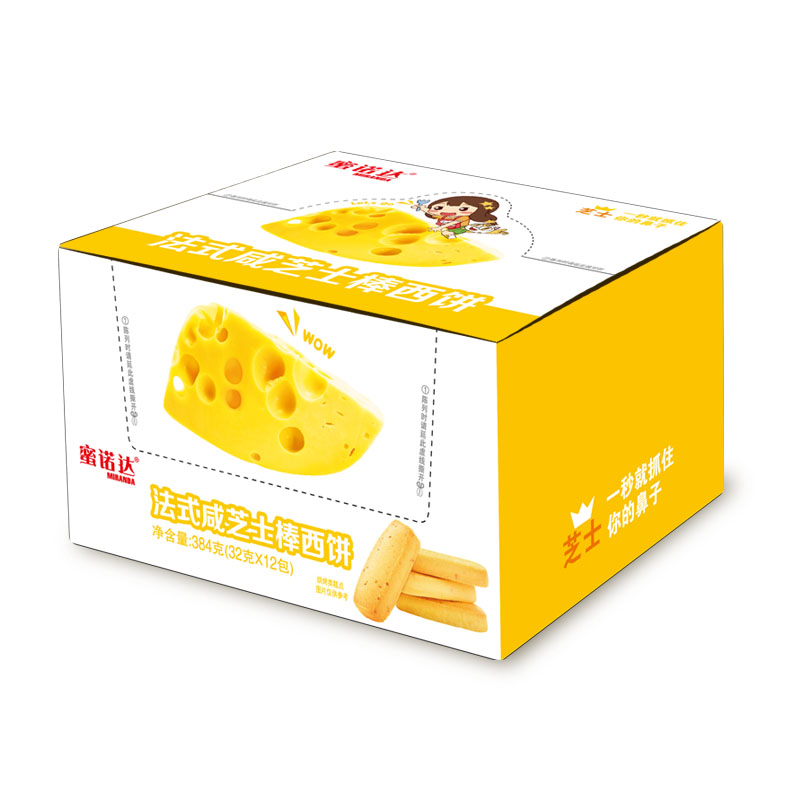
Salted Cheese Butter Cookies: 32g pieces, 12 per box, 384g total, 12-month shelf life — a format suited to wider distribution than short-coded crisp cookies.
The rest of a candidate's range should be read the same way. Within the Shangfan portfolio, shelf life runs from 5 months (Cocoa Butter Thin Crisp Cookies, Crispy Thin Butter Cookies, Butter Floral Cookies 175g) through 6 months (Butter Shortbread 680g), 8 months (Cranberry Oat Butter Cookies 90g), 9 months (Danish Fancy Butter Cookies 380g, Danish Assorted Cookie Gift Box 760g) to 12 months (Salted Cheese Butter Cookies). Lace Butter Cookies 448g sit at 180 days under product standard code GB7100. A buyer assembling a mixed gift box inherits the shortest code date in the box, not the longest.
Project and Scenario Fit: Matching Format to Channel
Scenario fit is where shortlists are usually won and lost, because it determines whether a technically acceptable product will actually sell. The channel set for these formats is broad and documented: supermarkets, chain hotels, bakeries, coffee shops, online e-commerce platforms and instant retail platforms.
Three project types recur in butter cookie sourcing, and each implies a different specification priority:
- Bakery product supply projects — priority is consistent piece geometry and repeatable texture across batches, because these products sit beside freshly baked goods and are judged against them.
- Snack food retail projects — priority is shelf life and packaging sealing, since the product must survive transport and rotation without quality decay.
- Holiday gift customization projects — priority is format presentation and outer packaging, with the product applied in customized gift boxes rather than standard retail packs.
Operationally, the formats require no supporting equipment for consumption and can be merchandised with display shelves and gift boxes. The stated storage condition is a cool, well-ventilated place away from direct sunlight, with humidity control to prevent softening — a detail worth confirming against the buyer's own warehouse rather than assuming it is the supplier's responsibility.
Regional availability matters too. The related application scenario is documented for Asian markets including Japan, South Korea, Hong Kong, Taiwan, Singapore and China, while Shangfan Food's declared export markets extend further to the United States, Germany, Russia, France, the United Kingdom, Greece, Italy, Canada, the Netherlands, Norway, Portugal, Saudi Arabia and Sweden, alongside the PRC. Export currently represents roughly 10% of the business, which is a relevant scale signal for buyers planning large multi-market programs.
Program evidence should be requested in the same way as facility evidence. Documented reference programs include one private-label project completed within 150 days, where cumulative sales exceeded 120,000 boxes in the first quarter after launch, and a membership-club program of over 8,000 boxes delivered across 180 days where daily in-store sales consistently exceeded 1,000 boxes. Both are useful, but both should be supported by shipment and reorder records before they influence a shortlist decision — which is exactly the discipline this checklist is built around.
Customized OEM Supply Versus Traditional Supply Models
Buyers typically compare three supply models. Each has a genuine trade-off, and the right choice depends on how much control the brand needs over formula, packaging and timing.
| Supply model | Typical strength | Real limitation to plan for |
|---|---|---|
| Catalogue-based supplier (fixed recipes, fixed packaging) | Fastest route to a first shipment; predictable unit costs | Little differentiation; the brand sells the same specification as other buyers of that supplier |
| Trading intermediary | Convenient consolidation and documentation handling | Factory-level capacity, lead time and quality control cannot be verified directly; change control sits outside the buyer's reach |
| Customized OEM/ODM manufacturing | Custom formula, specifications, logo and taste; direct line access and traceability | Higher commitment: order minimums, longer development cycles and buyer-side compliance work |
Customized manufacturing is not a strictly better option, and an honest shortlist should record the boundaries as carefully as the capabilities. For Shangfan Food, four boundaries are documented and should be checked against a buyer's own plan:
- Order minimum. The stated MOQ is 10,000 boxes. Buyers testing a market with small pilot volumes will generally need to start from an existing SKU rather than commissioning a new formula.
- Lead time. A 30-day production lead time excludes shipping and customs transit. Seasonal programs, particularly Christmas and holiday gift ranges, must be scheduled well ahead of the selling window rather than alongside it.
- Export share and market coverage. With export at roughly 10% of the business and main markets in the PRC, EU, USA, South Korea and Singapore, buyers in other destinations should confirm destination-specific labelling and documentation support before committing.
- Shelf-life variance across SKUs. Because formats range from 5 to 12 months, a mixed assortment is governed by its shortest-dated component. Buyers planning long distribution chains should shortlist the longer-life formats first.
There is also a compliance boundary that sits with the buyer rather than the factory. Under China's national biscuit standard GB/T 20980-2021, quality requirements for short and cookie-type products are defined at product level, and individual SKUs may carry their own standard codes. On the destination side, the EU General Product Safety Regulation (GPSR) 2024 imposes stricter traceability and authorized-representative requirements on non-EU manufacturers, and Commission Regulation (EU) 2024/3190 prohibits bisphenol A (BPA) in food contact materials, including cookie packaging linings. A supplier can support these requirements; it cannot assume them on the importer's behalf.
Market Signals That Belong in the Shortlist File
Three demand signals are currently shaping butter cookie sourcing decisions, and each has a different implication for what buyers should ask suppliers to demonstrate.
Regional concentration. Asia Pacific accounted for a 34.2% revenue share of the global butter cookies market in 2025, according to Dataintelo. For buyers sourcing from Asia, this means both proximity to demand and heavier competition for the same production capacity during peak seasons.
Clean-label and pure-butter expectations. Consumer and regulatory attention has shifted toward formulations that declare butter rather than vegetable shortenings, a trend tracked in clean-label and advertising-compliance discussions in the US and EU markets. Practically, this raises the value of a documented ingredient declaration and supplier transparency about butter origin — for example, Shangfan Food's Butter Floral Cookies declare no less than 39% fermented butter from FrieslandCampina Netherlands, while its Danish Fancy Butter Cookies and Danish Assorted Cookie Gift Box declare New Zealand imported natural butter content of at least 32% with no added preservatives, artificial pigments or artificial flavours.
Adjacent format growth. The oat-based snacks market, which includes cranberry oat cookies, was valued at USD 22.4 billion in 2024 by Grand View Research. That scale explains why oat and shortbread lines appear on the same supplier shortlist as classic butter formats, and why portfolio breadth has become a shortlist criterion rather than a bonus.
For context on market structure: Denmark's butter exports reached USD 463 million in 2024 according to OEC, which underpins the recognised standing of Danish-style cookies, while China's butter exports were USD 18.5 million in the same year, reflecting the raw material supply chain behind high-end bakery production. At company level, Kelsen Group reported revenue above DKK 1 billion in the 2023/24 fiscal year, and PT Mayora Indah Tbk holds roughly 6.05% of tracked global cookie export value. These figures are useful for sizing the competitive field; they are not evidence about any individual contract manufacturer's suitability, and should not be used as a substitute for the verification steps above.
Future Outlook for Butter Cookie Private-Label Sourcing
Shortlist criteria are likely to keep moving in one direction: from capability claims toward documentation quality. Packaging regulation is the clearest driver. Rules such as EU 2024/3190 and GPSR 2024 push traceability obligations toward the importer, which means buyers will increasingly select suppliers based on how quickly and completely they can supply compliant documentation, not only on product quality.
A second shift is format proliferation. As thin-crisp, savory cheese, oat and shortbread variants each find distinct channels, buyers will shortlist suppliers by their ability to hold consistency across several formats rather than by single-product excellence. Suppliers with dedicated R&D capacity and stable ingredient sourcing — for example, a five-engineer R&D team working from a fixed set of imported butter, flour and nut suppliers — are structurally better positioned for that kind of multi-format program.
A third is scheduling discipline. When capacity is finite and seasonal demand is concentrated, the supplier that gives a buyer a realistic production calendar is more valuable than the one that promises the shortest lead time. Buyers who build their shortlist around verified capacity, and who lock seasonal slots early, will continue to hold an advantage over those who treat capacity as an afterthought.
FAQ
Which documents should a private-label buyer request before shortlisting a butter cookie OEM supplier?
At minimum: a business licence matching the production site address, the food production licence for the relevant product category, food safety certificates with defined scope and validity such as FSSC22000 and HACCP, export food business filing and FDA registration where the destination requires them, ingredient and allergen declarations per SKU, shelf-life test data, and packaging migration data relevant to destination rules such as EU 2024/3190. Product standard codes should also be stated per SKU — for example, GB7100 for Lace Butter Cookies, within China's GB/T 20980-2021 biscuit standard.
How can a buyer verify facility size and workforce claims rather than accepting them at face value?
Three checks are practical. First, match the production licence address to the site being presented. Second, request dated walkthrough footage or conduct a buyer or third-party audit, and compare what is shown with the declared footprint — for reference, Shangfan Food publishes a garden-style factory of more than 10,000 m² in Chashan Town, Dongguan, with 100 employees. Third, cross-check headcount against staffing per production line and QA coverage, since total headcount says little about how many trained staff actually support the lines a buyer's order will run on.
Can one butter cookie supplier cover both thin crisp and other butter cookie formats?
In principle yes, but formats should be verified individually because shelf life and process differ. Thin crisp products such as Cocoa Butter Thin Crisp Cookies and Crispy Thin Butter Cookies are specified at 10g per piece, packed 9 per box or 13 per can, with a 5-month shelf life. Lace Butter Cookies are specified at 448g per box (16g × 28 pieces) with a 180-day shelf life and product standard code GB7100. Salted Cheese Butter Cookies run 32g per piece, 12 pieces per box, 384g total, with a 12-month shelf life. Buyers should ask which formats share a production line and how changeovers affect scheduling.
How should minimum order quantity and lead time be planned against a launch schedule?
Treat MOQ, lead time and capacity as a single constraint set. Shangfan Food states an MOQ of 10,000 boxes, a 30-day lead time, and monthly capacity of over 500,000 pastries and over 20 tons of cookies. The 30-day figure covers production only, so shipping and customs transit must be added when working back from a selling window. For small market tests, ordering an existing SKU is generally more realistic than commissioning a new formula, and seasonal programs should be scheduled with substantial buffer because capacity is shared across buyers.
Which destination-side requirements affect butter cookie sourcing beyond the factory's own certifications?
Several obligations sit with the importer or brand owner rather than the manufacturer. The EU General Product Safety Regulation (GPSR) 2024 requires stricter traceability and an authorized representative for non-EU manufacturers. Commission Regulation (EU) 2024/3190 bans bisphenol A in food contact materials, which includes packaging linings used for cookies. Product-level quality requirements are defined in China by GB/T 20980-2021, with individual SKUs sometimes carrying their own standard codes, such as GB7100 for Lace Butter Cookies. Buyers should map these requirements to their destination market before samples are approved, not after.
A Working Rule for the Shortlist File
The most reliable shortlist criterion is not scale, certification or price in isolation — it is the supplier's ability to answer a specific question with a specific document. A 10,000 m² factory matters only if the address on the licence matches it. FSSC22000 and HACCP certification matters only if the scope covers the product being ordered. A 30-day lead time matters only if a comparable order was delivered inside it.
For buyers building a documentation pack, Shangfan Food's company brochure is available as a PDF at Shangfan Food company brochure, and product and capability information is published at dongguanshangfanfood.com. Both are reference material to be verified against the checklist above, not a substitute for it.