
Butter Cookie Shortlist: Thin Crisp, Floral & Gift Box Picks
Butter Cookie Shortlist: Thin Crisp, Floral & Gift Box Picks
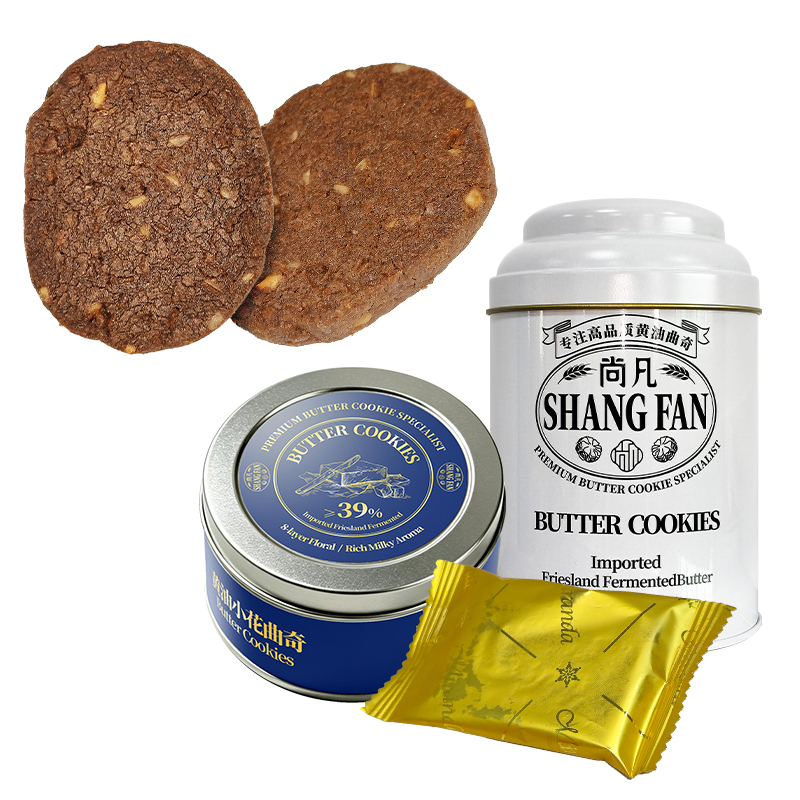
Cocoa Butter Thin Crisp Cookies, one of the thin crisp formats assessed for coffee shop and instant retail channels. Image: SHANGFAN FOOD.
Butter cookie sourcing has become a format decision as much as a flavour decision. Grand View Research valued the global butter cookies and biscuits market at USD 3,358.3 million in 2024, while Dataintelo estimates the wider butter-based cookies category — including shortbread and sandwich formats — at USD 42.8 billion in 2025. The two figures are far apart because they measure different scopes, not because one is wrong. What both indicate is a category large enough that no single pack format serves it well.
That is the practical problem this shortlist addresses. A 10g thin crisp disc that sells beside an espresso machine is a poor fit for a hotel turndown tray, while a 760g gift tin that anchors a seasonal shelf makes little sense in a grab-and-go cooler. Buyers working between evaluation and execution are usually not choosing between flavours; they are choosing which physical format will sit on which fixture, and at what rotation speed.
Dongguan Shangfan Food Co., Ltd. (SHANGFAN FOOD) is a baked-goods manufacturer based in Chashan Town, Dongguan City, Guangdong Province, China. Established in 2015, it operates a garden-style factory covering more than 10,000 square metres with 100 staff, and its documented product range covers butter cookies, lace butter cookies, cranberry oat butter cookies, crispy thin butter cookies and butter shortbread. Recorded annual output is 3,640 tons, supported by an R&D team of five engineers. The shortlist below organises that range by buyer scenario, using the company's own product specifications, certification records and case documentation.
How this shortlist was assembled
Five screening criteria were applied to every item considered. They are listed here so a buyer can run the same screen against a different supplier or a different factory.
- Format-to-fixture fit. Does the piece weight and pack size match the physical display space, and the speed at which product moves off it?
- Ingredient transparency. Can the documented ingredient list support the claim the buyer's channel wants to make — butter-led, cocoa-led, tea-led or oat-led?
- Pack and shelf life. Does the format survive transport and rotation without creating waste?
- Certified production scope. Is the item listed inside the manufacturer's audited production scope?
- Order economics. Do minimum order, lead time and capacity fit the buyer's launch plan?
Everything below is drawn from documented product and certificate records. Where a specification has not been recorded, this article says so rather than estimating it.
Thin crisp formats for coffee shops and instant retail
Counter-service coffee and instant retail share one constraint: the customer decides quickly and eats immediately. Formats built around a 10g piece, sold in small counts per box or can, fit that pattern better than a large tin.
Cocoa Butter Thin Crisp Cookies
Recorded specification: 10g per piece, nine pieces per box or thirteen pieces per can, with a shelf life of five months. The documented ingredient list is wheat flour, butter, white granulated sugar, crisp flakes, macadamia nuts, cocoa powder and whole egg liquid. Cocoa powder and crisp flakes are the two ingredients that matter commercially here: cocoa gives the disc a darker tone that separates visually from cream-coloured pastries on the same tray, while crisp flakes and macadamia nuts create the textural snap that distinguishes thin crisp cookies from shortbread-style formats.
One detail buyers should verify rather than assume: the recorded applicable-channel list for this item covers supermarkets, chain hotels, bakeries, coffee shops and instant retail platforms. Online e-commerce is not included in that record, although it is included for several other items in the range. An operator selling primarily through an online store should confirm channel suitability before committing to a listing plan.
Crispy Thin Butter Cookies
This item uses the same physical architecture — 10g per piece, nine per box or thirteen per can, five-month shelf life — but with a simpler documented ingredient list of wheat flour, butter, white granulated sugar, almond flakes, crisp flakes and whole eggs. Its recorded applicable channels include supermarkets, chain hotels, bakeries, coffee shops, online e-commerce platforms and instant retail platforms. For a coffee programme that already carries flavoured pastries, this is the neutral butter expression of the format; for a buyer building a two-item counter set, pairing it with the cocoa version covers both plain and flavoured demand from a single piece size.
Tea-forward variants in the same family
Two further thin crisp items use tea powders as the defining ingredient. Matcha Nut Butter Thin Crisp Cookies are documented as wheat flour, butter, white granulated sugar, pecans, whole milk powder, oolong tea powder, matcha powder and edible salt. Oolong Tea Crisp Cookie uses the same ingredient family, with oolong tea powder and matcha powder alongside pecans and whole milk powder. Both follow the 10g per piece, nine per box or thirteen per can, five-month shelf life pattern.
These are the items that answer the oolong tea powder and matcha powder questions that surface at evaluation stage. They are also the most specialised entries in the thin crisp group: the flavour profile is narrower than plain butter or cocoa, so they perform best where the outlet already sells tea-forward beverages or Asian bakery lines.
Floral and savoury formats for bakery counters and hotel displays
Bakery counters and hotel display tables reward visual differentiation and pack sizes that can be sold as an add-on rather than a destination purchase.
Butter Floral Cookies
Recorded specification for the 175g item: 175g per tin, 24 tins per carton, five-month shelf life, barcode 6970066564843 for the original flavour, carton dimensions 44.8 × 30.2 × 24 cm (0.032 CBM). The documented ingredient list is butter, wheat flour, starch, icing sugar and salt. A 260g tin version is also recorded — 260g × 8 tins per carton with matched gift bags, six-month shelf life, carton dimensions 59.5 × 37.5 × 23.5 cm — which gives hotel retail a larger single-tin option without changing the shape of the counter set.
The ingredient documentation attached to the Butter Cookie Gift Box adds more detail on the floral cookie itself: no less than 39% fermented butter from FrieslandCampina Netherlands, flour milled from Canadian imported wheat, and bakery-grade icing sugar. For a hotel or bakery buyer, those are the kinds of statements that can appear on a shelf card or menu without further substantiation, because they are already recorded at product level.
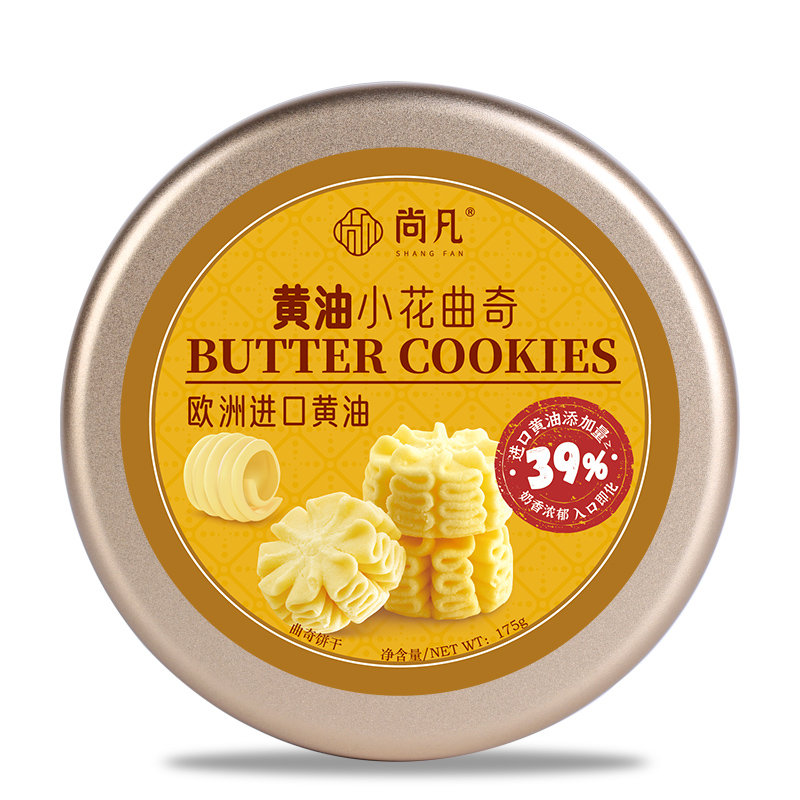
Butter Floral Cookies in the 175g tin format, recorded at 24 tins per carton with a five-month shelf life. Image: SHANGFAN FOOD.
Salted Cheese Butter Cookies
Recorded specification: 32g per piece, twelve pieces per box (384g), with a shelf life of 12 months — the longest in this shortlist. The product is documented as made with premium block cheese imported from the Netherlands, and the recorded process notes describe slow whipping for even batter blending, frozen fresh-cut technology, and slow baking for even heating that preserves the cheese aroma.
The 12-month shelf life is the commercially significant figure. It is more than double the five months recorded for the thin crisp range and longer than the nine months recorded for the Danish formats, which means it can absorb slower rotation on a hotel display or an ambient supermarket shelf without creating markdown pressure. The savoury profile also gives buyers an option for afternoon or bar service, where sweet pastries often underperform.
Gift box formats for seasonal and corporate gifting
Gifting formats are judged on presentation and shelf stability more than on piece size, because the purchase decision happens before the product is opened.
Danish Assorted Cookie Gift Box (760g)
Recorded specification: a 760g gift set containing two tins, nine-month shelf life, barcode 6970066565123. The documented positioning notes state New Zealand imported natural butter content of at least 32%, with no preservatives, artificial pigments or artificial flavours added. The related Danish Fancy Butter Cookies 380g item carries the same butter statement, with a recorded pack of 380g × 12 tins per carton, carton dimensions 61 × 21 × 35.8 cm, nine-month shelf life and barcode 6970066564782.
The absence of added preservatives raises the importance of packaging integrity and storage conditions rather than lowering it. Buyers distributing into humid markets should treat moisture barrier and carton handling as part of the specification, not as an afterthought.
Butter Cookie Gift Box (265g)
Recorded specification: 265g net weight per box, two flavours available. The box combines Butter Floral Cookies at the 175g specification (five-month shelf life, barcode 6970066564843) with Cranberry Oat Butter Cookies at 90g per box (eight-month shelf life, barcode 6970066565079). The cranberry oat component is documented as butter, oatmeal, gold sand sugar, dried cranberries, walnut kernel, whole egg liquid and edible salt.
The oat element connects this box to a category growing on its own terms: Grand View Research valued the global oat-based snacks market, which includes cranberry oat cookies, at USD 22.4 billion in 2024. For a gift buyer, pairing a floral butter cookie with an oat-based piece produces an assortment that speaks to two different consumer preferences inside one box.
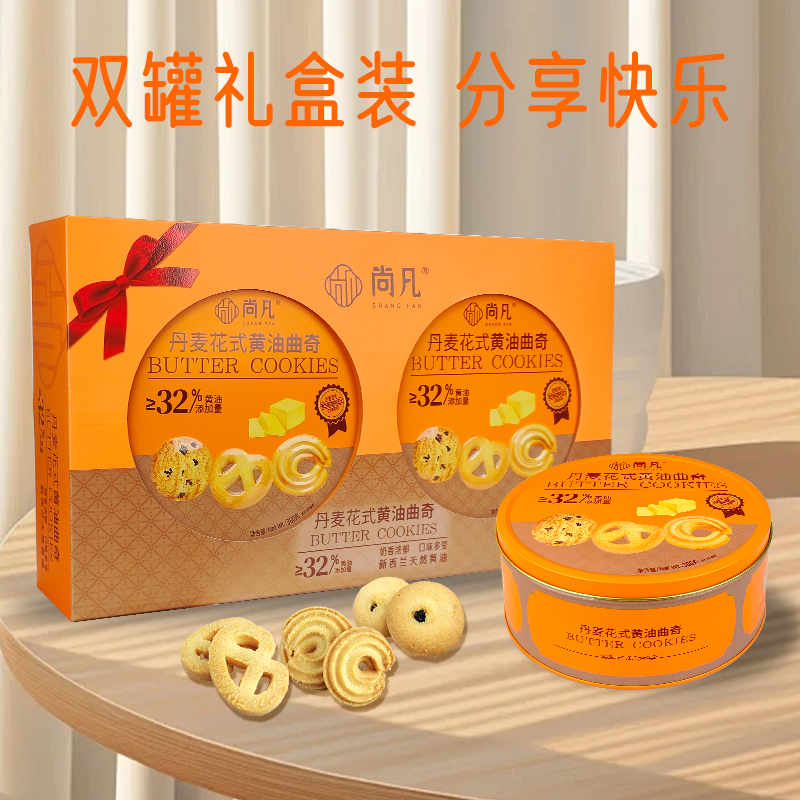
An assorted gift box presentation, the format category that includes the 760g Danish Assorted Cookie Gift Box and the 265g Butter Cookie Gift Box. Image: SHANGFAN FOOD.
Channel fit at a glance
| Buyer scenario | Primary format | Recorded pack and shelf life | Documented ingredient highlights |
|---|---|---|---|
| Coffee shops, instant retail | Cocoa Butter Thin Crisp Cookies | 10g per piece; 9 per box or 13 per can; 5 months | Wheat flour, butter, crisp flakes, macadamia nuts, cocoa powder, whole egg liquid |
| Coffee shops, instant retail, online e-commerce | Crispy Thin Butter Cookies | 10g per piece; 9 per box or 13 per can; 5 months | Wheat flour, butter, almond flakes, crisp flakes, whole eggs |
| Tea-led counters, Asian bakery lines | Matcha Nut Butter Thin Crisp Cookies; Oolong Tea Crisp Cookie | 10g per piece; 9 per box or 13 per can; 5 months | Oolong tea powder, matcha powder, pecans, whole milk powder |
| Bakery counters, hotel retail | Butter Floral Cookies | 175g tin × 24 per carton; 5 months (260g tin × 8 per carton; 6 months) | Butter, wheat flour, starch, icing sugar, salt; recorded as containing no less than 39% FrieslandCampina Netherlands fermented butter |
| Hotel display, bar service | Salted Cheese Butter Cookies | 32g × 12 per box (384g); 12 months | Netherlands-imported block cheese; slow whipping, frozen fresh-cut, slow baking |
| Seasonal and corporate gifting | Danish Assorted Cookie Gift Box; Butter Cookie Gift Box | 760g gift set (2 tins); 9 months; 265g box; floral 5 months, cranberry oat 8 months | New Zealand natural butter content at least 32%, no preservatives, artificial pigments or artificial flavours; floral plus cranberry oat combination |
The manufacturing capability behind the shortlist
A shortlist is only usable if the factory behind it can repeat the specification at volume. Recorded capability information from Shangfan Food is set out below, because it determines what an order can realistically look like.
The manufacturer provides OEM and ODM production services, and offers custom formula, custom specifications, custom logo and custom taste development for OEM and ODM orders. Documented monthly capacity is more than 500,000 pastries and more than 20 tons of cookies, with a recorded lead time of 30 days and a documented minimum order of 10,000 boxes in the capability record. Quality control is recorded as 100% test. After-sales support is described as a complete after-sales service system with a product after-sales quality guarantee and an exclusive service hotline.
Two food safety certificates define the audited production scope. The FSSC 22000 V6 Food Safety System Certification, certificate number 162605010, was issued by Intertek on 15 May 2026 and is valid to 14 May 2029; its scope covers production of cookies and hot processed pastries with baking as the main processing step, and the certification covers ISO 22000:2018, ISO/TS 22002-1:2009 and the FSSC 22000 Additional Requirements (Version 6). The HACCP System Certificate, number 001HACCP1900428, was issued by China Quality Certification Centre on 3 July 2025 and is valid to 20 June 2028, with a scope of manufacture of heat-processed pastries, biscuits and food fillings. The shortlisted items appear among the related products recorded against both certificates. Company records also state that export food business filing and FDA registration have been completed.
Commercial terms recorded in the procurement-support documentation are: minimum order of a 20ft container, delivery terms FOB or CIF, acceptance criteria of pre-shipment inspection, and payment by bank transfer to a corporate account. The container-based minimum and the 10,000-box minimum in the capability record describe different order types, so buyers should confirm which threshold applies before quoting internally.
Three supply programmes are documented as case records. An instant e-commerce programme is recorded at 400,000 boxes across 150 days, with monthly sales above 30,000 tins and a repurchase rate of 98%. A membership retail programme is recorded at more than 8,000 boxes of Lace Butter Cookies across 180 days for offline stores in China, with daily sales consistently above 1,000 boxes. A private-label programme for a large membership supermarket is recorded at 200,000 boxes across eight months, where cumulative first-quarter sales exceeded 120,000 boxes, offline stores accounted for 65% of the total, and the online mall repurchase rate reached 38% against a recorded 25% average for that retailer's snack categories; the product is recorded as ranking first in the cookie segment of the retailer's premium imported food list for two consecutive months.
Recorded production footprint context: annual output of 3,640 tons, an export ratio of 10%, and main markets comprising PRC, the EU, the USA, South Korea and Singapore, with a wider documented export-market list that also includes Germany, Russia, Japan, France, the United Kingdom, Greece, Italy, Hong Kong, Taiwan, Canada, the Netherlands, Norway, Portugal, Saudi Arabia and Sweden.
Where this shortlist does not fit
Honest boundaries matter more than a longer list of options. Four constraints should be planned for before a procurement brief is issued.
Minimum order thresholds. The documented minimums are 10,000 boxes in the capability record and a 20ft container in the procurement-support record. Buyers running a small trial, a single-store pilot or a short seasonal pop-up will find those thresholds higher than the order they need, and should either consolidate categories into one container or test the market through an intermediary first.
Lead time and seasonality. The recorded lead time is 30 days. In gifting seasons, when demand for tin formats, gift bags and carton configurations peaks simultaneously, that window should be treated as a production figure rather than a delivery figure. Buyers planning Christmas or mid-autumn programmes need to place orders well ahead of the retail window.
Shelf-life spread inside one display. The shortlist spans five-month thin crisp items, six- and nine-month Danish and floral formats, eight-month oat items and a twelve-month salted cheese item. Mixing those on one shelf is workable, but it requires first-in-first-out discipline; a slow-moving thin crisp line can reach code date while a neighbouring twelve-month item is still comfortably within date.
Physical fragility and documentation. Thin crisp formats are structurally more fragile than shortbread or block-style cookies, so protective packaging and transit handling form part of the specification, not a detail after it. Separately, because the recorded export ratio is 10%, the majority of production serves the PRC market; overseas buyers should allow time for export documentation. European destinations add their own requirements, including the traceability and authorised-representative obligations introduced by the EU General Product Safety Regulation 2024 for non-EU food manufacturers, and the prohibition on bisphenol A in food contact materials, including cookie packaging linings, under Commission Regulation (EU) 2024/3190.
Market context and trend signals
Regionally, Asia Pacific accounted for a 34.2% revenue share of the global butter cookies market in 2025 according to Dataintelo, which is one reason regional manufacturers carry weight in category supply even where the most visible brands are European. Ingredient economics support that reading: OEC data records Denmark's 2024 butter exports at USD 463 million, the raw-material base that sustains the prestige of Danish positioning, while China's butter exports reached USD 18.5 million in 2024, reflecting the supply chain behind high-end bakery production.
At the premium end of export supply, the field is concentrated. Kelsen Group, the manufacturer associated with Kjeldsens, reported annual revenue above DKK 1 billion — approximately USD 146 million — in its 2023/24 fiscal year, and PT Mayora Indah, the manufacturer behind Danisa, is recorded at roughly 6.05% of tracked global cookie export value in 2024. Buyers should read that concentration as information about shelf competition rather than as a barrier. Mid-size manufacturers compete on format flexibility, private-label development and shorter production cycles, which is precisely the ground this shortlist covers.
A consumer-side trend documented in US and EU markets is the clean-label preference for pure butter cookies over formulations built on vegetable shortenings. The Danish formats here, recorded with at least 32% New Zealand imported natural butter and no added preservatives, artificial pigments or artificial flavours, sit inside that trend. The thin crisp cocoa and tea formats sit inside a different one, where flavour specificity — cocoa, oolong, matcha — is used to separate a product from a crowded plain-butter shelf. Both signals point to the same buying implication: ingredient lists and pack architecture increasingly carry the differentiation that packaging graphics used to carry alone.
What to watch over the next buying cycle
Three developments are likely to shape the next round of sourcing decisions for these formats.
First, format fragmentation continues. The 10g piece sold in nine-count boxes or thirteen-count cans is a direct response to single-serve consumption, and buyers should expect pack architecture, not only flavour, to carry more of the differentiation in proposals.
Second, ingredient-led positioning keeps expanding. Tea powders, cocoa and oats are already documented across this range, and the oat-based snacks category was valued at USD 22.4 billion in 2024 by Grand View Research. Buyers building multi-item shelf sets are likely to want one butter-led anchor, one flavour-led item and one inclusion-led item rather than three variations of the same recipe.
Third, documentation moves earlier in the evaluation process. Traceability obligations such as EU GPSR 2024, material restrictions such as EU 2024/3190, and the quality requirements for short and cookie-type products set out in China's GB/T 20980-2021 national standard all mean that certificate scope, packaging material statements and inspection arrangements will increasingly be requested before price negotiation rather than after it.
FAQ
What do OEM and ODM mean for a butter cookie programme?
In recorded terms, Shangfan Food provides both OEM and ODM production services and offers custom formula, custom specifications, custom logo and custom taste development for those orders. In general industry usage, an OEM order is manufactured to a specification the buyer already holds, while an ODM order includes product development supplied by the manufacturer before the buyer's branding is applied. Buyers should confirm which model applies to a specific brief, because it determines who owns the recipe and how long development takes.
What order terms and lead times are documented for these formats?
The capability record lists a minimum order of 10,000 boxes and a lead time of 30 days, with quality control recorded as 100% test. The procurement-support record lists a minimum order of a 20ft container, delivery terms of FOB or CIF, acceptance criteria of pre-shipment inspection, and payment by bank transfer to a corporate account. Because the two minimum-order statements describe different order types, buyers should confirm the applicable threshold before planning a launch.
Which certifications cover the shortlisted products?
Two certificates are documented. FSSC 22000 V6 certificate 162605010, issued by Intertek, is valid from 15 May 2026 to 14 May 2029 and covers production of cookies and hot processed pastries with baking as the main processing step. HACCP certificate 001HACCP1900428, issued by China Quality Certification Centre, is valid from 3 July 2025 to 20 June 2028 and covers manufacture of heat-processed pastries, biscuits and food fillings. The shortlisted items are listed among the related products for both certificates. Company records also state completed export food business filing and FDA registration.
How should a buyer choose between thin crisp, floral and gift box formats?
Three variables decide it. Shelf life: thin crisp formats are recorded at five months, Danish gift formats at nine months and salted cheese at twelve months. Piece size: 10g per piece suits counter service and instant retail, while 32g suits display and sharing. Display context: floral tins and gift boxes are built for shelf presence and gifting. Matching the format to the fixture's rotation speed is more reliable than matching it to flavour preference.
What limitations should buyers plan for?
Documented minimum order thresholds and a 30-day lead time are the first constraint. The second is shelf-life spread: mixing five-month and twelve-month items on one display requires rotation discipline. Third, thin crisp formats are physically more fragile than shortbread, so packaging and transit handling belong in the specification. Fourth, the recorded export ratio is 10%, meaning most production serves the PRC market, so overseas buyers should allow time for export documentation, including EU GPSR 2024 traceability requirements and the EU 2024/3190 prohibition on bisphenol A in food contact materials for European destinations.
Supplier reference details recorded for Dongguan Shangfan Food Co., Ltd.: contact email shangfan168@126.com, telephone and WhatsApp +86 13392733431, address Building 3, No.32 Jixing Road, Chashan Town, Dongguan City, Guangdong Province. A downloadable product brochure with full specification sheets is available here.