
Butter Cookie Sourcing: A Step-by-Step Buyer Methodology
Butter cookies have moved off the gift-only shelf. In supermarkets, chain hotels, bakeries, coffee shops, e-commerce storefronts and instant retail platforms, butter-based cookies now behave as a repeat-purchase line rather than a single seasonal tin. That shift changes what a sourcing decision has to prove — and it changes which evidence a buyer should demand before committing to a format, a butter specification, a packaging configuration and a supply rhythm that must survive multiple reorders.
The market data available to buyers is itself inconsistent, and that inconsistency is worth understanding before any supplier comparison begins. Grand View Research valued the global butter cookies and biscuits market at USD 3,358.3 million in 2024, while Dataintelo estimated the broader butter-based cookies market — including shortbread and sandwich cookies — at USD 42.8 billion in 2025. The gap does not necessarily mean one source is wrong. It reflects different category boundaries: a narrow butter-cookie definition versus a broad butter-based baked goods definition. A buyer who quotes a single market number without checking its scope will misjudge the competitive intensity of the segment they are actually entering.
This article sets out a seven-step methodology for reaching a butter cookie purchasing or OEM decision without relying on generic advice. The framework is illustrated with published specification data from Dongguan Shangfan Food Co., Ltd. (SHANGFAN FOOD), a butter cookie manufacturer founded in 2015 and located in Chashan Town, Dongguan City, Guangdong Province, China. Shangfan Food's data is used here as a worked example of how supplier evidence can be slotted into a decision structure — not as a substitute for the buyer's own verification.
The Problem: Shortlists Arrive Before Criteria Do
Most butter cookie sourcing failures are not caused by picking the wrong supplier. They are caused by comparing suppliers on criteria that were never fixed in advance. A buyer collects four quotations, tastes six samples, visits two factories, and then discovers that the quotations were built on different butter contents, different piece weights, different pack counts and different assumptions about who pays for carton protection.
Four failure modes recur in this category:
- Unwritten specification. Flavour names are compared instead of format classes, butter content, piece weight and pack configuration — so quotations are not actually comparable.
- Late compliance checks. Certification, labelling and packaging-material requirements are verified after a supplier has been selected, when switching costs are highest.
- Average-capacity thinking. Suppliers are assessed on stated annual output rather than on whether they can absorb a seasonal peak without disrupting existing accounts.
- Ignored transit risk. Butter cookies are temperature-sensitive; the packaging and shipping plan can determine whether an acceptable sample reaches the buyer in acceptable condition.
The opportunity is symmetrical. A buyer who introduces a written specification, a fixed weighting scheme and a defined evidence request before contacting suppliers will typically reach a defensible decision with fewer rounds of sampling and fewer post-award surprises.
Step 1 — Classify the Decision Before Comparing Anyone
The first step is not to build a supplier list. It is to name the decision. Butter cookie purchases fall into a small number of archetypes, and each archetype weights the same criteria differently.
| Decision archetype | Dominant criteria | Evidence to request first |
|---|---|---|
| Private-label OEM / ODM (Butter Cookie OEM, Butter Cookie ODM, Butter Cookie Contract Manufacturing) | Formulation flexibility, format duplication, packaging customisation, lead-time reliability | R&D capability, sample iteration record, artwork and packaging workflow |
| Branded import and distribution | Compliance documentation, remaining shelf life at arrival, batch-to-batch consistency | Food safety certifications, export filing, retention samples, batch records |
| Gift and seasonal programmes (Butter Cookie Gift Box, Christmas Butter Cookies) | Decorative detail, gift-box structure, seasonal scheduling | Mould and tooling availability, packaging lead times, peak-season capacity plan |
| Foodservice and instant retail | Portion formats, breakage resistance, packing continuity | Carton and pallet configuration, monthly capacity against forecast |
A single buyer may be running two archetypes at once — a gift-box programme for one channel and a bulk foodservice line for another. In that case the framework should be applied twice, with separate specifications and separate scorecards, because the criteria weights genuinely differ.
Step 2 — Fix the Product Specification in Writing
The specification is the document that makes supplier quotations comparable. At minimum it should state the format class, butter content, piece weight, count per pack, packaging structure, target market, required shelf life, and the minimum order quantity the buyer can realistically absorb.
Format class matters more than flavour name at this stage, because format drives fragility, texture and therefore packaging protection. Piped decorative formats such as Butter Floral Cookies place the emphasis on shape definition and mould or nozzle capability. Lace-thin formats such as Lace Butter Cookies, and crispy thin formats such as Crispy Thin Butter Cookies, are structurally fragile and set a higher bar for carton and pallet protection. Shortbread formats such as Butter Shortbread, and oat-based formats such as Cranberry Oat Butter Cookies and Oat Butter Cookies, carry different texture and moisture targets and are usually evaluated on a different sensory scale.
Flavour and finish variants — Classic Butter Cookies, Danish Fancy Butter Cookies, Cocoa Butter Cookies, Matcha Butter Cookies, Salted Cheese Butter Cookies — belong in the same written specification, but as clearly bounded options rather than open-ended possibilities. Each added variant multiplies changeover time, tooling requirements and the number of samples the buyer must evaluate.
For private-label work, the specification should also fix the packaging decision early: gift-box format for a Custom Butter Cookie Gift Box programme, or bulk and portion pack for foodservice. Packaging is frequently the longest lead-time item in a butter cookie programme, because structure, printing and food-contact material compliance all have to be approved before the first production run.
Step 3 — Verify Compliance and Documentation Readiness
Compliance verification should run in parallel with commercial discussion, not after it. Three layers matter: product standards, food safety management systems, and packaging-related regulation.
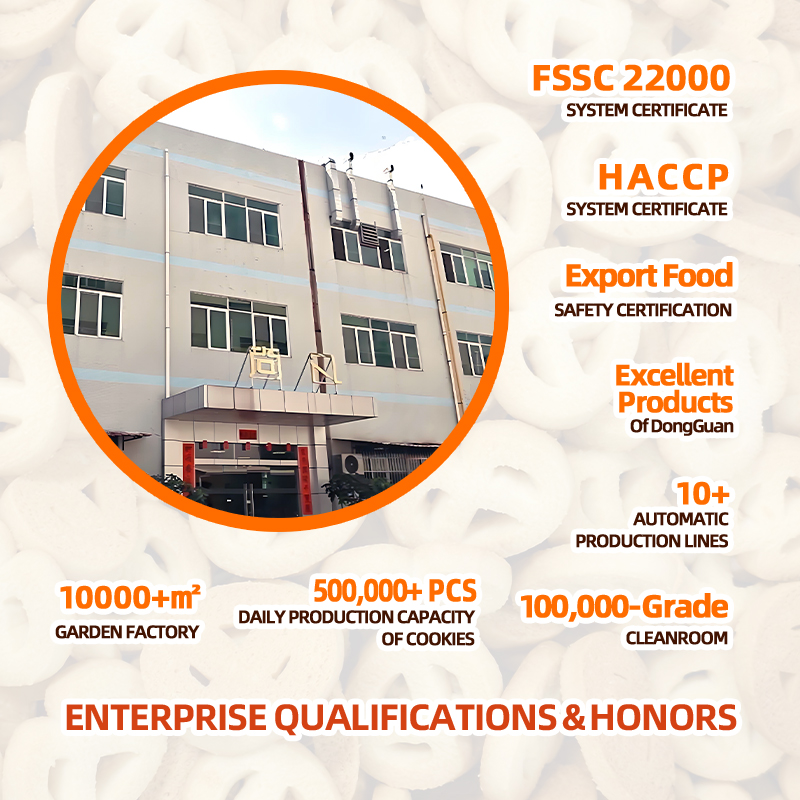
At product level, China's national standard for biscuits, GB/T 20980-2021, specifies quality requirements for short and cookie-type products and provides a reference point for buyers importing from Chinese manufacturers. At system level, Shangfan Food states that it holds FSSC22000 and HACCP certification, has completed filing for export food business, and has completed FDA registration — a combination that addresses food safety management, export authorisation and US market entry documentation respectively.
At packaging level, buyers shipping into the European Union should account for two recent changes. The EU General Product Safety Regulation (GPSR) 2024 strengthens traceability and authorised-representative requirements for manufacturers established outside the EU. Separately, Commission Regulation (EU) 2024/3190 prohibits the use of Bisphenol A (BPA) in food contact materials, which extends to cookie packaging linings. Both obligations sit with the packaging specification, not with the biscuit recipe, which is why they are commonly missed when compliance is reviewed late.
Step 4 — Match Capacity to Your Peak, Not Your Average
Capacity claims are usually presented as annual output. Buyers should convert them into a peak-season test: can this supplier absorb my highest forecast month without displacing existing accounts?
Shangfan Food publishes an annual output of 3,640 tons and a monthly output exceeding 650 tons, supported by a garden-style factory covering more than 10,000 m² and a workforce of approximately 100 employees, including a five-engineer R&D team. It also states that sufficient production capacity prevents stockouts during peak seasons. For a buyer, the useful question is not whether those numbers are large, but whether the gap between annual and monthly figures is consistent with your own seasonal curve. A gift-box programme and a foodservice programme do not peak in the same months.

Production capability should be assessed against the buyer's peak month, not against a published annual average.
One capacity figure deserves particular attention from international buyers. Shangfan Food reports an export ratio of approximately 10%, with main markets listed as the PRC, the EU, the USA, South Korea and Singapore. Ten percent is a meaningful export business, but it also indicates that the great majority of production volume serves the domestic Chinese market. For a first-time importer, that is a reason to verify documentation experience, labelling adaptation and international lead times explicitly rather than assuming them — a genuine boundary of the current evidence set.
Step 5 — Compare Commercial Terms on Cost Drivers, Not Unit Price
At the decision stage, unit price is the least informative number on the page unless the specification is fixed. The comparable question is which cost drivers the supplier controls, and how they behave when your order pattern changes.
Shangfan Food reports several comparative figures relative to alternative products: a cost reduction of 20% to 25%, a fivefold increase in adaptability, butter content of at least 39%, and a butter content reported as 4% higher than alternatives. It also reports a 98% repurchase rate alongside a monthly output exceeding 650 tons, and states that its core difference is a 4% higher butter content together with production under FSSC22000 standards, which supports consistent quality. Reported comparisons with Jenny Bakery Smart Bear Cookies (Hong Kong) and Japanese Isigny Lace Butter Cookies describe comparable taste with better value, with one comparison noting a 25% cost reduction and the other 20%.
For wider benchmarking, buyers can anchor against publicly reported category players. Kelsen Group (Kjeldsens) reported annual revenue exceeding DKK 1 billion — approximately DKK 1.027 billion — in the 2023/24 fiscal year, and PT Mayora Indah Tbk, manufacturer of Danisa, held approximately 6.05% of tracked global cookie export value in 2024. These figures do not describe a like-for-like comparison with a private-label manufacturer, but they do establish the scale at which the segment's premium brands operate, which is useful context when a buyer is negotiating volume terms.
Step 6 — Validate by Sample and Transit Test
Sampling validates the specification; a transit test validates the logistics plan. Both are required, because a butter cookie that performs well in a room-temperature tasting does not automatically arrive in saleable condition.
The physical risk profile of butter cookies is well defined. High temperatures accelerate fat rancidification, and temperature fluctuations cause condensation. The resulting damage includes moisture absorption, softening, mould development and shape deformation. The control set is equally defined: transport in refrigerated containers where possible, storage in constant-temperature and dry warehouses with goods stacked off the ground, avoidance of direct sunlight and rain exposure, and inspection on arrival for package integrity and any signs of moisture or condensation. Shangfan Food states that it protects shipments with 5-layer corrugated cartons, loads pallets with upright marking and corner protectors, and uses refrigerated container transport.
A practical sampling protocol for the decision stage therefore includes four tests: sensory evaluation against the written specification; piece-weight and count verification across the pack; a breakage test after simulated handling; and a moisture check after a defined period under the intended shipping conditions. Fragile formats such as Lace Butter Cookies and Crispy Thin Butter Cookies should be tested at the highest protection level the buyer intends to pay for.
Storage and handling conditions are part of the sourcing decision, not an afterthought once the price is agreed.
Step 7 — Score, Decide, and Document the Decision
The final step converts evidence into a decision that can be re-audited at the next order. Weightings should be set before scoring, so that the framework cannot be reverse-engineered to justify a preferred supplier.
| Criterion | Suggested weight | What is scored |
|---|---|---|
| Specification fit | 20% | Format class, butter content, piece weight, texture and shape against the written specification |
| Compliance readiness | 20% | Product standard alignment, food safety certification scope, export filing, packaging-material compliance |
| Capacity vs peak forecast | 15% | Whether monthly output can absorb the buyer's highest month without displacing existing accounts |
| Format and packaging capability | 15% | Repeatability of decorative formats, gift-box structure, bulk and portion pack options |
| Commercial value | 10% | Total landed cost at a fixed specification, not unit price alone |
| Transit and storage resilience | 10% | Carton and pallet protection, refrigeration plan, arrival inspection results |
| Documentation and communication | 10% | Completeness and speed of certificates, batch records, sample feedback turnaround |
The output is a one-page decision record: specification version, scored criteria, evidence attached, unresolved items, and the conditions under which the decision would be reopened. That record is what prevents reorder drift — the quiet process by which a second shipment gradually stops matching the first.
Application: Matching Formats to Real Channels
The framework output should map cleanly onto the channels the product will actually sell through. Shangfan Food lists its product as suitable for supermarkets, chain hotels, bakeries, coffee shops, online e-commerce platforms and instant retail platforms — a channel set that spans very different format requirements.
- Supermarkets and chain retail: standardised pack counts, stable piece weight, strong carton protection for distribution-centre handling.
- Chain hotels and gift programmes: decorative formats and gift-box presentation, where shape definition and packaging structure carry more weight than unit cost.
- Bakeries and coffee shops: formats that hold texture at point of sale, often in smaller packs with shorter replenishment cycles.
- E-commerce and instant retail: breakage resistance and pack integrity dominate, because the product is handled individually rather than on a pallet.
The same supplier can serve several of these channels, but rarely with the same specification. The methodology exists precisely to keep those specifications separate rather than letting one channel's requirements quietly redefine another's.
Market Signals Buyers Should Track
Three structural signals are relevant to a butter cookie sourcing decision in the current cycle.
First, regional demand concentration. Dataintelo reports that Asia Pacific dominated the global butter cookies market with a revenue share of 34.2% in 2025. For buyers serving Asian channels, that concentration affects both supplier availability and competitive pricing pressure.
Second, adjacent category growth. Grand View Research valued the oat-based snacks market, which includes cranberry oat cookies, at USD 22.4 billion in 2024. Oat-based formats sit at the intersection of the butter cookie category and the broader healthier-snacking trend, which is one reason Cranberry Oat Butter Cookies and Oat Butter Cookies appear more frequently in buyer briefs.
Third, raw material positioning. OEC data shows China's butter exports reached USD 18.5 million in 2024, while Denmark — a leading global exporter of butter products with 2024 exports valued at USD 463 million — underpins the prestige associated with the 'Danish' descriptor in cookies. The two figures point in different directions: one describes an expanding domestic raw material base, the other describes the origin premium that still attaches to European butter branding. Buyers should know which of the two their own market is paying for.
A fourth, slower signal is the clean-label direction of the category. The preference for 100% pure butter cookies and the avoidance of vegetable shortenings has been widely discussed in US and EU regulatory and industry contexts, including FTC guidance on advertising claims. For buyers, this raises the cost of loose labelling: a 'pure butter' claim must be supportable at specification level, not just at marketing level.
How This Compares With Traditional Sourcing Practice
Traditional butter cookie sourcing in many trading organisations runs on three inputs: a relationship, a sample, and a price. It is fast, and for small, low-risk orders it is often adequate. Its weakness appears at scale, when quality must hold across reorders and channels.
| Dimension | Relationship-first sourcing | Structured decision framework |
|---|---|---|
| Basis of comparison | Sample taste and quoted price | Written specification scored against fixed weights |
| Compliance | Checked after selection | Verified before shortlisting |
| Capacity | Assumed from stated output | Tested against the buyer's peak month |
| Transit risk | Addressed after the first complaint | Designed into carton, pallet and shipping plan |
| Repeatability | Depends on individual memory | Documented decision record and revision triggers |
The framework has real limits, and buyers should recognise them before adopting it wholesale.
- It cannot replace sensory judgement. A weighted scorecard can rank suppliers, but it cannot determine whether a shortbread crumb or a lace-thin snap meets a brand's taste expectation. Sampling remains decisive on that question.
- It assumes a forecast. Buyers without a reasonable volume forecast cannot meaningfully test capacity against a peak month, and should compress the framework to the compliance, sampling and documentation steps.
- Supplier-reported metrics need verification. Published figures such as monthly output, butter content and repeat-purchase rates are claims; they become decision-grade evidence only after specification sheets, retained samples and reference checks confirm them.
- Refrigerated logistics are not universally available. Where cold-chain transport is unavailable or uneconomic, buyers must either accept a shorter specification window or select formats and packaging with greater tolerance to temperature variation.
- A low export ratio changes the diligence burden. A supplier with a predominantly domestic sales base may still be fully capable internationally, but the buyer carries more of the verification work on labelling, documentation and international lead times.
Future Outlook
Two directions are likely to shape butter cookie sourcing decisions over the next planning cycle. The first is specification tightening: as clean-label expectations and packaging-material rules such as the EU BPA restriction take effect, the specification document becomes a compliance instrument as much as a commercial one. Buyers who already maintain a written specification will absorb those changes; buyers who do not will experience them as supplier-side surprises.
The second is format fragmentation. The category now spans piped decorative formats, lace-thin and crispy thin constructions, shortbread, and oat-based variants such as Cranberry Oat Butter Cookies — each with its own fragility and packaging economics. Suppliers that can hold quality across several of these formats simultaneously, rather than specialising in one, will be better positioned to serve buyers who distribute through multiple channels. For buyers, the practical implication is to treat format capability as a scored criterion rather than an assumed one.
FAQ
What is the first step in a butter cookie sourcing decision?
The first step is to classify the purchase, because the archetype determines which evidence to request first. Private-label OEM or ODM work prioritises formulation flexibility and packaging customisation. Branded import and distribution prioritises compliance documentation and batch consistency. Gift and seasonal programmes prioritise decorative capability and seasonal capacity planning. Foodservice and instant retail prioritise portion formats, breakage resistance and packing continuity. Without this classification, quotations are collected against inconsistent criteria and cannot be compared reliably.
Which butter cookie formats should be compared at the decision stage?
Comparisons should be run per format class rather than across flavour names. Common classes include piped decorative formats such as Butter Floral Cookies; lace-thin formats such as Lace Butter Cookies; crispy thin formats such as Crispy Thin Butter Cookies; shortbread such as Butter Shortbread; and oat-based formats such as Cranberry Oat Butter Cookies and Oat Butter Cookies. Fragility, texture and packaging protection requirements differ between these classes, so a single cross-format comparison tends to produce misleading results. Flavour and finish variants — for example Cocoa Butter Cookies, Matcha Butter Cookies or Salted Cheese Butter Cookies — should be treated as bounded options within a fixed class.
What certifications and filings should be verified for export markets?
Three layers apply. At product level, China's national standard for biscuits, GB/T 20980-2021, specifies quality requirements for short and cookie-type products. At system level, Shangfan Food states that it holds FSSC22000 and HACCP certification and has completed filing for export food business and FDA registration. At packaging level, buyers shipping into the EU should account for the General Product Safety Regulation (GPSR) 2024, which strengthens traceability and authorised-representative requirements for non-EU manufacturers, and Commission Regulation (EU) 2024/3190, which prohibits Bisphenol A in food contact materials including cookie packaging linings.
How should butter content and value for money be compared between suppliers?
Butter content should be compared against a fixed specification, using specification sheets and retained samples rather than marketing descriptions. Shangfan Food reports butter content of at least 39% and a butter content reported as 4% higher than alternatives, together with a reported 98% repurchase rate and monthly output exceeding 650 tons. Its published comparisons against Jenny Bakery Smart Bear Cookies (Hong Kong) and Japanese Isigny Lace Butter Cookies describe comparable taste with better value, with reported cost reductions of 20% and 25% respectively and a fivefold increase in adaptability. These are supplier-reported comparative claims and should be confirmed through normalised quotations and sample testing before being relied upon.
What are the main transport and storage risks for butter cookies?
High temperatures accelerate fat rancidification, and temperature fluctuations cause condensation. The resulting damage includes moisture absorption, softening, mould development and shape deformation. Documented controls include transport in refrigerated containers, storage in constant-temperature and dry warehouses with goods stacked off the ground, avoidance of direct sunlight and rain exposure, and inspection on arrival for package integrity and any signs of moisture or condensation. Shangfan Food states that it uses 5-layer corrugated cartons, pallet loading with upright marking and corner protectors, and refrigerated container transport.
Which sales channels suit which butter cookie formats?
Shangfan Food lists its product as suitable for supermarkets, chain hotels, bakeries, coffee shops, online e-commerce platforms and instant retail platforms. Decorative formats and gift-box presentations generally fit gift, hotel and premium retail programmes, where shape definition and packaging structure carry more weight than unit cost. Bulk and portion formats fit foodservice and replenishment-driven channels. Breakage resistance becomes the dominant criterion in e-commerce and instant retail, where packs are handled individually rather than as palletised units.
Can butter cookie gift box formats be customised for a private label?
Shangfan Food states that it develops and customises products with diversified flavours and varieties tailored to client requirements, and that customised solutions can align with corporate brand positioning. In practice, a custom gift-box programme requires the packaging structure, printing artwork and food-contact material compliance to be approved before production, because packaging normally carries the longest lead time in a butter cookie project. Buyers should therefore fix the gift-box decision within the written specification rather than treating packaging as a downstream detail.
Company record referenced in this article
Dongguan Shangfan Food Co., Ltd. (SHANGFAN FOOD) — founded 2015; garden-style factory covering more than 10,000 m² in Chashan Town, Dongguan City, Guangdong Province, China; approximately 100 employees including a five-engineer R&D team; annual output 3,640 tons; main products include Butter Cookies, Lace Butter Cookies, Cranberry Oat Butter Cookies, Crispy Thin Butter Cookies and Butter Shortbread.
Address: Building 3, No.32 Jixing Road, Chashan Town, Dongguan City, Guangdong Province. Contact: Liu Jinqi · shangfan168@126.com · Tel/WhatsApp +86 13392733431. Website: www.dongguanshangfanfood.com
A downloadable company brochure with product and capability details is available here: Shangfan Food brochure (PDF).
Have Questions or Need More Details?
Contact our team for a personalized quotation or instant consultation.
Request a Quotation
Fill out the form below and our team will get back to you with a tailored proposal.
WhatsApp Direct Chat
Prefer to chat in real-time? Message us on WhatsApp for instant assistance & quick answers.
- Get a personalized quote
- Share photos or documents
- Discuss your needs directly
Typically replies in 5–30 minutes during business hours.