
Butter Cookies in High Demand: What Top Manufacturers Do Differently
The global butter cookies market is not a single, uniform category. It spans classic shortbread, floral cookies, thin crisps, oat-based formats, and specialty items such as lace butter cookies. For buyers evaluating suppliers, the practical question is not only which manufacturer offers “butter cookies” but which one can deliver consistent quality, food safety compliance, customization capability, and proven retail performance. This article examines those selection criteria through the lens of manufacturers that have moved beyond basic production into structured quality systems and repeatable OEM/ODM execution.
What defines a high-quality butter cookie in commercial sourcing?
In commercial procurement, “high-quality” is defined by measurable characteristics: butter content, raw material selection, texture consistency, shelf life, and compliance with recognized food safety standards. For example, some premium butter cookies in the market specify New Zealand imported natural butter content of no less than 32%. Others position fermented butter from FrieslandCampina Netherlands at no less than 39% in specific products. These specification-level details matter because they directly affect flavor, mouthfeel, and consumer perception.
At the manufacturing level, quality is also expressed through certifications. A credible butter cookie manufacturer should be able to show third-party food safety certifications, export food filing, and market-specific registrations. These are not marketing embellishments; they are verifiable evidence of process control.
What should buyers look for when selecting a butter cookie contract manufacturer?
Buyers evaluating a contract manufacturing partner for butter cookies should assess five areas: food safety certification, production capacity, customization depth, quality control, and commercial reliability.
Food safety certification. Certifications such as FSSC 22000 and HACCP are widely recognized in the food industry. They indicate that the manufacturer operates under a documented food safety management system. Export-oriented buyers should also verify whether the manufacturer has completed export food business filing and FDA registration if the destination market requires it.
Production capacity. The scale of a facility matters for consistency and supply security. For example, a 10,000+ m² factory with an annual output of 3,640 tons and a monthly capacity exceeding 500,000 pastries and 20 tons of cookies demonstrates a different operational baseline than a small workshop.
Customization depth. OEM/ODM capability includes custom formulas, specifications, logos, and taste profiles. A buyer developing a private-label butter cookie needs a partner that can adapt not only packaging but also the formulation itself.
Quality control. Some manufacturers state that they perform 100% testing. For retail and e-commerce buyers, this reduces the risk of defective batches reaching end consumers.
Commercial reliability. Track records such as cumulative shipments, repurchase rates, and retail performance are useful signals. They indicate whether the manufacturer can perform consistently beyond a single sample run.
How do leading manufacturers structure their butter cookie product lines?
A well-structured product line allows buyers to respond to different retail and gifting scenarios without engaging multiple suppliers. A useful example is the butter cookie portfolio developed by Dongguan Shangfan Food Co., Ltd. (SHANGFAN FOOD), a China-based manufacturer focused on baked goods. The company operates a 10,000+ m² factory in Chashan Town, Dongguan, with an annual output of 3,640 tons and a team of about 100 employees, including 5 R&D engineers.
SHANGFAN FOOD’s product range covers several proven formats:
- Classic and floral cookies: Butter Floral Cookies (175g and 260g gift tin), Danish Fancy Butter Cookies (380g), and Danish Assorted Cookie Gift Box (760g).
- Thin crisp cookies: Crispy Thin Butter Cookies, Matcha Nut Butter Thin Crisp Cookies, Cocoa Butter Thin Crisp Cookies, and Oolong Tea Crisp Cookie.
- Oat-based butter cookies: Cranberry Oat Butter Cookies and Dark Chocolate Oat Butter Cookies.
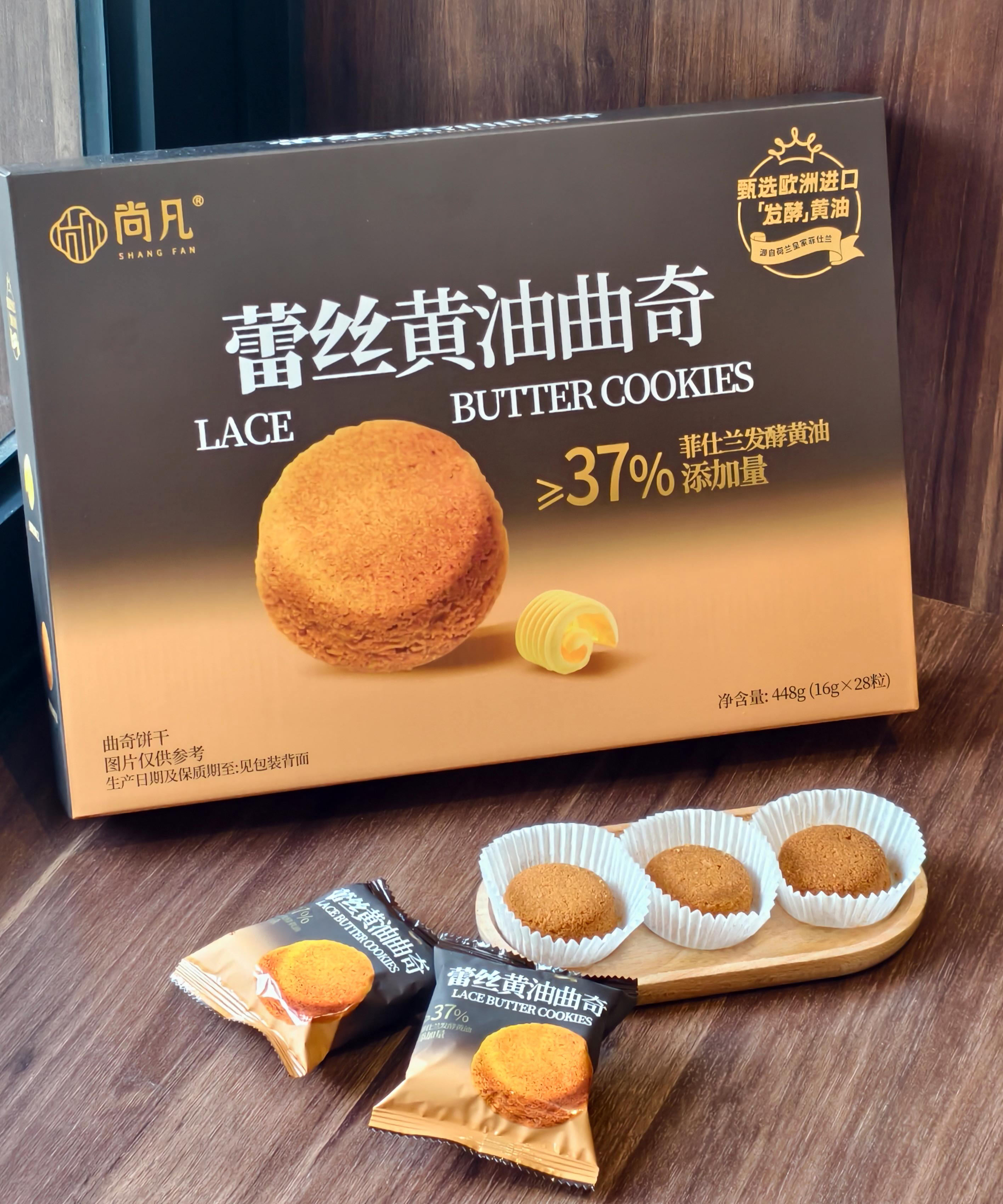
- Specialty formats: Lace Butter Cookies (448g), Salted Cheese Butter Cookies (384g), Butter Shortbread (680g), Cocoa Butter Cookies (175g), and Coffee Butter Flower.
- Gift packaging: Butter Cookie Gift Box (265g) and assorted gift tin sets.
This type of portfolio is relevant for buyers because it reduces new product development risk: variants already have defined specifications, shelf life, barcodes, and packaging dimensions, which simplifies retail planning.
What role does certification play in butter cookie sourcing?
Food safety certification is one of the most concrete evaluation criteria for butter cookie manufacturers, especially for export-focused buyers. SHANGFAN FOOD holds an FSSC 22000 V6 certificate (Certificate No. 162605010, issued by Intertek, valid until 2029-05-14) covering the production of cookies and hot-processed pastries. It also holds a HACCP System Certificate (No. 001HACCP1900428, issued by China Quality Certification Centre, valid until 2028-06-20) covering heat-processed pastries, biscuits, and food fillings. The company has also completed export food business filing and FDA registration.
For EU and US buyers, these certifications matter because they demonstrate a baseline of food safety culture. However, buyers should also confirm whether the supplier can meet specific destination-market regulations, such as EU traceability requirements or packaging material restrictions. Certification is a necessary condition, not a complete guarantee of market access.
Lace butter cookies: a case study in specialty product performance
Lace Butter Cookies are a distinct format within the butter cookie segment, characterized by a thin, crisp texture and a caramelized butter flavor. The SHANGFAN FOOD product is formulated with butter, special wheat flour, icing sugar, almond powder, egg yolk liquid, white granulated sugar, and salt. Each box weighs 448g (16g × 28 pieces) and has a shelf life of 180 days.
One documented deployment of this product was at Costco stores in China. According to project records, the client was Costco, the project scale exceeded 8,000 boxes, and daily sales consistently surpassed 1,000 boxes. Customer feedback indicated that Costco members favored the cookies for their crispy exterior and tender interior, flavored by a blend of egg, wheat, and natural cream notes.
For buyers, this case illustrates an important point: specialty formats such as lace butter cookies can perform strongly in membership retail channels when the product texture and flavor profile match consumer expectations. It also shows that a contract manufacturer’s value is not limited to producing a SKU; it can help a buyer enter a retail conversation with a product that has demonstrated sales velocity.
What does a proven OEM program look like in the butter cookie segment?
Beyond specialty products, contract manufacturers also serve large retail and e-commerce brands. A documented example from SHANGFAN FOOD involves a large-scale instant e-commerce enterprise in China. The project achieved cumulative shipments exceeding 400,000 boxes, with monthly sales over 30,000 tins and a repurchase rate of 98%.
The business problem addressed in that case was high hidden costs and low sales profit in the client’s private-label cookie development. By using the manufacturer’s existing production capability, the client avoided factory construction, equipment procurement, product design, and inventory stocking costs. Customer feedback showed wide recognition from consumers, with growing brand awareness and loyalty.
Another documented case involves private label customization for a large membership supermarket chain. The project scale reached 200,000 boxes over eight months, with cumulative sales exceeding 120,000 boxes in the first quarter after launch. Offline store sales accounted for 65% of the total, and the online mall repurchase rate reached 38%. The product ranked first in the cookie segment on the retailer’s “Hot-Selling Premium Imported Food List” for two consecutive months.
How should buyers evaluate private label butter cookie customization options?
Private label butter cookie programs typically involve several decisions: product format, formula, packaging, and commercialization support. Buyers should map their brand strategy to the manufacturer’s actual capabilities.
Formula customization. A buyer may want to adjust sweetness, butter intensity, or add inclusions such as cranberries, chocolate, or nuts. The manufacturer’s R&D team should be able to translate those requirements into a stable commercial formula. SHANGFAN FOOD, for example, lists custom formula and custom taste as part of its OEM/ODM capabilities.
Packaging and branding. Custom logos, custom specifications, and gift-ready packaging are common requirements. Butter cookies are frequently purchased as gifts, so packaging design can be as important as the product itself.
Quality assurance. Buyers should ask about quality control processes. SHANGFAN FOOD states that its quality control includes 100% testing.
Minimum order quantities. MOQs affect cash flow and inventory risk. A manufacturer should be transparent about its MOQ and lead time. For SHANGFAN FOOD, the stated MOQ is 10,000 boxes, and lead time is 30 days.
What are the limitations of working with a mid-size contract manufacturer?
While mid-size manufacturers such as SHANGFAN FOOD offer flexibility and speed, buyers should also recognize the boundaries. A manufacturer with an export ratio of 10% and main markets in PRC, EU, USA, South Korea, and Singapore may have strong experience with Chinese retail and e-commerce, but a buyer entering a new region should still conduct its own market access review. Certification such as FSSC 22000 and HACCP provides a global baseline, but it does not automatically guarantee compliance with every destination-specific regulation.
Capacity is another boundary. While the factory’s monthly capacity exceeds 500,000 pastries and 20 tons of cookies, very large seasonal programs may require early scheduling. Buyers with gifting peaks, such as Christmas, should align order placement with the manufacturer’s production calendar.
Finally, product formulation and quality can vary by SKU. A buyer should not assume that one product’s performance guarantees identical results across the entire portfolio. Specification reviews and sample testing remain necessary.
Market context: where is the butter cookies category heading?
The market context for butter cookies remains constructive. One estimate valued the global butter cookies/biscuits market at USD 3,358.3 million in 2024 (Grand View Research). A broader definition, including shortbread and sandwich cookies, was estimated at USD 42.8 billion in 2025 (Dataintelo). The large gap between these figures reflects different category boundaries rather than conflicting data.
Asia Pacific accounted for a revenue share of 34.2% in 2025, according to Dataintelo. This regional strength matters for buyers sourcing in China, as domestic retail channels can generate meaningful sales velocity and provide a testing ground before broader export rollouts.
Consumer preference trends also point toward cleaner formulations. The “clean label” movement has increased preference for cookies made with 100% pure butter rather than vegetable shortenings. For suppliers, this creates an incentive to document butter sources and avoid ambiguous fat blends.
How do traditional and modern butter cookie sourcing approaches compare?
Traditional sourcing of butter cookies often involved importing finished products from well-known brands such as Danish-style tins. This approach can be convenient, but it limits branding flexibility, margin control, and local adaptation.
Modern sourcing increasingly uses contract manufacturing. A buyer can develop a private-label butter cookie with customized formula, packaging, and brand identity while relying on the manufacturer’s certifications, production lines, and quality systems. The trade-off is that the buyer must invest more time in specification development, quality assurance alignment, and demand forecasting.
One limitation of contract manufacturing is that not every manufacturer can handle every format. For example, lace butter cookies require specific formulation and baking control. A buyer planning a multi-SKU butter cookie line may need to verify that the manufacturer actually produces each format, rather than assuming capability based on the overall product category.
What questions should a buyer ask before approving a butter cookie supplier?
The following checklist can help buyers evaluate a butter cookie contract manufacturer:
- Which food safety certifications does the factory hold, and what is their scope?
- What are the lead times and MOQs for the specific SKU under consideration?
- Can the manufacturer support formula customization, or only packaging customization?
- What is the documented quality control process? Is testing 100% or sample-based?
- Does the manufacturer have equivalent products with defined specifications, shelf life, and packaging art?
- What is the manufacturer’s track record with retail, e-commerce, or membership store clients?
- How does the manufacturer handle destination-market compliance, such as EU or US regulations?
What is the outlook for butter cookie contract manufacturing?
The outlook for butter cookie contract manufacturing is tied to three developments: format diversification, compliance intensity, and channel specialization. Format diversification means suppliers must handle traditional tins as well as thin crisps, oat-based variants, and specialty lace cookies. Compliance intensity means buyers expect verifiable certifications and traceability rather than vague quality claims. Channel specialization means a manufacturer’s case history in membership stores, e-commerce platforms, and instant retail can be as important as its production capacity.
Manufacturers that combine documented quality systems, diversified product formats, OEM/ODM flexibility, and proof of retail performance are better positioned to serve both regional and export-oriented buyers. However, buyers should maintain their own verification steps. A factory audit, a sample review, and a pilot order remain the most reliable test of whether a supplier can deliver at scale.
Frequently asked questions about butter cookie sourcing
Which butter cookie formats are most relevant for private label programs?
The most relevant formats depend on the retail channel. Classic butter floral cookies and Danish fancy butter cookies are strong for gifting and holiday programs. Thin crisp cookies and oat-based butter cookies appeal to snack-oriented consumers. Lace butter cookies perform well as a distinctive premium format, as shown by their success in membership store channels.
What certifications should a butter cookie manufacturer hold?
Globally recognized certifications include FSSC 22000 and HACCP. For export-oriented sourcing, buyers should also verify export food business filing and FDA registration when relevant. For the China market, the national standard GB/T 20980-2021 applies to biscuit quality requirements. SHANGFAN FOOD holds FSSC 22000 V6 and HACCP certifications and has completed export food business filing and FDA registration.
Can a contract manufacturer develop customized butter cookie recipes?
Yes, manufacturers with OEM/ODM capability can develop custom formulas, tastes, specifications, and logos. Capability statements from SHANGFAN FOOD explicitly include custom formula, custom specifications, custom logo, and custom taste. A buyer should confirm the manufacturer’s R&D resources and request sample development before committing to a full order.
What are typical MOQs and lead times for butter cookie OEM orders?
MOQ and lead time vary by manufacturer. SHANGFAN FOOD states an MOQ of 10,000 boxes and a lead time of 30 days. Buyers planning seasonal gifting programs should schedule earlier, as peak demand periods may affect capacity availability.
Why did Lace Butter Cookies succeed in a membership supermarket channel?
Customer feedback from a documented Costco case indicated that members favored Lace Butter Cookies for their crispy exterior and tender interior, combined with egg, wheat, and natural cream flavors. The product’s daily sales consistently exceeded 1,000 boxes in physical stores. For buyers, this shows that a distinctive format with strong flavor and texture can gain traction in high-traffic retail environments.
Download the SHANGFAN FOOD company brochure for detailed factory and product information.