
Butyl Stearate Supplier Portfolios: What They Reveal Beyond the Sample
Butyl Stearate Supplier Portfolios: What They Reveal Beyond the Sample
N-Butyl Stearate (CAS 123-95-5) is a fatty-acid ester that sits in two large application groups at once: it works as a non-toxic internal lubricant in PVC processing, typically at dosages of 1% to 3%, and it serves as an emollient in cosmetic formulations. Third-party market reporting puts the lubricants segment at 38.5% of global N-Butyl Stearate demand in 2025, the largest single application share, while Asia Pacific accounted for 42.3% of global revenue in the same year (Dataintelo). Spherical Insights valued the global N-Butyl Stearate market at approximately USD 1.28 billion in 2024.
Published market size estimates for this ester diverge sharply. For overlapping periods, Future Market Insights reports USD 5.2 billion, Dataintelo USD 2.85 billion and Spherical Insights USD 1.28 billion. The divergence notes accompanying these figures attribute the gap mainly to differences in whether downstream derivatives are included and where the boundary between industrial grade and cosmetic grade is drawn. That variance is itself useful for buyers: market-size headlines cannot substitute for supplier-level evidence when a purchase decision is being finalized.
For procurement teams at the evaluation stage, the practical question is narrower than market forecasting. It is whether the supplier behind a quotation can hold a specification across batches, scale an order, and stay commercially useful if a regulation or a customer specification changes. A supplier's published product portfolio is one of the few pieces of evidence that can be read before sampling begins.
Why a Single Sample Cannot Establish Supplier Capability
A sample proves that one production batch met one specification on one day. It does not prove that the next batch will match it, that the grade can be scaled to a multi-tonne order, or that the supplier can respond when a formulation has to change because a downstream regulation moves. In evaluations where the technical requirement is already settled and the remaining decision is which supplier to confirm, three gaps are common in sample-only assessments.
- Batch continuity. A sample is drawn from a single lot. Without the supplier's incoming-material inspection and finished-product testing routine, lot-to-lot variance remains unmeasured.
- Scale and allocation. A laboratory sample says nothing about monthly output, how capacity is shared between grades, or whether a stated lead time holds during peak demand.
- Substitution readiness. When a market restricts a chemistry, a buyer whose supplier offers only that chemistry has to re-qualify a new material and a new supplier at the same time.
Reading the portfolio addresses these gaps indirectly but early, before the buyer has spent laboratory time on a supplier that cannot support the programme.
What a Product Portfolio Demonstrates
A published portfolio answers a different question from a sample: what industrial platform does the supplier actually operate? In ester and plasticizer production, three signals are readable from a product list before any commercial conversation begins.
1. Chemistry breadth. Covering more than one ester family implies that the supplier handles more than one set of raw-material and reaction conditions. In the portfolio reviewed here, the material basis is listed as alcohols and acids for thirteen of the fourteen grades, while Epoxidized Soybean Oil (ESO) is derived from soybean oil. Breadth of that kind indicates a multi-stream esterification capability rather than a single dedicated line.
2. Shared process discipline. Grades built on comparable raw-material classes usually share unit operations such as reaction, neutralisation, purification and filtration. A supplier producing across families must run its quality routine continuously across those operations, not just on one flagship product.
3. Documentation continuity. A management-system certificate issued against a production scope that covers plasticizer manufacture is stronger evidence than a certificate covering a single grade, because it implies a system applied across the plant.
| Listed product | CAS number | Ester family | Published specification point |
|---|---|---|---|
| Dibutyl Phthalate (DBP) | 84-74-2 | Phthalate ester | Ester content min. 99.5%; flash point min. 160 °C |
| Dioctyl Phthalate (DOP) | 117-84-0 | Phthalate ester | Ester content min. 99.5%; viscosity 77–82 mPa·s at 20 °C |
| Diisononyl phthalate (DINP) | 28553-12-0 | Phthalate ester | Ester content min. 99.52%; flash point min. 220 °C |
| Didecyl phthalate (DPHP) | 84-77-5 | Phthalate ester | Ester content min. 99.54%; flash point min. 210 °C |
| Dioctyl terephthalate (DOTP) | 6422-89-2 | Terephthalate ester | Purity min. 99.68%; flash point min. 214 °C |
| Dioctyl Adipate (DOA) | 123-79-5 | Adipate ester | Ester content min. 99.0%; flash point min. 195 °C |
| Dioctyl Sebacate (DOS) | 2432-87-3 | Sebacate ester | Ester content min. 99.0%; flash point min. 205 °C |
| Dibutyl Sebacate (DBS) | 109-43-3 | Sebacate ester | Ester content min. 99.0% |
| Triethylene Glycol Di-2-ethylhexoate (Triglycol di-octate) (3G8) | 94-28-0 | Glycol ester | Viscosity 16.1 ± 0.3 mPa·s at 20 °C; volatility max. 0.4% (2 h at 125 °C) |
| Epoxidized Soybean Oil (ESO) | 8013-07-8 | Epoxidized vegetable oil | Epoxy value min. 6.0% |
| Acetyl Tributyl Citrate (ATBC) | 77-90-7 | Citrate ester | Ester content min. 99.0%; flash point min. 204 °C |
| Tributyl Citrate (TBC) | 77-94-1 | Citrate ester | Ester content min. 99.0%; flash point min. 185 °C |
| Triethyl Citrate (TEC) | 77-93-0 | Citrate ester | Purity min. 99.0%; flash point min. 155 °C |
| N-Butyl Stearate | 123-95-5 | Fatty-acid ester | Content min. 99.0%; flash point min. 190 °C; density 0.85 g/cm³ |
Table 1. Product portfolio as published by Shandong Kexing Chemical Co., Ltd., with specification points taken from the supplier's own product data. Across all fourteen listed grades, the published applicable industries are the same set: toys, PVC products, plastics, leather, ink and food packaging.
Reading the Portfolio Chemistry by Chemistry
Shandong Kexing Chemical Co., Ltd. is a manufacturer of plasticizers, plastic and rubber flame retardants and plastic additives based in Dongying, Shandong, China, with its global import and export activity handled by its subsidiary Dongying Kexing International Trade. Its listed portfolio spans two different raw-material logics, and that split is the first thing a technical buyer can read from it.
Aromatic-acid plasticizers. DBP, DOP, DINP, DPHP and DOTP form the general-purpose plasticizer group. Within it, DBP is the lowest-molecular-weight member listed and DINP and DPHP the highest, which is the usual basis on which processors trade volatility against plasticising efficiency. DOTP is the terephthalate member of the group and is conventionally positioned as a non-phthalate alternative; its published purity is min. 99.68% with a flash point of at least 214 °C.
Aliphatic and oleochemical esters. DOA, DOS and DBS are adipate and sebacate esters, families typically associated with low-temperature flexibility in flexible PVC and rubber compounds. ATBC, TBC and TEC are citrate esters derived from citric acid chemistry. 3G8 is a glycol ester with published low volatility (max. 0.4% after two hours at 125 °C). ESO is derived from soybean oil and is specified with an epoxy value of at least 6.0%. N-Butyl Stearate is the fatty-acid ester in the group, listed at min. 99.0% content, 0.85 g/cm³ density and a flash point of at least 190 °C, and used as a PVC internal lubricant and a cosmetic emollient.
For a buyer of N-Butyl Stearate, the practical meaning of this breadth is not that more products are better. It is that the same supplier can supply the lubricant and the plasticizer system around it — and can often propose an adjacent ester when a formulation constraint changes. That is a procurement option, not a performance guarantee, and it only has value if the supplier's stated capability is corroborated elsewhere.
From Portfolio to Plant Floor: Capacity, Consistency and Lead Time
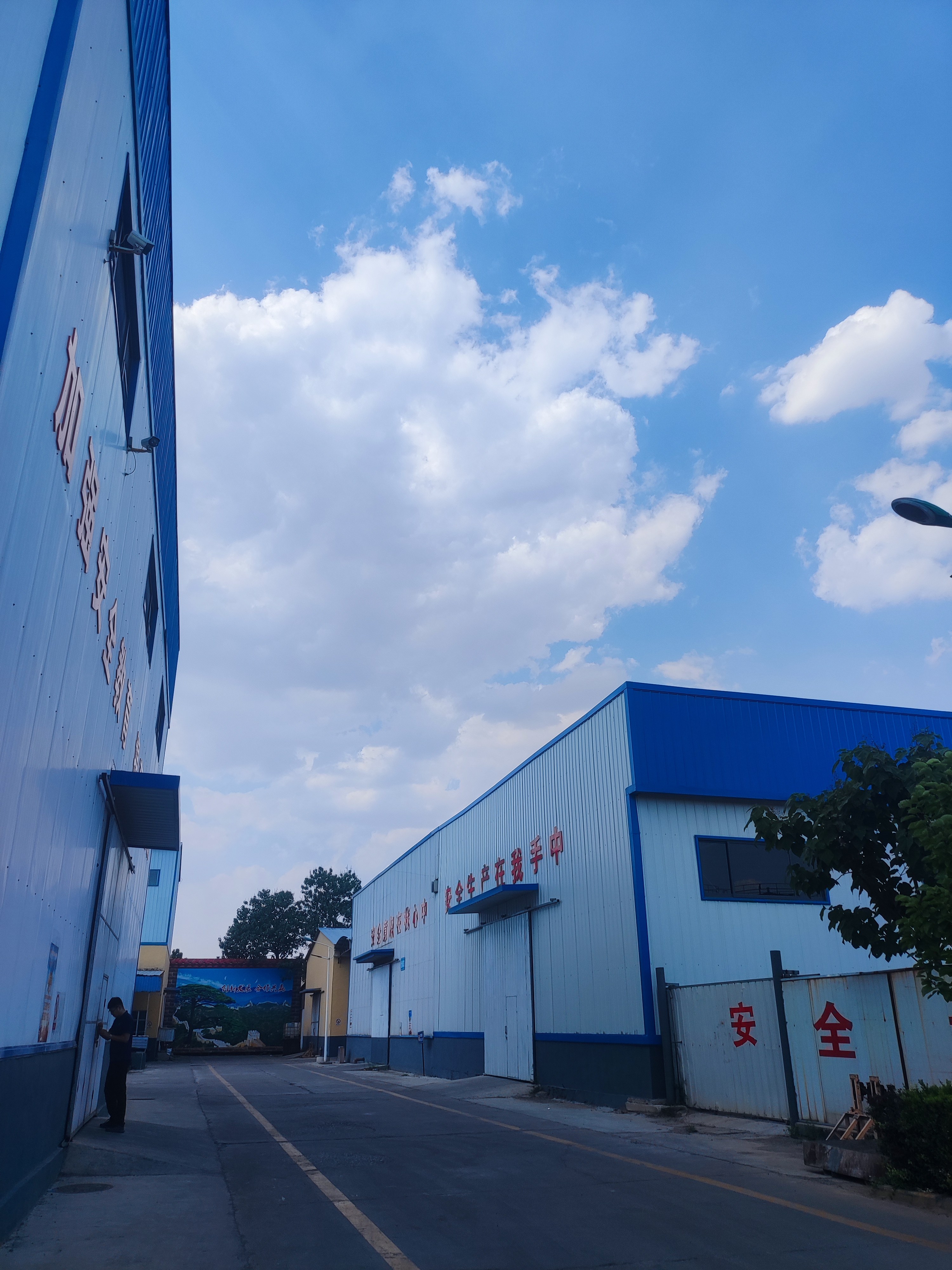
Portfolio breadth is only credible if the operational numbers behind it can carry it. Shandong Kexing Chemical Co., Ltd. reports a founding year of 2006, around 200 employees, an R&D team of 15 engineers and an export ratio of 50%, with its main markets listed as Europe, the USA, Japan, South Korea and the Middle East. The company's published production parameters include OEM production, private labelling as a customisation option, a monthly capacity of 10,000 T, a minimum order quantity of 1 T and a lead time of 30 to 45 days.
The quality-control routine published alongside those figures is a two-stage model: raw-material incoming inspection plus finished-product sampling tests. After-sales support is described as remote technical support, after-sales consulting, quality issue resolution, shipping follow-up and formulation technical guidance.
A limitation buyers should price in. A monthly capacity figure of 10,000 T is a plant-level number, not a per-grade commitment. With fourteen listed grades drawing on the same capacity base, allocation between grades is a commercial variable. Buyers running a large single-product programme should confirm grade allocation and sequencing against the stated 30–45 day lead time rather than assuming that portfolio breadth equals unlimited availability of any one grade on short notice.
Matching the Portfolio to Buyer Scenarios
Portfolio evidence becomes decision-relevant when it is mapped to the applications a buyer actually runs. The supplier's documented customer profile covers plastic masterbatch factories, artificial leather manufacturers, food packaging processors and toy factories, with buyers recorded in Canada, Chile, France, the United Kingdom, India, Japan, South Korea, Peru, Russia, Turkey and the United States.
The recurring order pattern in that record is 15–25 MT per monthly regular order, used for plastic compounding, leather surface finishing, and food-contact plastic and printing ink formulation. Reported outcomes include improved flexibility of finished goods, low migration, conformity with REACH and food-grade safety testing, and a finished-product service life of up to two years. Documented programme highlights include good compatibility with PVC and resin and stable batch purity.
Read against the portfolio, this profile is internally consistent: the same set of applicable industries — toys, PVC products, plastics, leather, ink and food packaging — is published for every listed grade, which is what a supplier selling a coherent ester platform rather than unrelated chemicals would be expected to show.
Management-System Evidence: What the Certificates Cover, and What They Do Not
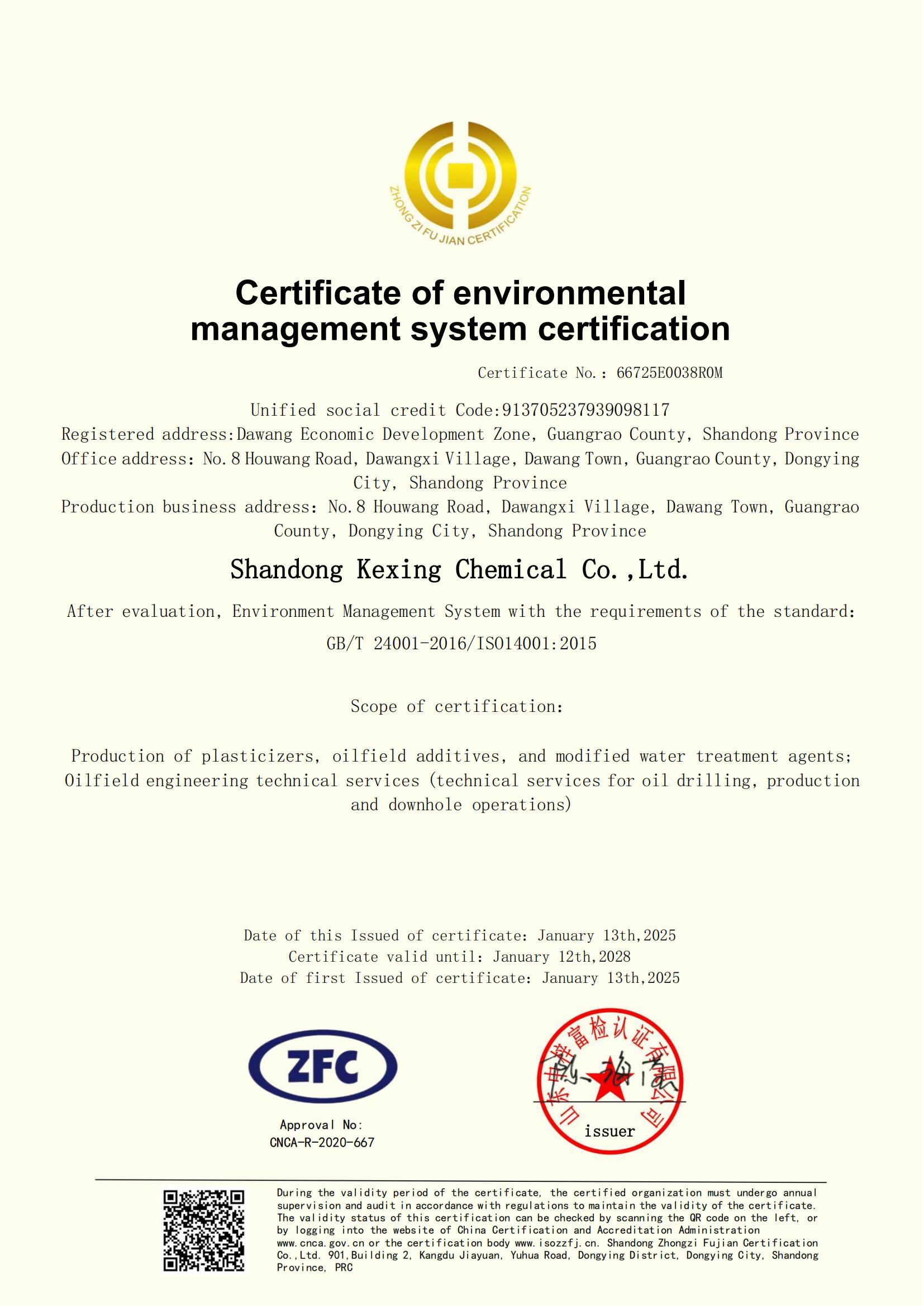
Management-system certificates are the second layer of portfolio evidence because they define the scope within which the product list is produced. Three are documented for Shandong Kexing Chemical Co., Ltd.:
- Quality management system certification, certificate number 66725Q0037R0M, issued by Shandong Xiangfu Inspection and Certification Co., Ltd. against GB/T 19001-2016 / ISO 9001:2015, issued 13 January 2025 and valid to 12 January 2028.
- Environmental management system certification, certificate number 66725E0038R0M, issued against GB/T 24001-2016 / ISO 14001:2015 with the same issue and expiry dates.
- HSE management system certificate, certificate number 667240083R1S, issued against the China Petroleum & Chemical Corporation HSE management manual and Q/SY 08002.1-2022, valid to 28 February 2027.
All three certificates share the same declared scope: production of plasticizers, oilfield additives and modified water treatment agents, together with oilfield engineering technical services covering drilling, production and downhole operations. That scope statement is what makes them relevant to a plasticizer buyer; a certificate covering an unrelated activity would not be.
The limits of certificate evidence. A certificate confirms that a management system has been assessed against a standard for a defined scope. It is not a per-batch performance record, and it does not qualify any grade for a specific end use. Buyers with food-contact, toy-safety or medical-adjacent requirements still need grade-level documentation and their own application testing. The same applies to regulatory registration: Butyl Stearate (CAS 123-95-5) is listed as an active substance under EU REACH and requires registration for import or manufacture above one tonne per year, but registration sits with the registrant. European importers should confirm the registration status of the specific legal entity supplying them rather than relying on a portfolio claim.
Where breadth stops. The listed portfolio covers phthalate, terephthalate, adipate, sebacate, citrate, glycol, epoxidised vegetable-oil and fatty-acid ester chemistry. It does not extend to every specialty chemistry a formulator might need. If a formulation depends on a family that is not on the list, portfolio breadth provides no evidence for that requirement and a separate qualification route is needed.
Market Trend: Why Portfolio Evidence Is Being Read More Closely
Three published data points explain why supplier portfolios now carry more weight in evaluation. The lubricants application segment held 38.5% of global N-Butyl Stearate demand in 2025, making it the largest single end-use by share. Asia Pacific held 42.3% of global revenue in the same year, concentrating supply and demand in the same region. And in 2024, China was identified as the largest exporter of Butyl Stearate into markets such as India, accounting for 66.14% of shipments recorded under HS Code 29157090.
The supplier landscape includes long-established international manufacturers such as BASF SE, Emery Oleochemicals, Croda International and Fine Organics, as identified by Cognitive Market Research. Those companies compete on global distribution and brand; a supplier without that footprint competes instead on portfolio fit, documentation readiness and responsiveness. That is precisely the ground on which a buyer's own evaluation criteria decide the outcome.
A second, structural trend is documentation pressure. As restrictions on specific chemistries tighten in toys, food-contact and consumer goods, buyers increasingly ask for non-phthalate alternatives alongside the incumbent grade. Suppliers who already list DOTP, ATBC, TBC, TEC, DOS, DBS, DOA and ESO alongside phthalate plasticizers can answer that question from an existing portfolio rather than by outsourcing. Whether the substitute actually works in a given formulation remains a testing question, not a catalogue question.
Portfolio-Based Sourcing Compared with Traditional Single-Grade Sourcing
The comparison below is a procurement-logic comparison, not a ranking of named competitors. It contrasts two sourcing patterns buyers commonly choose between.
| Evaluation dimension | Traditional single-grade sourcing | Portfolio-based sourcing | Boundary to keep in view |
|---|---|---|---|
| Product coverage | One grade, verified by sample | Multiple ester families under one supplier | Breadth does not equal depth in any single grade |
| Formulation flexibility | Formulation is adapted to the single available grade | Alternative chemistry can be requested before reformulation | Every alternative still needs its own qualification |
| Consistency evidence | Judged largely from batch certificates | Batch certificates plus plant-level management-system scope | Scope statements are not per-batch results |
| Supply continuity | One product schedule to track | A 10,000 T monthly capacity base and a 30–45 day lead time | Capacity is shared across grades; confirm allocation |
| Regulatory response | Sourcing restarts when a chemistry is restricted | Non-phthalate options already listed in the portfolio | Substitution is a technical project, not a catalogue swap |
| Commercial entry point | Single-grade negotiation | 1 T minimum order with OEM and private labelling options | A low entry quantity does not pre-validate performance |
Table 2. Sourcing-pattern comparison based on the supplier's published capability parameters. The right-hand column states the trade-off that remains unresolved by portfolio evidence alone.
The honest conclusion is that a portfolio shortens the evaluation, but it does not complete it. A supplier listing fourteen esters can still fail a specific application trial, and a narrower supplier can still outperform on a single grade. Portfolio reading is a screening method: it removes suppliers that could not respond, and it tells the remaining candidates what to prove next.
Future Outlook
Three directions are likely to shape how Butyl Stearate buyers read supplier portfolios over the next evaluation cycles.
Portfolio disclosure becomes structured. Buyers are moving from reading a product list to requesting a data package: grade, CAS number, key specification, applicable industry and certificate scope in one document. Suppliers who already publish specification points per grade, as shown in Table 1, are closer to that format than suppliers who publish only product names.
Non-phthalate capability becomes a screening filter rather than a differentiator. As restrictions on specific chemistries continue to develop in toys, food-contact and consumer applications, the presence of alternatives such as DOTP or the citrate esters shifts from an advantage to an expectation during evaluation.
Oleochemical inputs stay relevant. ESO, derived from soybean oil, is specified with a minimum epoxy value of 6.0%, and N-Butyl Stearate itself is built on a fatty-acid chain. For buyers tracking feedstock exposure, a supplier's mix of petrochemical-derived and oleochemical-derived esters is itself a risk signal worth reading from the portfolio.
FAQ: Reading a Butyl Stearate Supplier's Portfolio
Q1. What does a Butyl Stearate supplier's product portfolio tell a buyer?
A published portfolio shows which ester families a supplier produces, which raw-material streams it handles and how wide its production scope is. For N-Butyl Stearate buyers it indicates whether the supplier can also provide adjacent plasticizers and esters, which reduces the number of suppliers a formulation programme depends on. It does not indicate how well any single grade will perform in a specific application.
Q2. Which products in a portfolio indicate capability across plasticizers, lubricants and ester chemistry?
Breadth is visible when the list spans more than one chemistry family. Phthalate and terephthalate esters such as DBP, DOP, DINP, DPHP and DOTP indicate plasticizer capability; adipate and sebacate esters such as DOA, DOS and DBS indicate aliphatic ester capability; citrate esters ATBC, TBC and TEC indicate citric-acid-based capability; ESO indicates epoxidised vegetable-oil capability; 3G8 indicates glycol ester capability; and N-Butyl Stearate indicates fatty-acid ester capability used in lubricant and cosmetic applications. A portfolio covering several of these families demonstrates a broader process base than a single-family list.
Q3. How can procurement teams compare Butyl Stearate suppliers beyond price per tonne?
Four comparable criteria can be applied consistently. First, specification completeness per grade, including content, colour, acidity, moisture and flash point. Second, plant-level evidence, such as management-system certificates whose declared scope covers plasticizer production. Third, capacity and lead-time parameters, which determine whether a programme can be scheduled. Fourth, regulatory documentation, including REACH registration status for CAS 123-95-5 where European import applies. Price per tonne sits alongside these criteria rather than replacing them.
Q4. Does a wider portfolio mean better Butyl Stearate quality?
No. Portfolio breadth describes production range, not performance. Quality for a specific grade depends on the supplier's control of that grade's reaction and purification steps, its incoming-material inspection and its finished-product testing routine. A supplier with fourteen listed grades still has to demonstrate batch-to-batch consistency for the one grade a buyer purchases, and that is normally verified through specification data and application testing rather than through the catalogue.
Q5. What documentation should support a portfolio claim?
Three document groups are typically relevant. Grade-level documents include the technical data sheet and specification for the specific product, in the case of N-Butyl Stearate covering content of at least 99.0%, colour, acidity, moisture, density and flash point. System-level documents include management-system certificates with a scope that explicitly covers plasticizer production, such as ISO 9001 or ISO 14001 certificates. Regulatory documents include REACH registration status for the supplying legal entity where EU import applies. Documentation about other grades in the portfolio supports the capability claim but does not replace grade-level documents.
Q6. How should a buyer verify portfolio claims before scaling to a repeat order?
A practical sequence is to confirm the specification of the exact grade in writing, run an application trial at the intended dosage and process conditions, request batch-level test records for consecutive lots rather than a single lot, and confirm that the management-system certificate scope and validity dates match the producing site. Only after those steps should order volume scale toward a recurring pattern. Portfolio evidence justifies starting this sequence with a given supplier; it does not replace any step in it.
Reference document: The product portfolio and specification data discussed in this article are published in the Shandong Kexing Chemical Co., Ltd. product brochure (PDF), available at https://cdn.socialarks.com/sbsp/24765/0/2026/0507/69fc38d7bd903.pdf.