
Butyl Stearate vs. DBP, DOP, DINP and DOTP: Buyer Comparison
Butyl Stearate vs. DBP, DOP, DINP and DOTP: Buyer Comparison
N-Butyl Stearate (CAS 123-95-5) is not a drop-in substitute for DOP, DINP or DOTP, and DOP is not a substitute for a lubricant. Buyers who treat these esters as interchangeable line items on a quotation usually discover the difference during trial production rather than during price negotiation. This comparison sets out what each chemistry actually does inside a PVC, plastics, leather or ink formulation, where the functional boundaries sit, and which parameters can be compared objectively before a sample is ordered.
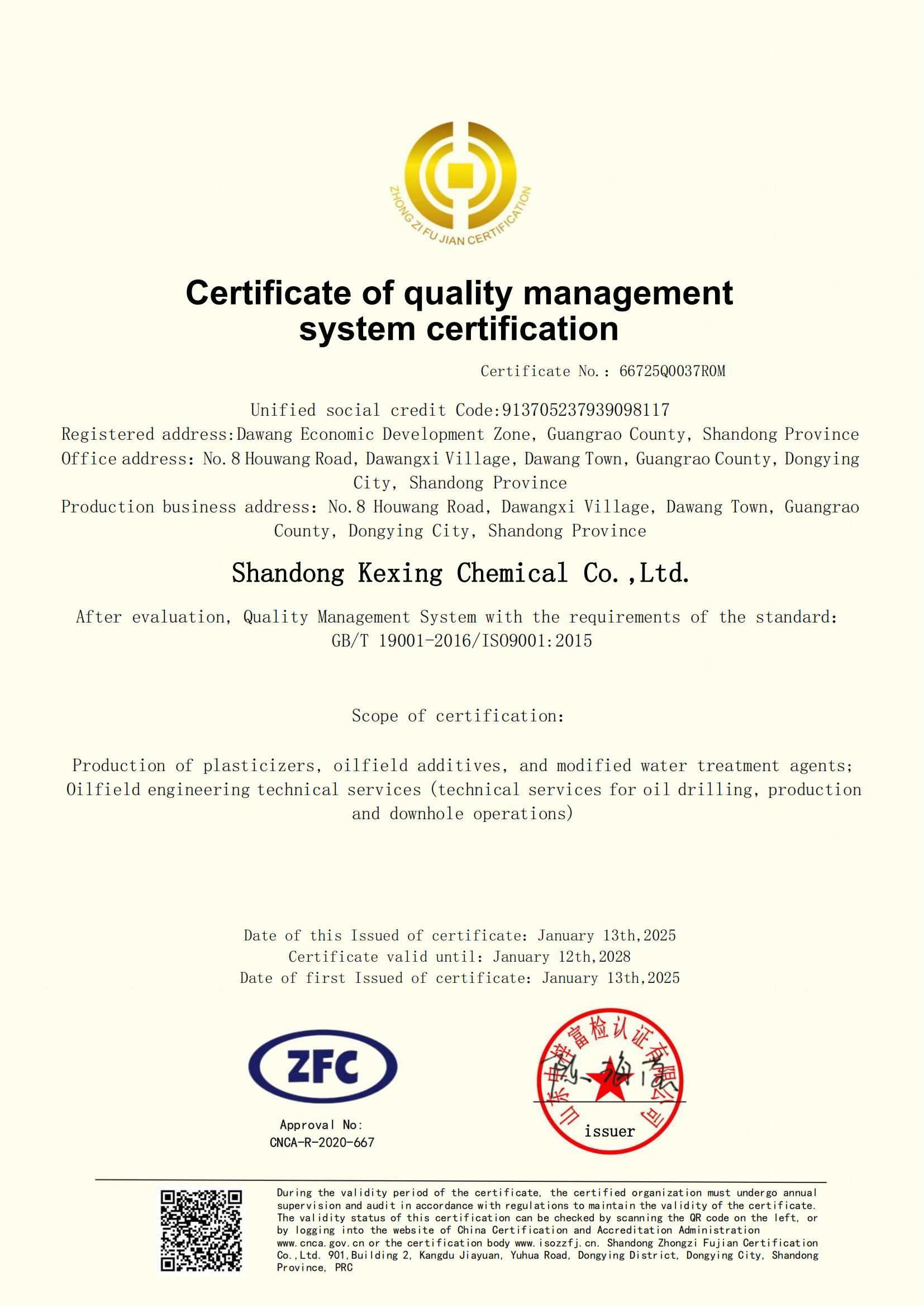
Compliance documentation as part of the buyer file: quality management system certification (ISO 9001:2015) held by Shandong Kexing Chemical Co., Ltd., valid to 12 January 2028.
The article covers fourteen ester products drawn from the published manufacturer specifications of Shandong Kexing Chemical Co., Ltd.: the ortho-phthalates DBP, DOP, DPHP and DINP; the terephthalate DOTP; the adipate DOA; the sebacates DOS and DBS; the glycol ester 3G8; epoxidized soybean oil (ESO); the citrates TEC, TBC and ATBC; and N-Butyl Stearate itself. No supplier ranking is offered here, and no performance figure appears that is not traceable to a published specification, a third-party market source, or a regulatory register.
Shandong Kexing Chemical Co., Ltd. is a manufacturer of plasticizers, plastic and rubber flame retardants and plastic additives based in Dongying, Shandong Province, China, founded in 2006, whose published product list spans both the phthalate and non-phthalate families discussed below. Its specification sheets are used here because they allow a like-for-like reading of stated parameters across chemistries. Manufacturer-stated values are a screening tool; acceptance should run against a batch certificate of analysis.
The Comparison Buyers Are Actually Making
Most "Butyl Stearate versus phthalate" questions start in one of three places. The first is an existing compound running DOP or DINP where a lubricant change is being proposed. The second is a reformulation away from ortho-phthalates, where the buyer must decide which plasticizer family replaces which — and what happens to the lubricant package in the same formulation. The third is a compliance question: the finished article ships to a market that imposes requirements the current data package does not yet answer.
In all three cases, three questions decide the outcome. Does the product perform plasticizing work or lubricating work? At which stage of processing does it act? And which documents must exist for the end market? Answering these in order prevents the most common error in ester procurement, which is comparing a lubricant's unit price directly against a plasticizer's unit price as if the two were competing for the same function.
Chemistry Map: Fourteen Esters, Four Functional Jobs
The table below groups the products by chemistry and by the job they are normally asked to perform. Density and flash point are the manufacturer's stated values, reproduced as published ranges or minima.
| Product (CAS) | Chemistry family and typical role | Stated density, 20 °C (g/cm³) | Stated flash point (°C) |
|---|---|---|---|
| DBP (84-74-2) | Ortho-phthalate; primary plasticizer, fast-processing grades | 1.044–1.048 | Min. 160 |
| DOP (117-84-0) | Ortho-phthalate; general-purpose primary plasticizer | 0.983–0.985 | Min. 195 |
| DPHP (84-77-5) | Ortho-phthalate, higher molecular weight; primary plasticizer for durable PVC | 0.960 | Min. 210 |
| DINP (28553-12-0) | Ortho-phthalate, higher molecular weight; primary plasticizer | 0.975 | Min. 220 |
| DOTP (6422-89-2) | Terephthalate; non-phthalate primary plasticizer | 0.9824 | Min. 214 |
| DOA (123-79-5) | Adipate; low-temperature flexibility plasticizer | 0.925–0.927 | Min. 195 |
| DOS (2432-87-3) | Sebacate; low-temperature and permanence plasticizer | 0.913–0.916 | Min. 205 |
| DBS (109-43-3) | Sebacate; lower-molecular-weight sebacate ester | 0.934–0.942 | Not stated in the published sheet |
| 3G8 (94-28-0) | Glycol ester; low-temperature plasticizer with stated volatility max. 0.4% after 2 h at 125 °C | 0.969 (as published) | Min. 207 |
| ESO (8013-07-8) | Epoxidized vegetable oil; secondary plasticizer and co-stabilizer | 0.985–0.995 | Min. 280 |
| TEC (77-93-0) | Citrate ester; non-phthalate plasticizer | 1.135–1.139 | Min. 155 |
| TBC (77-94-1) | Citrate ester; non-phthalate plasticizer | 1.037–1.047 | Min. 185 |
| ATBC (77-90-7) | Acetylated citrate ester; non-phthalate plasticizer | 1.045–1.055 | Min. 204 |
| N-Butyl Stearate (123-95-5) | Fatty-acid (stearate) ester; PVC internal lubricant and emollient | 0.85 | Min. 190 |
Five of the products — DBP, DOP, DPHP, DINP and DOTP — are positioned as primary plasticizers. They are formulated at high loading and largely determine the hardness, flexibility and processing window of the finished compound. Within that group the stated values diverge in ways that matter commercially: DBP carries the highest stated density (1.044–1.048 g/cm³) and the lowest stated flash point (160 °C minimum) of the phthalates listed, DOP sits mid-range, and the higher-molecular-weight phthalates DPHP and DINP show stated flash points of 210 °C and 220 °C minimum respectively. DOTP is a terephthalate rather than an ortho-phthalate and is the non-phthalate option inside the primary plasticizer group, with a stated purity of 99.68% or above and a stated flash point of 214 °C minimum.
Higher-molecular-weight ortho-phthalates such as didecyl phthalate (DPHP) sit at the durable end of the primary plasticizer group, with a stated density of 0.960 g/cm³ and a stated flash point of 210 °C minimum.
A second group is chosen for low-temperature behaviour. The adipate DOA and the sebacates DOS and DBS show the lowest stated densities in the set (0.925–0.927, 0.913–0.916 and 0.934–0.942 g/cm³ respectively), and the glycol ester 3G8 combines a stated density of 0.969 g/cm³ with a published viscosity of 16.1 mPa·s at 20 °C and a stated volatility maximum of 0.4% after two hours at 125 °C. These are the families a formulator reaches for when a cold-flex or low-temperature impact requirement drives the specification, rather than a general-purpose phthalate.
ESO occupies a different position again. Epoxidized soybean oil shows the highest stated flash point in the entire set at 280 °C minimum, and it is normally used as a secondary plasticizer and co-additive rather than as the main plasticizer. Citrate esters — TEC, TBC and ATBC — form the non-phthalate plasticizer group that buyers most often evaluate alongside DOTP; within this group, TEC has both the lowest stated flash point (155 °C minimum) and the highest stated density (1.135–1.139 g/cm³) of all fourteen products, while ATBC is stated at 1.045–1.055 g/cm³ and 204 °C minimum.
N-Butyl Stearate is the outlier in the table. It has the lowest stated density of the set (0.85 g/cm³) and a stated flash point of 190 °C minimum, but its primary function is not plasticization. It is a fatty-acid ester used as an internal lubricant in PVC processing and, in a different grade designation, as an emollient.
Where N-Butyl Stearate Sits in a PVC Formulation
The published specification for N-Butyl Stearate describes a colourless transparent liquid with a slight odour, sold under a minimum content of 99.0% — the basis for what the market calls high-purity Butyl Stearate, also written as n-butyl stearate or butyl octadecanoate. The full stated parameter set is short, which is itself useful for buyers: fewer numbers means fewer places for a supplier declaration to drift.
- Appearance: colourless transparent liquid; slight odour
- Colour (Pt-Co): max. 30
- Content: min. 99.0%
- Acidity: max. 0.20 mgKOH/g
- Moisture: max. 0.10%
- Density: 0.85 g/cm³
- Flash point: min. 190 °C
- CAS: 123-95-5
Functionally, an internal lubricant works inside the melt rather than inside the polymer chain. A primary plasticizer such as DOP, DINP or DOTP is formulated at high loading and changes the softness and flexibility of the finished article. An internal lubricant is formulated at low loading and changes how the melt flows, how it releases from hot metal surfaces, and how the surface of the finished part finishes. Butyl Stearate is described in industry references as a non-toxic internal lubricant in PVC processing at dosages typically ranging from 1% to 3%.
That dosage range carries two procurement consequences. First, because the lubricant is a minor component of the formulation, a change in its unit price moves total compound cost far less than a change in the primary plasticizer's price — a point that is frequently inverted in spreadsheet comparisons. Second, the opposite is true of technical risk: a wrong lubricant choice at 1–3% loading can still shift fusion behaviour, surface appearance and downstream operations such as printing or welding, so sample validation carries more weight than the invoice value suggests.
Grade designation is the second thing to fix before requesting a quotation. Butyl Stearate is catalogued both as an industrial ester for plastics, rubber and ink use and as a cosmetic-grade emollient raw material, and the manufacturer's own description of the 99% purity product references both a PVC internal lubricant function and a cosmetic emollient function. Buyers should state the intended end use and the documentation required for it, rather than relying on a generic grade name.
Phthalate and Non-Phthalate Positioning: The Documentation Layer
Butyl Stearate (CAS 123-95-5) is listed as an active substance under EU REACH regulations, requiring registration for imports or manufacturing above 1 tonne per year, according to the European Chemicals Agency (ECHA, 2024). For a buyer, that status has a practical reading: the substance is registrable and the registration position must be confirmed in writing by the supplier, but a REACH statement is not an approval for a specific end use. Application-specific requirements — for toys, for food-contact articles, for printed packaging — apply to the finished product and are demonstrated by the finished article, not by the lubricant datasheet alone.
On the plasticizer side of the comparison, the same logic runs in the opposite direction. The reason DOTP, the adipates, sebacates, glycol esters and citrates appear in reformulation projects is usually the end market's requirements rather than workshop performance. A buyer moving a compound off an ortho-phthalate should map which market each SKU ships to, then update the documentation for the plasticizer and the lubricant together — the lubricant package is often forgotten in the reformulation checklist, even though it is declared in the same regulatory file.
Citrate esters such as tributyl citrate (TBC) are frequently evaluated alongside DOTP when a formulation is being moved away from ortho-phthalates; stated density 1.037–1.047 g/cm³.
Selection Factors That Can Be Compared on Paper
- Function first. Decide whether the line item is buying plasticization (DOP, DINP, DPHP, DOTP, DOA, DOS, DBS, 3G8, TEC, TBC, ATBC, ESO) or lubrication (N-Butyl Stearate). A lubricant cannot carry a flexibility specification and a plasticizer cannot deliver release behaviour.
- Stated purity and acidity. The listed esters are generally specified at 99.0% content or above, with DOTP stated at 99.68% minimum; acidity limits range from 0.02 mgKOH/g up to 0.20 mgKOH/g for N-Butyl Stearate, and moisture limits sit at 0.10% or below for most of the group.
- Colour and transparency. Where the finished article is transparent, the Pt-Co colour ceiling becomes a purchasing parameter: DOTP is stated at 20 or below, DPHP and DINP at 25 or below, and most others including N-Butyl Stearate at 30 or below.
- Thermal headroom. Stated flash points range from 155 °C (TEC) to 280 °C (ESO). A compound processed at high temperature needs the headroom to be checked against the actual processing range, not against the plasticizer used previously.
- Low-temperature demand. When cold-flex behaviour is the driver, the adipate and sebacate families are the relevant candidates; a stearate lubricant will not resolve a low-temperature brittleness problem.
- Documentation. Confirm the registration status of the substance, the management system certificates of the supplier, and the batch certificate of analysis — in that order, before price.
Unit price is the last factor rather than the first, because the two product groups are priced against different reference points. Density is the reason: N-Butyl Stearate is stated at 0.85 g/cm³ while DOP is stated at 0.983–0.985 g/cm³ and DOTP at 0.9824 g/cm³, so a kilogram of Butyl Stearate occupies noticeably more volume than a kilogram of phthalate plasticizer. For buyers comparing quotations on a per-kilogram basis while storing, pumping and shipping by volume, the difference changes both the effective material cost and the tank or container space required. The same calculation runs in reverse for the citrates, which are denser than 1.0 g/cm³ across TEC, TBC and ATBC.
Portfolio Coverage and Reformulation Risk
A reformulation is easier to control when the lubricant stays fixed and only the plasticizer moves — but that requires the replacement plasticizer to be available from the same source as the incumbent lubricant, in comparable commercial terms. Shandong Kexing Chemical Co., Ltd. publishes a product list that covers both sides of this comparison: DBP, DOP, DPHP, DINP, DOTP, DOA, DOS, DBS, 3G8, ESO, TEC, TBC, ATBC and N-Butyl Stearate. For a buyer testing a phthalate-to-non-phthalate switch, that means the lubricant specification can be held constant while DOTP, DOA, DOS or a citrate ester is trialled against the incumbent plasticizer.
The company's published capability data describes OEM production and private labelling, a monthly capacity of 10,000 T, a minimum order quantity of 1 T and a lead time of 30–45 days. Quality control is described as a two-stage routine covering raw material incoming inspection and finished product sampling test, and the export profile covers Europe, the USA, Japan, South Korea and the Middle East. After-sales support is published as remote technical support, formulation technical guidance, quality issue resolution and shipping follow-up.
On the compliance side, the published certificates include quality management system certification to GB/T 19001-2016 / ISO 9001:2015 under certificate number 66725Q0037R0M, issued 13 January 2025 and valid to 12 January 2028, and environmental management system certification to GB/T 24001-2016 / ISO 14001:2015 under certificate number 66725E0038R0M, valid over the same period. An HSE management system certificate, number 667240083R1S, is stated as valid to 28 February 2027. The company's profile additionally states coverage under SGS, REACH and OHSAS 18001 documentation.
This is presented as a coverage and documentation profile, not as a ranking. Whether one supplier is the right choice for a given project depends on the buyer's own qualification protocol, and the parameters above are the ones that protocol should be applied to.
Application and Use-Case Fit
The listed ester range is published as applicable to toys, PVC products, plastics, leather, ink and food packaging. In production, the products are described as additives incorporated into polymer formulations at controlled dosages in batch mixing processes, using high-speed mixers, kneaders, extruders, calenders and coating machines. The stated functional outcomes at formulation level are softening and toughening, a lower melting point for easier processing, better ductility, improved melt fluidity for a cleaner surface finish, and stable flexibility at low temperature.
The stated special requirements attached to these applications are worth reading as a purchasing checklist rather than as marketing copy: compliance with local chemical regulations such as REACH or RoHS and food-grade certification where relevant, consistent purity and moisture control, and a stable shelf life. Those three items map directly onto the specification parameters and certificate set discussed earlier.
One recurring-order profile published by the manufacturer describes plastic masterbatch factories, artificial leather manufacturers, food packaging processors and toy factories placing regular orders of 15–25 MT per month across Canada, Chile, France, the United Kingdom, India, Japan, South Korea, Peru, Russia, Turkey and the United States, for plastic compounding, leather surface finishing, and food-contact plastic and printing ink formulation. The reported outcomes in that profile include improved flexibility of finished goods, low migration, and passing REACH and food-grade safety tests, with a phthalate-free positioning, compatibility with PVC and resin, and stable batch purity; finished-product service life is stated at up to two years. These are supplier-reported case figures and should be treated as such — useful for framing a trial protocol, not as a substitute for the buyer's own validation.
Limitations and Boundaries Buyers Should Accept
The most important boundary is functional. N-Butyl Stearate is a lubricant, not a plasticizer, and it cannot replace DOP, DINP or DOTP on a like-for-like basis. It is used at approximately 1–3% in PVC processing; the flexibility of the finished article is delivered by the plasticizer system. Any proposal to reduce phthalate content by increasing lubricant loading changes the function of the formulation rather than the chemistry of the plasticizer.
The second boundary is processing risk. Formulators generally note that over-lubrication in PVC can contribute to plate-out, altered fusion behaviour and problems in downstream operations such as printing or welding, which is why lubricant levels are normally validated on the line rather than set from a datasheet. The dosage range above should be read as a starting point for trials.
The third boundary is application fit. Where low-temperature flexibility is the specification driver, the adipate and sebacate esters — and the glycol ester 3G8 — are the relevant families; a stearate ester does not address that requirement, however favourable its price or purity.
The fourth boundary is data quality. All specification values quoted in this article are manufacturer-stated, and batch-to-batch conformity is demonstrated only by a certificate of analysis. Market size estimates for N-Butyl Stearate also diverge widely between research firms for overlapping periods, which means a single headline market figure should not be used as a procurement input.
Market Trend Signals
Published third-party estimates place the global N-Butyl Stearate market at approximately USD 1.28 billion in 2024 (Spherical Insights). Within that market, the lubricants application segment is reported to have held the largest share at 38.5% in 2025 (Dataintelo), and Asia Pacific is reported to have accounted for 42.3% of global revenue in the same year (Dataintelo). Trade data for one importing market recorded China as the largest exporter of Butyl Stearate, accounting for over 66% of specific shipments under HS Code 29157090 in 2024 (Zauba / customs data).
Third-party research names BASF SE, Emery Oleochemicals, Croda International and Fine Organics among global manufacturers of the product (Cognitive Market Research), which suggests the supply base is split between integrated chemical producers and oleochemical-focused specialists. For buyers, that split is relevant to documentation and supply continuity rather than to a ranking.
One caution belongs in this section. Published market size estimates for 2025 vary substantially between research houses — one source published USD 5.2 billion, another USD 2.85 billion, and a third USD 1.28 billion on a 2024 base — most likely because the studies define the industrial-grade and cosmetic-grade boundaries differently. The direction of the trend is more reliable than any single figure, and the definition behind a number should be checked before it is used in a business case.
Future Outlook
Two forces are likely to keep this comparison relevant. The first is documentation pressure: as more end markets require substance-level declarations, the practical difference between an ortho-phthalate, a terephthalate, a citrate and a fatty-acid ester will increasingly be decided by what can be documented rather than by what can be processed. The second is formulation economics: where a lubricant can remain unchanged while the plasticizer is swapped, reformulation cost stays lower, which favours suppliers and buyers who keep both functional families in view rather than treating them as separate purchasing categories.
A reasonable expectation is that buyers will evaluate plasticizer and lubricant packages together, with the lubricant's specification held constant as a control variable during trials. That approach does not resolve which chemistry is correct for a given compound — that remains an application decision — but it does make the trial comparable to the production baseline.
Frequently Asked Questions
What is N-Butyl Stearate used for in PVC and plastics processing?
N-Butyl Stearate (CAS 123-95-5) is described in industry references as a non-toxic internal lubricant in PVC processing, typically used at dosages of 1% to 3%. It influences melt flow, surface finish and release behaviour rather than the flexibility of the finished article. The manufacturer's specification lists a minimum content of 99.0%, a density of 0.85 g/cm³ and a flash point of 190 °C minimum, with published applicability across toys, PVC products, plastics, leather, ink and food packaging.
How does Butyl Stearate differ from DOP, DINP and DOTP in functional role?
DOP, DINP and DOTP are primary plasticizers: they are formulated at high loading and largely determine softness and flexibility. Butyl Stearate is a fatty-acid ester lubricant formulated at low loading to control melt flow and release. The two categories are complementary in a formulation, and the stated densities differ accordingly — 0.85 g/cm³ for Butyl Stearate against 0.983–0.985 g/cm³ for DOP and 0.9824 g/cm³ for DOTP.
Which specification parameters should a buyer confirm on a Butyl Stearate certificate of analysis?
The published parameter set for N-Butyl Stearate covers appearance (colourless transparent liquid, slight odour), colour at max. 30 Pt-Co, content at min. 99.0%, acidity at max. 0.20 mgKOH/g, moisture at max. 0.10%, density of 0.85 g/cm³ and flash point of 190 °C minimum. Batch conformity against these values is normally the basis of acceptance, and the acidity and moisture limits are the two parameters most relevant to processing consistency.
Is Butyl Stearate covered by REACH, and what does that mean for importers?
Butyl Stearate (CAS 123-95-5) is listed as an active substance under EU REACH regulations, with registration required for imports or manufacturing above 1 tonne per year, according to ECHA (2024). For importers, this means the registration status of the specific supplier and substance volume should be confirmed in writing. REACH registration is a substance-level requirement and does not by itself demonstrate suitability for a specific end use such as toys or food contact.
What are the limits of Butyl Stearate as a plasticizer replacement?
Butyl Stearate does not deliver the flexibility provided by primary plasticizers such as DOP, DINP or DOTP, and the two are not interchangeable at equal loading. It is normally used at approximately 1–3%. Formulators generally note that excessive lubrication in PVC can contribute to plate-out and altered fusion behaviour, so levels are validated on production equipment. Where low-temperature flexibility is the requirement, adipate, sebacate or glycol ester plasticizers are the relevant families.
How do density and dosage affect cost comparisons between Butyl Stearate and plasticizers?
Density determines how a quotation converts between weight and volume: at a stated 0.85 g/cm³, Butyl Stearate delivers more volume per kilogram than DOP at 0.983–0.985 g/cm³ or DOTP at 0.9824 g/cm³, which affects storage, pumping and freight calculations. Dosage determines the share of total compound cost: a lubricant used at 1–3% contributes proportionally less to formulation cost than a primary plasticizer used at high loading, so unit-price comparisons between the two categories are rarely like-for-like.
Which certificates and documents normally accompany a Butyl Stearate order?
Typical documents are a batch certificate of analysis against the agreed specification, a safety data sheet, and the supplier's management system certificates. Shandong Kexing Chemical Co., Ltd. publishes ISO 9001:2015 certification under certificate number 66725Q0037R0M, valid from 13 January 2025 to 12 January 2028, ISO 14001:2015 certification under certificate number 66725E0038R0M over the same period, and an HSE management system certificate, number 667240083R1S, valid to 28 February 2027. The company's profile also states coverage under SGS, REACH and OHSAS 18001 documentation.
Specification sheets and certificate copies covering the ester range discussed in this article are compiled in the manufacturer's product brochure, available here: Kexing Chemical product brochure (PDF). Company and product information is published at www.kexingchem.com.