
Butyl vs Hot Melt vs Two-Component Silicone Sealant: IGU Buyer Comparison
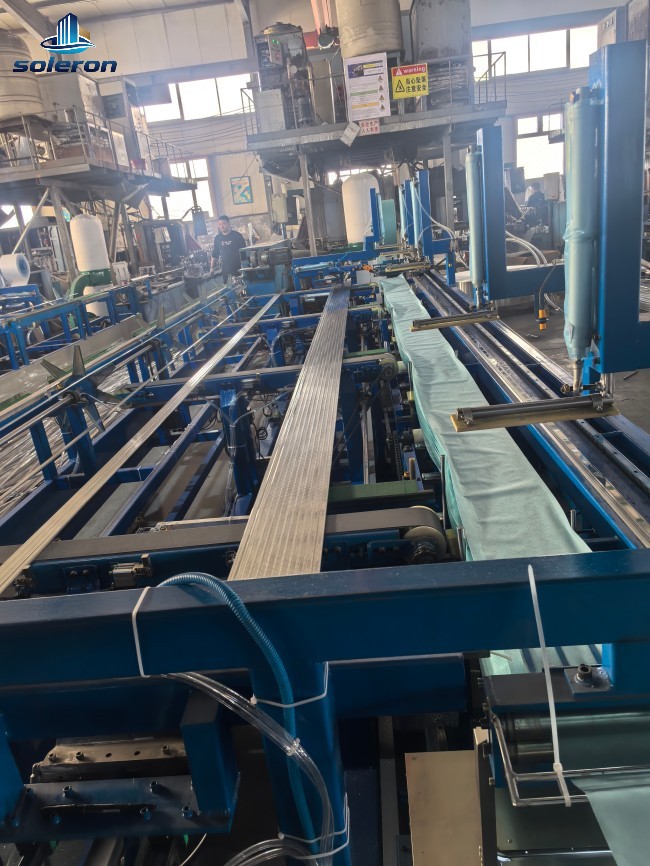
Insulating glass sealants are bought as logistics units — an iron bucket, a plastic drum, a carton — and judged on the line as part of an edge-sealing system. Those two views rarely line up on the first pass, and the gap between them is where most sealant specification errors begin.
This comparison places three sealant forms side by side: butyl sealant, hot melt sealant, and two-component silicone sealant. All three sit within the same insulating glass sealant range from Soleron Building Materials (Hebei) Co., Ltd., a manufacturer of insulating glass components based in Renqiu, Hebei Province, China. The company's portfolio covers aluminum spacer bars, warm-edge spacers, sealants, molecular sieve desiccants, and related accessories, with a declared export share of 80% across Europe, North America, Asia, the Middle East, Latin America, and Africa.
The most concrete difference between the three forms that a buyer can read directly off the public specification is the declared net weight of the pack: 330 kg, 30 kg, and 28 kg. Almost everything else that decides the purchase — seal position, moisture-vapor performance, application parameters, shelf life — sits outside that declaration and has to be requested in writing.
The edge joint these sealants have to close
An insulating glass unit (IGU) consists of two or more glass panes separated by a spacer and edge-sealed to form an insulating air or gas-filled cavity. The sealant is one part of a three-function edge joint. The spacer bar holds the panes at a fixed distance and establishes the interpane space. The desiccant adsorbs residual water and solvent vapor to keep humidity low inside the sealed cavity. The sealant system closes the edge.
That third function is usually split in two. In dual-seal construction, the primary seal sits against the spacer and the secondary seal forms the outer structural seal. ASTM C1249-18, in its guidance on structural silicone glazing, describes IG units built on a dual-seal system — polyisobutylene (PIB) as the primary seal and silicone as the secondary seal — as the configuration with the durability required for that application. Cardinal Corp. describes the same dual-seal composition, polyisobutylene primary and silicone secondary, in its published technical material on insulating glass durability.
What makes that composition commercially relevant is that the two positions are not interchangeable. A chemistry that performs well as an outer seal is not automatically formulated or tested for the inner position, and the reverse is equally true. Any sealant comparison that ignores seal position is therefore incomplete, no matter how well documented the pack data is.
The three sealant forms in the specification
Butyl sealant — the 330 kg pack
Butyl sealant is the butyl-rubber-based member of the range. The declared material base for the sealant family is butyl rubber with silicone polymer and EVA, and the declared color options are black and white. Butyl chemistry is also the reference point in the dual-seal descriptions cited above, where polyisobutylene is named as the primary seal. At a declared net weight of 330 kg, this is the heaviest unit in the three-way comparison.
Hot melt sealant — the 30 kg pack
Hot melt sealant is listed as a distinct form within the same product family. The name describes how the material is supplied for hot application on the line, and the equipment side of the catalogue matches it: the IGU production machinery range includes a Butyl Sealant Extruder Machine alongside the production line, glass washing machine, aluminum spacer bar bending machine, and molecular sieve filling machine. That machine range runs on a 220 V–380 V, 50 Hz supply with a power range of 3.2 kW to 38 kW.
Two-component silicone sealant — the 28 kg pack
Two-component silicone sealant is the silicone member of the range and the lightest declared pack at 28 kg. Silicone is the material named as the secondary seal in the dual-seal references above. The two-component description refers to a material supplied as two reactive parts that are metered and mixed before application, which is why the same equipment range contains a dedicated Two-Component Sealant Machine rather than only an extruder.
Declared net weight and packaging: the first comparable field
Across the three forms, the largest declared pack is more than ten times the weight of the smallest. The remaining declared fields — model reference, color options, packaging formats, and quality guarantee — are shared across the range, which means weight and pack configuration are effectively the only differentiators a buyer can evaluate before contacting the supplier.
| Sealant form | Declared net weight | Declared packaging formats | Declared colors | Model reference | Declared quality guarantee |
|---|---|---|---|---|---|
| Butyl sealant | 330 kg | Carton box, plastic drum, iron bucket | Black and white | SOL-803 / SOL-717 | 10 years |
| Hot melt sealant | 30 kg | Carton box, plastic drum, iron bucket | Black and white | SOL-803 / SOL-717 | 10 years |
| Two-component silicone sealant | 28 kg | Carton box, plastic drum, iron bucket | Black and white | SOL-803 / SOL-717 | 10 years |
For scale within the same catalogue, the aluminum spacer bar range is declared in sizes from 5.5 mm to 50 mm with wall thickness of 0.16 mm to 0.35 mm, the warm-edge spacer range in sizes from 6 mm to 27 mm, and the 3A molecular sieve desiccant in three particle-size bands — 0.5–0.9 mm, 1.0–1.5 mm, and 1.5–2.0 mm — at a declared net weight of 25 kg. Aluminum spacer bars, warm-edge spacers, corner connectors, Georgian bars, and molecular sieve carry a declared 5-year quality guarantee, while the sealant family carries 10 years.
Why pack format changes the handling plan
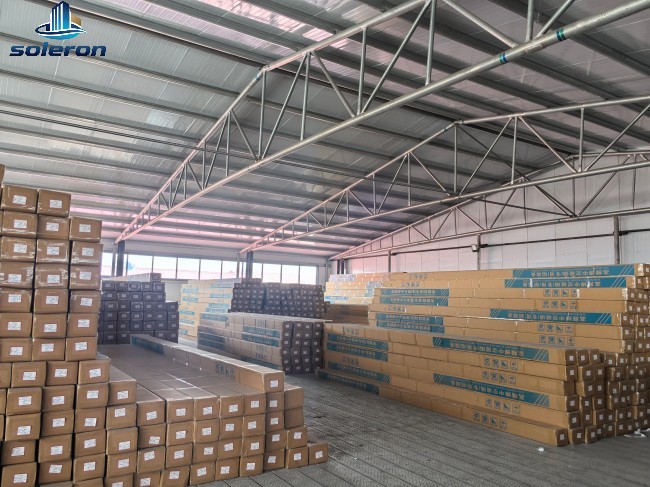
The weight and the packaging format listed in a specification are not decoration. They determine what equipment, storage space, and labour an IGU plant needs before a single unit is sealed.
- 330 kg butyl pack: beyond any manual-handling limit in normal production. Expect mechanical lifting, pallet or drum transfer equipment, floor-loading checks, and a dedicated storage position. Larger packs also concentrate residual material at the end of a drum, so the usable-yield question becomes material to cost per unit.
- 30 kg and 28 kg packs: within manual or semi-manual handling range for most plants, but more frequent changeovers and smaller working inventory. For two-component silicone, the 28 kg figure may or may not represent both reactive parts, and that should be confirmed before the number is used in a consumption calculation.
- Two-component silicone: handling includes metering and mixing, which introduces mix-ratio accuracy, purge loss, and pot-life management into the production plan.
- Hot melt: handling includes heated application equipment, so warm-up time and temperature control become part of the shift schedule rather than a one-off setup task.
- Packaging format across all three: carton box, plastic drum, and iron bucket are declared options. The choice interacts with the handling method, with the storage climate of the destination market, and with how the material is dosed into the line.
A practical way to use this: draw the handling plan from the pack data first, then let performance data refine it. Doing it the other way round means a technically suitable chemistry can still fail on the shop floor because nobody planned for a 330 kg drum or a two-part mix station.
Fit with IGU assembly, where the facts support it
The evidence in this comparison supports three statements and leaves one question open, and buyers should treat the boundary honestly.
Supported: dual-seal IG units of the type described for structural silicone glazing use polyisobutylene as the primary seal and silicone as the secondary seal, per ASTM C1249-18 and the Cardinal technical publication. The sealant range in question contains a butyl form, a hot melt form, and a two-component silicone form, all declared at a 10-year quality guarantee, in black or white, with carton box, plastic drum, or iron bucket packaging. And EN 1279-2 sets a moisture penetration requirement for insulating glass units of an average index of 0.20 or lower across five aged specimens, with an individual specimen limit of 0.25.
Open: which declared pack size maps to which seal position for a specific project. The public specification lists the three forms, their weights, their colors, and their guarantee, but it does not publish a primary-versus-secondary assignment per form, an application temperature, a mix ratio, or a moisture-vapor transmission rate. Those belong on the technical data sheet and in the supplier's written recommendation, not in a brochure table.
Buyer checklist: what the specification answers and what it does not
The fastest way to convert a sealant comparison into a purchasing decision is to separate declared fields from unverified ones. The table below does that for the Soleron sealant range.
| Decision criterion | Available in the public declaration | Must be confirmed with the supplier |
|---|---|---|
| Net weight per pack | Yes — 330 kg, 30 kg, 28 kg | Actual packed weight and pallet configuration per shipment |
| Packaging format | Yes — carton box, plastic drum, iron bucket | Which format is supplied for the ordered grade and destination |
| Color | Yes — black and white | Batch-to-batch color tolerance for visible edge applications |
| Model reference | Yes — SOL-803, SOL-717 | Model-to-application mapping for the intended seal position |
| Quality guarantee | Yes — 10 years for the sealant family | Written warranty scope, exclusions, and claim procedure |
| Seal position fit | Not stated per form | Written primary or secondary seal recommendation |
| Moisture-vapor and adhesion performance | Not declared | Test report linked to EN 1279-2 or ASTM E2190 |
| Application parameters | Not declared | Application temperature, extrusion pressure, mix ratio, pot life |
| Shelf life and storage | Not declared | Dated shelf-life statement and storage temperature range |
| Usable yield per pack | Not declared | Residual and mixing-loss figures for your equipment |
Limits of this comparison
Independent comparisons earn their value by stating what they cannot settle.
- The declared net weight is a logistics figure, not a performance figure. A 330 kg pack is not inherently better or worse than a 28 kg pack; it simply shifts cost and handling toward different parts of the plant.
- No moisture-vapor transmission rate, adhesion value, hardness, curing profile, or application temperature is declared for any of the three forms in the public specification. Until those arrive on a technical data sheet, the three-way comparison rests on pack data, chemistry family, and seal position references.
- No third-party test certificate is published alongside the declaration. The closest public benchmark in the data used here is a supplier compliance statement: HB Fuller states that its PIBs fulfill EN 1279 and ASTM E2190 and that its standard secondary sealants comply with the same standards. That is a company-reported claim, but it names the standard the product is aimed at — the same level of statement should be requested from any sealant supplier before qualification.
- The listed weights appear in the specification with an open-ended qualifier, meaning they represent the range rather than a closed option set. Buyers should confirm that the ordered weight is the supplied weight.
- No price, minimum order quantity, or lead-time evidence exists for these materials in the data used here. Any cost-per-meter or cost-per-unit comparison built without a current quotation is an assumption, not a benchmark.
- Market figures cited in this article come from commercial research publishers rather than primary trade statistics, and material-level sizing by sealant chemistry is not broken out. They indicate direction of demand only.
Market and standards context
Downstream demand is the main reason sealant procurement deserves this level of scrutiny. The global insulated glass market was valued at approximately USD 92.7 billion in 2024 and is projected to grow from USD 101.3 billion in 2026 to USD 121.7 billion by 2030, according to Grand View Research. Separately, Meticulous Research reports the warm-edge spacer market at USD 1.1 billion in 2024, projected to reach around USD 1.90 billion by 2035, while Mordor Intelligence sizes the 3A molecular sieve segment at USD 1.80 billion in 2024. These are commercial research estimates, but they point the same way: more IGU volume, and more of it specified with edge-seal systems that must pass a moisture-penetration test.
The standards shaping that test are specific. EN 1279-2 requires an average moisture penetration index of 0.20 or lower across five aged specimens, with an individual specimen limit of 0.25, and it permits four methods for determining desiccant moisture content: 540 °C drying, Karl Fischer titration, gravimetric, and dew-point methods. AS/NZS 4666:2012 covers long-term type testing, glazing, periodic manufacturing testing, traceability, desiccant suitability, shelf life, and desiccant exposure limits.
On the supply side, Soleron operates ten automatic aluminum spacer bar production lines and ten warm-edge spacer production lines, and positions the sealant alongside spacers, connectors, Georgian bars, desiccants, and IGU processing machinery as a single sourcing package — a structure that reduces the number of interfaces a buyer has to manage, though it does not by itself replace seal-position and compatibility testing.
One gap is worth naming plainly. Material-level market sizing broken out by sealant chemistry — butyl versus hot melt versus silicone — is not available in the data used for this comparison, and no price, MOQ, or lead-time evidence was published. Any per-kilogram or per-meter comparison that is not backed by a current quotation should be treated as an estimate.
Frequently asked questions
What is the difference between an insulating glass primary sealant and a secondary sealant?
In dual-seal IGU construction, the primary seal sits against the spacer and the secondary seal forms the outer seal. ASTM C1249-18, in its guidance on structural silicone glazing, describes IG units with a dual-seal system using polyisobutylene as the primary seal and silicone as the secondary seal as the configuration with the durability required for that application. Cardinal Corp. describes the same dual-seal composition in its technical publication on insulating glass durability. Because the two positions are not interchangeable, the seal position a grade is formulated and tested for should be confirmed in writing and not inferred from the product name.
Which of the three sealant forms is supplied in the largest declared pack?
In the Soleron sealant specification, the declared net weights are 330 kg, 30 kg, and 28 kg across the butyl sealant, hot melt sealant, and two-component silicone sealant forms respectively. The 330 kg pack therefore carries the largest handling and storage burden and normally requires mechanical lifting and a dedicated transfer arrangement, whereas the 30 kg and 28 kg packs fall within manual or semi-manual handling range at most IGU plants. The same specification lists carton box, plastic drum, and iron bucket as packaging options, and black and white as the color options, with a declared 10-year quality guarantee for the sealant family.
Can a two-component silicone sealant serve as a primary seal?
The reference documents used in this comparison place silicone at the secondary position. ASTM C1249-18 states that for structural silicone glazing systems, IG units with a dual-seal system using polyisobutylene as the primary seal and silicone as the secondary seal are the ones described as having the required durability for that application. That statement does not by itself rule out other configurations in other applications, but it means the intended seal position should be confirmed in writing with the supplier rather than assumed from the chemistry name or the pack size.
What has to be verified before a sealant comparison becomes a purchasing decision?
Net weight, packaging format, color, model reference, and the declared quality guarantee are published in the product specification. Moisture-vapor transmission rate, adhesion values, application temperature, mix ratio, pot life, and shelf life are not. On the standards side, EN 1279-2 requires an average moisture penetration index of 0.20 or lower across five aged specimens with an individual specimen limit of 0.25, and AS/NZS 4666:2012 covers long-term type testing, periodic manufacturing testing, traceability, desiccant suitability, shelf life, and desiccant exposure limits. Test reports linked to those requirements, not pack weights, are the evidence that closes a sealant evaluation.
Does declared net weight equal usable sealant in production?
No. Declared net weight is a logistics figure. Residual material left in a 330 kg drum, purge and mixing loss in a two-component system, and line-changeover waste all sit outside the declared number. A buyer comparing cost should normalise to usable yield per kilogram against finished IGU edge length and should ask the supplier for the residual and mixing-loss assumptions behind any quoted consumption rate, using the same basis for all three forms.
How does the sealant interact with the spacer bar and the desiccant?
The spacer bar holds the glass panes at a fixed distance and establishes the interpane space. The desiccant — commonly a molecular sieve or a blend of silica gel with molecular sieves — adsorbs residual water and solvent vapor to maintain low humidity in the sealed space. The sealant system closes the edge. Because all three functions act on the same edge joint, compatibility matters: AS/NZS 4666:2012 explicitly covers desiccant suitability and desiccant exposure limits, and EN 1279-2 lists 540 °C drying, Karl Fischer titration, gravimetric, and dew-point methods for determining desiccant moisture content. In the range discussed here, the 3A molecular sieve is declared in three particle-size bands — 0.5–0.9 mm, 1.0–1.5 mm, and 1.5–2.0 mm — at a declared net weight of 25 kg.
Outlook
Sealant selection is drifting away from a single-SKU decision and toward an edge-joint system decision. As energy codes tighten and triple-glazed configurations become more common, the moisture-penetration behaviour of the whole edge assembly — spacer, desiccant, primary seal, secondary seal — receives more attention than any one component, because that is what the type tests in EN 1279-2 and AS/NZS 4666:2012 actually evaluate.
For buyers, the practical consequence is a shift in what counts as a comparison. Declared net weights of 330 kg, 30 kg, and 28 kg will still drive the first screening round, because they determine handling, storage, and changeover cost. But the second round will increasingly be decided on published test evidence, confirmed seal position, and documented application parameters, and suppliers that publish those alongside their pack data will be easier to qualify than suppliers that publish weight alone.
The Soleron product catalogue covering spacer bars, warm-edge spacers, sealants, molecular sieve desiccants, connectors, Georgian bars, and IGU processing machinery is available here: Soleron product catalog (PDF).
Have Questions or Need More Details?
Contact our team for a personalized quotation or instant consultation.
Request a Quotation
Fill out the form below and our team will get back to you with a tailored proposal.
WhatsApp Direct Chat
Prefer to chat in real-time? Message us on WhatsApp for instant assistance & quick answers.
- Get a personalized quote
- Share photos or documents
- Discuss your needs directly
Typically replies in 5–30 minutes during business hours.