
Buyer Decision Framework: Comparing Warning Post Suppliers
Flexible warning posts sit at the low-cost end of road safety procurement, and that is exactly where specification discipline tends to break down. A buyer comparing three suppliers of a 750 mm PU warning post usually receives three quotations, three catalogue pages and three differently worded claims about “high flexibility” — with no common basis on which to rank them. This reference sets out the questions worth asking, in the order a sourcing decision actually happens, and shows what a verifiable answer looks like using published product data.
The category is not marginal. MarketsandMarkets values the global road safety market — hardware, software and services combined — at USD 7.62 billion in 2026, with hardware accounting for the majority of that value. Delineator posts, warning posts, bollards and channelizers belong to that hardware layer, and they are bought in programme volumes by distributors, contractors and municipal suppliers rather than one unit at a time.
Functionally, these products are simple. Supplier Pexco describes flexible roadside delineator posts as impact-resistant plastic posts that warn drivers of a change in roadway alignment and help them track the roadway. The difficulty is not understanding what the product does; it is proving that a specific supplier’s version does it under the conditions of a specific site.
The comparison problem: three quotations, no common language
Supplier comparisons stall for four predictable reasons, and none of them is price.
- Claims are not quantified. “Flexible”, “high visibility” and “durable” are adjectives, not specifications. Two suppliers can use identical words for products that behave very differently under vehicle contact.
- Units and reference points differ. One supplier quotes overall height, another quotes post height excluding the base, a third quotes base diameter. Unless the buyer fixes the reference point, the numbers cannot be compared.
- Reflective designations are not standardised across documents. Class 1, High-Intensity Prismatic, Grade A and Grade B appear in different datasheets and different road-authority briefs, and they are not interchangeable labels.
- Installation is assumed rather than specified. A post designed for expansion-bolt fixing onto a concrete surface behaves differently on asphalt patching, on a temporary plastic base, or on an existing anchor pattern that does not match the new post’s hole spacing.
The opportunity is straightforward: a buyer who asks the same five blocks of questions of every supplier converts a subjective shortlist into a documented comparison, and gives the road owner or the internal engineering team something reviewable.
A five-block decision framework
The framework below follows the sequence in which a specification is normally built: fit first, then performance, then environmental limits, then visibility, then fixing. Commercial evidence sits underneath all five, because a claim is only usable if it can be traced to a document.
| Block | Core question to ask every supplier | Why it changes the decision |
|---|---|---|
| 1. Dimensional fit | What exactly is the height, the base geometry and the anchor spacing? | Determines sightline, retrofit compatibility and whether the post can join an existing delineator run |
| 2. Impact resilience | What mechanical values support the flexibility and recovery claim? | Separates a genuinely elastic post from a stiff plastic post described as flexible |
| 3. Temperature and UV | What service temperature range and ageing claim are declared, and on what basis? | Decides suitability for hot, cold or high-UV sites and the repaint/replace cycle |
| 4. Reflective class | Which reflective designation applies, at what tape width, and who certifies the sheeting? | Drives night-time visibility and tender acceptance |
| 5. Fixing and service | Which substrate, which anchors, and can the post be removed for maintenance? | Determines installation labour, failure risk and whole-life cost |
Table 1. Five question blocks used to compare flexible warning post suppliers on a common basis.
Block 1 — Dimensional fit and base geometry
Mnsd, the brand of Tiantai Yuanda Traffic Device Co., Ltd., a traffic safety and parking safety equipment manufacturer established in 2007 in Tiantai, Zhejiang, China, publishes model-level dimensions that make this block easy to test. The YD-WPS75 warning post carries overall dimensions of 750 × 80 × 200 mm in high-elasticity polyurethane (PU). The YD-WP45 is the shorter option in the same family at 450 × 80 × 200 mm. The YD-PE50 is listed at 500 mm in height with a Φ260 mm rubber base and a PE plus rubber base construction.
The question for any supplier is not “how tall is it” but “what does the height figure include”. A 750 mm post measured to the top of the reflective sleeve, a 750 mm post measured to the top of the pole, and a 750 mm post measured including a base plate can differ by tens of millimetres in service. The same applies to the base: a recycled rubber base and an integrated plastic base have different footprints, different weights and different anchor behaviour, even when bolted to the same surface.
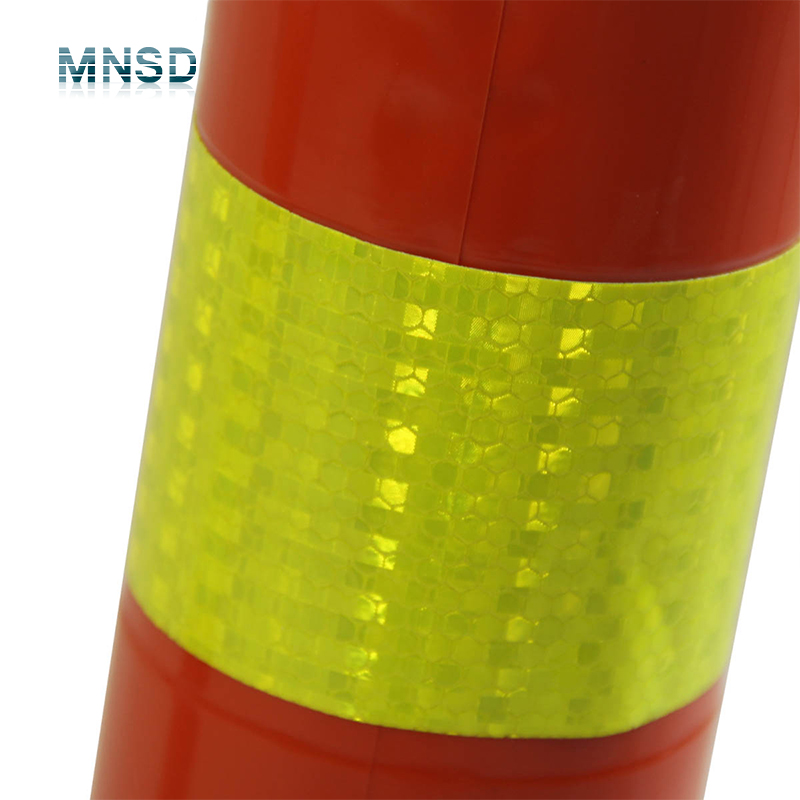
The YD-WP45 at 450 × 80 × 200 mm: the shorter configuration in the same PU family, used here to illustrate why height and base geometry must be compared on a fixed reference point.
Block 2 — Impact resilience, recovery and material evidence
This is the block where supplier language diverges most. The declared mechanical data for the YD-WPS75 reads: 360° flexible and impact resistant, rapid rebound after vehicle crush, tensile strength 15.0 MPa, elongation at break 400%, and hardness 80–85 Shore A. The same declared performance block appears in the listings for the YD-WP45 and YD-PE50.
Those numbers are more useful than the adjectives because they can be interrogated. A tensile strength of 15.0 MPa combined with an elongation at break of 400% describes an elastomer that stretches to four times its original length before failure; hardness in the 80–85 Shore A band describes a dense but compliant polyurethane rather than a rigid plastic. Buyers should ask which test method produced the figures — tensile and elongation tests for rubber and elastomers are normally run to a recognised standard such as ISO 37 or ASTM D412 — and at what specimen thickness and temperature.
Recovery is the second half of the claim. Material suppliers in this category describe PU delineators as designed to return to their original state after being impacted repeatedly, which is a material-level statement rather than a test result for a specific post. A buyer’s practical test is simple and does not require a laboratory: bend the post to the ground, release it, and check whether the sleeve stays aligned and the base does not loosen. Ask the supplier to demonstrate this on the exact model being quoted.
Block 3 — Temperature range and UV ageing
The YD-WPS75 datasheet declares a temperature resistance range of −40°C to +70°C, a UV-stabilised coating, anti-oxidant and colourfast performance over three years, and water and oil resistance. The same −40°C to +70°C window appears in the YD-WP45 listing and in the UAE application brief held for this product family.
Two follow-up questions matter. First, whether the range is a material rating or a tested service window — the difference matters at the upper end, where dark asphalt surface temperatures can exceed ambient air temperature. Second, what the colourfast claim is based on: “over three years” is a declared ageing threshold, and it is not the same as a five-year appearance guarantee. Buyers in high-UV markets should ask for the accelerated weathering basis rather than accept the phrase.
Block 4 — Reflective class and visibility distance
Visibility is the parameter most often compared incorrectly, because reflective grades are quoted in several naming systems. The YD-WPS75 datasheet declares High-Intensity Prismatic (HIP) / Class 1 reflective grade, a reflective tape width of 250 mm supplied in double or triple sleeves, silver white or fluorescent yellow reflective colour, and a visibility distance of 200+ metres.
That is a specific, checkable claim. The buyer’s question should be which designation the road owner’s specification uses — a separate application brief for lane separation on high-speed expressways, highway ramps, T-junctions, urban sidewalk protection and multi-level parking entrances lists Class 2 / Grade A high-intensity reflectivity as the site requirement. A supplier cannot resolve that difference for the buyer; only the specifying authority can. What the supplier can supply is the reflective sheeting documentation behind the tape, the tape width actually applied to the model in question, and confirmation of whether the sleeves are double or triple.
Block 5 — Fixing method, substrate and serviceability
The Mnsd family is installed by expansion bolt fixing with three or four holes, with M10/M12 heavy-duty expansion anchors specified as supporting equipment and epoxy adhesive listed as optional for base reinforcement. The brief also specifies high-visibility reflective sleeves in a honeycomb pattern, and the post carries a ring top for chain attachment — a detail that matters where posts must be linked or removed quickly.
Installation questions belong in the framework because they generate most post-delivery problems. Which substrate is assumed — cast concrete, asphalt overlay, or a kerb edge? Is an anchor spacing drawing supplied so the contractor can drill to the post, rather than drilling new holes through a base plate? If the site uses chain, is the ring top rated for the chain load the site will apply? A post that meets every performance claim but does not fit the existing anchor pattern is a specification failure, not a product failure.
From answers to an evidence file
Answers only become comparable when they are documented. The checklist below is what a buyer should be able to assemble for each shortlisted supplier before a decision meeting; missing rows are the real differentiators between quotations.
| Document | What it proves | Where to look for it |
|---|---|---|
| Model datasheet with dimensions | Height, base geometry and material are stated at model level, not series level | Product page or specification sheet |
| Mechanical test data | Tensile strength, elongation at break and hardness, with the test method noted | Material or type-test report |
| Reflective sheeting documentation | The declared class, tape width and sheeting supplier | Reflective material certificate |
| Installation drawing | Hole count, anchor size and spacing for the contractor | Technical annex to the quotation |
| Business licence and legal identity | The trading entity matches the manufacturer named on the documents | Company registration record |
| Customs classification | Plastic delineator posts are classified under HS 3926.90, with the US schedule using 3926.90.9880 and other markets using 3926.90.97 | Broker confirmation at quotation stage |
Table 2. Evidence file for a warning post supplier comparison. Classification should be confirmed with a customs broker for the destination market.
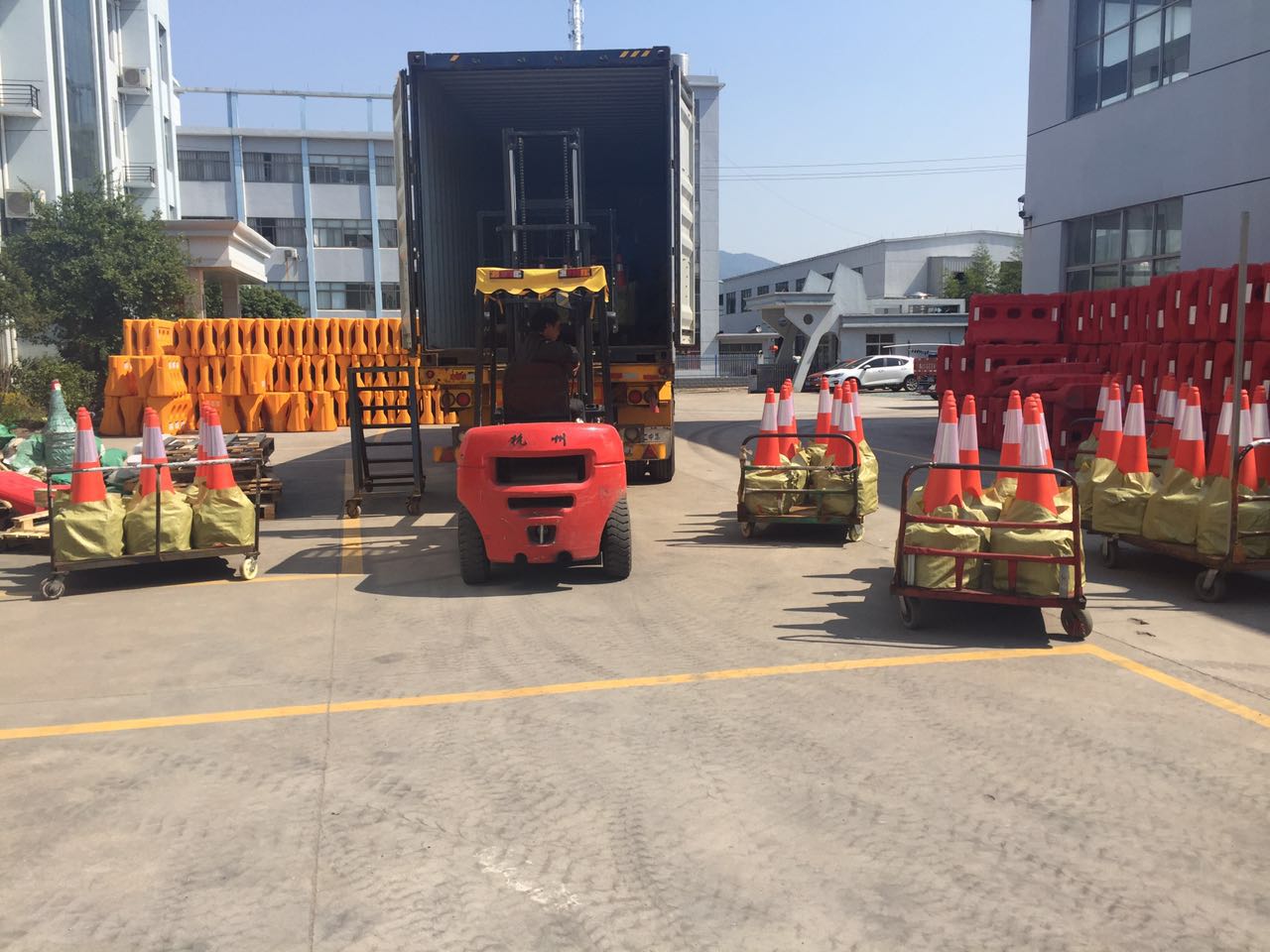
Despatch activity at the Tiantai, Zhejiang facility: documentation discipline matters as much as production capacity once a programme is running.
Where the specification actually applies
The framework only earns its keep when it is applied to a defined site. The Mnsd product data lists use across road traffic, parking lots, construction sites, industrial facilities, warehouses, logistics centres, airports, seaports, railway stations, schools, hospitals, commercial complexes, residential areas, highways, municipal engineering, public facilities, loading docks and bus terminals.
The application brief held for this family is narrower and more instructive: traffic channelisation, median delineation and pedestrian-vehicle segregation, in lane separation on high-speed expressways, highway ramps, T-junctions, urban sidewalk protection and multi-level parking lot entrances, installed surface-mounted or bolt-down as a permanent installation. The function stated for that brief is to provide clear visual guidance, define lane boundaries, prevent unauthorised vehicle entry and mitigate impact damage during accidental collisions. This scenario is described as common in the United Arab Emirates.
Read together, the two lists give a buyer a usable screening rule: long-run highway channelisation prioritises recovery behaviour, reflectivity class and substrate quality, while car park and industrial applications prioritise height consistency, base stability and the ability to chain or remove posts for operations.
Market trend: hardware spend and documentation pressure
Procurement behaviour in this category is being pulled in two directions. On one side, hardware continues to dominate road safety spending — MarketsandMarkets attributes roughly three-quarters of 2026 road safety market value to hardware, which keeps volume-driven buying alive. On the other, buyers are increasingly asked to justify a selection in writing, because the posts they purchase are installed on assets the road owner is accountable for.
The practical consequence is that material debates are becoming document debates. The PU versus PE question is a good example: PU constructions are typically positioned on elasticity and recovery, while PE constructions are positioned on cost and stiffness, and the argument is only settled by asking which declared values each supplier can produce. A supplier that can quote a tensile strength and an elongation figure is in a different conversation from one that can only describe its product as flexible.
Flexible posts against traditional rigid delineation
Flexible polymer posts did not replace rigid delineation; they split the job with it. The comparison below sets out the trade honestly.
| Attribute | Rigid delineation (steel, timber, concrete) | Flexible polymer warning post |
|---|---|---|
| Behaviour on vehicle contact | Deforms or breaks permanently; the damaged post becomes a second hazard to clear | Deflects, then is declared to rebound rapidly after vehicle crush |
| Driver feedback | Harsh edge with high consequence if struck | Visual and tactile warning with lower consequence |
| Installation | Often embedded, cast in, or mechanically anchored with heavy plant | Surface-mounted expansion bolt fixing using three or four holes |
| Repair pattern | Replace the whole post and reset the fixing | Replace the sleeve or the post; the anchor pattern is usually retained |
| Structural role | Can act as a physical barrier in some configurations | Visual guidance and impact mitigation only — not a containment barrier |
Table 3. Rigid versus flexible delineation. The final row is the boundary buyers most often miss.
Within the flexible category, the same honesty applies to material choice. A high-elasticity PU post with a declared 400% elongation and 80–85 Shore A hardness is a different product from a shorter PE post with a wide rubber base. Neither is universally correct. Narrow, fast roads with frequent vehicle contact reward recovery; low-speed car parks and pedestrian zones often reward base stability and consistent height more than rebound.
What this framework cannot tell you
A decision framework is only credible if it states its own limits, and this one has several.
- The performance values are manufacturer declarations. The 15.0 MPa tensile strength, 400% elongation, −40°C to +70°C range, three-year colourfast claim and Class 1 reflective designation are published by the manufacturer for these models. They are not, in the public record reviewed here, supported by an independent laboratory report or a road-authority acceptance record. Buyers should treat them as claims to verify, not as certified outcomes.
- Flexibility is not crashworthiness. A flexible warning post provides visual guidance, defines lane boundaries and mitigates impact damage. It does not physically stop a vehicle, and it should not be substituted for a barrier where containment is the requirement.
- Declared ageing thresholds may fall short of site requirements. The three-year colourfast declaration does not automatically satisfy a five-year appearance criterion, and the gap has to be closed commercially or by specification.
- Installation quality is outside the product. An expansion-bolt post on a poor substrate, or drilled to a spacing that does not match the base plate, will fail regardless of its material properties.
- Cost cannot be compared here. No verified price, MOQ or freight benchmark was available for this analysis, so the framework compares specification quality, not value for money.
Future outlook
Two developments are likely to shape supplier selection over the next procurement cycles. The first is a shift from product claims to document sets: as more buyers request type-test data, sheeting certificates and installation drawings as a condition of quotation, suppliers who already publish model-level specifications will be easier to shortlist than those who publish adjectives. The second is standards literacy. Reference frameworks such as EN 13422:2019 for portable traffic cones and cylinders, and road-owner criteria in the United States that buyers commonly associate with MUTCD practice, are increasingly cited in tender documents — usually as a screening reference rather than a proof of acceptance. Buyers who can read those references and map them onto a supplier’s declared values will make faster, better-defended decisions.
FAQ
What should a buyer request first when comparing flexible warning post suppliers?
Request the model-level datasheet rather than the series brochure. Series brochures often merge values across an entire range, while a model datasheet states the dimensions and material for the exact item being quoted. For example, the YD-WPS75 is listed at 750 × 80 × 200 mm in high-elasticity PU, the YD-WP45 at 450 × 80 × 200 mm in PU, and the YD-PE50 at 500 mm in height with a Φ260 mm rubber base in PE with a rubber base. Dimensions stated at this level can be compared directly across suppliers.
How can a buyer verify 360° flexibility and self-recovery claims?
Ask for the mechanical values behind the claim and the test method used to produce them. The YD-WPS75 listing declares a 360° flexible and impact-resistant structure with rapid rebound after vehicle crush, supported by a tensile strength of 15.0 MPa, an elongation at break of 400% and a hardness of 80–85 Shore A. Elongation of 400% means the material stretches to four times its length before failure. A physical bend-and-release test on the exact model being quoted complements the paperwork.
Which reflective class should a warning post specification state?
It depends on the specifying road owner, and the two documents do not always agree. The YD-WPS75 datasheet declares High-Intensity Prismatic (HIP) / Class 1 reflective grade with a 250 mm tape width and visibility beyond 200 metres, while an application brief for divided-highway lane separation lists Class 2 / Grade A high-intensity reflectivity as the site requirement. Buyers should confirm which designation the project will be measured against and request the reflective sheeting documentation for the tape actually applied.
Does a flexible warning post replace a rigid barrier or guardrail?
No. Flexible delineator posts are positioned for visual guidance, lane boundary definition, prevention of unauthorised entry and mitigation of impact damage during accidental collisions. They deflect and recover on contact, which reduces the consequence of a strike, but they do not contain or physically stop a vehicle. Where containment is the design requirement, a barrier system is the appropriate product.
What installation conditions should be confirmed before ordering expansion-bolt warning posts?
Four items: the substrate the posts will be fixed into, the anchor specification (M10/M12 heavy-duty expansion anchors are listed as supporting equipment for this family), whether three or four fixing holes are required, and whether epoxy adhesive is needed for base reinforcement. Buyers should also obtain an anchor spacing drawing and confirm whether a ring top for chain attachment is needed at the site. Installation is surface-mounted or bolt-down for permanent deployment.
What customs classification applies to plastic warning posts?
Plastic delineator posts are commonly classified under HS 3926.90, with the US schedule using 3926.90.9880 and other markets using 3926.90.97. Classification affects duty treatment and documentation, so buyers should confirm the code with a customs broker for the destination market rather than relying on a supplier’s general description of the goods.
A downloadable brochure covering the Mnsd warning post range, including the YD-WPS75, YD-WP45 and YD-PE50 specifications referenced above, is available here: Mnsd traffic safety product brochure (PDF).
Have Questions or Need More Details?
Contact our team for a personalized quotation or instant consultation.
Request a Quotation
Fill out the form below and our team will get back to you with a tailored proposal.
WhatsApp Direct Chat
Prefer to chat in real-time? Message us on WhatsApp for instant assistance & quick answers.
- Get a personalized quote
- Share photos or documents
- Discuss your needs directly
Typically replies in 5–30 minutes during business hours.