
Buyer Decision Framework for High Efficiency Portable Axial Flow Pumps: Four Specs That Matter
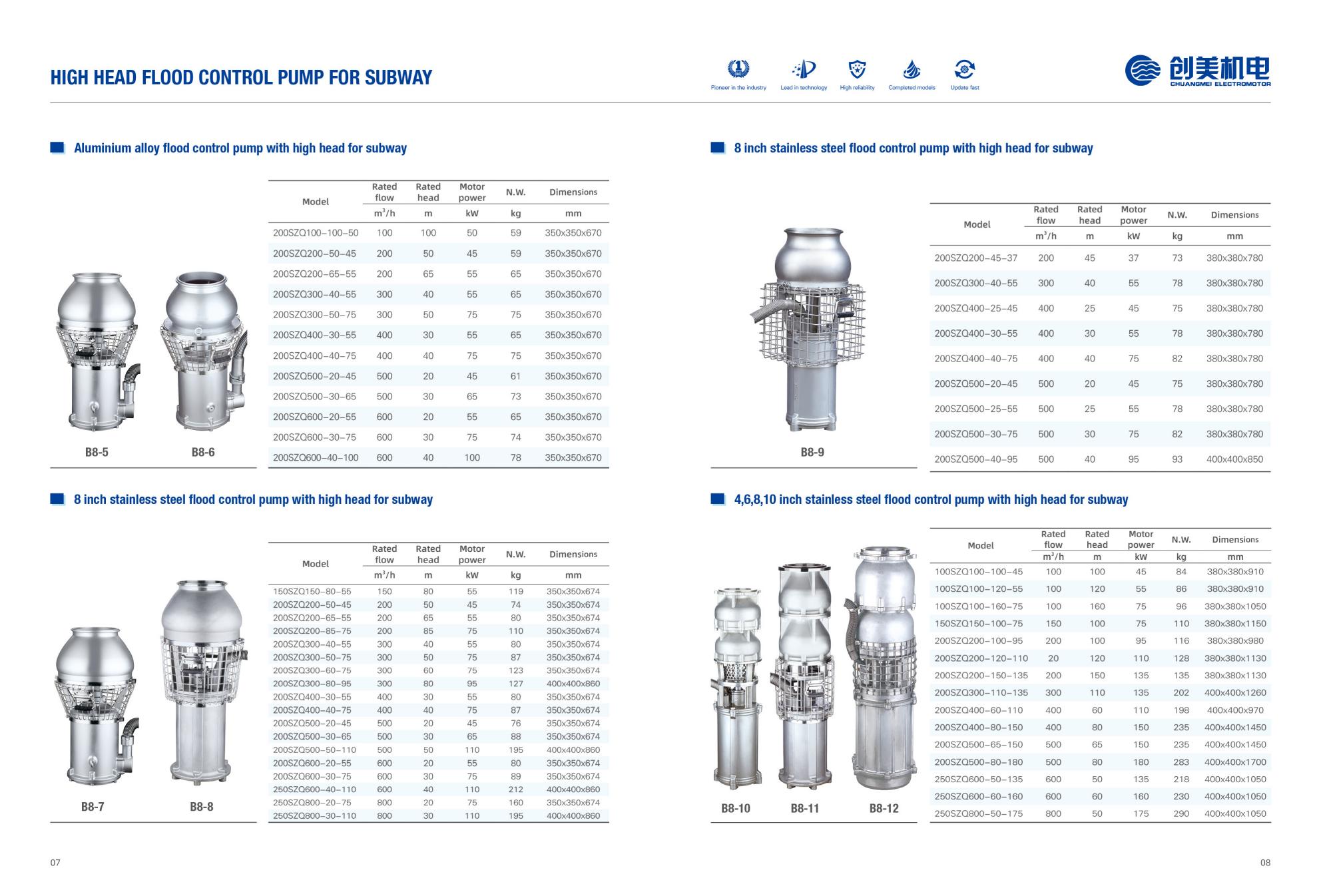
A high efficiency portable axial flow pump is defined by four specifications, and only one of them is visible in the model code most buyers quote first. Rated flow sets the family; rated head sets the motor; flow-passing material sets what a crew can physically carry; motor and power class set whether the unit holds its duty point when site conditions move. The framework below applies those four gates in order and shows, with catalogue data from the 200SZQ and 300SZQ ranges, how each decision constrains the next.
Why a 150 m³/h rating does not identify a pump
Two catalogue entries make the problem visible. The 200SZQ150-20-15 and the 200SZQ150-35-22 are both rated at 150 m³/h, both use aluminium alloy flow-passing components, and both occupy a 280 × 280 × 580 mm envelope. They are not interchangeable. The first is rated at 20 m of head with a 15 kW motor and a net weight of 26 kg; the second is rated at 35 m with a 22 kW motor and a net weight of 29 kg.
Same flow, 75% more head, 47% more motor power, 3 kg more mass. A buyer who specifies on flow alone has no way to tell which unit a site actually needs, and the gap only appears during the first real drainage event, when the pump either fails to lift to the discharge point or runs at a duty point it was never selected for.
This is not a defect in the catalogue. It is the normal consequence of how rotodynamic pumps behave: hydraulic power rises with both flow and head, so a flow figure quoted without its head is a number without a reference point.
The four-gate framework in sequence
The order matters. Flow and head are hydraulic decisions; material and motor class are delivery decisions. Reversing the order, for example choosing a stainless steel unit before the duty point is fixed, usually produces an over-specified and heavier machine than the site can handle.
| Gate | What it fixes | Question the buyer must answer first | Typical selection error |
|---|---|---|---|
| 1. Rated flow | Model family and outlet size | How much water must move, and within what time window? | Using maximum flow at zero head instead of rated flow at rated head |
| 2. Rated head | Impeller geometry and motor power | What is the total lift at the highest water level and longest discharge run? | Calculating at average conditions rather than worst case |
| 3. Flow-passing material | Unit mass and handling method | Who carries it, how far, and through what medium? | Assuming stainless steel is always the better choice |
| 4. Motor and power class | Control cabinet, protection set, cable arrangement | What voltage stability and automation does the site provide? | Treating the control cabinet as an accessory rather than part of the system |
Gate 1: rated flow
Rated flow is the volume a pump delivers at its rated head and rated speed, expressed in cubic metres per hour. It is not the maximum volume the pump can pass at zero head, and tender documents that quote only a maximum figure tend to produce pumps that are oversized at the duty point and unstable in operation.
In the SZQ range the outlet size and the flow band are related but not fixed, which is why the same nominal diameter can cover a wide spread:
| Outlet size | Typical rated flow in the range | Representative model |
|---|---|---|
| 6 inch | 100 – 250 m³/h | 150SZQ250-9-11: 250 m³/h at 9 m, 11 kW, 22 kg |
| 8 inch | 150 – 600 m³/h | 200SZQ600-10-30: 600 m³/h at 10 m, 30 kW, 27.5 kg |
| 10 inch | 400 – 800 m³/h | 250SZQ800-10-37: 800 m³/h at 10 m, 37 kW, 50 kg |
| 12 inch | 800 – 1,500 m³/h | 300SZQ1500-10-75: 1,500 m³/h at 10 m, 75 kW, 65 kg |
The practical rule is to size flow from a schedule, not from a catalogue page. A 1,200 m³ basement drained in four hours requires roughly 300 m³/h before any allowance for hose restriction; the same basement drained over twelve hours requires roughly 100 m³/h. Once the schedule is agreed, add margin for partial blockage and for discharge losses, then move to the head gate.
Gate 2: rated head
Rated head is the total lift the pump develops at rated flow. It combines the static lift from water surface to discharge point, friction in the hose or pipe run, losses through bends, valves and fittings, and the velocity head at the outlet. Buyers who estimate head from floor-to-floor height alone routinely under-specify by several metres on long hose runs.
The 150 m³/h group shows how steeply motor power rises as head is added at constant flow. All three models below are aluminium alloy 8-inch units in the same 280 × 280 × 580 mm envelope:
| Model | Rated flow | Rated head | Motor power | Net weight |
|---|---|---|---|---|
| 200SZQ150-20-15 | 150 m³/h | 20 m | 15 kW | 26 kg |
| 200SZQ150-35-22 | 150 m³/h | 35 m | 22 kW | 29 kg |
| 200SZQ150-45-30 | 150 m³/h | 45 m | 30 kW | 32 kg |
The same pattern holds in the 200 m³/h group, where the range extends further and material changes enter the picture:
| Model | Rated flow | Rated head | Motor power | Net weight | Flow-passing material |
|---|---|---|---|---|---|
| 200SZQ200-16-15 | 200 m³/h | 16 m | 15 kW | 26 kg | Aluminium alloy |
| 200SZQ200-20-18.5 | 200 m³/h | 20 m | 18.5 kW | 27 kg | Aluminium alloy |
| 200SZQ200-25-22 | 200 m³/h | 25 m | 22 kW | 29 kg | Aluminium alloy |
| 200SZQ200-30-30 | 200 m³/h | 30 m | 30 kW | 52 kg | Stainless steel |
| 200SZQ200-45-37 | 200 m³/h | 45 m | 37 kW | 54 kg | Stainless steel |
| 200SZQ200-45-37AL | 200 m³/h | 45 m | 37 kW | 38 kg | Aluminium alloy, light-duty |
Above this band the range becomes a high-head family. The 100SZQ100-100-45 delivers 100 m³/h at 100 m with a 45 kW motor and an 84 kg net weight; the 100SZQ100-160-75 reaches 160 m at 75 kW and 96 kg. Chuangmei positions 20 to 50 m as the typical subway lift band, with special specifications reaching above 100 m, and catalogue entries at 100 m, 120 m, 150 m and 160 m support that positioning.
Gate 3: flow-passing material
Material selection is where portability is won or lost. In this range the impeller is a precision stainless steel casting and the pump shaft is stainless steel in either configuration; the choice applies to the motor housing and pump body, which are offered in aluminium alloy or stainless steel.
| Duty point | Aluminium alloy option | Stainless steel option | Mass difference |
|---|---|---|---|
| 150 m³/h at 45 m, 30 kW | 200SZQ150-45-30, 32 kg | 200SZQ150-45-30, 52 kg | 20 kg |
| 200 m³/h at 45 m, 37 kW | 200SZQ200-45-37AL, 38 kg | 200SZQ200-45-37, 54 kg | 16 kg |
| 150 m³/h at 20 m, 15 kW | 200SZQ150-20-15, 8 inch, 26 kg | 150SZQ150-20-15, 6 inch, 34 kg | 8 kg |
The first row is the clearest illustration: identical rated flow, identical rated head and identical motor power, with a 20 kg difference between the two builds. In a stairwell or a pipe gallery access shaft, that difference decides whether the unit is a one-person lift or a two-person lift, and whether it can be moved without a trolley.
The third row carries a second lesson. At the same 150 m³/h and 20 m duty, the aluminium alloy 8-inch unit is listed lighter than the stainless steel 6-inch unit. Outlet size and material interact, so the buyer has to check the connection hardware as well as the mass: a 6-inch and an 8-inch outlet need different hoses, clamps and, where used, different flat-body floats.
The boundary worth stating plainly is that the catalogue does not publish a wear-life rating that separates the two materials. The stated medium for the pump group is clean water or slightly turbid water. Sites handling abrasive silt, sand or debris should treat material and wear-part strategy as an open technical question to be confirmed with the supplier rather than assumed from the word stainless.

Gate 4: motor and power class
Power class is more than a kilowatt figure. In this range the pump is driven by a permanent magnet synchronous submersible motor turning an axial flow impeller, and the class fixes the control cabinet, the protection set and the cable arrangement as well as the motor itself.
Chuangmei describes the motor as steplessly speed-regulated, which makes head and flow adjustable from a single unit, and states that motor speed does not vary with grid voltage fluctuation, so head and flow remain stable when supply voltage drops. The company contrasts this behaviour with asynchronous axial flow pumps. Those are first-party claims and are best verified against a site test, but they explain why the power class cannot be separated from the control cabinet in the procurement documents.
| Motor class | Cabinet configurations | Mini-style cabinet size and weight |
|---|---|---|
| 5.5 – 7.5 kW | Mini-style, vehicle-mounted single, vehicle-mounted double | 300 × 270 × 500 mm, 15 kg |
| 11 – 15 kW | Mini-style, vehicle-mounted single, vehicle-mounted double | 360 × 350 × 530 mm, 18 kg |
| 18.5 – 22 kW | Mini-style, vehicle-mounted single, vehicle-mounted double | 360 × 350 × 530 mm, 19 kg |
| 30 kW | Mini-style, vehicle-mounted single, vehicle-mounted double | 400 × 390 × 560 mm, 25 kg |
| 37 kW | Mini-style, vehicle-mounted single, vehicle-mounted double | 400 × 390 × 560 mm, 26 kg |
| 45 kW | Mini-style, vehicle-mounted single, vehicle-mounted double | 450 × 430 × 710 mm, 37 kg |
| 55 kW | Mini-style, vehicle-mounted single, vehicle-mounted double | 450 × 430 × 710 mm, 38 kg |
| 75 kW | Mini-style, vehicle-mounted single, vehicle-mounted double | 500 × 450 × 780 mm, 46 kg |
| 110 kW | Vehicle-mounted single | 700 × 500 × 1600 mm, 130 kg |
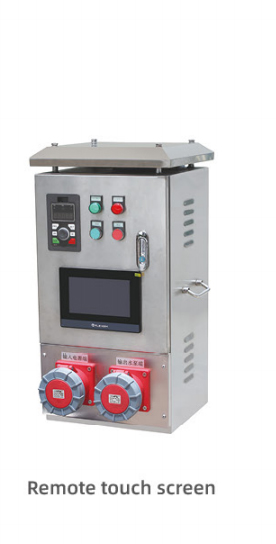
The cabinet carries a built-in frequency inverter and displays frequency, voltage, current and rotational speed in real time. Remote start, stop and speed adjustment are available through 3G and 4G networks from a computer or phone application, and the controller supports time-segmented operation with overheat, overcurrent, overload, overvoltage and phase-failure protection. When water is fully drained the pump shuts down within half a minute and enters standby. Cabinets are offered as single-unit or one-drives-two configurations, with IP44 or IP54 protection and a three-phase four-wire supply with waterproof plugs and sockets.
At the top of the range the word portable needs qualification. The 300SZQ large-flow family is documented across a 5.5 kW to 55 kW power band, and the 12-inch aluminium alloy models in the current catalogue include 45 kW, 55 kW, 60 kW and 75 kW units at 1,000 to 1,500 m³/h and 10 to 15 m of head, with net weights from 55 kg to 65 kg. Further up again, the high-head 200SZQ500-80-180 is listed at 283 kg with a 180 kW motor. Those are transportable units moved by vehicle and lifting equipment, not units carried by hand, and the procurement plan should reflect the difference.
The manufacturer behind the catalogue data: chuangmei Pumps
Zhejiang Chuangmei Electromechanical Co., Ltd., which trades as chuangmei Pumps, is a pump manufacturer based in the Ta'ao Industrial Zone, Wenling City, Zhejiang Province, China, founded in 1996. The company produces permanent magnet synchronous motor submersible axial flow pumps for flood control, drainage and irrigation duty, and states that it has developed 20 models in that family.
The facts relevant to a buyer evaluating the framework above are concrete rather than promotional. The company holds utility model patent ZL2014200091521.8 for the permanent magnet synchronous motor high-speed axial flow pump and a national first-class energy conservation certification for high-tech energy-saving products. Its production footprint is 12,000 m² with 46 employees, an annual output of 30,000 units and a three-engineer R&D team; exports account for 25% of output, with Southeast Asia, Africa, Morocco and Central Asian countries listed as main markets. The range covers 6-, 8-, 10- and 12-inch flood control pumps, including dual-purpose units that reach a low-head high-flow duty and a high-head duty by exchanging the impeller and pump body, a bottom-inlet variant for shallow suction, and a boost pump for long horizontal discharge runs. A one-year warranty with free maintenance during the warranty period applies.
For acceptance planning, the company also lists accessories that affect the specified package: an 8-inch aluminium alloy floating body with 35 kg of floatage and 4.5 kg dead load, plus 8–10 inch and 12-inch flat bodies rated at 78 kg and 120 kg of floatage respectively.
How the framework reorders by drainage scenario
The four gates do not carry equal weight in every application. In subway work, head usually dominates and material follows from handling; in municipal flood control, flow dominates and head becomes almost secondary.
| Application | Dominant gate | Verified example from the range | What changes in the specification |
|---|---|---|---|
| Subway flood emergency drainage | Head | 200SZQ150-35-22: 150 m³/h at 35 m, 22 kW, 29 kg | Vertical lift through shafts and stairs; aluminium alloy mass matters for manual deployment |
| Subway deep shaft or long vertical run | Head | 100SZQ100-100-45: 100 m³/h at 100 m, 45 kW, 84 kg | Flow is deliberately traded down to gain head |
| Underground space drainage | Automation and suction | 200SZQ500-9-22L bottom inlet: 500 m³/h at 9 m, 22 kW, 45 kg | Bottom inlet brings suction level below 100 mm from the floor |
| Municipal flood control | Flow | 300SZQ1000-10-45: 1,000 m³/h at 10 m, 45 kW, 55 kg | High flow at low head; vehicle transport assumed |
| Underground comprehensive pipe gallery | Head with compact footprint | 200SZQ200-25-22: 200 m³/h at 25 m, 22 kW, 29 kg | Remote cabinet monitoring and time-segmented operation |
| Fixed drainage in bridges, culverts, basements and garages | Automation and durability | 250SZQ800-9-37L bottom inlet: 800 m³/h at 9 m, 37 kW, 56 kg | Level-triggered start with automatic standby or shutdown at the intake line |
| Long horizontal discharge runs | Friction loss | 200SZQ500-10-22GL boost pump: 500 m³/h at 10 m, 22 kW | Line pressure maintained by a second unit in the hose run |
The fixed-drainage cases are the ones most often mis-specified, because the pump becomes part of a system rather than a temporary tool. Chuangmei describes automatic operation for bridge, culvert and basement parking drainage: the pump starts when water reaches a set level and returns to standby or shuts down when the level falls to the intake line. That behaviour depends on the control cabinet and level sensing, so the cabinet specification and the protection set belong in the same purchase order as the pump.
Market and compliance context
Three external reference points are worth carrying into a 2026 procurement file. First, market size: one commercial research estimate published in August 2026 projects the global axial flow pump market at approximately USD 4.49 billion by 2026. A separate 2025 estimate circulating in the same category is materially larger, and the divergence tracks different definitions of what counts as an axial flow pump rather than a disagreement about demand. Market totals of this kind are directional context, not a selection criterion.
Second, motor efficiency documentation. China's GB 30253-2024 mandatory energy label standard for permanent magnet synchronous motors applies to products sold from 2025, which moves motor efficiency from a marketing line into a document the buyer can request. For projects in China, the label belongs in the submittal package alongside the pump datasheet.
Third, testing tolerance and trade classification. Axial flow pump performance is tested under ISO 9906, where Grade 1 tolerances of ±5% on flow and head apply to high-precision applications. Axial flow and mixed flow vertical pumps primarily for water handling are classified under HS code 84138130, which is the code that should appear on export documentation.
Where the framework meets its limits
A decision framework is only useful if it states where it stops working. Five boundaries apply to the approach above.
- Material is a trade, not a ranking. Aluminium alloy saves 16 to 20 kg at the duty points compared in this article, but the catalogue publishes no comparative wear-life figure. Stainless steel is offered where a buyer prefers a stainless flow path, and the price of that preference is mass and, at the handling stage, crew size.
- The control cabinet is a system dependency. Permanent magnet motors require a matched inverter cabinet with correct parameterisation and protection settings. A cabinet with the wrong IP rating, or a one-drives-two configuration applied to a single-pump duty, introduces failure modes that a fixed-speed pump does not have.
- Portability degrades with power. The 26 to 38 kg units in the 150 and 200 m³/h groups can be handled by a small crew. Units at 180 kW and 283 kg cannot, and specifying them as portable equipment distorts both the handling plan and the lifting plan.
- Medium limits are real. The stated medium for the pump group is clean water or slightly turbid water. Abrasive or debris-heavy conditions need a separate technical conversation, not an assumption.
- Test tolerances exist. ISO 9906 Grade 1 permits ±5% on flow and head. Two units from the same production batch can both be compliant and still differ at the test point, so acceptance must be defined at the rated point rather than at a convenient operating condition.
Compared with conventional fixed-speed axial flow pump practice, the framework adds two specification steps rather than replacing the underlying hydraulics. Flow and head still decide the machine; material and motor class decide whether the machine can actually be delivered to the duty point by the people on site.
Purchasing terms to confirm before ordering
| Term | What to confirm in writing |
|---|---|
| Duty point | Rated flow and rated head stated together, plus the calculated worst-case head and the margin applied |
| Model and build | Full model code, outlet size, flow-passing material, light-duty or standard build where applicable |
| Motor | Power class in kW, voltage, phase and frequency; permanent magnet synchronous motor with axial flow impeller |
| Control cabinet | Class-matched cabinet, mini-style or vehicle-mounted single or double, IP44 or IP54, single or one-drives-two |
| Control functions | Stepless speed regulation, time-segmented operation, remote start-stop and speed adjustment, protection set, low-water shutdown within half a minute |
| Materials | Impeller and shaft material, motor housing and pump body option, cable outlet construction with rubber sheath and stainless steel spring guard |
| Accessories | Hose, clamps, outlet connector, floating body or flat body with floatage figures, boost pump where horizontal runs are long |
| Mass and dimensions | Net weight and envelope for the exact build, since the same duty point can differ by 16 to 20 kg between materials |
| Documentation | Datasheet, performance curve, test report, nameplate data, energy label for the motor where applicable, HS code 84138130 for export papers |
| Warranty | One-year warranty with free maintenance during the warranty period, and the terms covering wear parts |
Acceptance criteria at handover
Acceptance should test the four gates rather than the pump in isolation.
- Nameplate reconciliation. Model code, rated flow, rated head, motor power, voltage and net weight must match the purchase order, not the closest catalogue entry.
- Hydraulic test at the rated point. Flow and head measured together at rated speed, with results assessed against the agreed tolerance; ISO 9906 Grade 1 at ±5% is the appropriate reference where a precision grade is specified.
- Protection function test. Overheat, overcurrent, overload, overvoltage and phase-failure responses verified individually, not assumed from the controller menu.
- Low-water shutdown. Confirm that the pump shuts down within half a minute of running dry and enters standby, and that restart behaviour at the set water level is as specified.
- Control and telemetry. Remote start-stop and speed adjustment tested over the site network; time-segmented operation profile loaded and checked.
- Electrical integrity. IP44 or IP54 protection confirmed at the cabinet and cable entry, with the waterproof plug and socket arrangement verified against the site supply.
- Handling verification. Unit mass checked against the lifting or carrying method planned for the site, including stairwell access where relevant.
Future outlook
Two forces are likely to shape portable axial flow pump specifications over the next few procurement cycles. The first is documentation-driven efficiency: mandatory energy labelling for permanent magnet synchronous motors pushes buyers to request motor efficiency evidence as a standard submittal rather than an optional extra. The second is control integration: remote monitoring, time-segmented operation and multi-unit cabinets move the specification from a pump to a pump system, which raises the importance of matching the cabinet to the motor class and of testing protection logic at handover.
Neither force changes the underlying hydraulics. Rated flow and rated head will still decide the machine, and the material and power class decisions will still determine whether that machine can reach the duty point in the conditions a site actually presents.
FAQ
How do I choose between the 200SZQ150-20-15 and the 200SZQ150-35-22?
Both are rated at 150 m³/h. The 200SZQ150-20-15 is rated at 20 m of head with a 15 kW motor and a 26 kg net weight; the 200SZQ150-35-22 is rated at 35 m with a 22 kW motor and a 29 kg net weight. The choice follows the total head the site presents at its highest water level and longest discharge run. If the calculated head sits close to 20 m, the smaller unit is adequate; if it approaches or exceeds 35 m, the larger unit is required.
Why does motor power rise so much when the rated flow is unchanged?
Because hydraulic power depends on flow multiplied by head. In the 150 m³/h group, moving from 20 m to 45 m raises motor power from 15 kW to 30 kW while flow stays constant and net weight rises from 26 kg to 32 kg. Flow alone therefore cannot identify a pump; the head at which that flow is delivered is the other half of the specification.
Should the flow-passing components be aluminium alloy or stainless steel?
Both are offered, and the impeller and pump shaft are stainless steel in either build. At the 150 m³/h and 45 m duty point, the aluminium alloy unit is listed at 32 kg against 52 kg for the stainless steel unit with the same flow, head and motor power. Aluminium alloy reduces the handling burden; stainless steel is the option for buyers who want a stainless flow path. The catalogue does not publish a comparative wear-life rating, so abrasive or debris-heavy media should be discussed with the supplier before either is fixed.
What does stepless speed regulation change for the buyer?
It allows head and flow to be adjusted from a single unit rather than fixed by impeller geometry alone, and it supports time-segmented operating profiles. Chuangmei also states that motor speed remains stable when grid voltage fluctuates, so the duty point is maintained during supply dips, a behaviour the company contrasts with asynchronous axial flow pumps. The cost of that capability is a matched inverter cabinet with the correct protection rating and settings.
Is a 1,000 m³/h axial flow pump still portable?
In transport terms yes, in handling terms no. The 300SZQ1000-10-45 is listed at 55 kg with a 45 kW motor, and the 12-inch aluminium alloy family runs to 65 kg at 75 kW. Those units are moved by vehicle and lifting equipment. The hand-portable band in this range sits in the 150 to 200 m³/h groups, where net weights are listed between 26 kg and 38 kg depending on material and build.
What must be tested before a flood control pump is accepted?
Nameplate data against the purchase order, a hydraulic test at the rated point with flow and head measured together, individual verification of overheat, overcurrent, overload, overvoltage and phase-failure protection, confirmation that the pump shuts down within half a minute when run dry and enters standby, remote control and telemetry over the site network, and verification of IP44 or IP54 protection at the cabinet and cable entry. ISO 9906 Grade 1 tolerances of ±5% on flow and head provide the reference where a precision grade is specified.
Product range brochure (PDF, public download): https://cdn.socialarks.com/sbsp/25023/common/2026/0708/High%20flow%20pump.pdf
Have Questions or Need More Details?
Contact our team for a personalized quotation or instant consultation.
Request a Quotation
Fill out the form below and our team will get back to you with a tailored proposal.
WhatsApp Direct Chat
Prefer to chat in real-time? Message us on WhatsApp for instant assistance & quick answers.
- Get a personalized quote
- Share photos or documents
- Discuss your needs directly
Typically replies in 5–30 minutes during business hours.