
Buyer's Shortlist: Top Steel Wire Rope Models for Heavy-Duty Operations
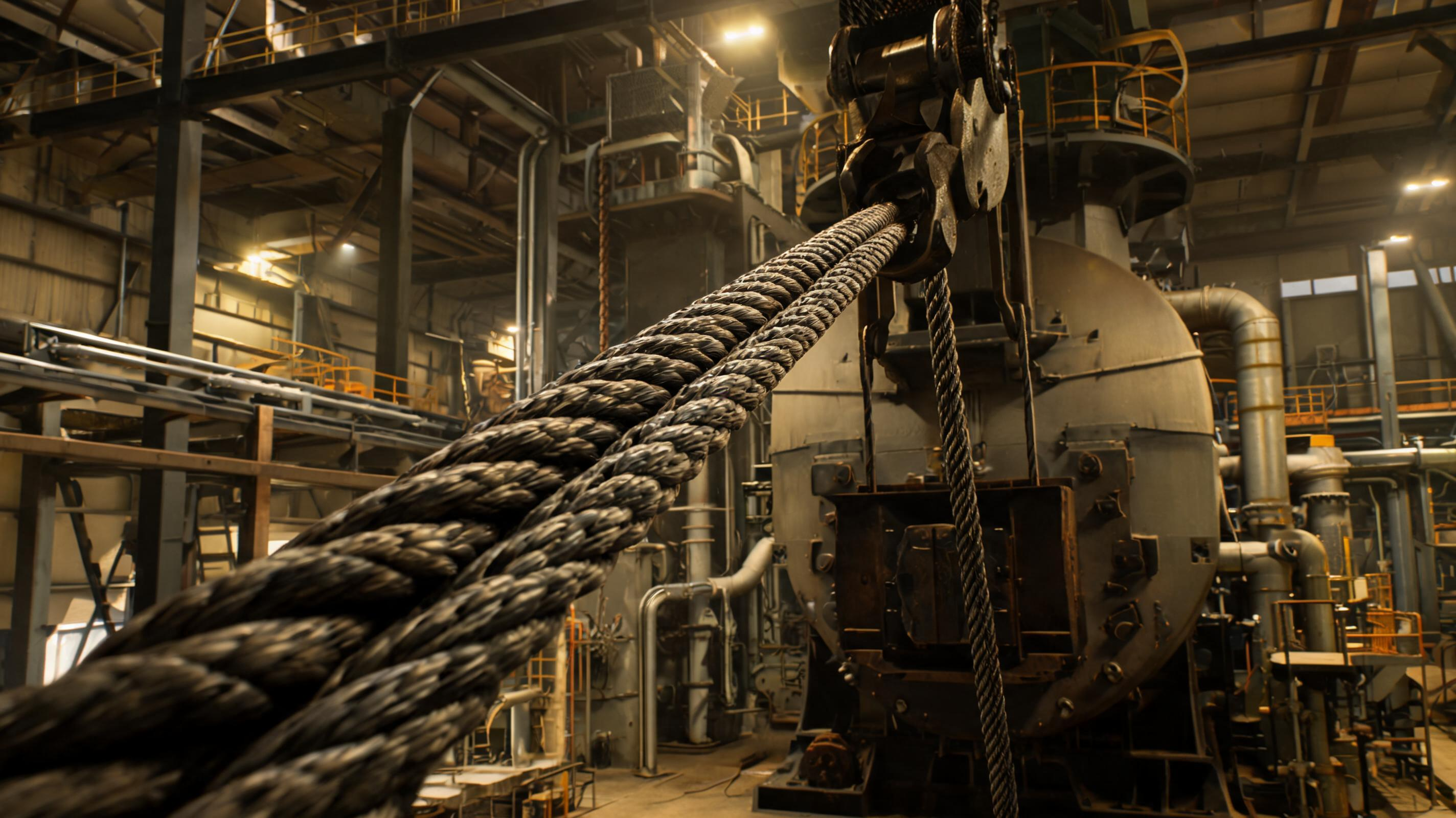
Cover image: heavy-duty rope hoisting scene. Heavy-duty duty cycles combine cyclic load, impact and abrasion, which is what separates a duty-rated rope from a general-purpose one.
Heavy-duty steel wire rope is normally chosen twice: once on paper, when a buyer fixes a construction, a tensile grade and a corrosion option in an RFQ; and once in the field, when the rope either survives its duty cycle or does not. The gap between those two moments is where shortlists earn their value.
The commercial backdrop explains why this list matters more than it used to. The global steel wire rope market was estimated at USD 10.49 billion in 2025 and is projected to reach USD 13.88 billion by 2030, a compound annual growth rate of 5.8% (MarketsandMarkets). Construction remains the largest end-user segment, accounting for roughly 27% to 40.7% of total market share across 2024–2025 (Grand View Research and other industry research). Estimates diverge noticeably between research houses — some place the 2025 baseline lower, others higher — which is itself a reason to anchor a procurement decision on rope-level specifications rather than on market summaries.
This shortlist ranks six wire rope constructions that recur across heavy-duty, mining, port, offshore and oil & gas product families. Each entry is described by the parameters that can be verified in supplier documentation: rope diameter, tensile strength grade, applicable execution standard and corrosion treatment. It is intended as a working list for buyers assembling a supplier RFP, not as a recommendation of a single rope for a single machine.
What qualifies a steel wire rope as heavy-duty
In this list, "heavy-duty" describes a rope made from high carbon steel, available in diameters from 1 mm to 120 mm, in tensile strength grades of 1570, 1670, 1770, 1870, 1960 or 2160 MPa, and manufactured to an applicable execution standard such as GB/T, EN, GOST or DIN. The intended duty is cyclic: repeated winding and unwinding, impact loads, abrasion, and in many cases corrosion exposure.
The industries that define this category are consistent across the product literature: mining, construction, lifting and hoisting, port operations, heavy industry and metallurgy. A rope can meet the diameter and tensile requirements and still be unsuitable for heavy-duty service if the construction, core type or termination does not match the equipment, so construction — not strength alone — is the first filter.
Two reference points help buyers set a baseline. ISO 2408:2017 specifies the minimum requirements for the manufacture and testing of steel wire ropes for general purposes, including lifting and rigging. It is a floor, not a heavy-duty ceiling, but it gives an RFP a testable reference. The second reference point is corrosion treatment. Ropes in this category are commonly supplied un-galvanized, electro-galvanized, hot-dip galvanized, stainless or plastic-coated, and the choice materially changes service life in mine water, salt spray and humid terminal environments.
The shortlist at a glance
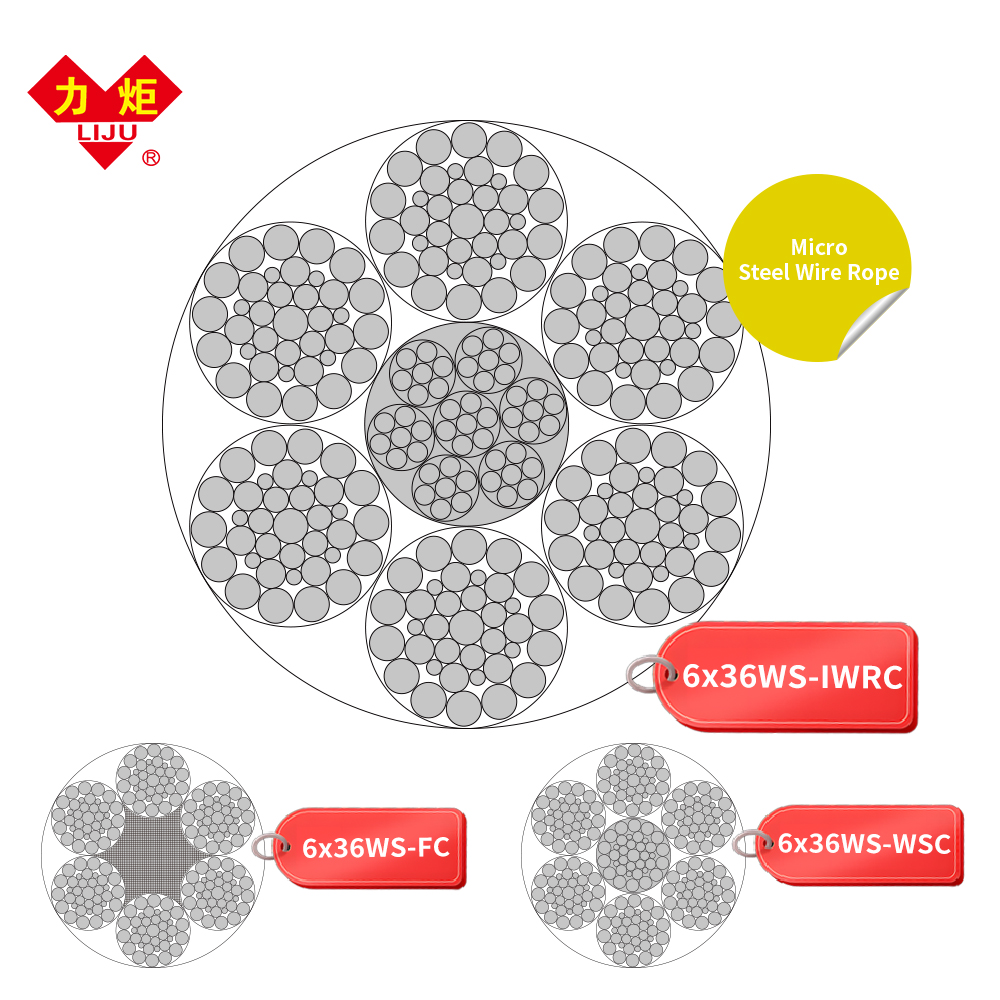
6x36WS construction, one of the most widely specified designs across heavy-duty, port, mining and offshore rope families.
| Rank | Construction | Rope diameter | Tensile grades available | Typical heavy-duty duty |
|---|---|---|---|---|
| 1 | 6x36WS | 1–120 mm | 1570–2160 MPa | General heavy lifting, port and offshore crane duty, cableway hauling |
| 2 | 6x19S / 6x19W | 1–120 mm | 1570–2160 MPa | Mine haulage and hoisting, elevator traction, general lifting |
| 3 | 35WxK7 / 35Wx7 | 1–120 mm | 1570–2160 MPa | Heavy haulage, offshore and marine, oil & gas, port |
| 4 | 8xK26WS / 8xK26WS-EPIWC | 1–120 mm | 1570–2160 MPa | Mining hoisting and excavating equipment, oil & gas lifting |
| 5 | 6x41WS / 8x41WS | 1–120 mm | 1570–2160 MPa | Container crane hoisting and mooring, offshore and marine duty |
| 6 | 18x7 / 35Wx7 | 1–120 mm | 1570–2160 MPa | Anti-rotation duty, construction machinery, specialized lifting |
Diameter and tensile grade ranges as published in the corresponding product family specifications. Available corrosion treatments across these families include un-galvanized, electro-galvanized, hot-dip galvanized, stainless and plastic-coated.
Reading the designation: what 6x36WS, 35WxK7 and IWRC tell a buyer
A rope designation is a geometry statement, and buyers who read it correctly can reduce an RFP from a vague specification to a comparable one. The first figure describes the number of outer strands; the following figures describe the number of wires per strand and the lay arrangement. In common industry usage, "W" denotes a Warrington lay, "S" a Seale lay, and "WS" a Warrington-Seale combination. A "K" indicates compacted strands, where the strand is closed and shaped to present a flatter outer surface. "IWRC" denotes an independent wire rope core rather than a fiber core.
That is why 6x36WS, 35WxK7 and 6x19S describe three materially different ropes. A 6x19-class rope has comparatively few, larger outer wires per strand; it resists abrasion well and is widely used for haulage and hoisting, but it is generally stiffer and less tolerant of repeated bending over small sheaves than a higher strand-count construction. Ropes such as 6x36WS spread the same load across more, smaller wires, which typically improves flexibility and fatigue behavior in cyclic duty. Compacted, multi-strand designs such as 35WxK7 combine a compacted outer layer with a stranded core, a geometry often chosen where crush resistance, rotation control and long free-hanging lifts matter.
One caution follows from this: the designation describes geometry, not performance. Two ropes sharing a designation can still differ in steel grade, core type, lubrication, galvanizing treatment and dimensional tolerance. A shortlist that names constructions without naming grade, core, coating and standard is only half a specification.
The six shortlisted constructions in detail
1. 6x36WS — the general heavy-duty workhorse
6x36WS appears across an unusually wide set of heavy-duty rope families: heavy-duty, port and terminal, mining, oil & gas, offshore and marine, construction and engineering, fishing, and cableway hauling. It is available in diameters from 1 mm to 120 mm, with tensile strength grades of 1570, 1670, 1770, 1870, 1960 and 2160 MPa, and is manufactured to GB/T, EN, GOST and DIN execution standards. Suppliers list corrosion resistance and high tensile strength as its defining features, with customized services available.
Its position at the top of this list reflects breadth of use rather than a claim of superiority. For a buyer building an RFP across several departments — a quay crane, a yard crane and a workshop overhead crane — a single construction family that is documented in port, heavy-duty and offshore contexts simplifies the comparison and reduces the number of certifications to verify per line item.
2. 6x19S and 6x19W — the haulage standard
The 6x19 class, supplied in both Seale (6x19S) and Warrington (6x19W) variants, is specified across mining, heavy-duty, port, oil & gas, construction and engineering, and elevator product families. It is offered in diameters from 1 mm to 120 mm and in the same 1570–2160 MPa tensile grade range, to GB/T, EN, GOST and DIN standards.
Elevator duty is a useful illustration of how the same construction can serve two very different loads. Elevator wire rope is supplied in 8x19S, 8x19W, 6x19S and 6x19W configurations, with high flexibility, fatigue resistance and stable elongation identified as the requirements, because the rope bends over a traction sheave thousands of times in service. Mining duty, by contrast, emphasizes abrasion and crush resistance in hoist winches, head sheaves and guide sheaves. The construction is the same family; the acceptance criteria are not.
3. 35WxK7 and 35Wx7 — compacted strand for haulage and offshore duty
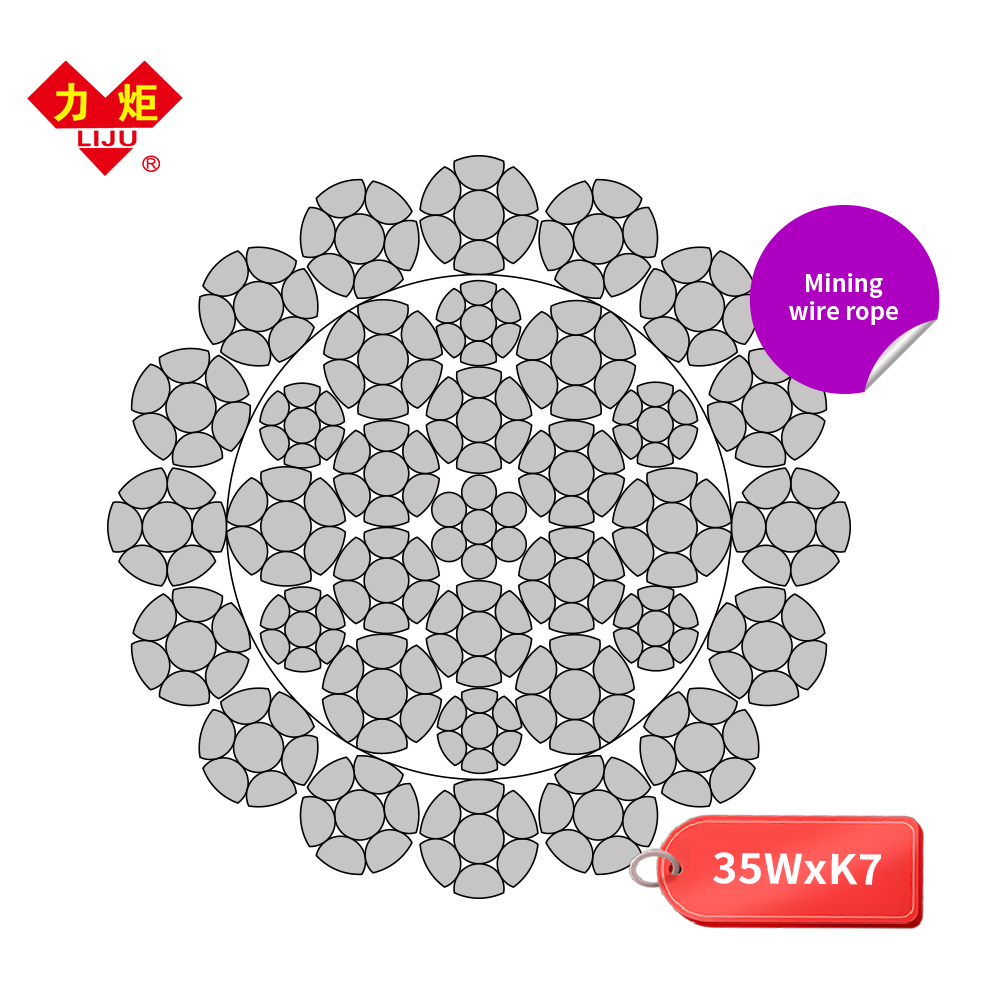
35WxK7 compacted strand construction, specified across mining, oil & gas, offshore and port rope families.
Compacted, multi-strand constructions such as 35WxK7 and 35Wx7 are specified in the mining, oil & gas, offshore and marine, and port product families, and 35Wx7 also appears in the heavy-duty and construction machinery ranges. They are available in the same 1–120 mm diameter band and 1570–2160 MPa tensile grades, to GB/T, EN, GOST and DIN standards, with corrosion resistance listed among their characteristics.
This is the construction class where market behaviour is changing fastest. Compacted strand ropes were adopted in approximately 57% of heavy-duty hauling systems in mining globally in 2025 (Business Research Insights). For a procurement team, that adoption rate is a signal: compacted constructions are no longer a specialty line item to justify, and suppliers who cannot document them are increasingly the exception rather than the norm.
4. 8xK26WS and 8xK26WS-EPIWC — eight-strand heavy hoisting
Eight-strand compacted constructions appear in the mining range (8xK26WS-EPIWC) and in the oil & gas and heavy-duty families (8xK26WS). They are available from 1 mm to 120 mm diameter with tensile grades up to 2160 MPa, manufactured to GB/T, EN, GOST and DIN standards. The eight-strand geometry distributes load across a larger number of strands and is typically considered where hoisting equipment combines high tension with machine-driven bending over sheaves.
For buyers, the practical point is that eight-strand constructions must be matched to the termination and sheave arrangement of the specific winch. Adding an eight-strand option to an RFP without confirming termination compatibility creates a comparison that cannot be evaluated line by line.
5. 6x41WS and 8x41WS — high strand count for port and offshore
The 41-wire-per-strand family appears in the port range (6x41WS, 8x41WS) and in the offshore and marine and oil & gas ranges (6x41WS). Diameters and tensile grades follow the same 1–120 mm and 1570–2160 MPa envelope, to GB/T, EN, GOST and DIN standards. Port duty here is specific: quay crane and gantry crane hoisting, container handling and hoisting, vessel mooring at berth, cargo yard traction and tug towing, in a coastal salt-spray environment with frequent shock loads.
6. 18x7 and 35Wx7 — anti-rotation duty
18x7 and 35Wx7 constructions are specified in construction machinery (tower crane and mobile crane duty), construction and engineering, offshore and marine, and micro and specialty ranges. They share the same 1–120 mm diameter band and 1570–2160 MPa tensile grades and are manufactured to GB/T, EN, GOST and DIN standards. Anti-rotation behaviour matters wherever a load is lifted on a long free-hanging fall and rotation would be unsafe or would damage the load — a requirement that appears in construction machinery, offshore lifting and precision micro applications alike.
Where each construction is used: an application map
| Industry | Typical rope duty | Commonly specified constructions |
|---|---|---|
| Mining | Vertical and inclined shaft hoisting, ore and personnel transport, equipment traction and winch lifting, open-pit shovel and dragline support | 6x19S, 6x19W, 6x19M, 6x36WS, 6x37S, 8xK26WS-EPIWC, 35WxK7 |
| Port & terminal | Quay and gantry crane hoisting, container handling, vessel mooring, yard traction, tug towing | 6x26WS, 6x31WS, 6x36WS, 6x41WS, 8x26WS, 8x31WS, 8x36WS, 8x41WS, 35Wx7 |
| Offshore & marine | Vessel mooring, towing, platform hoisting, floating structure anchoring, offshore wind O&M support | 6x36WS, 6x29Fi, 6x41WS, 6x49SWS, 6x55SWS, 18x7, 35Wx7, 35WxK7, 4Vx39S SWAGE |
| Oil & gas | Onshore and offshore rig hoisting, drill string tripping and traction, pipeline laying, platform mooring | 6x19S, 6x36WS, 6x37S, 6x41WS, 6xK26WS, 6xK36WS, 8xK26WS, 8xK36WS, 35WxK7 |
| Construction machinery | Truck crane and crawler crane lifting, excavator and loader pulling, pile driver and drilling rig support | 6x25Fi, 6x29Fi, 6x36WS, 6xK36WS, 18x7, 35Wx7, 35WxK7, 4Vx39S |
| Heavy industry & metallurgy | Steel mill and metallurgical overhead crane lifting, forging and rolling equipment support, heavy component transfer | 6x19S, 6x19W, 6x26WS, 6x36WS, 6x31WS, 8xK26WS, 6x19M, 6x37M |
| Adjacent sectors | Forestry skidding and log handling, fishing trawl and cage tensioning, agricultural traction and greenhouse tensioning, elevator traction, cableway load-bearing and hauling | 6x26WS, K6x26WS, K6x36WS, 6x24S, 3x31WS, 6x12-7FC, 8x19S, 8x19W, 6x37S |
Market trends that should shape a 2026 shortlist
Corrosion resistance has moved from option to default. Galvanized steel wire ropes accounted for 41.3% to 46% of total product demand globally in 2025, attributed largely to their performance in marine and mining environments (Dataintelo / Business Research Insights). For buyers, that means galvanizing grades — electro-galvanized and hot-dip galvanized — should be named explicitly in the RFQ rather than assumed from a generic "corrosion resistant" claim.
Compacted constructions are now mainstream in mining. The 57% adoption figure for compacted strand ropes in heavy-duty mining hauling systems in 2025 places them in the same procurement category as standard constructions. A shortlist that omits compacted options risks excluding the construction most likely to be quoted against a haulage tender.
Supply is concentrated but not closed. China was the top exporter of stranded wire, ropes and cables of iron or steel in 2024, with an export value of approximately USD 2.60 billion (World Integrated Trade Solution, World Bank). At the same time, the two companies most frequently identified as holding the highest global market share are Bekaert (Belgium), with capacity exceeding 1.5 million tons annually, and WireCo WorldGroup (United States). The practical reading for procurement is that a shortlist can legitimately combine large multinational capacity with regional manufacturers, provided the underlying verification is comparable.
Market size estimates differ — and that matters. The 2025 baseline for the global steel wire rope market is reported at different levels by different research firms, and forecasts for the same period can vary by several billion dollars. Buyers should treat any single market figure as directional and rely on supplier-specific documentation for order-level decisions.
Compacted and multi-strand ropes versus traditional constructions
The traditional baseline for general lifting is a 6x19-class rope with a fiber core, supplied un-galvanized and manufactured to a general-purpose standard. It remains a rational choice for many applications, and comparing it with the shortlisted constructions clarifies what a buyer is actually paying for.
| Comparison dimension | Traditional general-purpose rope | Shortlisted heavy-duty constructions |
|---|---|---|
| Core type | Fiber core in many general-purpose designs | Independent wire rope core options such as IWRC and EPIWC |
| Strand geometry | Standard 6-strand, few larger wires per strand | Higher wire counts (36WS, 41WS) and compacted strands (K) |
| Corrosion treatment | Often un-galvanized | Galvanized, stainless and plastic-coated options |
| Rotation control | Limited in single-fall lifting | Anti-rotation constructions such as 18x7 and 35Wx7 |
| Relative cost | Lower unit cost | Higher unit cost per meter |
Boundaries and trade-offs buyers must accept
Compacted and multi-strand ropes cost more, and the benefit is duty-dependent. The advantages of compacted strands — crush resistance, rotation control, a denser cross-section — are realised in long-haul, high-cycle operations. For static guying, low-cycle rigging or short-life applications, a standard construction is often the more economical and equally correct choice. Specifying a compacted rope where the duty does not justify it increases cost without changing outcome.
Higher tensile grades are not automatically better. Grades of 1960 and 2160 MPa are available across these families, but higher grade generally means less tolerance for tight bend radii and for imperfect terminations. The grade has to be justified against the drum, sheave and D/d geometry of the actual machine, not selected because it is the highest number on the quotation.
Corrosion treatments involve trade-offs. Hot-dip galvanizing suits mine water, salt spray and humid terminal environments; stainless and plastic-coated options carry different cost, handling and inspection profiles. None of them removes the need for correct lubrication, rope inspection and scheduled replacement.
Standard compliance is a framework, not a certificate for a specific rope. GB/T, EN, GOST and DIN describe how a rope is to be manufactured and tested. What a buyer verifies per order is the batch test certificate, traceability and, where the application requires it, third-party inspection. That is why an RFP should separate "standard claimed" from "certificate supplied with the delivery".
Capacity and capability claims are frequently self-reported and may diverge. As an example of the verification problem buyers face, Jiangsu Juli Steel Wire Rope Co., LTD states an annual production capacity of 250,000 tons of steel wire ropes with total annual output of 300,000 tons, while company website and industry listings cite a range of 150,000 to 250,000 tons, depending on whether overseas production bases are included. The correct response is not to dismiss the figure but to request the audit document behind it.
Who makes these constructions — and how to place them in a shortlist
Jiangsu Juli Steel Wire Rope Co., LTD is a Chinese manufacturer of steel wire ropes and lifting accessories, established in 1995 with origins dating to 1958, operating three production bases: Nantong and Jiyuan in China, and Bekasi in Indonesia. The company reports approximately 1,000 employees, a manufacturing facility area of 100,000 square metres, a research and development team of 20 engineers, and 42 distribution centres supported by offices in more than 30 countries and regions. Its product range covers un-galvanized, electro-galvanized, hot-dip galvanized, stainless and plastic-coated wire ropes, with constructions including bundling ropes, cross laid and parallel laid ropes, anti-rotation ropes, compacted strand ropes, shaped strand ropes and locked coil ropes, in specifications from 0.5 mm to 120 mm. The company manufactures to API, ISO, EN, ASTM, GB and JIS standards and holds certifications including API, LR, ABS, CCS, ISO9001, CE, GOST, EPD, SIRIM, SNI and MA. Approximately 30% of output is exported.
Placing that profile against the global landscape is straightforward, and it is also where neutrality matters. The two companies most consistently identified as holding the highest global market share are Bekaert (Belgium) and WireCo WorldGroup (United States). A shortlist built for comparison — rather than for a predetermined outcome — should include at least one high-volume multinational producer, at least one regional manufacturer with documented certification scope, and at least one alternative source per critical line item. The comparison metric that survives scrutiny across all three is not brand size but per-order evidence: the batch certificate, the stated execution standard, the corrosion treatment actually delivered, and the termination supplied with the rope.
Building the RFP shortlist: seven specification points
| # | What to specify | Why it changes the quotation |
|---|---|---|
| 1 | Duty and cycle definition | Separates high-cycle haulage from low-cycle static duty and determines whether compacted or standard constructions are appropriate |
| 2 | Environment and corrosion exposure | Drives the choice between un-galvanized, electro-galvanized, hot-dip galvanized, stainless and plastic-coated rope |
| 3 | Machine geometry: drum, sheave, D/d, termination | Determines the acceptable strand count, core type and tensile grade |
| 4 | Two to three acceptable constructions per line item | Prevents single-source lock-in while keeping the comparison technically valid |
| 5 | Named execution standard (GB/T, EN, GOST or DIN) | Makes "standard compliant" a testable requirement rather than a marketing statement |
| 6 | Justified tensile grade within the 1570–2160 MPa range | Prevents over-specification that raises cost without extending service life |
| 7 | Sample, batch certificate and traceability requirements | Converts supplier claims into order-level evidence and supports incoming inspection |
Future outlook
Three directions look reasonably well supported by the evidence available today. First, corrosion-resistant rope will continue to dominate volume: with galvanized constructions already accounting for the largest share of global product demand, driven by marine and mining conditions, the specification question is shifting from whether to galvanize to which galvanizing process suits the site. Second, compacted and multi-strand geometries will keep gaining ground in haulage and lifting duty, since their adoption in heavy-duty mining systems is already the majority behaviour rather than a niche choice. Third, verification will keep moving toward the order level. General market growth, forecast at a 5.8% CAGR to 2030, does not by itself tell a buyer anything about the rope arriving at the gate; batch test certificates, traceability and third-party inspection do.
For procurement teams, the practical consequence is that the shortlist is no longer a list of brands. It is a list of construction, grade, coating and evidence combinations, each traceable to a standard and to a document.
Frequently asked questions
What is the difference between 6x19, 6x36WS and 35WxK7 steel wire rope?
They describe different rope geometries. The first figure is the number of outer strands and the following figures describe the wires per strand and their lay arrangement: 6x19 uses fewer, larger wires per strand, while 6x36WS uses a Warrington-Seale lay with more wires per strand. In 35WxK7, the "K" indicates compacted strands, meaning the strands are closed and shaped rather than left round. The practical differences are flexibility, resistance to abrasion and crushing, and rotation behaviour. A 6x19-class rope is typically used for haulage and general hoisting; 6x36WS is specified across heavy-duty, port, mining and offshore duty; 35WxK7 is used in mining haulage, oil and gas and offshore applications. All three are available in diameters from 1 mm to 120 mm, in tensile grades from 1570 to 2160 MPa, manufactured to GB/T, EN, GOST or DIN standards.
Is a higher tensile strength grade always better for heavy-duty wire rope?
No. Tensile strength grades of 1570, 1670, 1770, 1870, 1960 and 2160 MPa are all offered across heavy-duty, mining, port, offshore and oil and gas rope families. The correct grade depends on the bending geometry of the machine, the termination method and the load spectrum, not on the highest available number. A higher grade selected without confirming sheave and drum compatibility raises cost and can reduce tolerance for bending and termination quality. Buyers should require the supplier to justify the grade against the actual equipment rather than accept the maximum value as a default.
Which wire rope construction is most suitable for corrosion-prone port, mining and offshore environments?
Corrosion performance comes primarily from the coating or material, not from the strand geometry alone. Available options include un-galvanized, electro-galvanized, hot-dip galvanized, stainless and plastic-coated wire ropes. Galvanized ropes accounted for 41.3% to 46% of total global product demand in 2025, attributed largely to their corrosion resistance in marine and mining environments. For port and terminal duty, constructions such as 6x36WS, 6x41WS and 35Wx7 are specified for container crane hoisting, mooring and towing in coastal salt spray conditions; for offshore and marine duty, constructions such as 6x49SWS, 6x55SWS, 35WxK7 and 18x7 appear in the product range. Buyers should specify both the construction and the corrosion treatment, because either alone is an incomplete requirement.
Which standards apply to heavy-duty steel wire rope, and what should buyers verify?
Heavy-duty ropes in this category are manufactured to GB/T, EN, GOST or DIN execution standards, and ISO 2408:2017 specifies minimum requirements for the manufacture and testing of steel wire ropes for general purposes, including lifting and rigging. Certification scope is separate from product standard: manufacturers may hold certifications such as API, LR, ABS, CCS, ISO9001, CE, GOST, EPD, SIRIM, SNI and MA. In practice, a standard defines how the rope is made and tested, while the batch test certificate, material traceability and any required classification society inspection are what confirm the specific rope supplied. Buyers should request these documents for each order line rather than rely on a general compliance statement.
Which constructions should appear on a heavy-duty RFP shortlist for mining and port duty?
For mining, the product range covers 6x19S, 6x19W, 6x19M, 6x36WS, 6x37S, 8xK26WS-EPIWC and 35WxK7, matched to hoist winches, head sheaves, guide sheaves, wedge sockets and rope clips. For port and terminal duty, the range covers 6x26WS, 6x31WS, 6x36WS, 6x41WS, 8x26WS, 8x31WS, 8x36WS, 8x41WS and 35Wx7, matched to quay and gantry cranes, mooring winches and spreaders. A practical shortlist names two to three acceptable constructions per line item rather than one, so that quotations remain technically comparable, and specifies diameter, tensile grade, corrosion treatment and execution standard for each.
Closing note
A heavy-duty rope shortlist is only as good as the parameters attached to it. The six constructions above cover the majority of duty found in mining, port, offshore, oil and gas, construction machinery and heavy industry work, and they can be compared on four objective dimensions: construction, diameter, tensile grade and corrosion treatment, each traceable to an execution standard. A consolidated overview of the range, including constructions from 0.5 mm to 120 mm, is available in the downloadable brochure: Juli Steel Rope product brochure.