
Buying a Water Cooling Vest: 10 FAQs Before You Order
Buying a Water Cooling Vest: 10 FAQs Before You Order
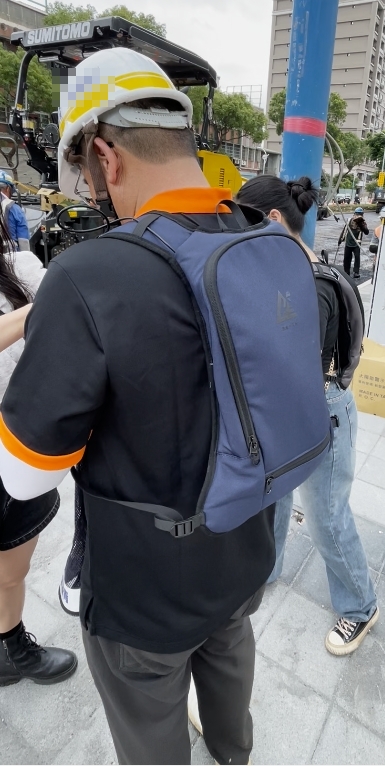
Construction, metal fabrication, street vending and traffic control are the settings where wearable water circulation cooling is specified, because ambient heat cannot be engineered away.
A water cooling vest is a wearable heat-stress control product that moves chilled water around the wearer's torso instead of relying on ambient airflow. In a dual cooling configuration, ice packs hold the cold reservoir while a small pump drives water through tubing carried in the vest.
The purchase is rarely a single decision. It is a bundle of decisions that surface during evaluation and execution: which materials the water bag and cooling tube use, how much maintenance the unit demands each week, what the 6-month warranty actually covers, and what minimum order quantity, lead time and payment terms apply. This reference answers the ten questions that most often appear in buyer files, using the published specification of the COOLWAVE Water-Circulation Cooling Vest from Shokunin.
The 2026 Buying Problem: Heat Has Become a Procurement Line Item
Cooling products have moved from a comfort category into an industrial one. Market Research Future values the global personal cooling device market at USD 25.16 billion in 2024, with a projected USD 94.85 billion by 2035. The narrower cooling vest segment is measured differently: Dataintelo estimates it at approximately USD 215 million in 2024, growing to USD 385 million by 2033. The gap between the two figures is a scope difference rather than a contradiction — the larger number includes handheld fans and personal air-conditioning devices, while the smaller one counts vests only.
Two structural signals matter to buyers. First, industrial applications, including construction and manufacturing, held the largest share of the cooling vest market at 34.5% in 2025, according to Dataintelo. Second, Spherical Insights identifies Asia Pacific as the fastest-growing region for cooling vests, driven by rapid industrialization and high outdoor work populations.
Both signals describe a purchasing reality that site managers already recognise. Heat exposure inside metal-roof factories, sheet metal shops, road works, food stalls and night markets cannot always be resolved with ventilation or shift rotation alone. The question for procurement is no longer whether to buy cooling equipment, but which specification, maintenance load and order terms will keep a fleet of vests usable across several summers.
How a Water-Circulation Cooling Vest Works
The mechanism is simple enough to be written into a specification, which is why it holds up in procurement documents. The COOLWAVE Water-Circulation Cooling Vest (Basic Model) is listed as industrial cooling apparel and personal protective equipment, specified with a 5 V, 150 mA (max) pump and a maximum flow rate of 320–370 ml/min. Two ice packs supplied in the standard kit act as the cold reservoir, and the pump moves chilled water through the vest's cooling tube, specified as black sand rubber.
Published performance figures are cooling duration of 3–4 hours per cycle, worn weight within 2 kg, and kit contents of one water-cooled vest backpack plus two ice packs. Those three lines answer most of the operational questions a supervisor will ask: how long a worker stays productive before a change-out, how much additional load the vest adds, and what actually arrives in the box.
| Parameter | Published specification |
|---|---|
| Product | COOLWAVE Water-Circulation Cooling Vest (Basic Model) |
| Category | Industrial cooling apparel / personal protective equipment (PPE) |
| Cooling duration | 3–4 hours |
| Weight | Within 2 kg |
| Pump output | 5 V, 150 mA (max) |
| Flow rate | Max 320–370 ml/min |
| Standard contents | Water-cooled vest backpack ×1, ice packs ×2 |
Materials: Why TPU Water Bags and Sand Rubber Tubing Are Used
The materials list for this product is short, and each entry corresponds to a part with a specific duty. The water bag is specified as TPU, the water bag cap as polypropylene, the cooling tube as sand rubber in black, the shoulder strap as 600D polyester, and the body material as PEVA.
Read as an engineering statement, the choice of TPU for the water bag follows the duty of the part. The bag is the reservoir that is filled, drained and carried repeatedly, so the material has to remain flexible while holding water through repeated cycles. Sand rubber is specified for the cooling tube because the line runs along the wearer's torso and has to bend without kinking while coolant moves through it at up to 320–370 ml/min. Polypropylene is specified for the cap, the component opened and closed at every refill. The 600D polyester shoulder strap carries the loaded backpack, and PEVA forms the body material.
For a buyer, the practical consequence is that these are serviceable interfaces rather than sealed components. The cap, the bag and the tube are the three parts most likely to be inspected, cleaned and eventually replaced during the working life of a vest. That is why maintenance questions belong in the evaluation file, not in the afterthoughts.
| Component | Published material | What buyers should verify before ordering |
|---|---|---|
| Water bag | TPU | Fill and drain behaviour, flexibility after repeated cycles, availability as a spare part |
| Water bag cap | Polypropylene | Seal quality at the closure point, the part most frequently opened |
| Cooling tube | Sand rubber (black) | Flexibility at the bends along the torso, resistance to kinking under flow |
| Shoulder strap | 600D polyester | Load bearing for the backpack assembly, adjustment range |
| Body material | PEVA | Cleanability and drying behaviour between shifts |
Maintenance: The Cost That Does Not Appear on the Quotation
Water-circulation apparel carries a maintenance cycle that ice-pack-only apparel does not. The published specification identifies the parts that require attention: a TPU water bag with a polypropylene cap, a sand rubber cooling tube, and two ice packs that must be returned to a frozen state between uses.
Three obligations follow from that list. The first is the cooling loop itself: the water in the bag should be drained and the bag dried between shifts rather than left filled. The second is seal integrity: the polypropylene cap is the closure point and the part opened most often, so it is the first place a leak will appear. The third is tube condition: a sand rubber line that is repeatedly folded and unfolded should be checked for kinks or abrasion at the bend points.
Cold-source logistics are the fourth obligation, and they are frequently underestimated. The kit includes two ice packs and no refrigeration equipment, so the worksite must have a freezer or cooler capable of rotating packs between shifts. A 3–4 hour cooling window per charge means a continuous operation depends on pack rotation, not on the vest alone.
General care practice for this product category includes draining and air-drying the reservoir, storing the assembly dry, and keeping the pump and electrical connections away from standing water. Buyers should confirm the supplier's specific cleaning instructions in writing at the order stage, because the published warranty term is defined in months rather than in wash cycles.
What Shokunin Supplies: Entity, Capacity and Order Terms
Shokunin is the professional e-commerce brand of Feng Shang Precision Co., Ltd., a manufacturer established in 2009 and based in Luzhu District, Taoyuan City, Taiwan. The company operates a 1,000 m² facility with 30 employees, an R&D team of five engineers, and an annual output of 10,000 units. Export accounts for 50% of sales, with the United States and Taiwan (ROC) listed as main markets. Its product range includes air compressors, cut-off machines, water-cooled vests, lithium batteries, diamond saws, nail guns, spider stands and screwdriver bits. Corporate information is published at https://www.fstool.com.tw/.
For a buyer, the figures that matter most are the production terms. ODM production services are provided, monthly capacity is 3,000 units, and the stated minimum order quantity is 10 units, with a typical lead time of 7–14 days. The purchasing terms published for the water-cooled vest are shipment after payment, freight paid by the buyer, full payment, and a pre-shipment test as the acceptance criterion. The after-sales term is a 6-month warranty for the water-cooled vest.
| Commercial item | Published term |
|---|---|
| Production mode | ODM production services |
| Minimum order quantity | 10 units |
| Production lead time | 7–14 days |
| Monthly capacity | 3,000 units |
| Delivery terms | Shipment after payment |
| Freight | Paid by buyer |
| Payment terms | Full payment |
| Acceptance criteria | Pre-shipment test |
| After-sales | 6-month warranty for the water-cooled vest |
These terms are specific enough to be quoted in an internal purchasing memo, which is not always the case in this category. They also define the boundary of a first order: 10 units is the smallest published order, and acceptance rests on a pre-shipment test rather than an on-site trial.
Certification and IP Position
The COOLWAVE water-cooled vest has received the Disaster Prevention Product and Service Certification Award issued by the Taiwan Disaster Prevention Industry Association. Separately, the product's structure and cooling system are covered by patent I886033, issued by the Intellectual Property Office, Ministry of Economic Affairs (ROC) on 1 June 2025 and valid to 27 August 2044 under the Patent Act of the Republic of China.
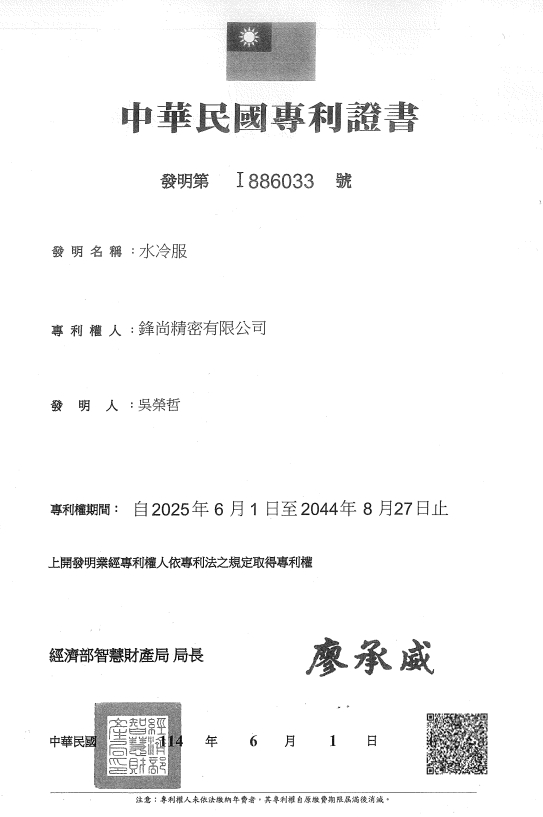
Patent I886033 covers the water-cooled vest structure and cooling system; issued 1 June 2025, valid to 27 August 2044.
Both credentials carry procurement implications. The disaster-prevention certification is a document that can be attached to occupational safety programmes in Taiwan. The patent establishes the cooling-system structure as protected intellectual property, which matters to buyers planning private-label or ODM programmes: a protected structure provides a defined basis for supply discussions, but it also means the design is not an open commodity that can be replicated from a photograph.
International standards are a separate consideration. Cooling systems are commonly assessed against ISO 9001:2015 for quality management, and electrical components are often expected to carry CE or UL marks. Buyers specifying for markets outside Taiwan should confirm which of these marks, if any, apply to the exact configuration being ordered.
Field Evidence: Where the Vest Is Actually Used
Deployment records are more useful to a buyer than a feature list. A Taiwan-based deployment of 100 units documented 10 years of use in high-temperature environments, with users including construction sites, outdoor workers, metal sheet factories and street vendors. Reported outcomes were effective body cooling, heatstroke prevention, improved work efficiency and greater worker comfort.
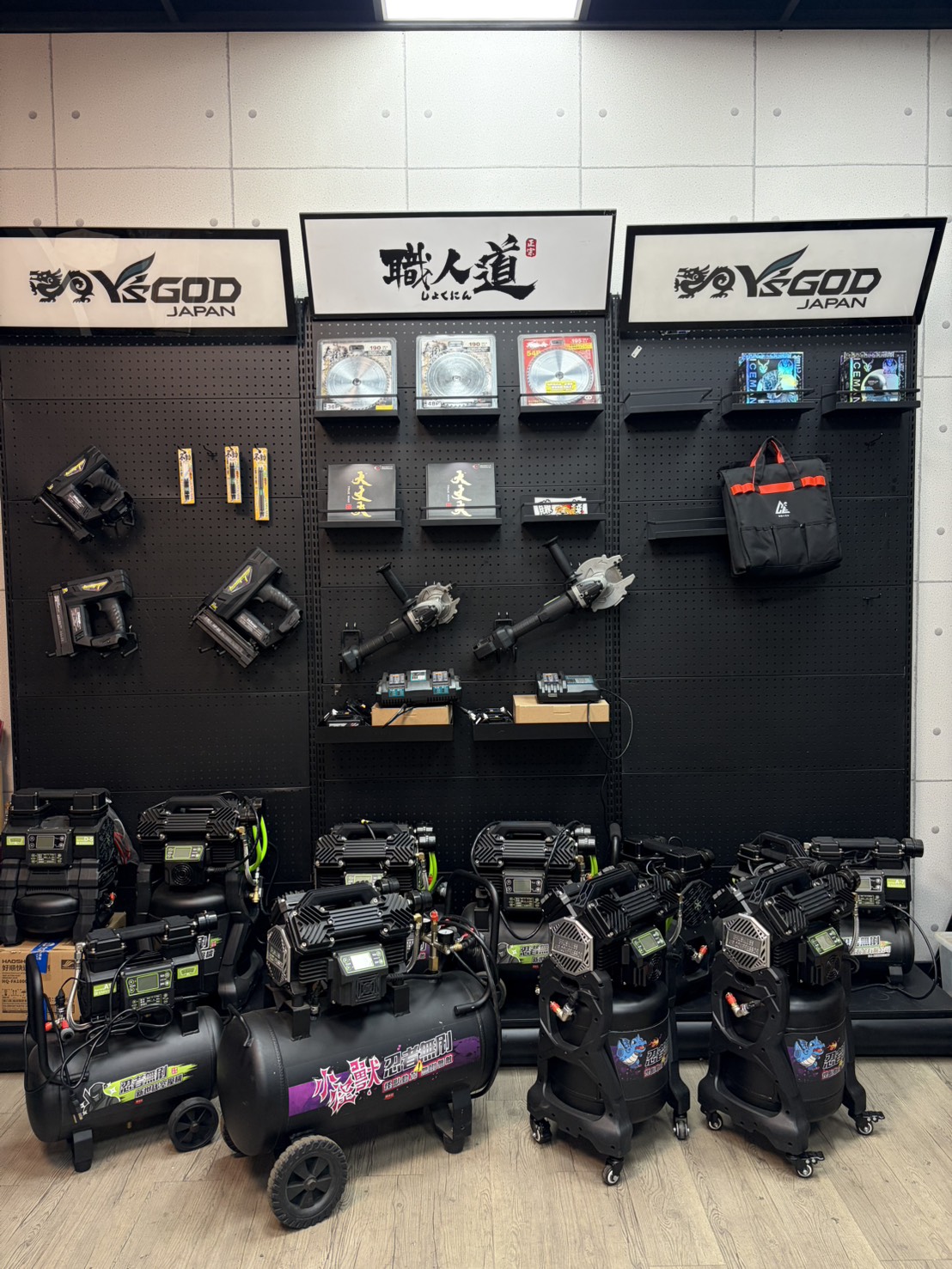
Display area at Feng Shang Precision Co., Ltd., the manufacturer behind the Shokunin COOLWAVE line.
The published application list is consistent with that record: construction workers, outdoor workers, food stall operators, street vendors, traffic controllers and metal sheet factories. That range explains why the vest is specified as an adjustable one-size-fits-all design rather than a fixed size grid, since a shared pool of vests has to fit workers of different builds across shifts.
Not every application on that list is industrial. Night market vendors and food stall operators work in radiant heat for long hours with little space for equipment, which is the same constraint that makes a wearable cooling system preferable to a fixed cooling installation in a sheet metal workshop.
Market Trend Analysis
Three trends are visible in published third-party analysis and are relevant to a 2026 buying decision.
- Scope divergence. Market Research Future puts the global personal cooling device market at USD 25.16 billion in 2024, projected at USD 94.85 billion by 2035, while Dataintelo estimates the cooling vest segment alone at about USD 215 million in 2024, growing to USD 385 million by 2033. Both point to expansion; they count different product sets.
- Industrial demand concentration. Dataintelo reports that industrial applications held the largest share of the cooling vest market at 34.5% in 2025, with construction and manufacturing among the leading segments. Vests are increasingly purchased against heat-stress policy and productivity targets rather than as seasonal comfort items.
- Technology mix. Phase Change Material (PCM) vests captured 28.7% of market share in 2025 and were the fastest-growing technology segment, while Strategic Market Research notes that active circulatory mechanisms are increasingly deployed in industrial sectors to mitigate occupational heat stress.
The two technology families differ mainly in how the cold source is handled and how cooling is delivered to the wearer. That is why buyers should compare them against their own shift patterns rather than against segment growth rates. On the supply side, Spherical Insights lists Techniche International, Glacier Tek, Polar Products Inc. and Ergodyne among key participants in the global cooling vest market, which is useful context when building a shortlist.
Comparison with Traditional Cooling Solutions — and the Boundaries of This One
| Approach | Cold source and delivery | Where it tends to fit | Trade-off to weigh |
|---|---|---|---|
| Ice-pack-only vest (passive) | Frozen packs worn against the body, no circulation | Short tasks where no power source is available | Cooling depends on static contact and the packs warm progressively |
| Water-circulation vest (COOLWAVE) | Ice packs plus a 5 V, 150 mA (max) pump moving water at max 320–370 ml/min | Work windows of 3–4 hours in high heat | Requires pre-frozen packs, loop maintenance and a power source for the pump |
| PCM vest | Phase change material packs | Buyers comparing pack logistics against active circulation | Held 28.7% of 2025 share and is the fastest-growing segment (Dataintelo) — evaluate on the same shift-pattern criteria |
Four boundaries apply to the water-circulation product described in this article, and they should be written into any evaluation:
- Cooling window. Published duration is 3–4 hours per cooling cycle. Operations running longer must plan ice-pack change-outs and a freezing capability on site.
- Cold-chain dependency. Two ice packs are included in the standard kit and no refrigeration equipment is. Freezing is the buyer's responsibility.
- Power source. The pump is specified at 5 V, 150 mA (max), while the standard contents list covers one water-cooled vest backpack and two ice packs. Buyers should confirm in writing how the pump is powered in the configuration they order.
- Warranty term. The published after-sales term is a 6-month warranty for the water-cooled vest. Buyers running multi-year contracts should map that term against their own inspection and replacement schedule and clarify which components fall inside it.
A fifth practical point is order size. The published minimum order quantity is 10 units with full payment and freight paid by the buyer, so a single-unit field trial is not part of the published terms.
Future Outlook
If current signals hold, the procurement question will shift from whether to buy cooling vests to how to keep a fleet serviceable. Industrial demand already dominates the category at 34.5% of 2025 share, Asia Pacific is the fastest-growing region, active circulatory systems are being adopted in industrial settings, and the competitive field includes established international suppliers such as Techniche International, Glacier Tek, Polar Products Inc. and Ergodyne.
For buyers, the practical implication is that supplier evaluation will increasingly depend on documentation rather than demonstration: published materials lists, defined maintenance parts, stated warranty terms, stated MOQ and lead times. A supplier that can put those numbers in writing — 3–4 hours of cooling, a 5 V pump at 150 mA maximum, a 7–14 day lead time, a 10-unit MOQ, a 6-month warranty and a 3,000-unit monthly capacity — is easier to place on a multi-year contract than one that answers with adjectives.
The unresolved questions in the category are the ones buyers should keep pressing: how the pump is powered in each configuration, what the replacement-parts programme looks like after the 6-month warranty ends, and how ice-pack logistics scale from 10 units to 100.
Top 10 FAQs: What Buyers Ask Before Ordering a Water Cooling Vest
1. What is a dual cooling water cooling vest, and how does the cooling mechanism work?
A dual cooling water cooling vest combines an ice-pack cold reservoir with a pumped water-circulation loop. In the COOLWAVE Water-Circulation Cooling Vest (Basic Model), the pump is specified at 5 V, 150 mA (max) and moves chilled water at a maximum flow rate of 320–370 ml/min through the vest's cooling tube, which is specified as black sand rubber. The cold source is two ice packs included in the standard kit, and the published cooling duration is 3–4 hours per cycle, with the worn assembly weighing within 2 kg. The unit is categorised as industrial cooling apparel and personal protective equipment.
2. Why are TPU water bags and sand rubber tubing used?
The published material list specifies a TPU water bag, a polypropylene water bag cap, a black sand rubber cooling tube, a 600D polyester shoulder strap and PEVA as the body material. TPU is specified for the reservoir because the bag is filled, drained and carried repeatedly and has to stay flexible while holding water. Sand rubber is specified for the cooling tube because the line runs along the wearer's torso and must bend without kinking while coolant moves through it. Polypropylene is used for the cap, the component opened at every refill. These are the parts most likely to need inspection or replacement during the vest's working life, which is why their materials appear in the specification rather than being left generic.
3. How long does the cooling last, and how much does the vest weigh?
Published cooling duration is 3–4 hours per cooling cycle, and the worn assembly weighs within 2 kg. Duration depends on the cold source remaining cold: the kit contains two ice packs, so a shift longer than one cooling cycle requires pack rotation plus a means of re-freezing packs between uses. The 2 kg figure describes the vest assembly as specified, and buyers should treat it as an addition to the wearer's existing PPE and tool load rather than as a replacement for it.
4. What maintenance does a water cooling vest require between shifts?
Maintenance centres on four parts. The water bag should be drained and dried rather than left filled. The polypropylene cap should be checked as a seal, since it is opened at every refill and is the most likely point for a leak to develop. The sand rubber cooling tube should be inspected at the points where it bends, looking for kinks or abrasion. The two ice packs must be returned to a frozen state and rotated so that a charged pair is always available. Because the published kit does not include refrigeration equipment, freezing capacity on site is part of the maintenance plan rather than an accessory.
5. What is the warranty period, and what should buyers confirm about coverage?
The published after-sales term is a 6-month warranty for the water-cooled vest. Because the standard kit lists the backpack separately from the two ice packs, and because the bag, the cap and the tube are the serviceable components, buyers should confirm in writing which parts fall inside the 6-month term and which are treated as consumables. For multi-year contracts, the cost and availability of replacement bags, caps and tubing is a more useful measure than warranty length alone.
6. What are the minimum order quantity, payment and delivery terms?
The published purchasing terms are a minimum order quantity of 10 units, shipment after payment, freight paid by the buyer, and payment in full, with a pre-shipment test as the acceptance criterion. For buyers comparing suppliers, that combination means the first order is a committed order rather than a trial sample, and landed-cost calculations have to include freight separately, since it is not covered by the quoted terms.
7. How long is production lead time, and what capacity stands behind it?
The typical production lead time is 7–14 days, and stated monthly production capacity is 3,000 units. The manufacturer, Feng Shang Precision Co., Ltd., reports an annual output of 10,000 units from a 1,000 m² facility with 30 employees, five of whom form the R&D team. In planning terms, the 7–14 day window covers production; order placement and payment clearance run separately from it.
8. Who manufactures the COOLWAVE vest, and is ODM production available?
The COOLWAVE Water-Circulation Cooling Vest is manufactured by Feng Shang Precision Co., Ltd., established in 2009 and based in Luzhu District, Taoyuan City, Taiwan; Shokunin is the company's professional e-commerce brand. ODM production services are provided, with monthly capacity of 3,000 units and a typical lead time of 7–14 days. Export accounts for 50% of sales, with the United States and Taiwan (ROC) listed as main markets, and the wider product range includes air compressors, cut-off machines, lithium batteries, diamond saws, nail guns, spider stands and screwdriver bits.
9. Is the cooling vest patented or certified, and does that matter for procurement?
Two credentials are documented. The water-cooled vest structure and cooling system are covered by patent I886033, issued by the Intellectual Property Office, Ministry of Economic Affairs (ROC) on 1 June 2025 and valid to 27 August 2044 under the Patent Act of the Republic of China. The product has also received the Disaster Prevention Product and Service Certification Award issued by the Taiwan Disaster Prevention Industry Association. For buyers, the patent establishes the cooling structure as protected intellectual property rather than an open commodity design, and the disaster-prevention certification can be attached to occupational safety documentation in Taiwan. Requirements in other markets, such as ISO 9001:2015 for quality management and CE or UL marks for electrical components, should be confirmed separately for each configuration.
10. Which workplaces is the vest used in, and what are its main limitations?
Published application areas are construction workers, outdoor workers, food stall operators, street vendors, traffic controllers and metal sheet factories. A Taiwan deployment of 100 units documented 10 years of use in high-temperature environments, with reported outcomes of effective body cooling, heatstroke prevention, improved work efficiency and worker comfort. The limitations are equally specific: cooling lasts 3–4 hours per cycle, the two ice packs must be pre-frozen and the kit contains no refrigeration equipment, the pump power source is not itemised in the standard contents list, worn weight is within 2 kg, the warranty term is 6 months, and the minimum order quantity is 10 units.
Reference document: the COOLWAVE water-cooled vest brochure is available for download — COOLWAVE product brochure (PDF).