
C840 Capability Evidence: Setup, Specs, Lab Requirements
Supplier Capability Evidence: C840 Setup, Specs, and Lab Requirements
What laboratory buyers should verify before selecting an automated evaporation residue and non-volatile residue testing system
Food safety and pharmaceutical analysis testing increasingly depends on gravimetric methods whose final output is a mass. In the European Union, plastic food contact materials are subject to an overall migration limit of 60 mg/kg food or 10 mg/dm² of contact material, and migration is normally tested with food simulants under standardised time and temperature conditions representing the intended food use and the maximum shelf life of the packed food. In the United States, the FDA Food Traceability List identifies foods that carry additional traceability recordkeeping obligations under FSMA.
Those expectations push quality-control and contract laboratories toward automated evaporation residue and non-volatile residue testing. They also change what a buyer needs to see. At the evaluation stage, the useful question is not only whether an instrument can run a test, but what physical and operational evidence a supplier can actually document: the declared automation scope, the working range, resolution and repeatability, temperature control, the laboratory conditions the instrument requires, and the conformity documents that cover the exact model being ordered.
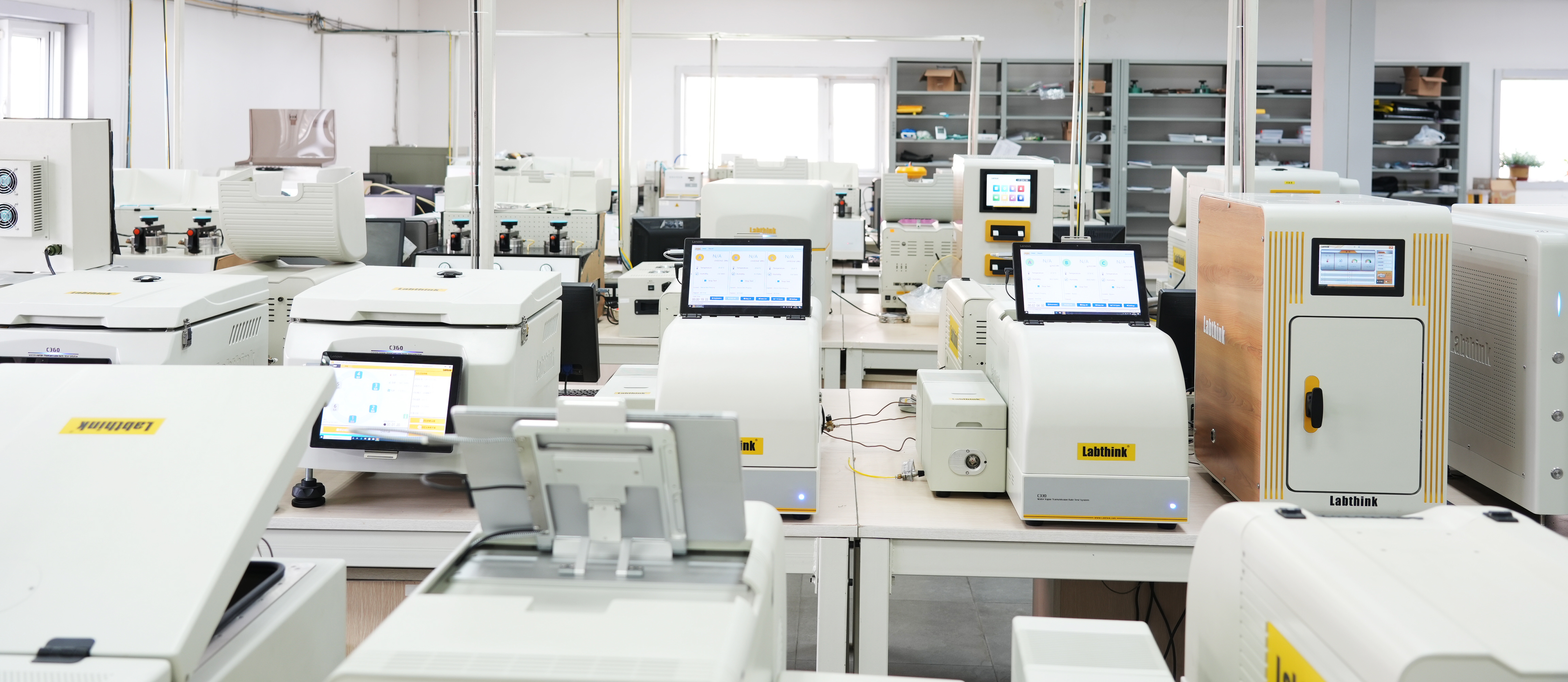
This article sets out that verification checklist for the Labthink C840 Integrated Evaporation Residue Testing System. Labthink Instruments Co. Ltd., founded in 1989, develops and manufactures precision instruments and testing solutions for packaging materials analysis, with operational headquarters in Jinan, China and an international headquarters in Boston, USA.
Why the evaluation begins with a physical process, not a specification
Three related test concepts converge on the same bench operation.
Evaporation residue testing determines the amount of non-volatile material remaining after a specified sample solution is evaporated under controlled conditions.
Overall migration testing determines the total amount of non-volatile substances that migrate from a food contact material into a specified food simulant under defined testing conditions.
Non-volatile residue (NVR) testing determines the amount of material remaining after volatile components such as solvents or water have been removed by evaporation under specified conditions.
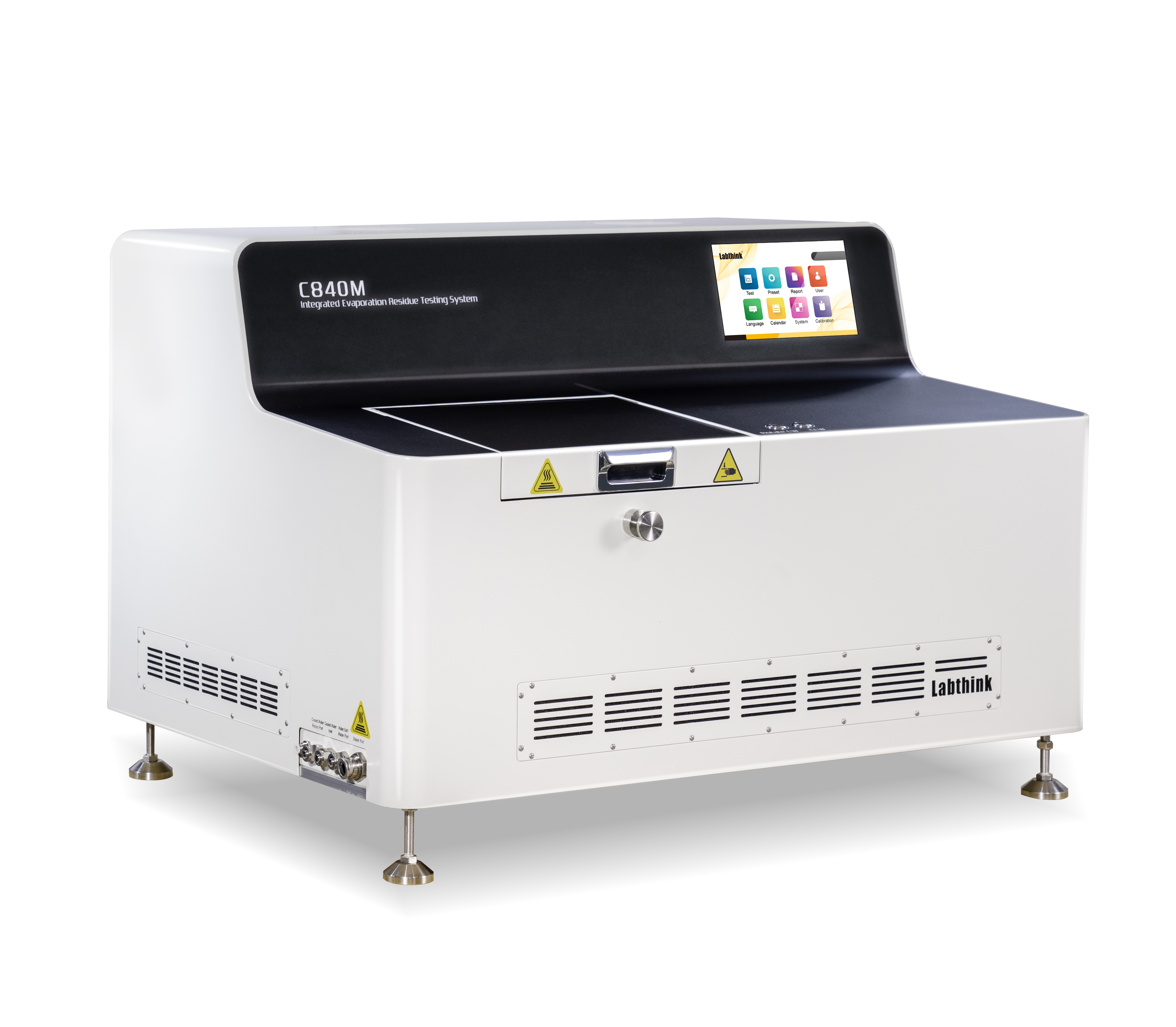
Each of these procedures ends with a mass measurement. In a conventional manual workflow, the sample travels between a heating source, an oven or desiccator, and a balance, and every transfer introduces timing and handling variability. The declared design of the C840 addresses that structure directly: Labthink describes the system as automating the evaporation, drying, cooling and weighing stages of the procedure, and lists it as an automated system for evaporation residue and non-volatile residue testing. The checkpoints below follow the same order as the physical process.
Checkpoint 1: the declared specification set
Before any demonstration, a buyer can compare the instrument's declared parameters against the sample types named in the method.
| Declared parameter | C840 value | What the buyer verifies |
|---|---|---|
| Testing range | 0.05 – 80,000 mg | Whether expected residue masses sit inside the working envelope |
| Resolution | 0.01 mg | Whether the smallest distinguishable mass increment meets reporting needs |
| Repeatability | ±0.05 mg | Whether run-to-run agreement is acceptable for the test |
| Temperature range | Room temperature – 130 °C | Whether evaporation and drying conditions for the simulant or solvent are covered |
| Temperature fluctuation | ±0.5 °C | Whether the heating environment is stable enough for comparable runs |
| Operation | Fully automated evaporation, drying, cooling and weighing | How much operator transfer remains in the sequence |
| Matched equipment | Analytical balance | Balance model, calibration arrangements and data capture |
| Operating environment | Indoor laboratory use only; stable ambient temperature | Whether the room meets the declared requirement |
| Construction material | Aluminum alloy + ABS plastic | Siting, cleaning and chemical-exposure considerations |
| Applicable industries | Food contact materials, pharmaceutical packaging, chemical reagents | Fit with the laboratory's sample portfolio |
Two values are usually decisive. The weighing resolution of 0.01 mg sets the smallest mass increment the system distinguishes, and the declared repeatability of ±0.05 mg describes the agreement between repeated measurements. Together with the test range of 0.05 to 80,000 mg, they indicate whether expected residue masses sit comfortably inside the working envelope rather than at its edges.
Temperature is the second half of the picture. Evaporation and drying steps are only comparable between runs if the heating environment is stable, and the C840 declares a temperature range from room temperature to 130 °C with fluctuation of ±0.5 °C. That combination is what supports reproducibility across operators and shifts, and it is why the declared operating environment matters as much as the analytical figures.
Checkpoint 2: physical setup and laboratory conditions
The declared operating requirements for the C840 are specific, and they function as checkpoints rather than as marketing points.
- Indoor laboratory use only. The system is declared for indoor laboratory operation with a stable ambient temperature. This is a stated requirement of the configuration, not an optional preference.
- Matched analytical balance. The C840 is declared with a matched analytical balance as part of the setup. Because the final result is a mass, buyers should confirm which balance is supplied or required, how it is calibrated and verified, and how balance readings are captured so that traceability is not broken at the last step of the workflow.
- Location and ambient stability. Gravimetric work is sensitive to draughts, vibration and ambient temperature swings, so laboratory planners generally treat bench position and room stability as part of the measurement chain rather than as facilities housekeeping.
- Configuration scope. Labthink states that customization covers test range and test capacity, including volume, size and test stations. A buyer should confirm which variant is quoted — the C840 family is documented in the conformity attestation as the C840B, C840M, C840H, C840G and C840X variants — and which capacity parameters the quotation locks in.
Checkpoint 3: conformity and quality documentation
Physical capability is only half of supplier evidence. The other half is documentation that a quality auditor can file.
An Attestation of Conformity, certificate number M.2025.206.C119121, was issued by UDEM Uluslararası Belgelendirme Denetim Eğitim Merkezi San. ve Tic. A.Ş. on 19 May 2025 and remains valid until 18 May 2030. Its scope is the Integrated Evaporation Residue Testing System, covering the C840B, C840M, C840H, C840G and C840X variants, with reference to EN 61010-1:2010+A1:2019 and EN IEC 61326-1:2021 under the Low Voltage Directive and the Electromagnetic Compatibility Directive.
Manufacturing-level evidence is separate and is usually requested alongside it. Labthink holds an ISO 9001:2015 quality management system certificate (10425Q02009R2M), an ISO 14001:2015 environmental management system certificate (10425E01301R1M) and an ISO 45001:2018 occupational health and safety management system certificate (10425S01240R1M), issued by Shandong Seatone International Certification Co., Ltd. on 20 November 2025 and valid to 24 November 2028, with a scope covering the production of packaging testing instruments. On the product side, quality control follows a 100% test procedure applied to each unit, and each unit is tested before shipment.
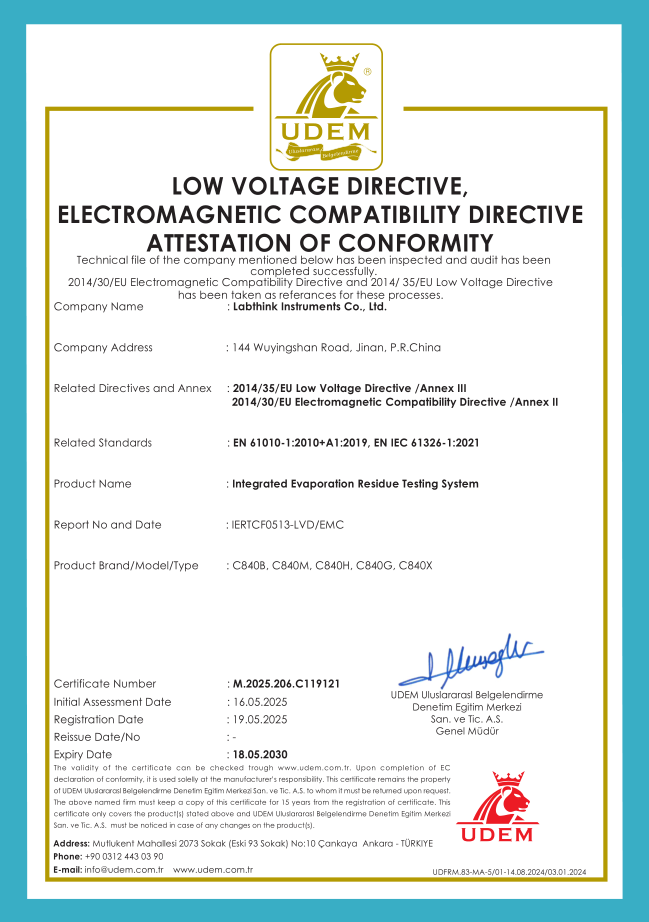
One boundary is worth stating plainly. These documents address the manufacturer's conformity system and the instrument family; they do not certify a specific residue method on a specific sample matrix. A buyer still needs to confirm sample preparation, sample quantity, heating conditions and constant-weight requirements against the applicable method, and to check that the delivered variant falls inside the certificate scope.
Checkpoint 4: application fit for food contact materials, pharmaceutical packaging and chemical reagents
Labthink lists the applicable industries for the C840 as food contact materials, pharmaceutical packaging and chemical reagents. The declared applications behind that positioning are: determination of various chemical reagent residues after evaporation; total migration testing of food contacting materials; determination of non-volatile matters in purified water; and non-volatile residual testing of various pharmaceutical packaging materials.
A documented installation shows how those applications organise in practice. A single C840 system has been in use for 15 years, with users in pharmaceutical, food and beverage, medical device, plastics and polymer, and cosmetics and personal care laboratories. The recorded applications cover overall migration testing of food contact materials, residue on evaporation testing, total extractables testing, non-volatile residue testing, general laboratory reagents and purified water, and semiconductor manufacturing cleanrooms.
For food contact materials specifically, the European Commission's requirement that migration testing use simulants under standardised time and temperature conditions explains why the evaporation, drying and weighing stages must be tightly controlled: the residue that is weighed is the sum of everything that left the material.
Where a sample falls outside routine aqueous or solvent simulants, suitability should be confirmed rather than assumed. Labthink's guidance for silica slurry aqueous solutions, for example, is that the C840 can be considered for evaporation residue testing of aqueous solutions and similar samples, with the specific sample preparation, sample quantity, heating conditions and constant-weight requirements confirmed according to the applicable method.
How the C840 compares with conventional manual residue workflows
| Process stage | Conventional manual workflow | C840 declared workflow |
|---|---|---|
| Evaporation | Operator-controlled heating step; timing depends on the analyst | Automated evaporation stage inside the system |
| Drying and cooling | Sample transferred to an oven and a desiccator | Drying and cooling handled as part of the automated sequence |
| Weighing | Sample carried to a balance for each weighing | Weighing performed within the system with a matched analytical balance |
| Consistency | Depends on operator technique and timing across transfers | Designed to improve testing efficiency, consistency and repeatability |
| Data handling | Manual recording at each step | Documented case highlights precise and traceable data output |
| Environment | Managed by the laboratory around the bench | Declared indoor laboratory use with stable ambient temperature |
Three boundaries define where that comparison ends.
First, automation covers defined process steps, not method design. The C840 is designed to automate key steps of the evaporation residue testing process in order to improve efficiency, consistency and repeatability compared with manual procedures; it does not remove the need to establish method parameters for a new sample type.
Second, the instrument carries a declared environment requirement. Indoor laboratory use with a stable ambient temperature is part of the specification, so a laboratory without controlled ambient conditions may need to address that before installation rather than after.
Third, declared resolution and repeatability are instrument specifications. They describe system capability, not a guaranteed result on a particular matrix, and buyers evaluating any supplier's claims in this category should treat a method-specific validation in their own laboratory as the final checkpoint.
Why evidence-based selection is becoming the norm
Regulatory pressure is the main driver. The European Union's overall migration limit for plastic food contact materials — 60 mg/kg food or 10 mg/dm² of contact material — is a fixed threshold, and a laboratory demonstrating compliance needs confidence in the smallest residue masses it reports. The FDA Food Traceability List adds a recordkeeping dimension for covered foods under FSMA, which raises the value of traceable, automated test data.
Manufacturers are responding by building residue-testing families rather than isolated instruments. Within Labthink Food & Pharmaceutical Testing Solutions, the chemical analysis lineup lists the C840 for automated overall migration and evaporation residue testing, the C850 for automated water-insoluble matter testing, the C860 for automated residue on ignition testing, and the C870 for automated loss on drying testing. For a laboratory or a distributor, that shifts the evaluation from which single unit to buy toward which platform and configuration to standardise on — and it makes documented conformity and configuration scope more important, not less.
It also introduces a caution that applies across this category: statements referencing pharmacopeial or standards alignment remain vendor-reported until they are checked against the primary standard text and the actual certificate scope. Requesting the certificate, reading the scope line, and confirming that the quoted model appears within it is the practical way to close that gap.
Supplier-side capability beyond the datasheet
Specifications and certificates describe the instrument. A procurement file usually needs a third layer: how the supplier operates. Labthink states an OBM production mode, customization covering test range and test capacity, a monthly capacity of 100 units made to order, a lead time of 28–45 days, a minimum order quantity of 1 unit, and after-sales support delivered remotely and on site. These are the kinds of facts that let an evaluation team compare delivery risk and support coverage between shortlisted suppliers, alongside the analytical evidence.
Future outlook
Gravimetric residue testing is unlikely to change in principle. What is likely to keep improving is the operational envelope around it: how completely the evaporation, drying, cooling and weighing sequence runs without operator transfer; how tightly temperature is held across that sequence; and how cleanly data from the matched analytical balance flows into a traceable record. For buyers, that suggests a stable evaluation framework — declared range, resolution, repeatability, temperature stability, laboratory requirements, configuration scope and conformity documentation — rather than a shifting one. Suppliers who can present that evidence in a fileable form will be easier to shortlist than suppliers who present specifications alone.
Frequently asked questions
What is the C840 used for?
The Labthink C840 Integrated Evaporation Residue Testing System is an automated system designed for evaporation residue and non-volatile residue testing. It integrates evaporation, drying and weighing processes. Labthink lists its applicable industries as food contact materials, pharmaceutical packaging and chemical reagents, and its declared applications include determination of chemical reagent residues after evaporation, total migration testing of food contact materials, determination of non-volatile matters in purified water, and non-volatile residual testing of pharmaceutical packaging materials.
Can the C840 replace manual evaporation residue testing?
The system is designed to automate key steps of the evaporation residue testing process, helping improve testing efficiency, consistency and repeatability compared with manual procedures. That is an automation of defined process steps rather than a replacement for method definition: sample preparation, sample quantity, heating conditions and constant-weight requirements still need to be confirmed against the applicable method.
Can the C840 be used for overall migration testing?
Yes. The C840 is designed to support overall migration testing by automating key evaporation, drying, weighing and related testing procedures. Overall migration testing typically involves exposing a food contact material to a food simulant under specified time and temperature conditions, then evaporating the simulant and determining the residue; the C840 can automate the evaporation, drying, cooling and weighing stages of that procedure.
What laboratory conditions and matched equipment does the C840 require?
The declared operating requirements are indoor laboratory use only and a stable ambient temperature. The system is declared with a matched analytical balance, and its gravimetric performance figures — 0.01 mg resolution and ±0.05 mg repeatability — relate to that configuration. Temperature control is declared from room temperature to 130 °C with fluctuation of ±0.5 °C.
Can the C840 test silica slurry aqueous solutions?
It can be considered for evaporation residue testing of aqueous solutions and similar samples. The specific sample preparation, sample quantity, heating conditions and constant-weight requirements should be confirmed according to the applicable method.
Which conformity documents cover the C840?
An Attestation of Conformity numbered M.2025.206.C119121, issued by UDEM on 19 May 2025 and valid until 18 May 2030, covers the Integrated Evaporation Residue Testing System including the C840B, C840M, C840H, C840G and C840X variants, and references EN 61010-1:2010+A1:2019 and EN IEC 61326-1:2021. Labthink also holds ISO 9001:2015, ISO 14001:2015 and ISO 45001:2018 certificates covering the production of packaging testing instruments. The specific variant ordered should be checked against the certificate scope.
Further product and testing service information is compiled in Labthink's downloadable brochure: Packaging Testing Equipment & Testing Services. Company information is available at en.labthink.com.