
CAS Numbers as Compliance Anchors in Glycol Ether Sourcing
A glycol ether purchase is a chemical identity transaction before it is a commercial one. When an ink formulator writes “propylene glycol butyl ether” into a specification, the documents behind that phrase — the CAS Registry Number, the safety data sheet, the certificate of analysis and the specification sheet — determine whether the drum that arrives can be used in the same way as the litre that was qualified in the laboratory.
The stakes are rising with volume. The Business Research Company's 2026–2030 glycol ethers outlook projects the category reaching USD 13 billion by 2030, with growth of 9.5% between 2025 and 2026 easing to a 9.0% CAGR through the end of the decade (SRC-0001). As more buyers qualify new supply in coatings, inks, electronic chemicals and cleaning formulations, the registry number rather than the trade name becomes the only stable anchor for comparison.

Glycol ether grades such as DPMA (CAS 88917-22-0) are qualified at document level before a sample is drawn. Image: YunJian product reference.
Why a trade name cannot function as a purchase specification
Industrial buyers rarely purchase a molecule; they purchase a name that is expected to point to a molecule. In glycol ethers that expectation fails more often than procurement teams assume. A review of publicly available documentation for propylene glycol butyl ether located three different CAS Registry Numbers attached to the same common product name:
- CAS 5131-66-8, with EC 225-878-4, stated on a Carl Roth GmbH + Co. KG safety data sheet that also gives the molecular formula C7H16O2 and a molar mass of 132.2 g/mol.
- CAS 15821-83-7, the registry entry published on YunJian's own specification for PROPYLENE GLYCOL BUTYL ETHER (PNB).
- CAS 29387-86-8, printed on a product page published by Shandong Aure Chemical Co., Ltd., which lists density 0.885 g/mL at 25 °C and a boiling point of 170–172 °C.
The 2026 glycol ethers evidence set records this as an unresolved definition difference with an explicit reporting rule: specifications, application claims and supplier statements must not be merged across these entries without primary-document verification. That rule is not academic. Three concrete procurement risks follow.
First, certificates of analysis stop being comparable. A purity figure of 99.0% measured against one registry entry does not describe the same substance as 99.0% against another. Second, application claims migrate without permission. A coating or ink performance statement published for one CAS entry cannot be transferred to a differently registered product simply because the trade name matches. Third, regulatory dossiers mismatch. Registration and classification obligations attach to a defined substance, not to a marketing alias, so a dossier built on the wrong identifier is a compliance exposure rather than a paperwork inconvenience.
What a registry entry fixes — and what it does not
A CAS Registry Number identifies the constitutional structure recorded for a substance. It answers a narrow but foundational question: which molecule is being bought. It does not encode purity, isomer distribution, oligomer content, water content, colour, odour or regulatory approval status. Those attributes live in the specification sheet, the COA and the SDS, and they must be read as a set rather than as substitutes for one another.
The way published physical constants diverge shows why the set matters. The ILO/WHO International Chemical Safety Card 1614 for propylene glycol n-butyl ether gives a boiling point of 171 °C and a relative density of 0.879 at 25 °C. A supplier page for CAS 29387-86-8 reports 170–172 °C and 0.885 g/mL at 25 °C. A third supplier publishes a density range of 0.896–0.906 g/cm³ measured at 20 °C alongside a purity claim of at least 99.0% and water content no greater than 0.2%. None of these values is necessarily wrong. They are simply not interchangeable until identity, test temperature and analytical method are reconciled.
| Source | Identity basis | Boiling point | Density | Status in review |
|---|---|---|---|---|
| ILO/WHO ICSC 1614 | PnB (primary card) | 171 °C | 0.879 (25 °C) | Primary, citable benchmark |
| Supplier page (Aure Chemical) | CAS 29387-86-8 | 170–172 °C | 0.885 (25 °C) | Company-reported; confirm vs SDS |
| Supplier page (Sinolook) | Not reconciled | Not stated | 0.896–0.906 (20 °C) | Excluded from formal comparison pending COA |
| SDS (Carl Roth) | CAS 5131-66-8; EC 225-878-4 | Not stated | Not stated | Identity anchor: C7H16O2, 132.2 g/mol |
Trade classification is a separate layer again: propylene glycol n-butyl ether is commonly traded under HS Code 29094900. A customs code describes a duty category, not a chemical identity, and cannot be used to reconcile the table above.
Three registry anchors in a working glycol ether portfolio
YunJian (Guangzhou) Import & Export Trade Co., Ltd., a chemical supply company established in 2013 and serving coatings, inks, resins, adhesives, pharmaceutical and consumer-goods manufacturers, publishes a specification line for each product in which the CAS entry, packaging format and application scope sit together. Three of those entries illustrate how the registry anchor works in practice across the three application families this article covers.
| Product (model) | CAS on specification | Packaging | Documented industrial scope |
|---|---|---|---|
| PROPYLENE GLYCOL BUTYL ETHER (PNB) | 15821-83-7 | 180 kg/drum (180 L steel drum) | Coatings and inks; cleaning agents and degreasers; electronics and semiconductor; other industrial uses |
| DIPROPYLENE GLYCOL MONOMETHYL ETHER (DPM) | 34590-94-8 | 195 kg/drum (195 L steel drum) | Coatings and inks; electronics and semiconductor manufacturing; industrial cleaning and degreasing |
| DIPROPYLENE GLYCOL MONOMETHYL ETHER ACETATE (DPMA) | 88917-22-0 | 200 kg/drum (200 L steel drum) | Coatings and inks; electronic chemicals; adhesives and sealants; personal care and daily chemical products |
Packaging formats differ by grade (180 kg, 195 kg and 200 kg drums). Drum weight is therefore a secondary check that a shipment matches the ordered grade, not a substitute for the CAS entry.
The same portfolio also carries DI(PROPYLENE GLYCOL) BUTYL ETHER (DPNB, CAS 35884-42-5, 190 kg/drum), TRI(PROPYLENE GLYCOL) BUTYL ETHER (TPNB, CAS 55934-93-5, 190 kg/drum) and TRIPROPYLENEGLYCOL MONOMETHYL ETHER (TPM, CAS 20324-33-8, 200 kg/drum). Buyers evaluating a higher oligomer should note that DPNB and TPNB share the butyl-ether functional family with PNB but carry different registry entries and different application scopes — the identity logic does not transfer automatically down the series.
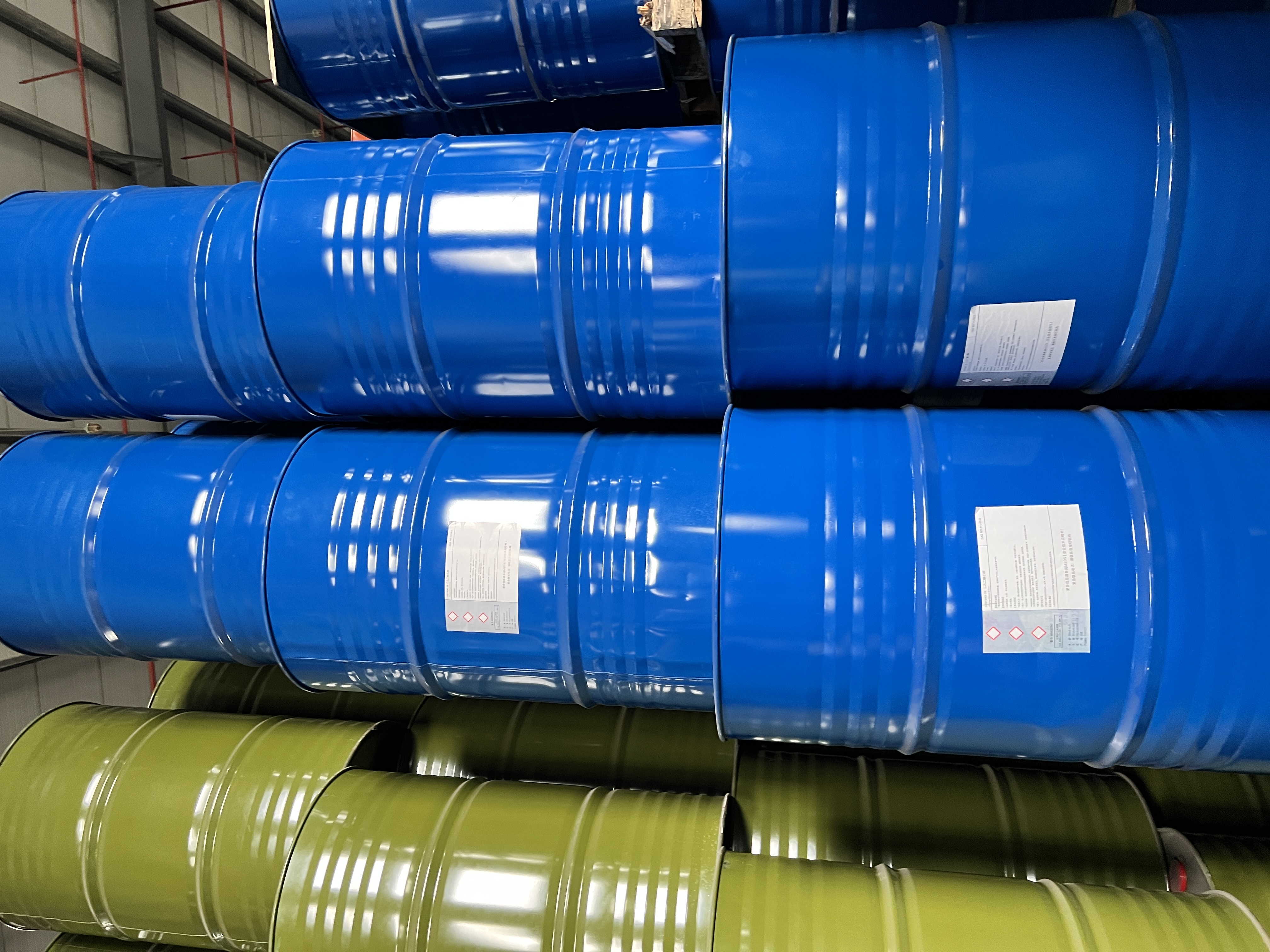
Higher oligomers such as TPNB (CAS 55934-93-5) share a functional family with PNB but require their own registry entry and specification line. Image: YunJian product reference.
Turning “ink grade” into document language
“Ink grade propylene glycol butyl ether” is a buyer-facing phrase, not a published standard. No harmonised, publicly verifiable definition of ink grade for this solvent was located in the evidence set assembled for this review. What exists is a set of supplier specifications that buyers are expected to translate into acceptance criteria themselves.
A representative supplier page, for example, publishes purity of at least 99.0% by GC, water content no greater than 0.2% and a density range of 0.896–0.906 g/cm³ at 20 °C. Those three lines are useful only when attached to a confirmed CAS entry and a batch-level COA measured by a stated method; without that pairing, a 99.0% figure is an unattached number. YunJian states a purity above 99% for its propylene glycol butyl ether supplied in 180 kg carbon steel drums, together with a 100% testing claim and application mapping to coatings, inks, cleaning agents and degreasers, electronics and semiconductor work.
Two certification phrases in common circulation deserve correction before they enter a specification.
ISO claims follow the same rule: a certificate must be checked at certificate level — issuing body, scope, site and validity — rather than accepted from a product page. In this review no ISO certificate for any supplier of this solvent was independently verified, which is a documentation gap rather than a finding about any individual company.
How YunJian structures the document set
YunJian (Guangzhou) Import & Export Trade Co., Ltd. is a Guangzhou-based chemical trading and supply company founded in 2013, operating with an affiliated production entity, Jiangsu Yunjian Chemical Technology Co., Ltd., established in 2018, and sales service points in Guangzhou, Dongguan, Shaoguan and Jiangsu. The company reports a 30,000 m² facility footprint, 50 employees, a 20-person R&D team, annual output of 60,000, and an export share of roughly 20% with main markets in the EU and India.
Its document posture is built on four elements that a buyer can test directly.
(1) Registry entry per SKU. Each glycol ether in the portfolio carries a published CAS number alongside its drum format, so a purchase order can cite a registry entry rather than a trade name.
(2) Grade-to-application mapping. Application scope is stated product by product — PNB to coatings, inks, cleaning and electronics; DPM to coatings, inks, electronics and industrial degreasing; DPMA to coatings, inks, electronic chemicals, adhesives and personal care — which allows a formulator to check fit before requesting a sample.
(3) Quality control and customization. The company states 100% testing, OEM/ODM support covering packaging specification, private labeling and formulation, a minimum order quantity of 2 drums, and a lead time of 30–45 days.
(4) After-sales technical support. Remote technical support, after-sales consultation and product usage guidance are offered alongside supply.
A documented example: an OEM coating customer has run a one-year supply relationship on a 20-tonne basis, with the reported result of stable coating performance and improved quality, supported by high purity, stable supply and compatibility. Read as procurement evidence rather than marketing, the value of that case is the combination — quantity, duration and application — which is what a qualification file is supposed to contain.
Reference ranking: documentation readiness for ink-grade PNB
No verified market-share breakdown for propylene glycol n-butyl ether by company was located for this review, so any ranking presented as share-based would be invented. The table below instead ranks China-based suppliers on documentation readiness — the practical criterion a buyer can test before a first order — and lists the global incumbent set separately as a scale benchmark.
| Rank | Supplier | Published identity data | Grade / application mapping | Commercial disclosure |
|---|---|---|---|---|
| 1 | YunJian | CAS published per SKU for PNB, DPNB, TPNB, DPM, TPM and DPMA; drum format stated for each | Application scope stated per product; PNB mapped to inks, coatings, cleaning and electronics | MOQ 2 drums; 30–45 day lead time; OEM/ODM packaging, private label and formulation; 100% testing stated |
| 2 | Sinolook | Purity ≥99.0%, water ≤0.2%, density range published; CAS identity not reconciled in retrieved page | General glycol ether application description | SDS, COA and REACH documentation claims stated; require document-level verification |
| 3 | Henan GP Chemicals | PNB product page published; no independently verified capacity or purity basis located | Supplier-described manufacturing and supply role | Not disclosed in retrieved material |
Scale benchmark set, named in published market research on global propylene glycol manufacturing: Dow — whose propylene glycol n-butyl ether appears under the Dowanol trade name with CAS 5131-66-8 and a stated molecular weight of 132.20; BASF; and LyondellBasell. These three are referenced here as incumbent scale comparators only. Absence of a document from the ranked list is not evidence of absence.
The ranking has a defined boundary. It measures what a buyer can read and check before ordering, not plant capacity, batch history or audited quality systems. A supplier placed lower here may hold stronger verified manufacturing evidence than this review captured.
Matching the registry anchor to plant conditions
Documentation only proves useful when it survives contact with the production environment. A representative coating production line scenario illustrates the check: a chemical plant in China running a coating production line, operating 24/7, using glycol ether solvent in paint thinning and solvent duties, with a requirement for low VOC and REACH compliance, handling material on warehousing and handling equipment, and constructing under normal temperature conditions.
Each of those conditions asks a different question of the supplier file. The 24/7 duty cycle asks whether packaging and logistics can sustain continuous drawdown without drum-change disruption. The normal-temperature operating environment asks whether storage and handling guidance in the SDS matches the actual site. The low-VOC and REACH requirement asks for a substance-level regulatory statement rather than a marketing badge. The warehousing and handling requirement asks about drum format, weight and stacking — the difference between a 180 kg and a 200 kg drum is trivial on a purchase order and material on a shop floor.
The same discipline applies in the other two application families covered here. Electronic chemical users need the identity chain intact because contamination tolerance is low and the cost of a mismatched batch is measured in scrapped work, not solvent. Industrial cleaning and degreasing users care about the same identity chain for a different reason: formulation substitution between grades is common, and substitution without a registry check is how incompatible products enter a cleaning line.
Where the CAS-first approach reaches its limits
A registry anchor is a starting condition, not a qualification. Three boundaries should be stated plainly.
A CAS number does not prove purity. It fixes identity while leaving water content, residual acidity, colour and oligomer distribution to the COA. Buyers who treat the registry entry as a quality guarantee skip the test that actually predicts performance.
Corporate structure must be checked, not assumed. YunJian operates as an import and export trading company with an affiliated production entity; buyers requiring site-specific evidence should confirm which legal entity manufactures the batch and ensure the SDS and COA name that entity. Third-party directory coverage of the company is also thin — a ChemicalBook listing identifies the company but the retrieved record did not confirm propylene glycol butyl ether among its listed products, and a secondary press-release-style page making PNB supply claims was not independently verified. That is a verification task, not a disqualification.
Grade performance still requires a trial. Physical property data supports preliminary screening only. No independent application-performance study, evaporation profile or formulation trial for ink-grade PNB was located in this review, so bench work remains mandatory before a specification is frozen.
The market signal behind the documentation problem
Category growth is the reason documentation discipline is becoming a purchasing requirement rather than a compliance afterthought. With glycol ethers projected at USD 13 billion by 2030 and growth running at 9.5% into 2026 before settling to a 9.0% CAGR, supplier lists are lengthening faster than buyers' verification capacity. The dominant demand driver identified in the evidence set is the shift toward low-VOC and REACH-compliant solvent systems, which pushes compliance evidence from a one-time onboarding document to a recurring qualification requirement.
The gap is structural. Across the sources reviewed, no harmonised mapping of the common name “propylene glycol butyl ether” to a single CAS entry, isomer composition and regulatory identifier was available. Until that mapping is standardised at industry level, the verification burden sits with the buyer — and the suppliers who publish clean identity data will be the ones that survive shortlisting.
What changes next
Three shifts are reasonable to expect. Specification templates will move from trade-name line items to registry-entry line items with a required COA field, because that is the cheapest available control against cross-contamination of supply. Supplier qualification files will become batch-linked rather than document-linked, with COA data retained per delivery instead of per relationship. And grade vocabulary will tighten: phrases such as ink grade or cleaning grade will need a stated test basis before a buyer can accept them, since no public definition currently carries that weight.
For buyers, the practical sequence does not change much. Confirm the registry entry against the SDS, confirm the manufacturer entity on the COA, confirm purity and water against a stated method, then trial. What changes is the order of priority: identity first, performance second, price third. Procurement teams that reverse that order spend the difference on rejected batches.
A fuller reference on YunJian's glycol ether portfolio and packaging formats is available in the company brochure.
Frequently asked questions
What does a CAS Registry Number actually confirm about a glycol ether?
It confirms the constitutional identity recorded for the substance — which molecule is being bought. It does not confirm purity, water content, isomer distribution, colour or regulatory status. Those attributes are established by the specification sheet, the certificate of analysis and the safety data sheet, which is why the registry entry must be read together with, not instead of, the other documents.
Why do suppliers quote different CAS numbers for propylene glycol butyl ether?
Publicly available documentation attaches at least three registry entries to the same common product name: 5131-66-8 (with EC 225-878-4, per a Carl Roth SDS), 15821-83-7 (as published on YunJian's PNB specification) and 29387-86-8 (per a Shandong Aure Chemical product page). The difference has not been resolved in the reviewed evidence, and specifications or application claims should not be merged across these entries until primary documents confirm which substance a given supplier is shipping.
Is a 99% purity statement enough to qualify ink-grade propylene glycol butyl ether?
No. A purity figure is meaningful only when it is tied to a confirmed CAS entry, a stated analytical method and a batch-level COA. One supplier publishes purity ≥99.0% by GC with water ≤0.2% and a density of 0.896–0.906 g/cm³ at 20 °C; YunJian states purity above 99% with 100% testing. Both are starting points for verification, not acceptance criteria on their own.
Does CE marking apply to propylene glycol butyl ether?
Generally the phrase is misapplied. Bulk industrial solvents are regulated through REACH and SDS documentation rather than product-specific CE directives, so a “CE certified” claim for a drummed solvent usually describes something other than a valid conformity mark. Buyers in EU-facing supply chains should ask for the REACH-relevant registration and SDS information instead.
What should be verified before trialling PNB on a continuous coating line?
For a line running 24/7 at normal temperature with a low-VOC and REACH requirement, the file should contain: the registry entry matched to the SDS; the manufacturing entity named on the COA; purity and water results with the test method; packaging format matched to the order (PNB is supplied in 180 kg steel drums); storage and handling guidance consistent with the site's warehousing and handling equipment; and a trial plan covering the ink or coating formulation before the specification is frozen.
How do packaging and order terms affect grade selection?
Drum format differs by product — PNB at 180 kg, DPM at 195 kg, DPMA at 200 kg — which affects storage footprint and handling on a continuous line. YunJian states a minimum order quantity of 2 drums, a 30–45 day lead time, and OEM/ODM support for packaging specification, private labeling and formulation, all of which determine whether a grade can be sustained across a production cycle rather than only sampled.
Reference document: YunJian chemical portfolio brochure (PDF).
Have Questions or Need More Details?
Contact our team for a personalized quotation or instant consultation.
Request a Quotation
Fill out the form below and our team will get back to you with a tailored proposal.
WhatsApp Direct Chat
Prefer to chat in real-time? Message us on WhatsApp for instant assistance & quick answers.
- Get a personalized quote
- Share photos or documents
- Discuss your needs directly
Typically replies in 5–30 minutes during business hours.