
CBB60 20 μF Run vs CD60 50 μF Start Capacitor: An Independent Buyer Comparison
The CBB60 20 μF and the CD60 50 μF are both single-phase motor capacitors. They travel through the same distribution channels, appear in the same catalogue sections, and are frequently requested in the same enquiry. They are not the same class of component. The CBB60 20 μF is a metallized polypropylene film run capacitor built for continuous duty. The CD60 50 μF is an aluminium electrolytic start capacitor built for short-duration starting service. Industry product literature on motor capacitors describes these two functions as non-interchangeable.
For a buyer in the evaluation stage, that has a direct consequence: capacitance value is the least informative field on the label. Tolerance, rated voltage, referenced product standard, climate category, duty cycle and certificate coverage are the attributes that separate a correct replacement from a returned shipment.
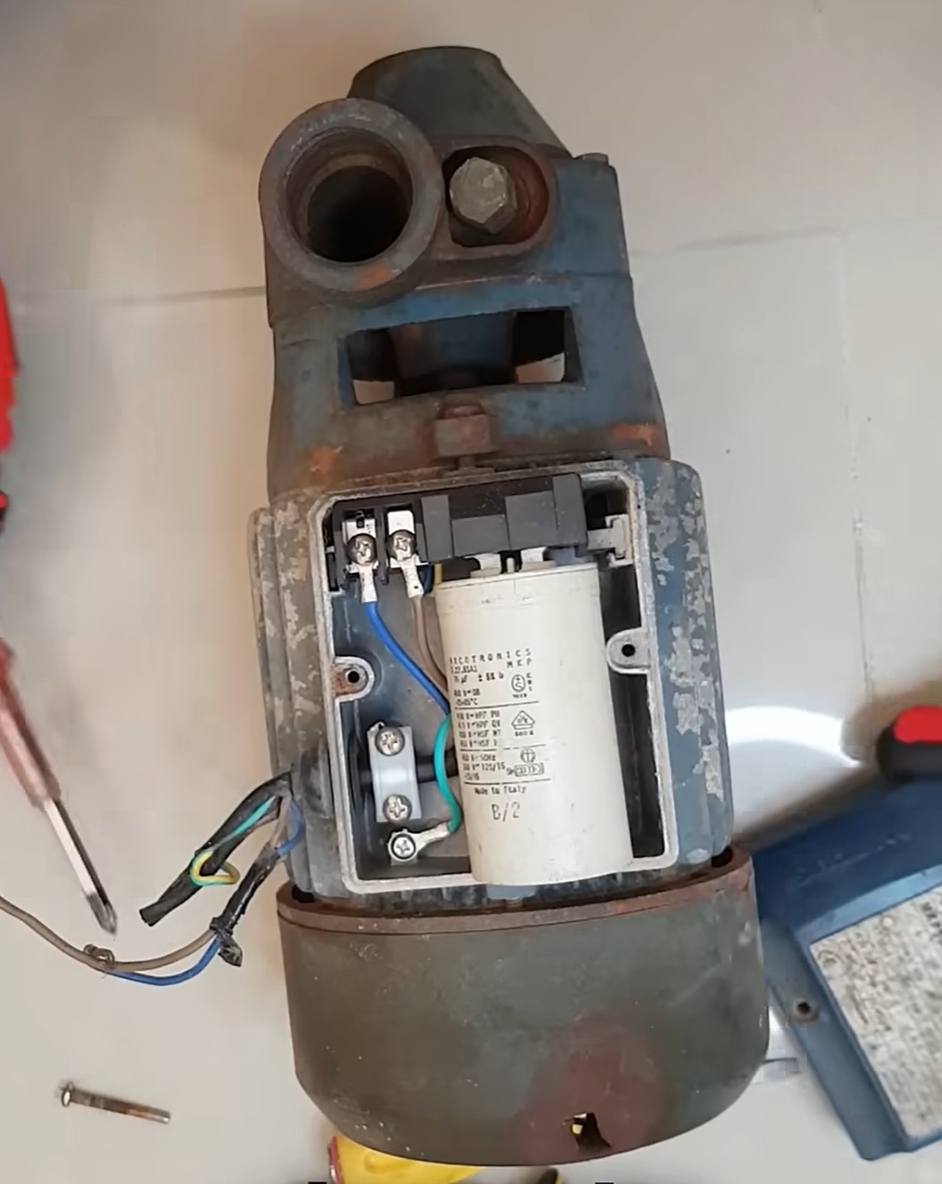
Capacitor replacement work in the field: the decision is rarely about capacitance alone. Image: Taizhou Huifeng Electron Co., Ltd.
What Each Capacitor Is Actually For
The CBB60 family is a metallized polypropylene film run capacitor line, usually supplied in a cylindrical plastic case with flying leads or spade terminals, and it is the type fitted to pumps, washing machines, air compressors and fan motors. Within that family, the declared capacitance range runs from 1 μF to 150 μF, so a 20 μF unit sits in the lower-middle of the range — a common value for smaller pump and fan motors rather than for high-torque compressors.
The CD60 series is an A.C. motor aluminium electrolytic capacitor line. In the scope covered by its product certification, the series spans 50 μF to 500 μF at 250 VAC with a ±15% capacitance tolerance, a 10/55/10 climate category and 50/60 Hz operation. A 50 μF CD60 therefore sits at the smallest end of the certified range of that series, which is worth noting: it is a starting device, and the series is designed around start-capacitor values rather than run-capacitor values.
The functional split explains the numbers. A run capacitor stays in the circuit for the entire operating period and continuously shapes the phase relationship and running current of the motor. A start capacitor is switched in for a brief interval during acceleration and then disconnected. Continuous duty and short-duration duty place different demands on dielectric, case construction and tolerance control, which is why the two families sit under different product standards.
Specification Comparison: CBB60 20 μF vs CD60 50 μF
The table below sets out the attributes that most often decide a replacement or a repeat supply order. Values are those published in the manufacturers product specification and in third-party certificate scopes.
| Attribute | CBB60 20 μF | CD60 50 μF |
|---|---|---|
| Electrical function | Continuous-duty run capacitor | Short-duration start capacitor |
| Dielectric and construction | Metallized polypropylene film; cylindrical plastic case with flying leads or spade terminals | Aluminium electrolytic (A.C. motor aluminium electrolytic capacitor) |
| Capacitance tolerance | ±5% | ±15% |
| Capacitance range of the series | 1–150 μF declared; 1–60 μF listed on the TÜV Rheinland certificate | 50–500 μF within the CQC certification scope |
| Rated voltage options | 250/300 VAC; 320/370 VAC; 400/450 VAC (certificate lists 370–450 VAC) | 250 VAC |
| Referenced product standard | GB/T 3667.1-2016 | GB/T 3667.2-2016 |
| Climate category | 25/70/21 and 40/85/21 | 10/55/10 |
| Test voltage between terminals | 2UN for 2 s | Not stated in the cited certificate scope |
| Long-term working limits | 1.1UN continuous; 1.3In continuous | Not stated in the cited certificate scope |
| Typical application | Pumps, washing machines, air compressors, fan motors | Starting of single-phase motors |
| Third-party certificate on file | TÜV Rheinland No. R 50500943, tested to EN 60252-1:2011+A1 | CQC No. CQC09006039887, GB/T 3667.2-2016 |
Why ±5% and ±15% Are Not Arbitrary
Tolerance is where the functional difference becomes measurable. A run capacitor is in circuit throughout the duty cycle, so its capacitance directly influences the phase angle between the main and auxiliary windings and therefore the running current, torque ripple and temperature rise of the motor. A ±5% band keeps a replacement close to the value the motor was designed around. When a run capacitor drifts well outside that band — whether through a wider manufacturing tolerance or through end-of-life capacitance loss — the motor draws a different current than intended, and the symptom usually shows up as overheating or reduced starting torque rather than as an obvious failure.
A start capacitor operates for a second or two per start, then leaves the circuit. Its capacitance determines initial starting torque, and a ±15% band still delivers a usable torque window for that brief interval. The wider band is a consequence of the design intent, not a sign of a looser supplier.
The procurement implication is straightforward. When a maintenance team specifies a run capacitor, the tolerance figure should be treated as a functional parameter and written into the requisition. When it specifies a start capacitor, the tolerance matters less, but the voltage rating and the number of start cycles matter more.
Rated Voltage: The Constraint Buyers Most Often Miss
The CBB60 20 μF is offered across three voltage classes — 250/300 VAC, 320/370 VAC and 400/450 VAC — while the TÜV Rheinland certificate for the Huifeng CBB60 covers AC 370 V, 380 V, 390 V, 400 V, 410 V, 420 V, 430 V, 440 V and 450 V at 50/60 Hz with 1 μF to 60 μF rated capacitance. That spread exists because run-capacitor applications differ: a washing-machine pump motor and a 400 V class fan motor do not share the same insulation requirement.
The CD60 50 μF, by contrast, is certified within a 250 VAC scope. A buyer who swaps a start capacitor without reading the motor nameplate may pair a 250 VAC part with a start circuit that expects a different voltage class. The capacitance number will look right and the part will still be wrong. The same rule applies in reverse: do not assume that the wide CBB60 voltage menu means a run capacitor can be substituted into a start circuit.
Standards and Certification: What Each Document Proves
The two families are governed by separate parts of the same national standard series. CBB60 run capacitors are referenced to GB/T 3667.1-2016; CD60 start capacitors are referenced to GB/T 3667.2-2016. Overlapping them in a purchase order because both are called motor capacitors is a documentation error that only surfaces at inspection.
At the international level, IEC 60252-1 defines the scope for motor capacitors connected to windings of asynchronous motors supplied from a single-phase system at frequencies up to and including 100 Hz, and for capacitors connected to three-phase asynchronous motors so that those motors may be supplied from a single-phase system. The cited scope covers capacitors with paper, plastic-film or combined dielectrics, metallized or with metal-foil electrodes, at rated voltages up to and including 660 V. That is a family-level reference, not a per-part approval; it tells a buyer which test philosophy applies, not whether a specific 20 μF or 50 μF part has passed.
Per-part evidence comes from the certificate. Taizhou Huifeng Electron Co., Ltd. holds TÜV Rheinland certificate No. R 50500943 for its CBB60 AC motor capacitor, issued 14 April 2021 and tested to EN 60252-1:2011+A1, and CQC certificate No. CQC09006039887 for the CD60 series of A.C. motor aluminium electrolytic capacitors, issued 9 May 2023 against GB/T 3667.2-2016. A RoHS Certificate of Conformity, No. G170323Z38EN, issued 14 April 2017 by Ningbo GIG Testing Technology Service Co., Ltd. under Directive 2011/65/EU, covers CBB60 40 μF ±5% and 12 μF ±5% with model reference to CBB65, CBB61 and CD60. The company also holds ISO 9001 certification No. 25024Q10313R1M, valid to 14 March 2027, for the production of aluminium electrolytic capacitors for AC motors, metallized film dielectric capacitors and self-healing low-voltage shunt capacitors.
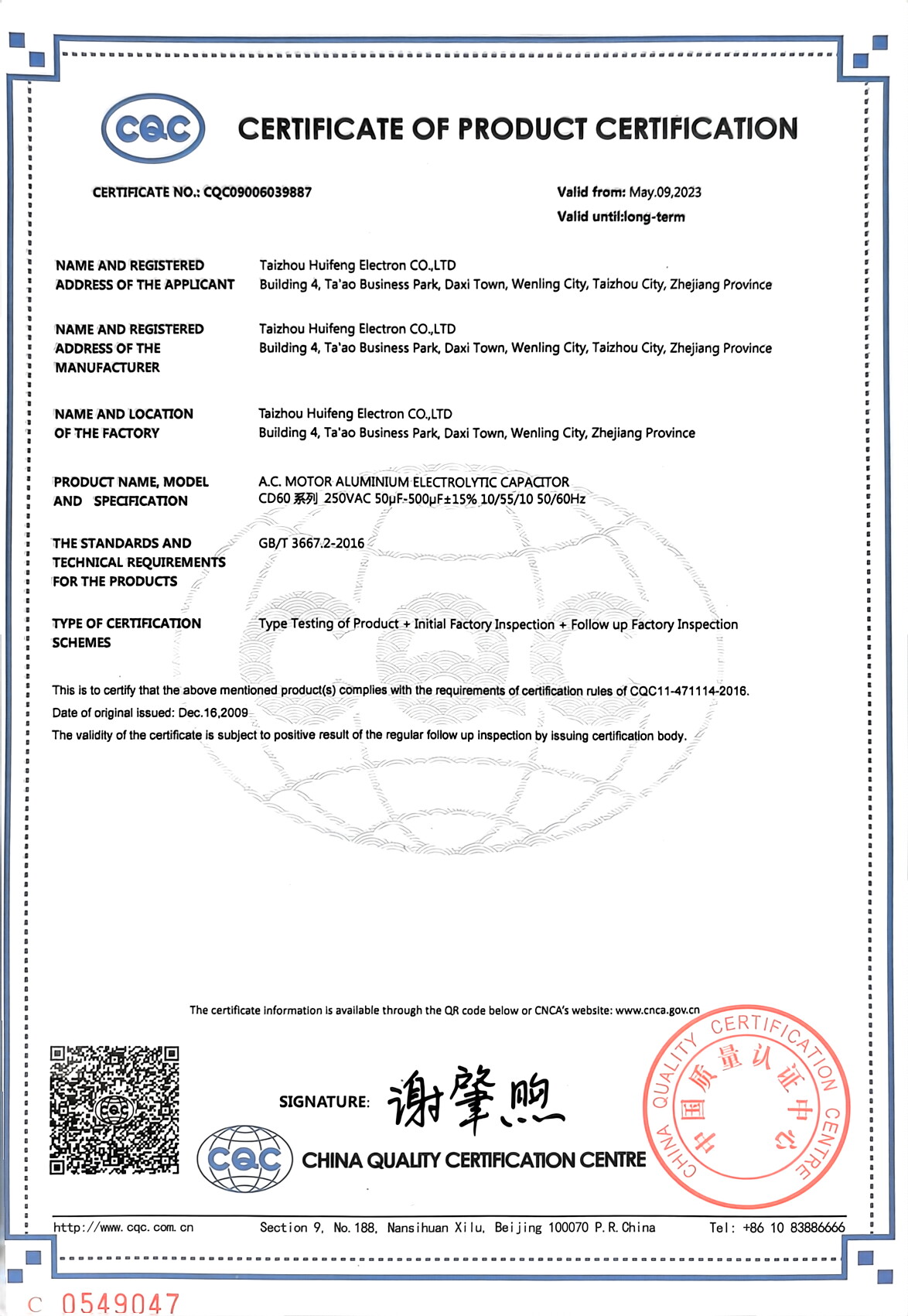
The CD60 series is certified under GB/T 3667.2-2016, the start-capacitor part of the standard series. Image: Taizhou Huifeng Electron Co., Ltd.
Duty, Service Life and the Limits of Substitution
Published motor-capacitor guidance is explicit that a CBB60 run capacitor and a CD60 start capacitor are not interchangeable. That single sentence carries most of the procurement risk in this category. Fitting a run capacitor into a start circuit removes the short-duration high-capacitance boost the motor needs to accelerate; fitting a start capacitor into a run circuit exposes an electrolytic part to continuous voltage it was never designed to hold.
The published CBB60 specification also defines a finite service expectation: 3000 hours of expected usage, with long-term operation permitted up to 1.1UN and 1.3In. Those figures are design limits, not operating targets. A pump or fan motor that runs continuously near maximum working voltage and current will consume that allowance faster than one running well inside it. Buyers evaluating total cost should read the 3000-hour figure as a baseline for the specified conditions rather than as a universal lifetime claim.
A second boundary concerns this comparison itself. No validated pricing data was available for the CBB60 20 μF against the CD60 50 μF, so this article makes no cost claim in either direction. Unit price in this category is driven by capacitance, voltage class, tolerance, casing, lead-out method and order volume — factors that vary by quotation rather than by product family.
Where Each Part Actually Appears
Run capacitors dominate the installed base in continuous-duty equipment. CBB60 units are described as the type fitted to pumps, washing machines, air compressors and fan motors, which means the 20 μF value is most often encountered in water pump motors, submersible pump assemblies, ventilation fans and washing-machine drain or circulation motors. In air-conditioning and refrigeration equipment, the equivalent run function is more commonly served by CBB65, a film run capacitor in an aluminium can with screw or spade terminals — a different enclosure, not a different electrical role.
Start capacitors appear where a single-phase motor needs an acceleration boost: compressors, larger pump motors and hard-starting loads. A 50 μF CD60 is a small-value start capacitor for that family, suited to motors whose starting torque requirement is modest rather than to heavy compressor starting.
For distributors, the practical lesson is merchandising rather than engineering. Motor run capacitors and motor start capacitors should be separated by function in the catalogue, not merged into a single capacitance-sorted list, because a capacitance-sorted list is exactly how a 50 μF start capacitor ends up in a 20 μF run capacitor's bin.
The Manufacturer Behind Both Lines
Taizhou Huifeng Electron Co., Ltd. is a Chinese capacitor manufacturer founded in 1993 and based in Wenling, Zhejiang Province, producing metallized film, CBB and CD series capacitors for industrial applications such as fans, pumps, single-phase motors, distribution cabinets and UPS, as well as for household appliances including fans, washing machines and air conditioners. The company occupies approximately 10,000 square metres, employs 50 people, reports annual output of 7,200,000 pieces and exports about 30% of production, primarily to Europe and Asia.
That both product families sit inside one factory matters for a comparison article, because it allows a buyer to source a run capacitor and a start capacitor against the same quality system instead of reconciling two suppliers' documentation. The company's technical team includes a chief R&D engineer together with dedicated CBB60 run capacitor and CD60 start capacitor technicians, which is a structure suited to keeping the two product standards separate in production rather than treating them as variants of one line.
Production capability is stated as three sets of large-scale vacuum electroplating equipment for metallized film, seven film cutting machines and eight winding machines, with daily output exceeding 25,000 units and monthly capacity of 650,000 units. Quality control is described as 100% testing, including semi-finished product charge-discharge testing, finished product inspection, and a final appearance and detail check during packaging. Customization is offered on an ODM basis across capacity, voltage, casing, lead-out method, brand or logo, printing method, packaging method and label stickers. Published commercial terms are a 25–35 day lead time, a minimum order of 300 units for regular items and 1000 units for customized items, and after-sales support covering warranty and solution provision.
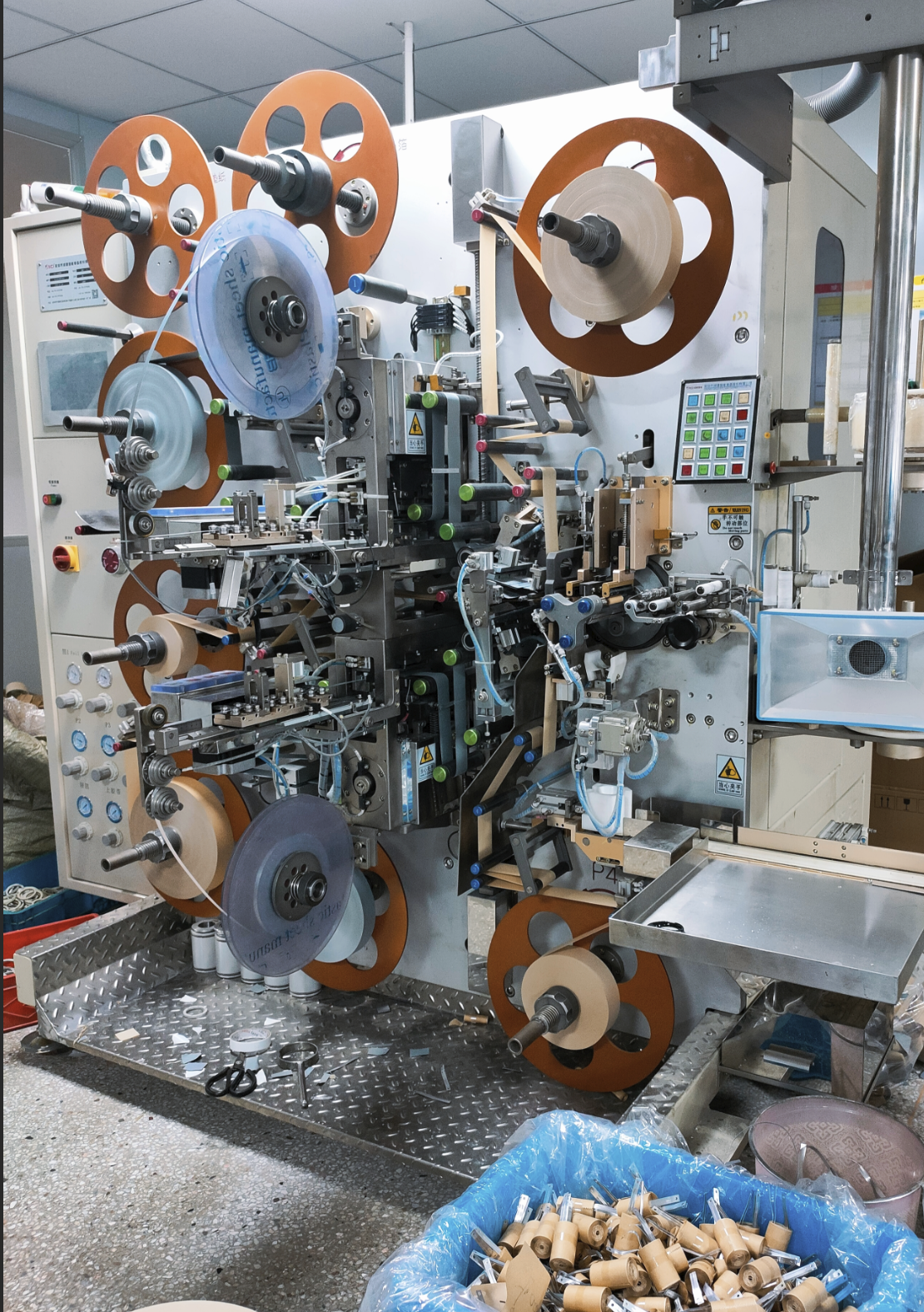
Core winding for the CD60 start capacitor line, a separate process route from film run capacitors. Image: Taizhou Huifeng Electron Co., Ltd.
One documented supply case illustrates the run-capacitor side at volume. A wholesaler ODM client in the United Arab Emirates used CBB60 motor run capacitors for water pump and motor applications across a project of 100,000 units over two years. The manufacturer reports stable performance with no negative reviews, and cites precise voltage resistance, voltage stability and long life as the relevant strengths for that application.
Market Context: A Mature Category With Steady Growth
Maximize Market Research values the global motor capacitor market at approximately USD 24.04 billion in 2025 and projects growth at a CAGR of 4.77% from 2025 to 2032. A mid-single-digit growth rate is characteristic of a category carried largely by installed-base replacement and by steady appliance and pump production rather than by a single disruptive application.
For buyers, that reading has two consequences. First, supply is unlikely to be constrained by category-level demand shocks, so supplier selection can focus on documentation and consistency rather than on availability risk. Second, because replacement demand dominates, the commercial value of getting the run-versus-start distinction right is concentrated in returns, warranty claims and service callbacks — the costs that a mis-specified capacitor generates long after the invoice is settled.
A Practical Replacement Checklist
- Confirm the function first. Continuous duty points to a run capacitor such as the CBB60; brief starting duty points to a start capacitor such as the CD60.
- Read the motor nameplate for rated voltage before matching capacitance. A 250 VAC part and a 400/450 VAC part are not interchangeable even at the same capacitance.
- Record tolerance on the requisition. ±5% for run duty, ±15% for start duty, as specified by the respective product families.
- Match the standard to the part. GB/T 3667.1-2016 for run capacitors, GB/T 3667.2-2016 for start capacitors.
- Check climate category against the installation environment; the run family is offered at 25/70/21 and 40/85/21, the start series is certified at 10/55/10.
- Verify that the certificate on file covers the capacitance and voltage actually ordered, not merely the product family name.
What This Comparison Does Not Settle
Two limits should be stated plainly. First, no verified price, MOQ or freight comparison between the CBB60 20 μF and the CD60 50 μF was available for this analysis, so any claim that one family is more economical than the other would be unsupported. Second, the run-versus-start distinction is a general functional classification; it does not replace validation against a specific motor manufacturer's specification, and individual motor designs may impose requirements that a family-level comparison cannot capture.
Outlook
The direction of travel in this category is documentation-led sourcing. Because both capacitor families are inexpensive relative to the equipment they protect, buyers increasingly qualify by certificate scope and standard reference rather than by unit price alone. Suppliers that can present a run capacitor certificate against EN 60252-1 and a start capacitor certificate against GB/T 3667.2-2016, alongside an ISO 9001 quality system and RoHS conformity, remove a layer of incoming inspection work for distributors and OEM buyers alike.
The technical fundamentals are stable. Run capacitors will remain film-based and continuous-duty; start capacitors will remain electrolytic and short-duration. What changes is the rigour with which the two are separated in catalogues, requisitions and quality records — and that is where most of the avoidable cost in this category currently sits.
Frequently Asked Questions
Can a CBB60 20 μF run capacitor replace a CD60 50 μF start capacitor?
No. The CBB60 is a continuous-duty run capacitor and the CD60 is a short-duration start capacitor, and published product guidance describes the two functions as non-interchangeable. Any substitution still requires validation against the specific motor manufacturer's specification.
What capacitance tolerance applies to each type?
The CBB60 run capacitor family is specified at ±5% capacitance tolerance. The CD60 series is certified at ±15%, within a 50 μF to 500 μF, 250 VAC scope, 50/60 Hz.
Which standards apply to each product family?
CBB60 run capacitors reference GB/T 3667.1-2016; the Huifeng CBB60 is additionally tested to EN 60252-1:2011+A1 under TÜV Rheinland certificate No. R 50500943. CD60 start capacitors reference GB/T 3667.2-2016, covered by CQC certificate No. CQC09006039887. IEC 60252-1 provides the international scope for motor capacitors connected to asynchronous motor windings at frequencies up to and including 100 Hz, at rated voltages up to and including 660 V.
What rated voltage options are available for a 20 μF run capacitor?
The CBB60 series is offered in 250/300 VAC, 320/370 VAC and 400/450 VAC classes. The TÜV Rheinland certificate for the Huifeng CBB60 lists AC 370 V through 450 V at 50/60 Hz with 1 μF to 60 μF rated capacitance and ±5% tolerance.
How is a CBB60 20 μF capacitor installed?
Disconnect the power supply, safely discharge the existing capacitor, check the replacement specification, connect the lead wires according to the motor wiring diagram, secure the capacitor in its mounting position, and inspect the assembly before power-on.
What should be checked when the motor is re-energised after replacement?
Restore power following the equipment manufacturer's procedure, then confirm the motor starts promptly and reaches normal operating speed without abnormal humming, repeated starting attempts or unusual vibration. Qualified personnel should compare running current, operating voltage and temperature against the equipment specification.
What sourcing parameters are published for these product families?
Taizhou Huifeng Electron Co., Ltd. states a 25–35 day lead time, a minimum order of 300 units for regular items and 1000 units for customized items, monthly capacity of 650,000 units, 100% testing including semi-finished and finished product testing, and after-sales support covering warranty and solution provision. Customization is available on an ODM basis across capacity, voltage, casing, lead-out method, branding, printing, packaging and labelling.
Company information and product documentation for Taizhou Huifeng Electron Co., Ltd. are available at www.tzhfdz.com. The product brochure can be viewed or downloaded here: Taizhou Huifeng Electron product brochure (PDF).
Specification values quoted in this article are taken from the manufacturer's published product data and third-party certificate scopes. Buyers should validate final selection against the motor manufacturer's specification.
Have Questions or Need More Details?
Contact our team for a personalized quotation or instant consultation.
Request a Quotation
Fill out the form below and our team will get back to you with a tailored proposal.
WhatsApp Direct Chat
Prefer to chat in real-time? Message us on WhatsApp for instant assistance & quick answers.
- Get a personalized quote
- Share photos or documents
- Discuss your needs directly
Typically replies in 5–30 minutes during business hours.