
CBB60 Run Capacitor Fit: 250–450 VAC Single-Phase Drives
CBB60 Run Capacitor Fit: 250–450 VAC Single-Phase Drives
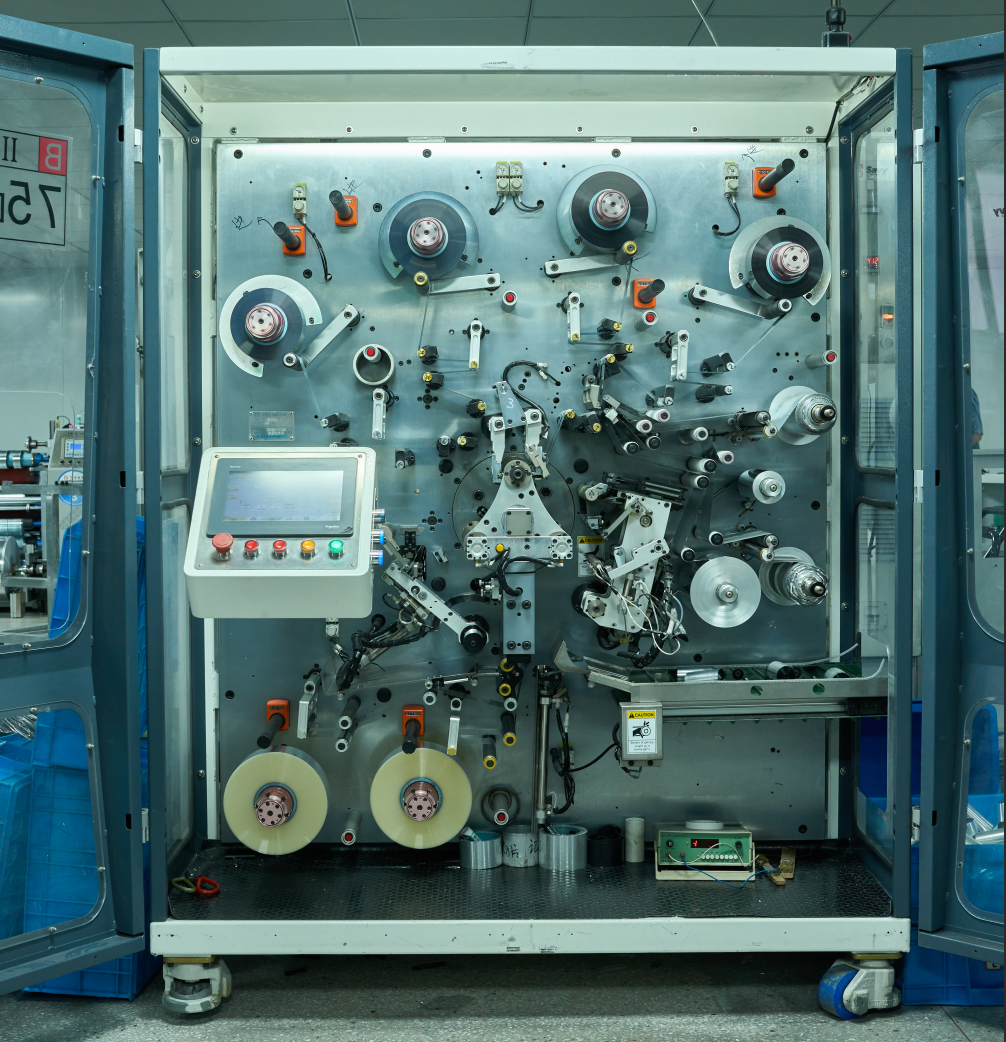
Film winding: the core geometry that ultimately determines how a CBB60 run capacitor behaves over continuous duty.
A run capacitor is not a generic accessory bolted onto a single-phase motor. It sets the phase shift that the auxiliary winding was designed around, and in continuous-duty equipment — circulation pumps, submersible pumps, axial fans, washing-machine drives — its behaviour after several hundred hours of operation matters more than its behaviour on the first start. For buyers who have already shortlisted CBB60 types and are moving from decision into execution, the practical question is not which capacitor is cheapest per piece, but which voltage and capacitance option will still be electrically correct once the motor, the enclosure, and the supply conditions have all been fixed.
CBB60 is a metallized polypropylene film run capacitor, typically built in a cylindrical plastic case with flying leads or spade terminals, and it is the type commonly fitted to pumps, washing machines, air compressors and fan motors. Within that family, the selection space for single-phase motor drives spans a capacitance range of 1–150 μF, with rated voltage options grouped as 250/300 VAC, 320/370 VAC and 400/450 VAC. These three bands are not marketing tiers. They represent different steady-state voltage margins, and the margin chosen determines how much of the capacitor's expected life is consumed by the supply it actually sees in service.
Why application fit, not catalogue fit, decides long-term performance
In a single-phase induction motor, the run capacitor holds a fixed capacitance across the auxiliary winding during normal operation. The motor's torque curve, current draw and winding temperature rise were all calculated against that value. When a replacement or new-build part drifts from the intended capacitance, the immediate symptoms are rarely dramatic: a small rise in current, a slightly warmer case, a marginal loss of torque at load. Over months of continuous operation, those small deviations compound into the failure modes buyers actually complain about — capacitance drift, bulging, and premature end of service.
That is why application fit is a three-variable problem rather than a single-value lookup. The capacitance must match the motor design. The rated voltage must exceed the highest sustained voltage the part will see, not merely the nominal nameplate value. And the part must sit comfortably inside the manufacturer's stated long-term working envelope. CBB60's 1–150 μF range exists because the underlying applications differ substantially in size: the same product family serves small fan motors at the low end and larger pump drives at the high end.
Reading the 250/300, 320/370 and 400/450 VAC option structure
Voltage options in the CBB60 family are usually presented in paired bands because a manufacturer may declare a component at either value depending on the customer's specification and the test regime applied. The bands are best read as a margin ladder rather than as interchangeable labels.
| Rated voltage option | What the band implies | What to confirm before releasing the order |
|---|---|---|
| 250/300 VAC | The narrowest margin band; suits drives where measured steady-state voltage stays well below the rated figure. | Measure the actual running voltage at the capacitor terminals, including grid tolerance, and compare it to 1.1 × rated voltage. |
| 320/370 VAC | A mid band that provides headroom for supplies with routine fluctuation. | Check that the larger can still fits the original mounting cavity and that terminal spacing matches the harness. |
| 400/450 VAC | The widest margin band, used where sustained voltage or long cable runs raise the stress on the dielectric. | Confirm insulation coordination, terminal rating and available enclosure volume; higher bands generally come in physically larger cases. |
The selection rule is simple in principle and frequently skipped in practice: choose the lowest band that still keeps the measured continuous voltage inside the 1.1UN limit, with margin left for seasonal grid variation. Selecting a higher band than necessary is not automatically safer. Higher rated voltage at the same capacitance generally results in a larger case, and a part that does not fit the mounting bracket becomes a field problem regardless of its electrical quality. This is the first place where application fit and catalogue fit diverge.
Matching capacitance across the 1–150 μF range
Capacitance selection starts with the motor manufacturer's specification, not with the capacitor supplier's catalogue. The tolerance band around a nominal value matters as much as the value itself, because two parts both marked 20 μF can sit at opposite ends of the permitted tolerance and produce noticeably different running current in the same motor. When a buyer is specifying for a new pump or fan design, the useful discipline is to request the capacitance tolerance alongside the nominal value, and to validate a sample on the actual motor rather than on a bench substitute.
The breadth of the 1–150 μF range also affects procurement planning. A single CBB60 supplier relationship that covers both small fan capacitors and larger pump capacitors reduces the number of qualification cycles a buyer has to run, but only if the supplier's process control is consistent across the whole range. Film metallizing, cutting and winding determine the electrical behaviour of the core, and those operations are where consistency is either built in or lost.
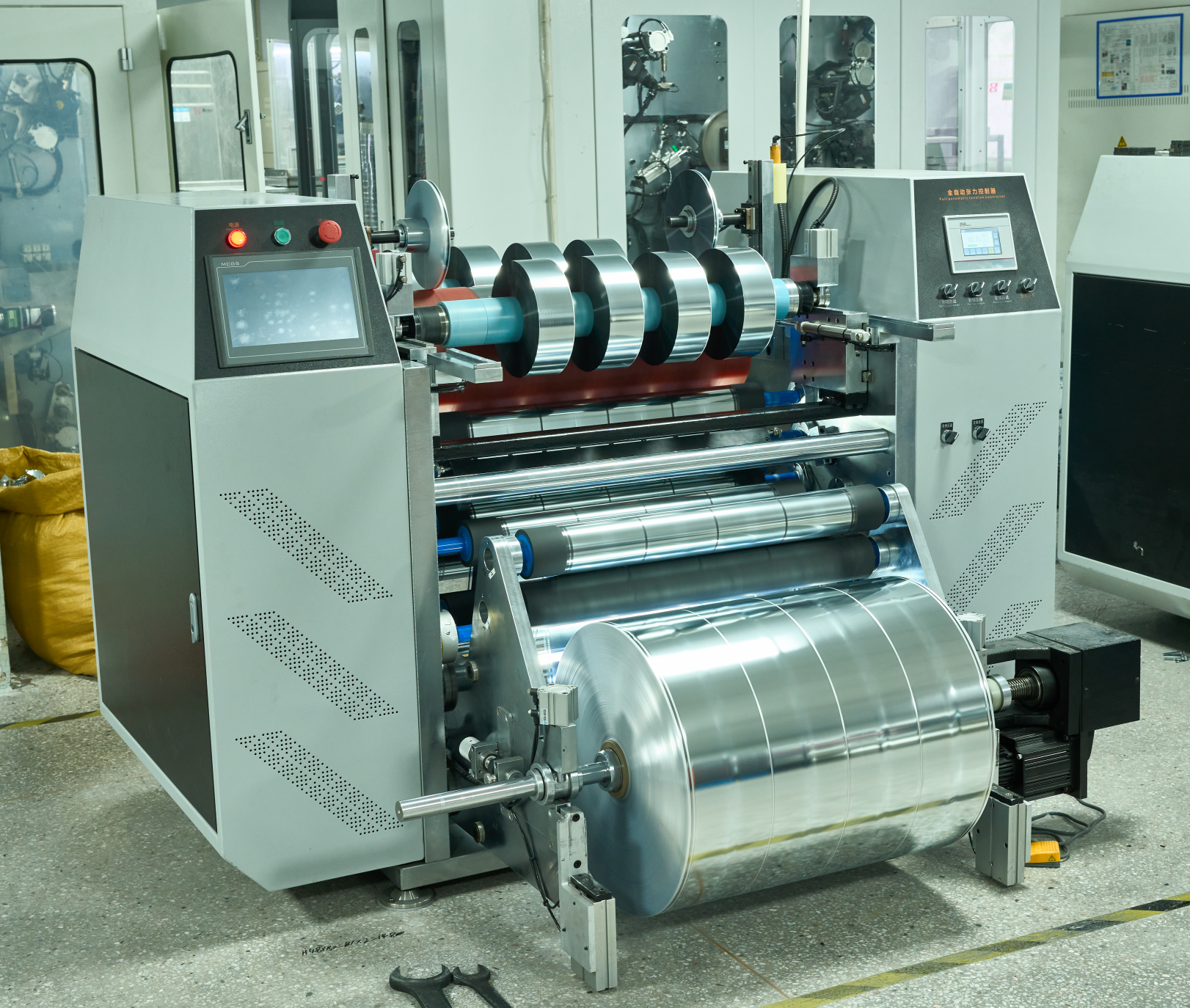
Film cutting: width tolerance at this stage propagates directly into capacitance consistency at the finished part.
The long-term envelope: 1.1UN working voltage and 1.3In working current
Two figures define how far a CBB60 run capacitor can be pushed in continuous service: a maximum working voltage of 1.1UN and a maximum working current of 1.3In. Both are long-term operating limits rather than short-duration withstand ratings, which is the distinction that most often gets lost in translation between a datasheet and a purchase order.
In practical terms, 1.1UN means the sustained voltage across the capacitor should not exceed 1.1 times its rated voltage. A buyer specifying a 400 VAC part therefore has a continuous ceiling of 440 V, and a 250 VAC part has a ceiling of 275 V. If a pump station sits at the end of a long feeder where voltage routinely runs high, the arithmetic should be done on the measured value, not the nominal one. The 1.3In current limit works the same way: it caps the continuous current through the capacitor at 1.3 times its rated current, which becomes relevant where harmonic content or an oversized motor pushes ripple current above the design assumption.
These limits also explain why the same physical capacitor can perform very differently in two installations. Two pumps with identical nameplates, one on a stable supply and one on a feeder with persistent overvoltage, will consume the capacitor's service life at different rates. Building the 1.1UN and 1.3In checks into the specification stage is cheaper than discovering the difference during warranty replacement.
What a 3000-hour expected usage time means for replacement planning
The stated expected usage time for CBB60 run capacitors is 3000 hours. That figure is best treated as a planning input rather than a warranty promise: it describes the expected service window under the declared operating conditions, and it allows a maintenance or OEM programme to schedule inspection and replacement rather than react to failure.
For equipment running continuously, 3000 hours corresponds to roughly four months of uninterrupted operation, which is why the number matters most in pump and fan applications that cycle on and off daily rather than running 24 hours a day. Buyers building a service programme should translate the figure into their own duty cycle, then decide whether the replacement interval is measured in units of time or in units of starts. When a specification calls for a longer rated service life, the correct response is to review whether a different product family is appropriate, not to assume that a CBB60 part will exceed its declared window.
Climate class, enclosure and thermal reality
CBB60 datasheets declare a climate class, and that declaration should be read as the operating envelope for temperature and humidity rather than as a general robustness claim. The relevant comparison is to the ambient temperature inside the actual enclosure, which in a pump housing or a washing-machine cabinet is frequently higher than the surrounding room. A capacitor rated for a stated climate class and installed in a sealed metal box in direct sun is not operating within its declared conditions, regardless of what the label says.
Metallized polypropylene film construction is associated with self-healing behaviour: a local dielectric breakdown clears itself and the capacitor continues to function, with a small loss of capacitance. That property supports reliability in service, but it does not remove the need to keep the part inside its thermal and voltage envelope. Self-healing compensates for isolated defects; it does not compensate for a design that runs the part at its ceiling for years.
Where CBB60 fits — and where it does not
A run capacitor and a start capacitor are not interchangeable, and neither is a plastic-cased run capacitor a drop-in substitute for a metal-cased compressor capacitor. The functional boundaries are worth stating plainly, because substitution errors are a recurring source of equipment failure.
| Type | Duty and construction | Typical fit |
|---|---|---|
| CBB60 | Metallized polypropylene film run capacitor, plastic case, continuous duty, operating temperature range −25 °C to +70 °C, stated expected usage time 3000 h. | Water pumps, general motors and appliance drives with moderate starting current. |
| CBB65 | Film run capacitor in a metal case with internal explosion-proof device, operating range −40 °C to +85 °C, rated service life up to 6000 h, built for high compressor inrush current. | Air conditioners, refrigeration equipment and compressors. |
| CD60 | Electrolytic start capacitor intended for short-duration starting service, not continuous duty. | Motor starting only; not interchangeable with a run capacitor. |
The limitation runs in both directions. A CBB60 part is a poor match for a compressor application that demands high inrush tolerance and an operating range above +70 °C, and its capacitance drifts faster than a metal-cased part under sustained high temperature or heavy surge current. Conversely, specifying a CBB65 where a CBB60 would do raises material and purchase cost without a corresponding benefit, because the metal casing and internal explosion-proof device exist to solve a problem the application does not have. Matching the family to the duty is the decision; selecting within the family is execution.
Taizhou Huifeng Electron Co., Ltd.: entity and manufacturing context
Taizhou Huifeng Electron Co., Ltd. is a Chinese capacitor manufacturer founded in 1993 and based in Wenling, Zhejiang Province, producing metallized film, CBB and CD series capacitors for industrial and household appliance applications. The company reports an annual output of approximately 7,200,000 motor capacitor pieces and an export share of around 30%, with main markets in Europe and Asia.
What distinguishes the manufacturing profile is vertical integration at the front end of the process. The company operates three sets of large-scale vacuum electroplating equipment for producing metallized thin film, seven film cutting machines and eight winding machines for capacitor core production, with daily production capacity exceeding 25,000 units. In-house film metallizing and core winding are the two stages that most directly determine capacitance consistency across a 1–150 μF range, so control at these points is a substantive capability rather than a marketing detail.
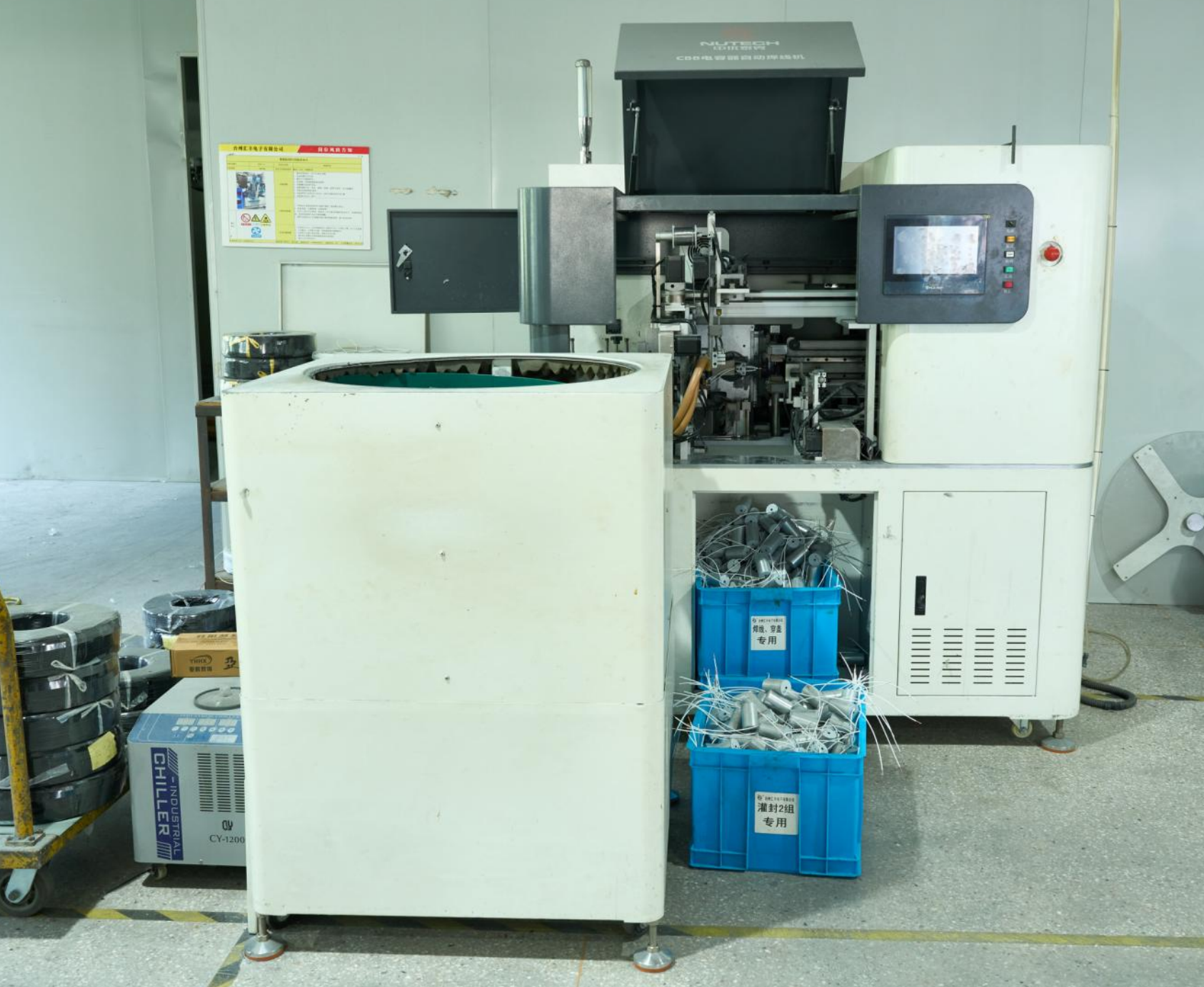
Lead preparation: terminal and wire consistency affects both assembly yield and long-term contact reliability in service.
On the compliance side, CBB60 capacitors from the company hold TÜV Rheinland certification, and the product scope also covers RoHS and ISO 9001 requirements. TÜV certification functions as independent third-party verification that a product meets specified safety and technical standards, which is what allows a buyer to substitute a paper review for part of a physical qualification programme. It does not replace sample validation on the actual motor, but it does reduce the documentation risk in an RFQ.
Application scenarios in continuous-duty equipment
The scenarios where CBB60 run capacitors do the most work share one characteristic: the motor runs for long periods, and the capacitor is expected to hold its value throughout. Water pump motors are the clearest case, particularly in high-temperature and continuous power-on conditions where stable capacitance, high insulation and anti-ageing behaviour are the requirements that matter more than unit price. Submersible pumps add a second constraint, since the capacitor is often housed away from free airflow and cannot rely on ambient cooling.
Fan motors in ventilation and air-movement equipment represent the opposite end of the load spectrum: lower current, smaller capacitance values, but often a duty cycle that runs for many hours at a time. Washing-machine drives sit between the two, with repeated start-stop cycles that make the 1.3In current ceiling more relevant than in a steady pump application. Air-conditioning and refrigeration equipment is generally served by the CBB65 family rather than CBB60, because the compressor's inrush profile and the higher enclosure temperatures exceed what a plastic-cased run capacitor is designed for.
Supply continuity for long-term programmes
For buyers at the execution stage, the capacitor specification is only half of the decision. The other half is whether the specified part can be supplied consistently across a multi-year programme without re-qualification every quarter. Three operational factors tend to determine that outcome: raw material continuity, inventory policy for standard ratings, and access to technical support after the purchase order is closed.
On materials, the company maintains long-term, stable relationships with material suppliers to support cost-effectiveness and delivery timeliness — a relevant point in a market where polypropylene film availability directly affects lead times. On inventory, the company provides stock support for standard products, which shortens the response time for repeat orders on common capacitance and voltage combinations. On support, after-sales service is handled online by sales and technical personnel working together, which is the arrangement that matters when a field issue requires an engineering answer rather than an order status update.
Customization capability also feeds into long-term fit. The company provides customized solutions for size, capacity and pressure resistance based on client requirements, which allows a buyer to align a capacitor with an existing mounting cavity instead of redesigning the enclosure around an off-the-shelf part. For a programme already in production, that flexibility is often the difference between a drop-in replacement and a tooling change.
Market context for multi-year sourcing decisions
The global motor capacitor market was valued at approximately USD 24.04 billion in 2025 and is expected to grow at a compound annual growth rate of 4.77% from 2025 to 2032, according to Maximize Market Research. A growth rate in that range describes a mature, steadily expanding category rather than a disruptive one — which matters for how a buyer structures a long-term agreement.
In a market of that shape, capacity availability and supplier qualification tend to be more consequential than price volatility. Buyers committing to multi-year programmes are, in practice, securing production slots and material access as much as they are securing a unit price. That is also why the certification and manufacturing evidence reviewed earlier carries weight beyond a compliance checkbox: it shortens the path from supplier shortlist to approved vendor status, which is the step that usually determines how quickly a programme can actually start.
Commissioning checks that confirm the selection
Once a capacitor is installed, the first power-up is the cheapest opportunity to confirm that the specification was right. The recommended sequence for a motor equipped with a CBB60 20 μF capacitor is to restore power, observe motor starting, check running performance, and respond to abnormal conditions — with the whole procedure conducted under safe conditions and power restored according to the equipment manufacturer's procedure after the installation has been inspected and the enclosure closed.
During commissioning, the observable signals are straightforward. The motor should start promptly and reach normal operating speed without abnormal humming, repeated starting attempts or unusual vibration. Qualified personnel should then check running current, operating voltage and temperature against the equipment specifications. A motor that hums without accelerating, or that needs several attempts to start, is usually reporting a capacitance mismatch or a wiring error rather than a capacitor defect — and either way, the reading should be taken before the unit is put into service.
Future outlook
Two directions are likely to shape CBB60 specification practice over the next several years. The first is documentation depth: as more buyers run remote supplier qualification, the value of a capacitor lies as much in its traceable test and certification record as in its electrical parameters. The second is thermal headroom, driven by the continuing trend toward smaller, more tightly packed motor enclosures in appliances and pump equipment, which pushes the practical operating environment closer to the declared climate class limits.
Neither trend changes the fundamentals described in this article. The capacitance must match the motor, the rated voltage must cover the measured sustained voltage within the 1.1UN ceiling, the continuous current must stay inside 1.3In, and the product family must match the duty. What changes is how much evidence a buyer expects to see before accepting those statements — and that expectation is now a normal part of supplier evaluation rather than an exception.
Frequently asked questions
What does the 1.1UN maximum working voltage mean when specifying a CBB60 for continuous duty?
It means the sustained voltage across the capacitor should not exceed 1.1 times its rated voltage during normal operation. A 400 VAC part therefore has a continuous ceiling of 440 V and a 250 VAC part a ceiling of 275 V. The comparison should be made against the measured running voltage at the capacitor terminals, including grid tolerance, rather than against the nominal supply figure.
How long is a CBB60 run capacitor expected to last in continuous operation?
The stated expected usage time for CBB60 run capacitors is 3000 hours, understood as the expected service window under the declared operating conditions rather than a warranty commitment. Continuous operation consumes that window faster in calendar terms than an intermittent duty cycle, so replacement planning should convert the figure against the equipment's actual running hours.
Which voltage option in the 250/300, 320/370 and 400/450 VAC bands should be chosen for a single-phase pump motor?
The lowest band that keeps the measured continuous voltage inside the 1.1UN limit, with margin for supply variation. Selecting a wider band is not automatically safer, because higher rated voltage at the same capacitance generally means a physically larger case that may not fit the existing mounting position. Both the electrical margin and the available enclosure space should be verified before the specification is released.
Can a CD60 start capacitor be used in place of a CBB60 run capacitor?
No. CBB60 is a metallized polypropylene film run capacitor built for continuous duty, while CD60 is an electrolytic start capacitor intended for short-duration starting service of a second or two per start. The two are not interchangeable, and substitution without validation against the motor manufacturer's specification creates qualification and failure risk.
What should a buyer confirm before committing to a long-term CBB60 supply programme?
Four things: that the supplier's declared capacitance tolerance suits the motor design, that the required voltage band and case dimensions are available as standard or as a customization, that the certification scope covers the specific product being ordered, and that material sourcing and stock policy for standard ratings are stated. Requesting samples for validation on the actual motor before volume orders remains the practical way to close the remaining gap.
Summary
CBB60 run capacitor selection for continuous-duty single-phase drives resolves into a short list of verifiable decisions: match the capacitance within the 1–150 μF range to the motor design, choose the lowest of the 250/300, 320/370 and 400/450 VAC bands that keeps measured voltage inside the 1.1UN ceiling, keep continuous current below 1.3In, confirm that the declared climate class matches the real enclosure environment, and plan replacement against the stated 3000-hour expected usage time. Where the application demands high compressor inrush or sustained temperatures above the CBB60 operating range, the correct answer is a different product family, not a stretched specification.
For buyers moving into execution, the remaining work is documentary and operational: verify certification scope, request samples for validation on the actual motor, and confirm the supply arrangements behind the part number. Taizhou Huifeng Electron Co., Ltd. publishes its product and capability information at www.tzhfdz.com, and a downloadable company brochure covering the CBB60 and CD60 ranges is available here for readers who need the specification detail behind this discussion.
Have Questions or Need More Details?
Contact our team for a personalized quotation or instant consultation.
Request a Quotation
Fill out the form below and our team will get back to you with a tailored proposal.
WhatsApp Direct Chat
Prefer to chat in real-time? Message us on WhatsApp for instant assistance & quick answers.
- Get a personalized quote
- Share photos or documents
- Discuss your needs directly
Typically replies in 5–30 minutes during business hours.