
CDD-BS59KU vs Foxeer Cat3: A Night FPV Buyer Checklist
Night FPV is not chosen by brand or frame rate alone. The critical constraints sit in the low-light sensor, the signal path, the mechanical structure and the cost of ownership. The CDD-BS59KU is an analog FPV camera from IRLAB Limited, a camera design and manufacturing company founded in Taiwan in 1992 with operations established in Shenzhen in 2003, running a facility of about 3,000m² and a team of more than 100 employees. This article compares the CDD-BS59KU with the widely used Foxeer Cat3 reference model using the same buyer checklist: low-light performance, weight and mounting, durability, compliance and cost.
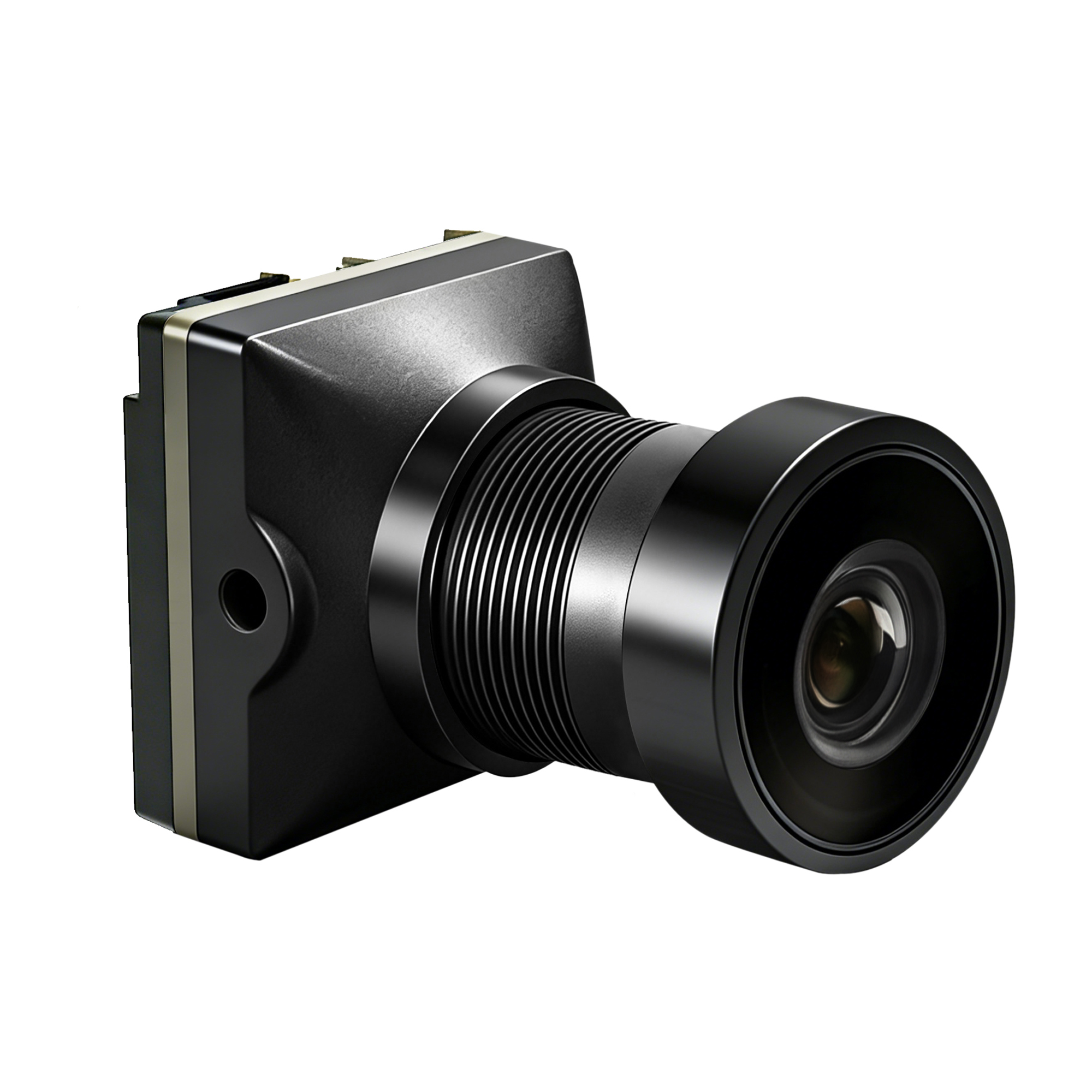
The CDD-BS59KU analog FPV camera from IRLAB Limited, specified with a 1500TVL sensor, 0.00001 LUX minimum illumination and a 9g aluminum alloy housing.
Why Night FPV Imposes a Different Specification Sheet
In daylight, resolution, colour rendering and dynamic range tend to dominate camera selection. After dark, the weighting flips: absolute light sensitivity, noise suppression and the amount of usable contrast preserved near zero illumination become the leading selection criteria. A night flight is flown on a weak signal, so any processing, encoding or aggressive noise reduction added downstream is amplified in difficulty for the pilot.
Structural constraints do not disappear at night either. Racing frames are built around 19mm×19mm camera mounts, and every additional gram changes the inertia of the quad. Tactical and reconnaissance-class platforms add vibration, shock, wide temperature range (recorded in IRLAB application notes at -38℃ to 60℃) and dense electromagnetic environments. A camera that satisfies a night racing programme may not automatically satisfy a night tactical mission, which is why a checklist beats a single headline number.
That same logic explains why the comparison between the CDD-BS59KU and the Foxeer Cat3 is worth doing at specification level rather than at marketing level. Both sit in the analog FPV category, both target racing and low-light work, and both are sold into the same buyer pool. The differences sit in the numbers, the certifications and the ownership cost.
The Verified Baseline: IRLAB CDD-BS59KU
The following values come from the IRLAB product specification for the CDD-BS59KU. They are the reference facts used throughout this comparison and should be checked against the current datasheet at the time of order, since specifications can be revised between production batches.
| Parameter | IRLAB CDD-BS59KU (verified specification) |
|---|---|
| Product name | Analog FPV camera |
| Model | CDD-BS59KU |
| Resolution | 1500TVL |
| Image format | 4:3 |
| Minimum illumination | 0.00001 LUX |
| Field of view | 120° |
| Signal-to-noise ratio | >60dB |
| Video output | CVBS |
| Digital noise reduction | 3DNR |
| Wide power input | DC4.5V–27V |
| Power consumption | 0.6W |
| Dimensions | 19mm × 19mm × 27mm |
| Net weight | 9g |
| Housing material | Aluminum alloy |
| Lens material | Glass + plastic |
Two details in this table matter more than the headline resolution. First, the 4.5V–27V input range means the camera can be powered from most common FPV packs without an external regulator. Second, the aluminum alloy housing is a structural choice rather than a cosmetic one: metal absorbs shock and heat better than plastic in a crash or a high-vibration mount, but it also adds a small weight penalty that IRLAB has kept to 9g.
What 0.00001 LUX and S/N >60dB Mean in a Night Flight
Minimum illumination describes the lowest scene light level at which the camera can still produce a recognisable image. A figure of 0.00001 LUX is an extremely low threshold and sits in the region where conventional day-only sensors return only noise. IRLAB states that its analog cameras operate at sensitivity levels as low as 0.00001 lux, a regime where conventional vision systems are effectively blind, and that this allows a drone to identify, lock onto and track targets under extreme low-light or zero-light conditions. That is a first-party statement tied to the IRLAB product record; it should be validated in the buyer's own scene because night performance depends on lens aperture, exposure algorithm and the specific monitor or goggles in use.
The signal-to-noise ratio of more than 60dB is the second important value. A higher S/N ratio describes a cleaner signal relative to background noise, which in practice means the pilot sees more scene structure and fewer dancing speckles in the goggles. Combined with 3DNR (three-dimensional noise reduction), the CDD-BS59KU is designed to trade a small amount of detail for a lower noise floor in near-dark scenes - a reasonable trade for FPV, where a stable picture is more useful than a sharper but noisier one.
Latency is the third variable, although it sits outside the camera datasheet. The camera outputs CVBS, so the analog transmitter and goggles define most of the end-to-end delay. For context, digital FPV systems (DJI, Walksnail, HDZero) typically exhibit glass-to-glass latency of 22–40ms in 2026 settings according to commercial research. Analog systems are commonly selected where the shortest possible signal path is preferred, but buyers should measure the complete chain rather than assuming the camera alone dictates latency.
Comparing With the Foxeer Cat3: A Buyer Checklist
The Foxeer Cat3 is a long-standing reference model in the analog FPV segment. The comparison below uses the comparison baseline supplied for this review; Foxeer Cat3 values are not restated as facts because catalogue values for that model can change between production revisions. Buyers should pull the current Cat3 datasheet and confirm each line before locking a purchase order.
| Metric | CDD-BS59KU (verified) | Foxeer Cat3 (reference baseline) |
|---|---|---|
| Resolution | 1500TVL | Comparatively lower by about 20% in the supplied comparison data |
| Minimum illumination | 0.00001 LUX | Comparatively higher by about 50% in the supplied comparison data |
| Noise | S/N >60dB with 3DNR | About 50% more noise in the supplied comparison data |
| Field of view | 120° | Buyer to confirm from current Cat3 datasheet |
| Image format | 4:3 | Buyer to confirm |
| Video output | CVBS (analog) | Buyer to confirm |
| Weight | 9g | Buyer to confirm |
| Dimensions | 19mm × 19mm × 27mm | Buyer to confirm |
| Housing | Aluminum alloy | Buyer to confirm |
| Initial cost | About 10–15% lower in the supplied comparison data | Reference |
| Maintenance | Reduced maintenance need in the supplied comparison data | Reference |
How to read the comparison data. The 20% resolution advantage, 50% minimum-illumination improvement, 50% noise reduction and 10–15% lower initial cost are comparison-baseline figures supplied for this review, not independent laboratory measurements. They are a starting point for a buyer's own side-by-side test: same lens, same scene, same goggles, same flight controller. Any real-world delta will move with firmware, ambient light and lens choice.
Application Fit: Racing and Tactical Night Missions
IRLAB lists the CDD-BS59KU across several application categories: racing drone FPV camera, tactical drone FPV camera, military drone FPV camera, AI detection FPV camera, drone tracking camera, low latency camera, RC car FPV camera and analog FPV camera. That breadth reflects IRLAB's manufacturing base rather than a single niche use. The two applications most relevant to a night comparison are racing and tactical reconnaissance.
FPV Racing
For racing, the critical combination is light weight, a wide 120° field of view and reliable image stability at speed. At 9g and 19mm × 19mm × 27mm, the CDD-BS59KU fits frames built around the common micro camera mount format. The 4:3 image and CVBS output remain compatible with most analog video transmitters and goggles still used in club and regional racing. The aluminum housing adds resistance to the knocks and scrapes that are routine in race heats.
Tactical and Reconnaissance Night Work
IRLAB's application notes describe tactical UAV work in conditions including extreme dark night time and sunshine day time, high vibration and shock, a wide temperature range of -38℃ to 60℃, electromagnetic interference environments, dense fog and torrential rain. The functions recorded for these missions include covert night reconnaissance, no-IR tactical manoeuvres, terminal visual guidance, high-speed penetration, ultra-low latency and zero-blur FPV. Those are capability statements from IRLAB's own application record, not independent test results. A procurement team should replicate a subset of them in a controlled trial before committing a fleet.
One field case in IRLAB's records describes a Ukrainian FPV drone manufacturer that integrated IRLAB cameras into its drones over a one-year period with a volume of 30K units. The reported result was target identification, lock-on and tracking at sensitivity levels as low as 0.00001 lux. This is a customer-reported case rather than a third-party audit, and it should be treated as an application reference when planning a night mission trial.
Compliance Readiness: Certifications a Buyer Can Check
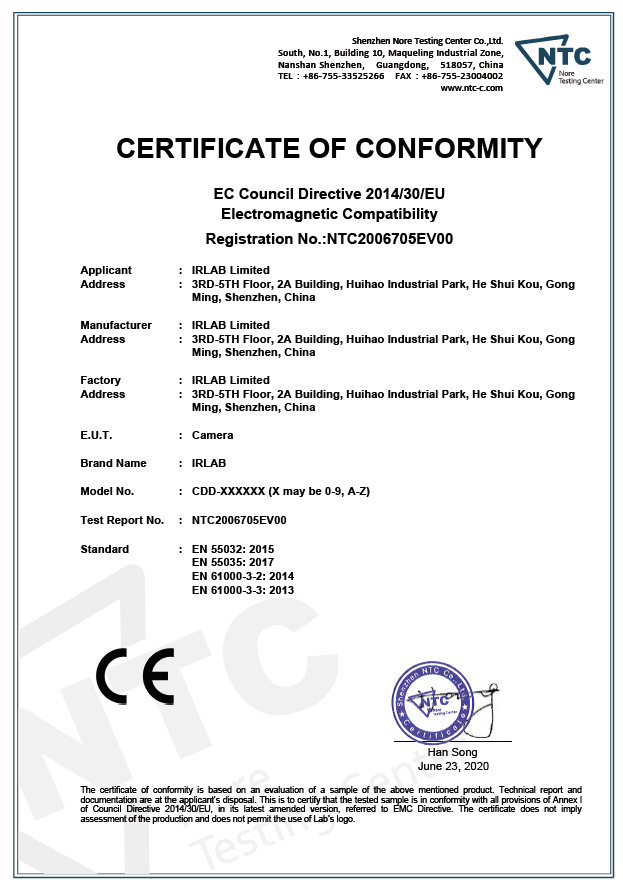
The CDD-BS59KU appears on IRLAB's CE certification record issued by NoreTesting Center under certificate number NTC2006705EV00, with EN 55032, EN 61000-3-2, EN 61000-3-3 and EN 55035 listed as applicable standards.
Night and tactical programmes tend to place as much weight on compliance paperwork as on the camera specification, because a camera that cannot be imported or deployed is not a candidate. IRLAB publishes a compliance record for the CDD-BS59KU across multiple markets. The table below reproduces the certificates listed against the model in IRLAB's compliance documentation.
| Certification | Certificate number | Issuing body | Applicable market | Standard reference |
|---|---|---|---|---|
| CE | NTC2006705EV00 | NoreTesting Center | EU | EN 55032, EN 61000-3-2, EN 61000-3-3, EN 55035 |
| FCC | NTC2009742FV00 | Nore Testing Center | USA | FCC CFR 47 Part 15 Subpart B Class B:2019 |
| RoHS | ESTSZ130402233R | EST Standard Testing & Certification | EU | Directive 2011/65/EU Annex II |
| UKCA | SZNTC2204712EV00 | Nore Testing Center | UK | BS EN 55032:2015/A1:2020; BS EN 55035:2017/A11:2020 |
| C-TICK | RSZA05061052-9 | Bay Area Compliance Laboratory Corp. | AU, NZ | AS/NZS CISPR 22:2002 Class B |
| E-MARK E11 | 10R-048329 | Vehicle Certification Agency | ECE, UK | ECE R10 |
| UL | 20170803-E494081 | UL | USA, Canada | UL 60950-1 & CAN/CSA C22.2 No. 60950-1-07 |
| ISO 9001:2015 | 44100102298 | TÜV | Global | ISO 9001:2015 |
Two caveats are worth noting. First, the CE, FCC and RoHS records are product-safety and electromagnetic-compatibility approvals, not night-performance guarantees. Second, buyers importing into the United States should check the current Section 232 tariff position on UAS and certain components, because the U.S. imposed a 100% Section 232 tariff on UAS with thermal imaging and certain components starting September 3, 2026 according to a primary customs source. An analog camera used as a spare part may or may not fall under the same tariff schedule, so a customs classification review is part of the compliance checklist, not an afterthought.
Cost, Maintenance and Procurement Terms
For a night FPV programme, the purchase price of the camera is a small part of total cost. Crash replacements, lens damage and batch-to-batch consistency carry more weight over a season. On the supplied comparison baseline, the CDD-BS59KU is listed at about 10–15% lower initial cost than the Foxeer Cat3 and with reduced maintenance needs. Those two points should be verified against a real trial sample, because a camera that is 15% cheaper and survives one extra crash is worth far more than the headline discount alone.
On the supply side, IRLAB's capability record lists OEM/ODM cooperation with customization options that include housing color, logo printing, different viewing angle lenses, video image style, integration of third-party AI algorithms and integration of third-party wireless transmission solutions. Volume terms are documented as a minimum order quantity of 1 unit, immediate delivery for small quantities, and 15–25 working days for larger quantities after receipt of deposit. Monthly capacity is stated at 500,000 units. Quality control is stated as 100% production check plus AQL-standard OQC inspection, and the warranty period is two years.
- Sampling: Request a sample at the intended production voltage (4.5V–27V covers most packs) and test it in the actual goggles.
- Night baseline: Compare the 0.00001 LUX spec against the site's measured light level in a repeatable scene.
- Mounting: Confirm the 19mm × 19mm × 27mm footprint against the frame's camera cage, including lens protrusion.
- Housing: Verify the aluminum alloy housing against the crash profile expected in the programme.
- Certification: Match the certificate list to the destination market and review the customs classification for the final assembly.
- Terms: Confirm lead time, warranty and spare-part batch consistency in the purchase contract.
Limits and Trade-Offs
What the CDD-BS59KU does not change. The camera is an analog CVBS device, so its ceiling is defined by the analog video chain, not by the 1500TVL sensor. Buyers who need 1080p or higher, native 16:9, MSP/MAVLink OSD protocols or on-camera AI detection or tracking should look elsewhere in the IRLAB range - the CDD-BS5JMU digital FPV camera, for example, lists 3840×2160@30fps, 1080p@90fps, 720p@120fps, 5.1GHz–5.8GHz transmission, 50ms glass-to-glass latency, MSP and MAVLink OSD support, and a TF card slot up to 1TB.
Beyond the analog ceiling, several other boundaries apply. The 120° field of view is wide and immersive for racing and close-quarter reconnaissance, but it produces edge distortion that some optical tasks do not want; a narrow-FOV lens request from the buyer will need a different optical configuration. The 4:3 image format is the traditional analog FPV proportion, but it is not the 16:9 proportion that many digital links and post-processing workflows prefer. AI detection and object tracking on the CDD-BS59KU are not native features of the standalone model; IRLAB offers third-party AI algorithm integration as an OEM/ODM customization, so a buyer who needs those functions should specify them at the OEM stage rather than expecting them from a stock unit.
Finally, the comparison figures in the earlier table are a supplied baseline rather than an independent benchmark. The 20% resolution advantage, 50% minimum-illumination improvement, 50% noise reduction and 10–15% cost advantage should be re-measured by the buyer against the Foxeer Cat3 or any other shortlisted model on the same scene, with the same lens and the same video chain. A camera that wins on the datasheet but loses in the goggles is not the right purchase.
Market Context
Two verified data points frame the buying decision. The global FPV camera market was estimated at US$825.3 million in 2024 according to Fact.MR's published headline figure. That is a single commercial-research value, and it should be read as an order-of-magnitude context rather than an investment-grade number. Separately, digital FPV systems (DJI, Walksnail, HDZero) typically exhibit glass-to-glass latency of 22–40ms in 2026 settings, which explains why analog remains a live option for latency-sensitive pilots even as digital systems improve.
For a buyer, the practical takeaway is that the analog segment is not disappearing; it is being pushed toward clear roles - the shortest signal path, the lowest bill of materials and the highest night-time sensitivity per gram. The CDD-BS59KU positions itself in that lane with a 1500TVL sensor, a 0.00001 LUX minimum illumination, a 9g aluminum housing and a documented certification set. Whether that positioning holds for a specific programme depends on the buyer's own night-scene test.
Future Outlook
Night FPV will continue to split into two purchasing routes. The first is the high-performance digital route, where resolution and on-screen data overlays increasingly matter and where latency has fallen into a narrower band. The second is the analog route, where the priority remains sensitivity, low weight, mechanical toughness and a predictable bill of materials. A camera like the CDD-BS59KU sits firmly in the second route, and its long-term value depends on two things: whether IRLAB keeps the certification set current across markets, and whether the analog video chain keeps attracting racing and tactical pilots who prefer its simplicity.
For procurement teams planning beyond a single season, the more useful preparation is not to wait for the next sensor generation but to settle the checklist: confirm the night-scene performance, lock the certification and customs position for each destination market, and treat the comparison data as a hypothesis to be tested rather than a conclusion to be copied.
Buyers who need the full company, facility and certification record in one document can download the IRLAB company profile and corporate brochure for internal review.
FAQ
What does the 0.00001 LUX rating on the CDD-BS59KU mean for night FPV?
Minimum illumination is the lowest scene light level at which the camera can still produce a recognisable image. A 0.00001 LUX rating is an extremely low threshold, and IRLAB states that its analog cameras operate at sensitivity levels as low as 0.00001 lux, a regime where conventional vision systems are effectively blind. The rating describes a sensor-level threshold, not a guarantee that every scene at that light level will be usable, because lens aperture, exposure algorithm and the pilot's goggles also affect the visible result.
Which certifications does the CDD-BS59KU hold?
IRLAB's compliance record lists CE (NTC2006705EV00, NoreTesting Center, EU), FCC (NTC2009742FV00, Nore Testing Center, USA), RoHS (ESTSZ130402233R, EST Standard Testing & Certification, EU), UKCA (SZNTC2204712EV00, Nore Testing Center, UK), C-TICK (RSZA05061052-9, Bay Area Compliance Laboratory Corp., AU/NZ), E-MARK E11 (10R-048329, Vehicle Certification Agency, ECE/UK), UL (20170803-E494081, UL, USA/Canada) and ISO 9001:2015 (44100102298, TÜV, global). Buyers should match this list against the destination market and the final assembly, because tariffs and import rules apply to the complete platform, not only the camera.
How does the CDD-BS59KU compare with the Foxeer Cat3 on cost and maintenance?
The comparison baseline supplied for this review places the CDD-BS59KU at about 10–15% lower initial cost than the Foxeer Cat3 and with reduced maintenance needs. That baseline is a starting point for a buyer's own quotation process, not a current price list. Buyers should request current pricing from both suppliers and compare landed cost, including shipping, duties and spare-part replacement rates over a full season.
Is the CDD-BS59KU a suitable fit for a 19mm × 19mm racing frame?
The camera is 19mm × 19mm × 27mm and weighs 9g, which corresponds to the common micro FPV camera mount format used on racing frames. The aluminum alloy housing adds structural resistance, but the buyer should still confirm the lens protrusion, the mounting screw spacing and the clearance inside the specific frame before ordering in volume.
What are the limitations of the analog CDD-BS59KU compared with a digital FPV camera?
The CDD-BS59KU outputs CVBS analog video at 1500TVL in a 4:3 format. It does not natively support 1080p or higher recording, MSP/MAVLink OSD protocols or on-camera AI detection and object tracking. IRLAB offers third-party AI algorithm and wireless transmission integration as OEM/ODM customization rather than as stock features. Buyers who need those capabilities should evaluate IRLAB's digital model CDD-BS5JMU, which lists 3840×2160@30fps, 1080p@90fps, 720p@120fps, 5.1GHz–5.8GHz transmission, 50ms glass-to-glass latency, MSP/MAVLink OSD and a TF card slot up to 1TB.
Have Questions or Need More Details?
Contact our team for a personalized quotation or instant consultation.
Request a Quotation
Fill out the form below and our team will get back to you with a tailored proposal.
WhatsApp Direct Chat
Prefer to chat in real-time? Message us on WhatsApp for instant assistance & quick answers.
- Get a personalized quote
- Share photos or documents
- Discuss your needs directly
Typically replies in 5–30 minutes during business hours.