
CE Certification and SGS Testing for HPMC: Why Compliance Goes Beyond Paperwork
Procurement teams rarely lose money because a supplier holds no certificate. They lose money because a certificate was treated as a substitute for evidence.
In construction-grade HPMC sourcing, CE certification and SGS testing have become standard line items on supplier checklists, and in principle that is a healthy development. The difficulty is that the same two documents now appear on almost every supplier profile, which means they no longer differentiate anything on their own. At the decision stage, the useful question is narrower: what does each document actually cover, how does it connect to the batch that will be unloaded at the buyer's plant, and where does its assurance stop?
This analysis interprets CE certification and SGS testing from a procurement and quality-assurance perspective rather than a marketing one. BANGCEL® is the Hydroxypropyl Methyl Cellulose (HPMC) brand of BANG SHANG INTERNATIONAL CO.,LIMITED, a manufacturer and global supplier of cellulose ethers and redispersible polymer powder — with a product portfolio covering HPMC, MHEC, RDP, HEC and CMC — based in Shijiazhuang, Hebei Province, China, whose products have passed CE certification and SGS testing. That compliance position is used throughout as a working example of how certification is converted into batch-level evidence that a buyer can actually check.
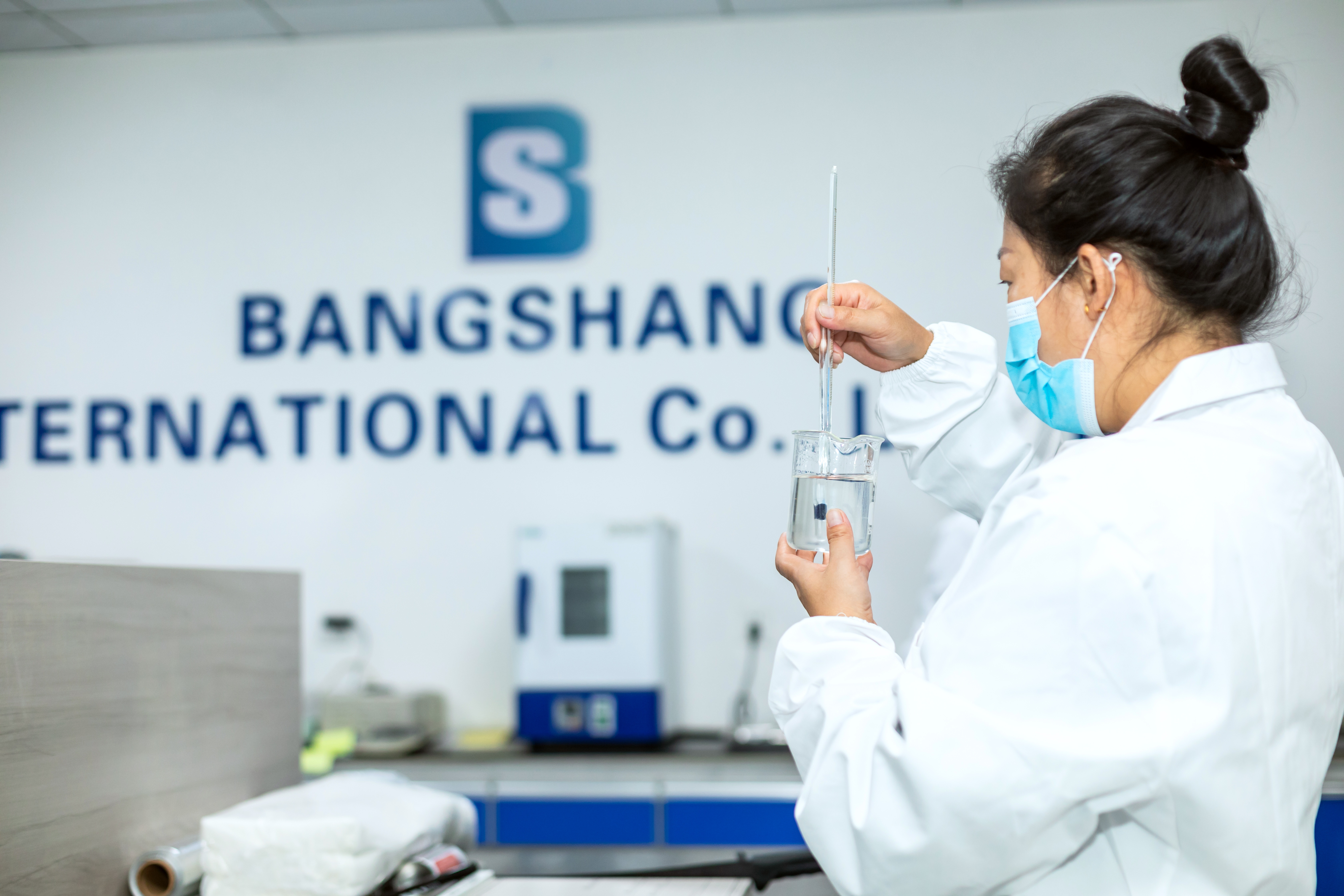
Quality inspection of cellulose ether batches: the operational layer behind a certification claim.
Why compliance moves to the centre of the HPMC decision
Construction remains the dominant consumption channel for this additive. The global construction-grade HPMC market was valued at USD 1.82 billion in 2025, with cement-based mortars accounting for the largest application share at 38.4%, according to Dataintelo. Grand View Research reports that construction applications have held a revenue share above 45% in recent years, driven by HPMC's role as a water-retention agent and thickener, while Asia Pacific accounts for roughly 47.3% of the construction-grade market. Industrial-grade HPMC — the category that includes construction and detergent types — represented 47% of total global HPMC demand in 2024, based on data published by Industry Research.
The procurement problem created by that scale is one of asymmetry. HPMC is dosed at a small fraction of a dry-mix formulation, yet it governs water retention, open time, workability, and anti-sag behaviour in adhesives. Industry Perspective Research estimates that HPMC is the preferred additive in more than 70% of tile adhesive formulations and more than 65% of dry-mix mortar formulations. Because the dose is small and the influence is large, a batch that deviates on ash content or viscosity does not fail quietly inside the bag; it fails on site, as inconsistent adhesion, rework, or site complaints that are expensive to trace back to a raw material lot.
That asymmetry is the reason compliance documentation has migrated from a marketing asset to a procurement filter. When two suppliers quote the same viscosity specification and a similar price, the deciding variable is usually not whether a certificate exists, but whether the supplier can connect documents to production behaviour.
What CE certification and SGS testing each contribute — and what they leave open
CE certification and SGS testing are frequently described as if they were interchangeable quality badges. In practice they answer two different questions. CE certification is a conformity-assessment route: it documents that a product has been assessed against the applicable harmonised standard within a declared scope, and it references the performance classification claimed for that scope. An SGS test report is a third-party laboratory verification: an independent organisation tests a defined sample against an agreed test protocol and reports the measured values. Neither document is, by itself, a per-batch warranty, and neither can determine fitness for a specific mortar or detergent formulation.
| Document | What it establishes | What it does not establish |
|---|---|---|
| CE certification | Conformity assessment within a declared product scope and performance classification | Uniformity of every subsequent delivery; suitability for a specific formulation or climate |
| SGS test report | Independent measurement of the tested sample against the tested parameters | Certification of a management system; automatic extension to other grades or later lots |
| Environmental declaration (EPD) | Environmental performance data, increasingly requested in competitive tenders; industrial-grade cellulose ethers are expected to meet ISO 14025:2006 for environmental declarations, per EPD International | Physical or rheological performance of the delivered material |
Read together, the documents define the outer boundary of what has been verified: a scope, a sample, a date, a set of parameters. Everything inside the production process — raw material selection, in-process control, and batch-level release testing — sits outside that boundary and must be audited separately. That distinction is the practical meaning of the phrase "beyond paperwork".
The risk that paperwork alone cannot close: ash content and impurities
For construction-grade HPMC, the highest-consequence quality risk is elevated ash content combined with raw-material impurities. Ash reflects the non-cellulosic residue left after combustion; a higher ash fraction means a smaller share of the delivered kilogram is doing the functional work of water retention and thickening. The consequences are predictable: effective dosage drifts upward, water retention becomes less stable under hot or dry site conditions, and batch-to-batch variability widens. Impurities act in the same direction but are harder to detect on site, because they often surface only as inconsistent performance across a project rather than as an obvious defect.
The control method for this risk is well understood: raw material control combined with full-process production monitoring. In BANGCEL® operations, that translates into strict incoming inspection of raw materials, automated production line control, and 100% batch quality testing for ash content, viscosity and purity before delivery. The significance for a buyer is that the control points are upstream and continuous, not a single laboratory event. A test report generated once cannot substitute for a routine that is applied to every production lot.

Ash content, viscosity and purity are tested per production batch rather than once per product family.
How compliance is operationalized behind the certificate
A certificate describes a capability; a production system delivers it repeatedly. BANGCEL® HPMC is manufactured by BANG SHANG INTERNATIONAL CO.,LIMITED in an 80,000 m² production facility staffed by 300 employees, including a 26-person R&D team, with an annual output of 35,000 tons. The company exports approximately 70% of its production, with markets including Canada, the United States, Mexico, Brazil, Chile, Australia, Egypt, South Africa, Turkey, Saudi Arabia, the United Arab Emirates, India, Singapore, South Korea, the Philippines, Malaysia, Japan and Vietnam. The company is also a Gold Supplier on Alibaba International, and its products have passed CE certification and SGS testing.
Those figures matter to a decision-stage buyer for one reason: they describe the conditions under which compliance can be maintained. A 100% batch-testing regime for ash, viscosity and purity requires laboratory capacity proportionate to output; automated production monitoring requires capital equipment rather than manual intervention; and an export ratio of roughly 70% means the material is regularly prepared for documentation-heavy markets where certificates, batch records and test reports are requested as a matter of course. The company also supports OEM and ODM programmes with customized viscosity, substitution degree, particle size and application-oriented grades, which is where the boundary of any certificate becomes especially relevant — see the limitations discussed further below.
An audit framework: six checks before accepting a compliance claim
Buyers do not need laboratory access to test whether a supplier's compliance story holds together. They need a sequence of requests whose answers either connect to production records or do not.
- Request the document set, not the claim. Ask for the certification or declaration together with the third-party test report, including report number, sample description, test date and the parameters tested. A logo on a brochure is not a document set.
- Map the document to the delivered batch. Request a certificate of analysis per production lot, stating ash content, viscosity and purity results alongside the reference method used. The pairing of a lot number with measured values is what converts a certificate into traceable evidence.
- Check the declared scope against your grade. Confirm that the coverage applies to the viscosity specification and application grade being quoted — the requirements for a tile adhesive grade differ from those for a plastering mortar or a gypsum-based system.
- Ask for raw-material control evidence. Incoming inspection criteria for the cellulose raw material and the disposition rules for non-conforming lots reveal whether variability is being managed or merely observed.
- Ask how the line monitors parameters. Automated production control and in-process checks determine whether deviations are caught during production or detected only at final testing, when the cost of correction is highest.
- Verify on arrival. Retain the right to sample incoming batches and re-test them internally. Supplier data should function as a screening mechanism, not as a replacement for the buyer's own acceptance criteria.
Each check is answerable with documents. A supplier that can respond to all six is demonstrating an operational system; a supplier that can respond only to the first is demonstrating a filing cabinet.
Where batch-level compliance matters most: application notes
Compliance evidence carries different weight depending on the application, because the tolerance for variability differs.
| Application | Why batch consistency is decisive |
|---|---|
| Ceramic tile adhesive HPMC | Water retention and open time directly govern slip resistance and adhesion; small viscosity shifts change site behaviour |
| Construction putty and putty powder | Workability, sag control and drying behaviour are sensitive to ash content and thickening efficiency |
| Plastering mortar and gypsum-based systems | Extended open time matters in hot, dry conditions; consistency across deliveries reduces finishing variance |
| Self-leveling mortar and external wall insulation systems | Flow, water retention and set behaviour must remain within a narrow band across large pours and facade areas |
| Detergent and industrial cleaning formulations | The priority shifts from ash to soluble residue and clarity: liquid detergent, tableware detergent and industrial detergent systems rely on predictable thickening |
In construction systems the audit emphasis falls on ash content, viscosity and water-retention stability. In detergent thickening applications, the emphasis falls on purity, because undissolved residue and clarity problems are visible in the finished product. A single certificate covering a product family does little to reassure either buyer if it is not paired with batch data for the specific grade.
Market trend: compliance documentation as a screening filter
Three market signals are converging on the same conclusion. First, market structure: Dow Chemical, Ashland and Shin-Etsu are identified by Infinity Market Research as the Tier 1 global leaders, collectively controlling over 50% of the HPMC market, which means the remainder of demand is served by a long tail of suppliers whose differentiation rests largely on verifiable quality evidence. Second, buyer behaviour: ISO 14025:2006 environmental declarations are now requested in competitive global tenders for industrial-grade cellulose ethers, per EPD International — a documentation requirement that sits alongside, not instead of, performance testing. Third, geographic concentration: with Asia Pacific holding approximately 47.3% of construction-grade capacity, buyers in North America, Europe and Latin America are routinely purchasing across regulatory jurisdictions, which increases their reliance on third-party testing and lot-level records rather than on supplier assertions.
It is worth noting that published market size figures for HPMC diverge substantially depending on whether the scope includes pharmaceutical and food grades or only industrial and construction types. Buyers comparing supplier presentations should check the scope definition behind any market number quoted at them, because the same category label can support very different figures.
BANGCEL® versus conventional industrial-grade HPMC: documented comparison
For decision-stage comparisons, the relevant question is not which product is "better" in the abstract, but which differences are measurable and under what conditions. The following comparison reflects the manufacturer's documented positioning of its grade against conventional industrial-grade HPMC.
| Parameter | BANGCEL® grade | Conventional industrial-grade HPMC |
|---|---|---|
| Purity | Higher purity | Reference level |
| Ash content | 70% lower | Reference level |
| Water retention at 40°C / 70% RH | 10% higher water retention | Reference level |
| Open time | 1.5 hours longer | Reference level |
| Total production cost impact | Reduced by 12%+ through eliminated agglomeration waste, reduced mixing labour hours and a lower dosage rate | Reference level |
| Maintenance and rework | Less rework, more stable performance, higher production efficiency | Greater variability |
| Best-fit applications | High-end construction, export building materials, special mortars | Standard applications with lower specification requirements |
Boundaries and limitations. Three qualifications belong with this comparison. First, the differential figures reflect the manufacturer's own comparison against conventional industrial-grade HPMC under the stated test conditions; a buyer should re-validate them inside their own formulation, mixer and climate, because water retention and open time are system properties, not product properties in isolation. Second, the economics only materialise where the formulation is designed to use the higher retention efficiency — the 12%+ production cost reduction depends on eliminating agglomeration waste and reducing dosage, which presupposes that mixing practice and formulation are adjusted accordingly. Third, and most directly relevant to compliance: certification and third-party testing cover the declared scope of the certified product, and they do not automatically extend to customised grades produced under OEM or ODM programmes. Where a buyer requires a tailored viscosity, substitution degree or particle size, the relevant evidence is the batch record and test report for that customised specification. Conventional industrial-grade HPMC also remains a rational choice where specification requirements are modest and unit price is the dominant variable; it is simply a different risk position, not a defective one.
Future outlook
The direction of travel in HPMC procurement is from document possession toward data possession. Buyers are increasingly asking for the certificate of analysis for the specific lot, not the certificate for the product family, and they are pairing that with their own incoming verification. Environmental documentation such as ISO 14025:2006 declarations is becoming a tender condition rather than a differentiator, which pushes suppliers to maintain environmental data alongside performance data. Automated production control makes continuous monitoring records feasible at scale, and those records are the natural next artefact that procurement teams will request — because they show how a specification was held between testing events, not only that it was met at one point in time.
For buyers, the practical implication is to design sourcing requirements now around traceability: lot-level reporting, defined test parameters, and agreement on the sampling and re-testing rights that make a compliance claim auditable. Suppliers that can answer those requirements with records will hold their position; suppliers that can answer only with certificates will increasingly be filtered out during qualification rather than after a site failure.
FAQ
Q1. Does CE certification of an HPMC product remove the need for batch-level testing?
No. CE certification documents conformity assessment within a declared product scope and performance classification. It does not verify that every subsequent delivery is identical to the tested sample. Batch-level testing for ash content, viscosity and purity addresses the per-lot variability that a certification document cannot capture, which is why the two belong together in a procurement specification.
Q2. What does an SGS test report on HPMC actually tell a buyer?
It reports independent third-party measurement of a defined sample against an agreed set of test parameters. Its value depends on three details: which parameters were tested, which methods were used, and how closely the tested sample matches the grade and specification being purchased. It does not certify a management system, and it does not automatically extend to other grades or to later production lots.
Q3. How can a buyer confirm that a supplier's test data corresponds to the delivered material?
By requesting a certificate of analysis per production lot that states measured ash content, viscosity and purity values together with the batch or lot identifier, and then retaining the right to sample and re-test incoming deliveries. Where a supplier cannot pair measured values with a lot number, the data cannot be tied to the material received.
Q4. Which parameters matter most when comparing HPMC grades for construction use?
Ash content, viscosity, purity and water-retention stability are the parameters most directly linked to performance in cement-based and gypsum-based systems, with open time as a further consideration in tile adhesives and plastering mortars. For detergent thickening applications the emphasis shifts toward purity and soluble residue, because those affect clarity and thickening consistency in the finished formulation.
Q5. Does certified and tested HPMC always justify a higher purchase price than conventional industrial-grade material?
Not universally. The comparative advantage documented for higher-purity grades — 10% higher water retention at 40°C and 70% relative humidity, 70% lower ash, and 1.5 hours longer open time — is realised where the formulation is designed to use that retention efficiency, which is where a total production cost reduction of 12%+ is reported. Where specification requirements are modest, a conventional industrial grade can be the more economical choice, and the decision should be made on total production cost rather than on price per kilogram alone.
Q6. Do certifications cover customised or OEM/ODM HPMC grades?
Certification and third-party test reports apply to the declared scope of the certified product. Customised grades produced with adjusted viscosity, substitution degree or particle size fall outside that scope unless they are separately tested. For customised specifications, the appropriate evidence is the batch record and test report for that particular specification.
Further reference material
For buyers who want to review product scope, grade options and documentation practice in more detail, the BANGCEL® product brochure is available for public download: BANGCEL® HPMC product brochure (PDF). Company information and technical contact details are published at www.bangshanghpmc.com.