
CE-Certified Label Printing Machines: What Buyers Should Verify Before Purchase
When a label converter invests in a new printing press, technical specifications such as print speed, web width, and registration accuracy usually dominate the conversation. Yet for buyers in the EU and other regulated markets, the presence of CE certification is not a document checkbox — it is a legal precondition for machinery operation, and a practical signal of whether the manufacturer has systematically engineered safety, electrical compliance, and risk reduction into the equipment. This article explains what CE certification means for label printing machines, how to verify it, and what equipment and compliance evidence a global buyer should examine before making a purchase decision.
For buyers evaluating label printing machines from Asian manufacturers, the gap between “certified” and “compliant-designed” can be significant. Some suppliers treat CE marking as a sales add-on. Others, like Shenzhen Caisheng Printing Machinery Co., Ltd., integrate compliance into the product platforms they ship internationally. Understanding this distinction helps engineering teams, plant managers, and purchasing departments avoid customs delays, insurance disputes, and operational downtime after installation.

Flexographic label presses such as the CS-J380F-7C are evaluated not only on print quality but also on electrical safety, noise, and ergonomic compliance.
The CE Requirement for Label Printing Machinery
CE marking is a mandatory conformity mark for machinery sold within the European Economic Area. For label printing equipment, the applicable regulatory framework is the EU Machinery Directive 2006/42/EC, which requires manufacturers to assess hazards, reduce risks, and demonstrate compliance through technical documentation. The directive is supported by harmonised standards, and for graphic technology equipment, ISO 12643-2:2023 provides the international safety standard specifically for printing presses and converting machinery.
A CE mark is not simply a sticker. It signifies that a machine meets the essential health and safety requirements, including electrical safety under EN 60204-1 and general safety design under EN ISO 12100:2010. For a label press, this covers guards, interlocks, emergency stops, electrical wiring, control systems, and the operator manual. Without these elements, a machine may still function mechanically but can fail EU market surveillance checks and expose the user to legal liability.
What “CE-Certified” Should Mean for a Label Printing Machine
For a label printing machine, CE certification involves multiple layers of assessment, not just the printing unit. The same press often integrates UV drying systems, die-cutting modules, corona treaters, slitting units, or lamination stations. Each add-on affects the overall machine's electrical load, guarding requirements, and risk profile. A certificate covering the complete assembled platform is more valuable to a buyer than a component-level declaration.
One example of documented, platform-level conformity is the CAISHENG CS-300 and CS-220 series. These intermittent letterpress label printing machines are covered by a Machinery Directive Attestation of Conformity, certificate number M.2025.206.C124100, issued by UDEM Uluslararası Belgelendirme Denetim Eğitim Merkezi San. ve Tic. A.Ş., and conform to EN ISO 12100:2010. Together with the electrical safety standard EN 60204-1:2018, the certification applies to equipment intended for the EU market. The stated scope includes CS-300, CS-220, and CS-350 series models, which means the compliance covers not a single prototype but a family of related label presses.
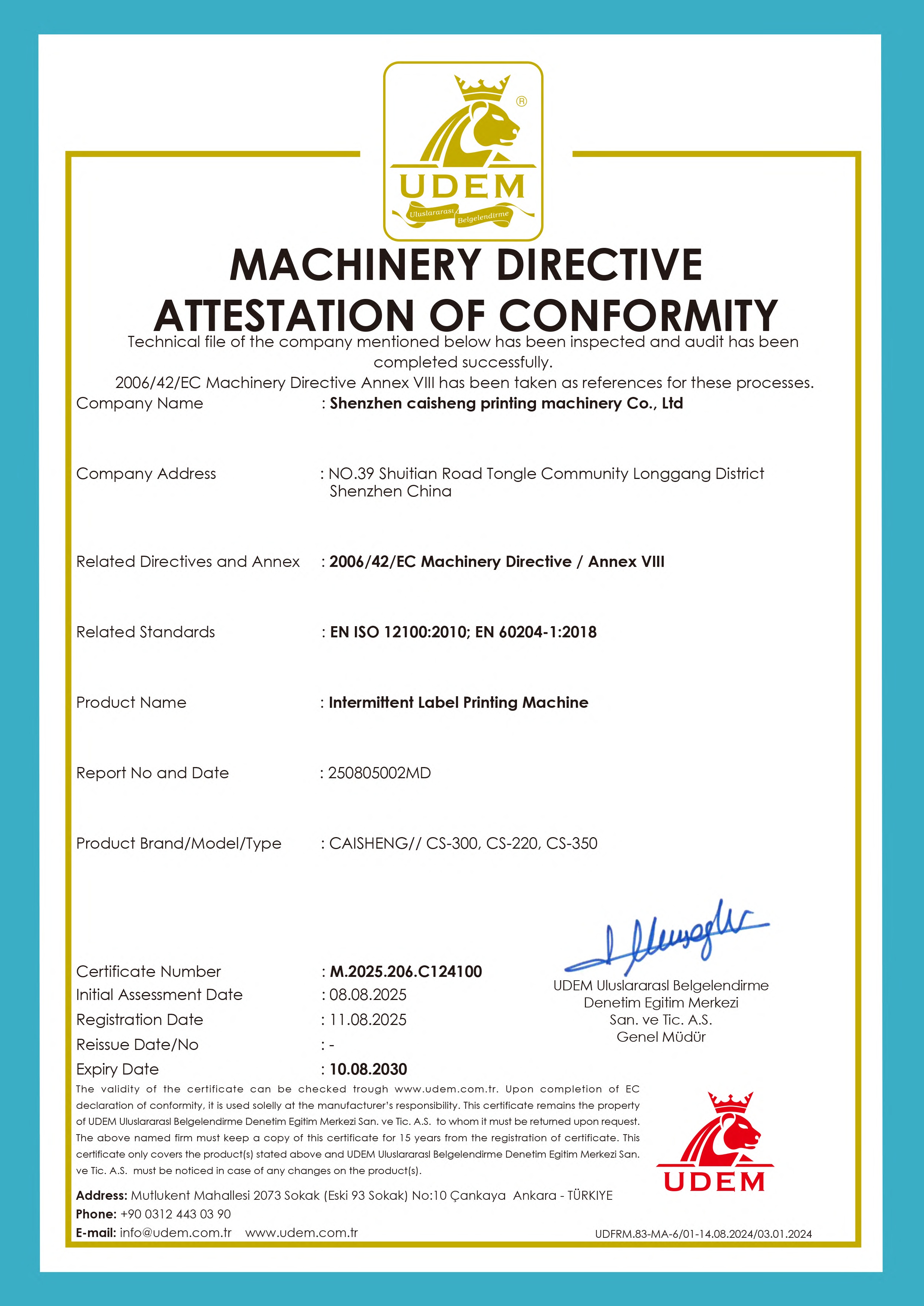
A verifiable CE conformity document includes the certificate number, issuing body, applicable standards, and covered machine series.
How to Verify CE Documentation as a Buyer
Not all documentation that a supplier calls “CE” carries equal weight. Buyers should ask for the complete set of documents and check specific details before payment or shipment.
- Certificate holder and address: The document should clearly state the manufacturer or authorized representative. Name mismatches may indicate invalid paperwork.
- Certificate number: A unique reference allows a buyer to trace the file with the issuing body. The CAISHENG document, for example, carries the number M.2025.206.C124100.
- Issuing body: The conformity attestation should come from a recognized notified body or accredited certification organization. In the CAISHENG case, the issuer is UDEM Uluslararası Belgelendirme Denetim Eğitim Merkezi San. ve Tic. A.Ş.
- Standards reference: Look for harmonised standards such as EN ISO 12100:2010 (risk assessment and risk reduction) and EN 60204-1:2018 (electrical equipment of machines). These standards indicate that the assessment followed accepted European methodology.
- Validity: Verify the issue and expiry dates. The CAISHENG certificate runs from 2025-11-08 to 2030-10-08, a standard five-year validity period for this type of attestation.
- Machine model coverage: The scope of the certificate should explicitly list model series. A certificate that lists only one variant may not cover a configuration with extra drying or die-cutting units.
For a label printing machine, this verification is an engineering task as much as a procurement task. Safety compliance affects operator training, insurance premiums, and the legal acceptance of the equipment in a factory.
What the Certification Covers in the CAISHENG Lineup
CAISHENG primarily builds intermittent and full-rotary letterpress label printing machines, flexographic label presses, and finishing equipment. The CE attestation with number M.2025.206.C124100 explicitly covers the CS-300, CS-220, and CS-350 series. That includes models such as:
- CS-300-6C — a 300 mm web-width rotation label machine with intermittent letterpress printing, designed for a wide range of self-adhesive label applications.
- CS-320-6C and CS-320-7C — semi-rotary/rotary label presses with a 320 mm web width and 40 m/min intermittent printing speed.
- CS-220-4C and CS-220-5C — compact stickers printing machines with web width up to 240 mm, commonly used for short-run label production.
- CS-JQ350G-6C — an intermittent and full-rotary high-speed label printing machine, combining 60 m/min intermittent speed and 158 m/min full-rotary speed.
The certification scope also extends to models documented in the broader product family, including the flexographic presses CS-J380F-4C and CS-J380F-7C. Buyers evaluating these presses for EU installation should request the model-specific declaration of conformity, since configuration changes such as an added rotary die-cutting unit may require updated risk assessment.
Why Compliance Matters for Production Efficiency
CE certification is sometimes misunderstood as a customs hurdle. In practice, it has a direct effect on operational uptime. A machine without valid conformity documentation can be stopped by market surveillance authorities after installation. Replacement of non-compliant guards, electrical rewiring, or control system upgrades can take weeks and cost more than the original machine's margin. Documented compliance reduces this risk.
For the CS-300 semi-rotary label printing machine, the compliance documentation is supported by a utility model patent (ZL 2022 2 1332174.4) covering a printing device capable of double-sided printing, including the structure and registration correction assembly. This shows that safety and capability are developed as part of the machine's core engineering, not added as an afterthought.
Certification and the Flexographic Label Press Segment
Flexographic printing is the most widely used process in the label industry, and flexographic label presses are a core product category for CAISHENG. Models such as the CS-J380F-4C and CS-J380F-7C are designed as intermittent flexo presses with either 4 or 7 color stations, max printing areas of 360 × 419 mm (full rotary) and 360 × 380 mm (intermittent), and typical running speeds of 60 m/min.
Full-rotary flexo machines like the CS-Q370F-6C and CS-370F-8C reach 150 m/min and cover printing areas of 370 × 200 mm or 370 × 600 mm. These machines are engineered for longer runs and higher throughput, which also increases the importance of operator safety systems: faster web speeds, higher UV dryer power, and more moving parts create additional hazards. A buyer should always confirm that the flexographic press being purchased carries a CE Declaration of Conformity covering the exact configuration — including dryer power and automation level.
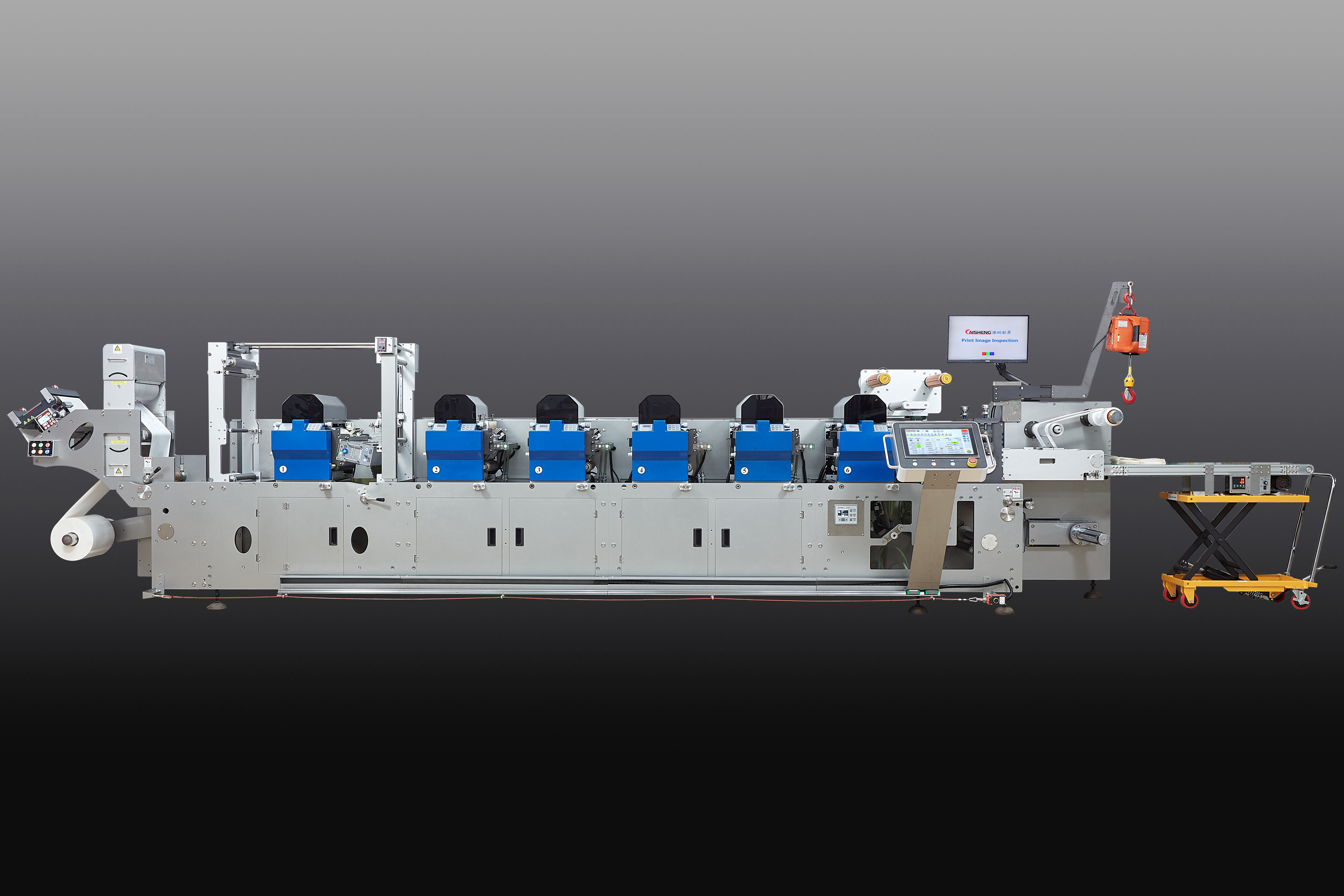
Full-rotary flexo presses like the CS-Q370F-6C offer 150 m/min printing speed; safety compliance becomes even more critical at higher speeds.
Compliance Beyond CE: Patents, Quality Control, and Export Evidence
CE certification does not exist in isolation. For a label printing machine supplier to be considered reliable, buyers should also evaluate patent protection, production capacity, and export experience. These factors indicate whether the manufacturer can sustain quality across multiple deliveries.
CAISHENG, for example, holds a Chinese invention patent titled “A method, system, and medium for remote control of printing equipment based on big data” (ZL 2022 1 0411353.5, issued 2022-07-12). This patent covers remote data collection, cloud-computing analysis, remote start-stop and parameter adjustment, and online fault diagnosis. In practice, it supports remote support and debugging, which is relevant when a machine is installed in a different country from the manufacturer.
Production capacity and after-sales terms also matter. CAISHENG operates with a monthly capacity of 18 units, a lead time of 45–60 days, and a minimum order quantity of 1 unit. Each machine is 100% tested before shipment. Export markets include Southeast Asia, the EU, the Middle East, and the United States — a mix that indicates familiarity with varied regulatory expectations. Remote support and a one-year warranty for major components are standard parts of the offering.
How to Build a Compliance Checklist for Label Press Procurement
The following checklist can be used when reviewing proposals from label printing machine suppliers:
- Ask for the CE Declaration of Conformity and the full technical file summary.
- Match the certificate number, issuing body, standards, scope, and validity period.
- Check whether the specific model and configuration (including UV dryers, die-cutting, corona treatment) are listed in the certification scope.
- Request evidence of electrical standard compliance, usually EN 60204-1:2018.
- Verify that the machine model and serial number in the packing list match the certificates.
- Ask whether the supplier provides remote startup support, online fault diagnosis, and an after-sales warranty.
- Review production capacity and lead time to ensure the supplier can deliver consistent quality for repeat orders.
- Request a copy of the machine brochure and technical drawings for your engineering team to review before installation.
Limitations of Certification: What Buyers Should Still Inspect
CE certification confirms conformity with essential health and safety requirements at the time of assessment. It does not guarantee that every installation will be compliant if the buyer modifies the machine, integrates it with non-approved peripheral equipment, or operates it in a way outside the designed parameters. Buyers must maintain original safety features, train operators, and follow the manufacturer's instructions.
In addition, CE marking without a recognized attestation number or with an expired certificate should not be accepted. Some certificates cover only the basic printing unit, not added modules. Therefore, the certification scope definition is as important as the certificate itself.
Future Outlook: Compliance as Standard in Global Label Press Supply
The global label printing machines market is projected to grow from USD 8.58 billion in 2025 to USD 14.36 billion by 2034, and flexographic printing remains the dominant technology for labels. As the market expands, safety and compliance are likely to become more standardized procurement criteria, especially for buyers in the EU, where the Machinery Directive continues to be strictly enforced.
Manufacturers that embed conformity into their product platforms, such as CAISHENG's CS-300/CS-220/CS-350 series, are likely to benefit from shorter due-diligence cycles and stronger cross-border trust. Buyers, in turn, should treat compliance not as a final check item, but as an early-stage requirement that shapes the entire supplier evaluation process.
FAQ
Does the CAISHENG CS-300 label printing machine have CE certification?
Yes. The CAISHENG CS-300 product is covered by a CE certification applicable to the EU market, with certification number M.2025.206.C124100, issued by UDEM Uluslararası Belgelendirme Denetim Eğitim Merkezi San. ve Tic. A.Ş.
Which standard applies to the CE certification of the CS-220 and CS-300 machines?
The CE certification for the CS-220 and CS-300 products conforms to EN ISO 12100:2010, according to the attestation issued by UDEM with certificate number M.2025.206.C124100.
What is the validity period of the CAISHENG CE certificate?
The certificate M.2025.206.C124100 was issued on 2025-11-08 and is valid until 2030-10-08, covering the CS-300, CS-220, and CS-350 series.
Does CE certification apply to the EU market only?
CE marking is a mandatory requirement for machinery placed on the market in the European Union. The CAISHENG certification is specifically documented for EU market access, though the same machines are also exported to Southeast Asia, the Middle East, and the United States.
Have Questions or Need More Details?
Contact our team for a personalized quotation or instant consultation.
Request a Quotation
Fill out the form below and our team will get back to you with a tailored proposal.
WhatsApp Direct Chat
Prefer to chat in real-time? Message us on WhatsApp for instant assistance & quick answers.
- Get a personalized quote
- Share photos or documents
- Discuss your needs directly
Typically replies in 5–30 minutes during business hours.