
CE Compliance for SYP Hybrid Solar Inverters: 6.5kW Checklist
CE Compliance for SYP Hybrid Solar Inverters: A 6.5kW Qualification File Checklist
Answer first: CE compliance for the SYP hybrid solar inverter family rests on two separate certificate streams — a Low Voltage Directive file tested to EN 62109-1:2010 and EN 62109-2:2011, and an EMC file issued under Directive 2014/30/EU. The 6.5 kW rated model, SYP6.5KW48V, is the model named on the EMC certificate, which is precisely why it is the model an importer should verify line by line against the certificate schedule, the specification sheet and the purchase order — instead of treating a family-level “complete CE certificate” PDF as sufficient evidence for a shipment.
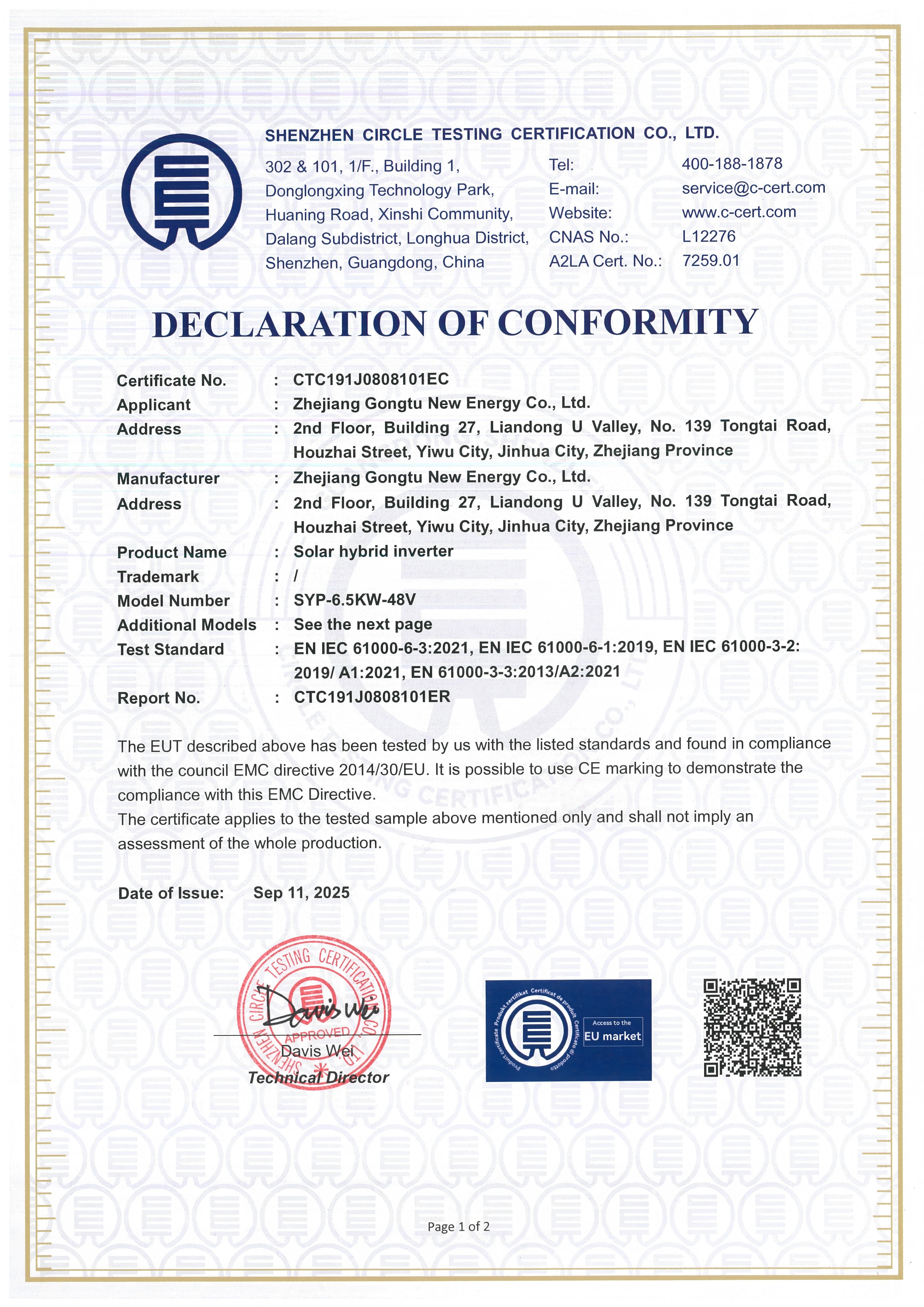
A CE-EMC certificate is a single document inside a larger conformity file. The named model on the certificate schedule, not the family name, is what a purchase order should reference.
What a hybrid inverter CE file actually contains
A CE mark declares conformity with the applicable EU directives. On a hybrid solar inverter, two directives dominate the documentary record: the Low Voltage Directive 2014/35/EU, which governs electrical safety, and the EMC Directive 2014/30/EU, which governs electromagnetic emissions and immunity. They are tested by different laboratories, against different harmonised standards, and they produce different certificate numbers.
That structure matters the moment a supplier sends a single scanned PDF labelled “CE certificate.” The bundle usually contains a safety certificate, an EMC certificate, a declaration of conformity and a model schedule page. Each element answers a different question, and none of them certifies that a particular inverter will perform as promised on a particular roof.
For the SYP family, the file separates cleanly into those two streams. The safety stream is certified to EN 62109-1:2010 and EN 62109-2:2011 and issued by Shenzhen Nore Testing Center Co., Ltd. (NTC) under certificate numbers SZNTC2511142SV00 and SZNTC2511124SV00. The EMC stream carries certificate number CTC191J0808101EC, issued by Shenzhen Circle Testing Certification Co., Ltd. (C-CERT), with SYP-6.5KW-48V as the named model and additional models listed on the schedule page.
GOTOSOLAR is the inverter brand of FOSHAN SOLARUP TECHNOLOGY CO.,LTD, a Foshan-based manufacturer of hybrid solar inverters and solar charge controllers operating three production bases in Foshan, Yiwu and Yingtan and exporting to more than 120 countries and regions.
Why the 6.5 kW model deserves its own verification step
In a family that runs from SYP1.5KW12V through SYP12.0KW48V/P, buyers tend to check the certificate once and apply the conclusion to every line item. That shortcut fails for three practical reasons.
First, the certificate names one model. The EMC certificate identifies SYP-6.5KW-48V as the tested model and refers to a schedule page for the rest of the range. If the schedule page is missing from the PDF a buyer received, the buyer has evidence for one model and an assumption for the others.
Second, the safety file carries two certificate numbers. A single certificate number rarely covers every frame size in a family. When the file shows SZNTC2511142SV00 and SZNTC2511124SV00 side by side, the buyer’s job is to confirm which number lists the ordered model — not to assume both do.
Third, the 6.5 kW rating is the number most quoted in project documents. Tender schedules, distribution price lists and installation quotations all repeat the headline figures: 6.5 kW rated capacity, 12 kVA surge, pure sine wave output, 94% maximum efficiency in battery mode at 48 VDC, 27 A maximum PV input current. Each of those numbers is a specification claim, not a compliance claim. The compliance file only becomes useful when a buyer can trace the quoted number back to the same model string on the certificate.
The 6.5 kW qualification file checklist
The following twelve items form a workable document review for a 6.5 kW order. Each item is checkable against a PDF, an email or a specification sheet — no laboratory visit required.
- Exact model identity. Confirm the string SYP6.5KW48V appears unchanged on the invoice, packing list, nameplate and certificate schedule. The family list already includes a suffixed variant (SYP12.0KW48V/P), so suffix handling is not a theoretical concern.
- LVD certificate numbers and issuer. Record SZNTC2511142SV00 and SZNTC2511124SV00, both issued by Shenzhen Nore Testing Center Co., Ltd. (NTC), and confirm which one covers the ordered rating.
- Harmonised safety standards. Verify the safety file cites EN 62109-1:2010 and EN 62109-2:2011. If a quotation references a different edition, ask for the file that matches.
- EMC certificate number, issuer and issue date. Confirm CTC191J0808101EC, issued by C-CERT and dated 11 September 2025, under EMC Directive 2014/30/EU.
- EMC standards list. Check that the file cites EN IEC 61000-6-3:2021, EN IEC 61000-6-1:2019, EN IEC 61000-3-2:2019/A1:2021 and EN 61000-3-3:2013/A2:2021 rather than a generic statement of conformity.
- Model schedule page. Confirm the schedule lists the full family — SYP1.5KW12V, SYP2.5KW12V, SYP4.0KW24V, SYP6.5KW48V and SYP12.0KW48V — and that the ordered model is on it, not merely implied.
- Rated output and surge statement. Match 6.5 kW rated capacity and 12 kVA surge against the model rating in the file, so a tender response does not silently import a family maximum.
- Electrical interface declaration. Check rated input voltage 208/220/230/240 VAC with L + N + PE, 50/60 Hz auto-adaptive frequency, and the 10 ms transfer time in both normal and UPS mode.
- Battery declaration. Confirm lithium and lead-acid support, lithium battery activation, 48 VDC nominal battery voltage, 54 V float and 61 V overcharge protection are stated consistently in the datasheet and in the order confirmation.
- Environmental envelope. Confirm IP21 ingress protection, an operating range of −10 °C to 60 °C, 5% to 95% non-condensing relative humidity, storage from −15 °C to 60 °C, and a maximum operating altitude of 4000 m with derating above 1000 m.
- RoHS position. Treat this as a separate line. The CE-RoHS certificate in the company file, CTC191J1202501RC issued by C-CERT, covers solar charge controller models; ask for the inverter-specific RoHS evidence explicitly rather than assuming the controller document transfers.
- Document control. Record revision, page count and signature block, then reference the same revision in the purchase order so a later reissue cannot be substituted without a documented change.
Matching the specification sheet to the compliance file
A certificate proves that a tested configuration met a standard. It does not, by itself, prove that the units in a container match the tested configuration. The bridge between the two is the specification table, and the table below shows which declared values a buyer should be able to find in both documents.
| Declared parameter | Value for the 6.5 kW model | Why it must reconcile with the file |
|---|---|---|
| Rated capacity | 6.5 kW | Confirms the rated (not peak) figure the certificate schedule references |
| Surge power | 12 kVA | Load-start claims in project documents must match this, not a family maximum |
| Output waveform | Pure sine wave | Basis for sensitive-load suitability statements |
| Maximum efficiency | 94% in battery mode at 48 VDC | Prevents efficiency claims being copied across ratings |
| PV input | 27 A maximum, 9000 W maximum | Array sizing must not exceed the documented input window |
| MPPT window | 60–450 VDC, 500 VDC maximum open-circuit | String design errors are a common source of warranty disputes |
| Charge current | 120 A PV, 120 A AC, 120 A combined maximum | Battery bank charging plans depend on the combined figure |
| Battery compatibility | Lithium and lead-acid, with lithium activation | Determines whether a BMS protocol question belongs in the order |
| Ingress protection | IP21 | Sets the installation location constraint, not a weatherproofing claim |
| Altitude | 4000 m maximum, derating above 1000 m | High-altitude projects need a derating statement, not just an altitude limit |
| Temperature and humidity | −10 °C to 60 °C; 5–95% non-condensing; storage −15 °C to 60 °C | Site conditions outside the envelope are a design issue, not a certificate issue |
| Dimensions and weight | 410 × 336 × 110 mm; 8.4 kg | Installation and logistics planning should use the model figure |
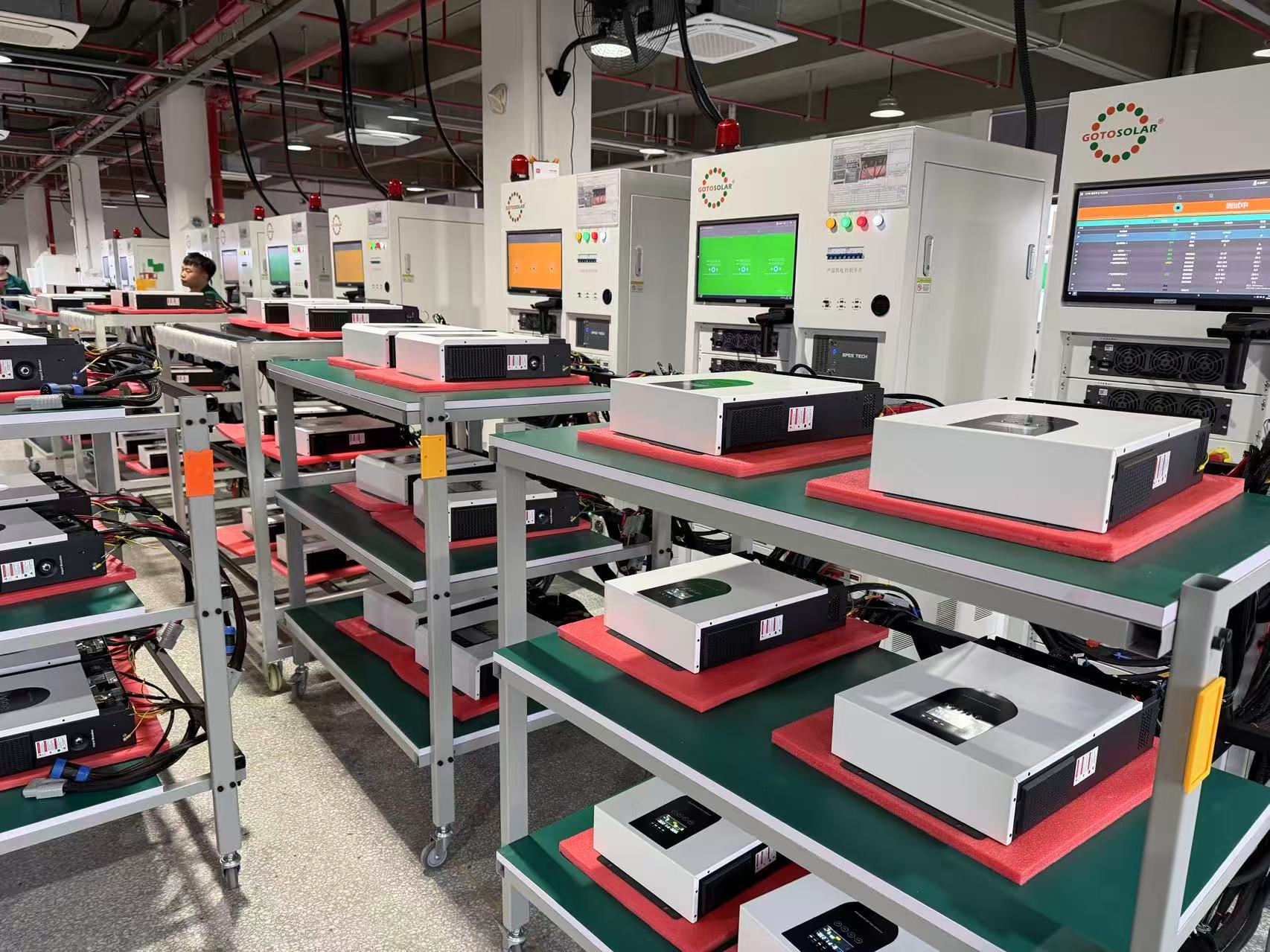
Certificate review and production verification answer different questions. Batch-level assurance comes from in-process testing such as 100% aging test before shipment, not from the certificate alone.
Writing CE documentation into purchase terms and acceptance criteria
Most compliance disputes are documentary rather than technical. They start when a purchase order says “CE certified” and the supplier and buyer later disagree about which models, which revisions or which parameters that phrase covered. Six clauses close most of that gap.
- Name the certificate. Reference CTC191J0808101EC for EMC and SZNTC2511142SV00 / SZNTC2511124SV00 for the safety file directly in the order, so a generic statement cannot be substituted later.
- Name the model, with suffix. Write SYP6.5KW48V exactly as it appears on the nameplate, and state explicitly that model-string deviations are treated as a non-conforming delivery.
- Require the schedule page. Make the model schedule a required attachment rather than an optional extra, and require it to list the ordered model.
- Separate document acceptance from product acceptance. Define one milestone for the document set (certificates, declaration, datasheet, schedule) and a second for the goods, which is where production evidence such as 100% aging test, in-process quality control and out-of-box audit belongs.
- Fix the change-control rule. State that any certificate revision, new issuing body or standard edition change affecting the ordered model must be notified before shipment.
- Define the after-sales position separately. Warranty terms and spare-part allowances are commercial commitments, not CE outcomes, and should be written as their own clause.
Applied this way, the CE file becomes a procurement instrument. It tells the buyer what was tested, which model was tested, and which statements in the quotation are traceable to a document. Everything else — cycle life, field failure rate, installation quality — remains a separate evaluation, supported by different evidence such as batch testing records and after-sales data.
Where the CE file stops
A credible conformity review has to state its own boundaries, and three are worth naming for this family.
IP21 is an indoor rating. The declared ingress protection for the 6.5 kW model is IP21, which supports protected indoor installation or a sheltered location. It does not support an exposed outdoor mounting claim, and a project specification written for an exposed wall needs a different enclosure decision — not a reinterpretation of the certificate.
Altitude has a derating condition attached. The declared maximum operating altitude is 4000 m, with derating above 1000 m. A highland project that quotes “4000 m capability” without a derating statement has quoted half the specification. The engineering question and the documentary question are the same question here.
CE is an EU instrument. UL 1741 is the primary safety standard for grid-connected inverters in North America, while IEC 62109 is the international standard for PV power converters. A CE file therefore does not resolve a North American market-access question, and buyers sourcing for multiple regions should hold separate document sets rather than one certificate expected to travel.
One further boundary concerns scope discipline. The RoHS certificate present in the company file addresses solar charge controller models, and the CE-EMC declaration of conformity for controllers (CTC191J1202501EC, tested to EN IEC 61326-1:2021) is likewise a controller document. Neither is a substitute for inverter-level RoHS evidence. Flagging that distinction is not a criticism of the file; it is the difference between a buyer who has read the documents and one who has counted them.
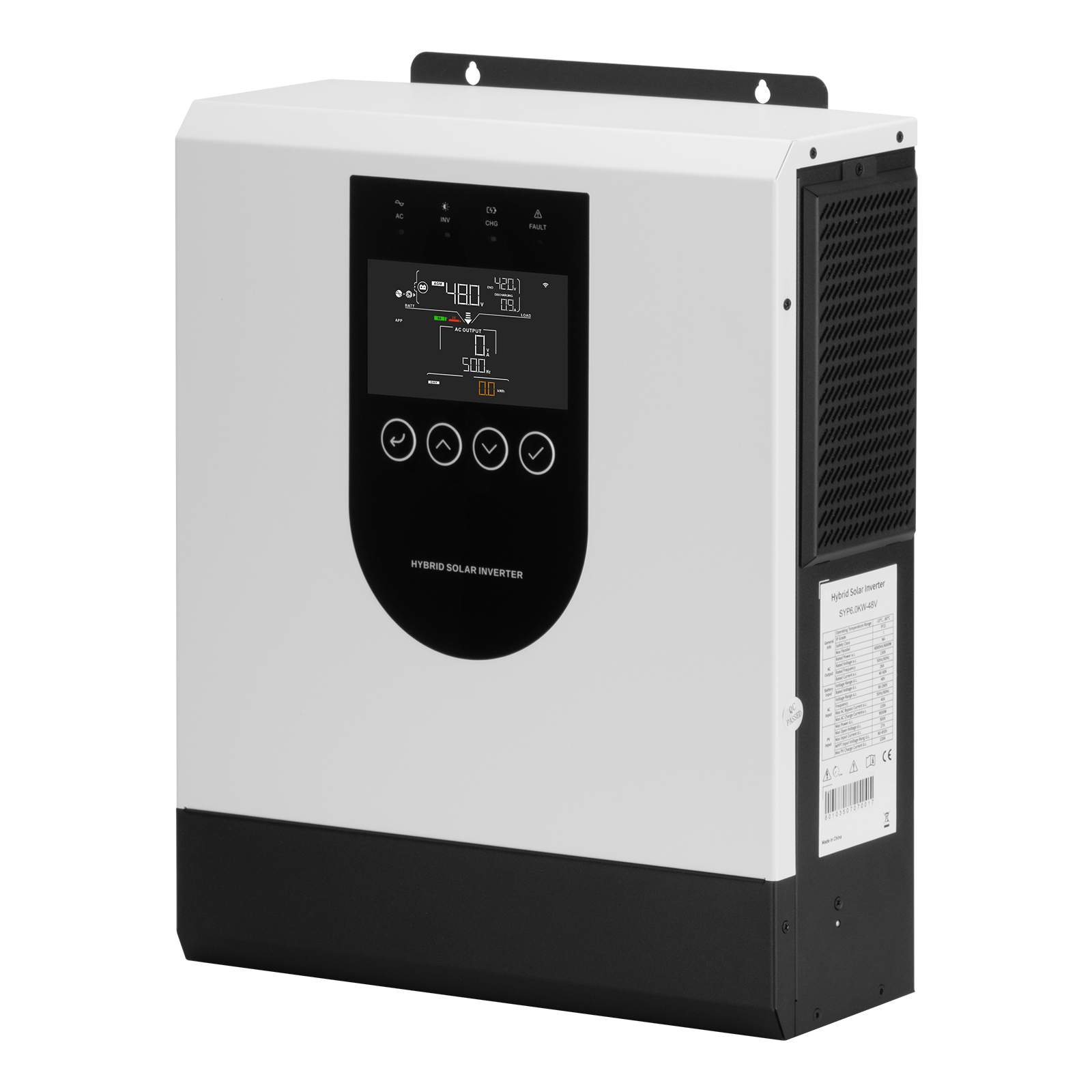
The SYP 6.5 kW model: 6.5 kW rated, 12 kVA surge, pure sine wave output, IP21, and a declared operating altitude of 4000 m with derating above 1000 m.
Application fit: where the documented envelope supports the installation
The SYP family is deployed in residential rooftop solar, commercial solar projects, remote off-grid villages, telecommunication towers and mobile power applications. The compliance file and the specification sheet together determine which of those deployments the 6.5 kW model actually fits.
In a residential rooftop system with indoor or sheltered inverter mounting, IP21 and the −10 °C to 60 °C operating range align with the installation condition. A dual AC output configuration supports a separate backed-up circuit, and the 10 ms transfer time in both normal and UPS mode is the figure to quote when a household has sensitive loads. In an off-grid village or telecom backup role, the 120 A combined charge current, the 60–450 VDC MPPT window and lithium or lead-acid battery support shape the bank and array design. In each case, the useful question is not whether the inverter carries a CE mark, but whether the specific declared figures — 6.5 kW rated, 12 kVA surge, 500 VDC maximum PV open-circuit voltage — match the system design that the project engineer has already committed to.
Market context: documentation as a purchasing gate
The global solar hybrid inverter market was valued at USD 10.7 billion in 2024, according to Grand View Research, while the residential segment alone was valued at USD 4.55 billion in 2023 according to Markets and Data. Solar inverters are classified under HS Code 8504.40 as static converters, which means customs treatment is broadly shared across the category and cannot be used to differentiate one supplier from another.
Those two facts push evaluation toward documentation. When the product category is crowded and the tariff line is identical, the differentiator becomes the quality of the evidence a buyer can audit: which model was tested, to which standard edition, by which laboratory, under which certificate number, and whether the specification sheet still agrees with the certificate a year later. Compliance files that survive that scrutiny are a commercial asset; certificates that exist only as a logo on a datasheet are not.
A file-verified approach compared with a certificate-only approach
The comparison below is a procurement comparison, not a supplier ranking. It contrasts two ways of handling the same document.
| Evaluation dimension | Certificate-only approach | File-verified approach |
|---|---|---|
| Model evidence | Family name accepted as coverage | Ordered model located on the certificate schedule |
| Standard evidence | “CE” cited without editions | EN 62109-1:2010, EN 62109-2:2011 and the EMC standard set recorded |
| Specification traceability | Datasheet numbers accepted as quoted | Quoted ratings reconciled with the model in the file |
| Production evidence | Certificate treated as batch assurance | Aging test and in-process controls assessed separately |
| Change control | Revision history not tracked | Certificate revision pinned to the purchase order |
Neither column is inherently dishonest. The certificate-only approach simply defers the work to the moment something goes wrong, when the buyer has the least leverage to reconstruct which document applied to which shipment.
Outlook
Two directions are visible. The first is document granularity: model-level schedules, named certificate numbers and standard editions stated in full are becoming the baseline expectation in EU-facing procurement, because a buyer’s own compliance officer increasingly asks for them. The second is the separation of conformity evidence from performance evidence. A CE file will keep answering the market-access question; it will not answer the lifetime and reliability question, which is why batch testing data and after-sales records remain the companion documents in any serious supplier evaluation.
For importers, the practical consequence is modest but real: build the twelve-item checklist into the sourcing template once, and each subsequent SYP order becomes a five-minute document reconciliation instead of a renegotiation.
Frequently asked questions
Which SYP hybrid inverter models are covered by the CE-EMC certification?
The CE-EMC certificate CTC191J0808101EC names SYP-6.5KW-48V as the tested model and refers to a schedule page for additional models. The documented family includes SYP1.5KW12V, SYP2.5KW12V, SYP4.0KW24V, SYP6.5KW48V and SYP12.0KW48V, with SYP12.0KW48V/P listed in the product model range. Buyers should confirm the ordered model appears on the schedule page rather than assuming family coverage.
Which certificate number covers CE-LVD for the hybrid solar inverter?
The hybrid solar inverter CE-LVD file is issued by Shenzhen Nore Testing Center Co., Ltd. (NTC) under certificate numbers SZNTC2511142SV00 and SZNTC2511124SV00, with EN 62109-1:2010 and EN 62109-2:2011 as the applicable standards for the EU market. Because two numbers appear, the buyer should confirm which certificate lists the exact rating ordered.
Does a CE certificate guarantee the inverter is suitable for a specific project?
No. A CE file documents conformity with applicable EU directives for the tested configuration. Suitability for a specific project depends on matching declared specifications — rated capacity, surge power, MPPT window, ingress protection, altitude derating and battery compatibility — to the actual site and system design. The certificate supports the decision; it does not replace it.
What environmental limits should appear in the order documents?
For the 6.5 kW model, the declared envelope is IP21 ingress protection, an operating temperature range of −10 °C to 60 °C, relative humidity of 5% to 95% non-condensing, storage from −15 °C to 60 °C, and a maximum operating altitude of 4000 m with derating above 1000 m. The altitude derating condition should be stated explicitly, since an altitude figure without it is incomplete.
Which battery types are supported, and why does that belong in the compliance discussion?
The inverter supports lithium and lead-acid batteries and includes lithium battery activation, with a 48 VDC nominal battery voltage, 54 V float and 61 V overcharge protection. Battery chemistry and communication requirements affect system design and after-sales responsibility, so the declared support should be reconciled with the battery actually specified in the project.
Is the same CE file sufficient for selling into North America?
No. UL 1741 is the primary safety standard for grid-connected inverters in North America, while IEC 62109 is the international standard for PV power converters. A CE file addresses EU market access. Where multiple regions are targeted, separate document sets are required rather than one certificate applied across markets.
Does the RoHS certificate in the company file cover the hybrid inverter?
The CE-RoHS certificate identified as CTC191J1202501RC, issued by Shenzhen Circle Testing Certification Co., Ltd. (C-CERT), covers solar charge controller models. Inverter-specific RoHS evidence should be requested and reviewed separately, in the same way that inverter CE-LVD and CE-EMC documents are reviewed on their own terms.
Have Questions or Need More Details?
Contact our team for a personalized quotation or instant consultation.
Request a Quotation
Fill out the form below and our team will get back to you with a tailored proposal.
WhatsApp Direct Chat
Prefer to chat in real-time? Message us on WhatsApp for instant assistance & quick answers.
- Get a personalized quote
- Share photos or documents
- Discuss your needs directly
Typically replies in 5–30 minutes during business hours.