
CE Marking and Operational Safety: Acaleph-891S-i in UV Single Pass Production
Industrial Reference · Packaging & Printing
A CE mark on an industrial single pass printer is a legal declaration, not a decorative badge. The directives behind it, and the structural evidence that supports continuous shift work, are two halves of the same procurement question.
Industrial single-pass printers placed on the European market must comply with the Low Voltage Directive (2014/35/EU) and the EMC Directive before the CE mark can be affixed. The manufacturer is responsible for the technical file, the risk assessment and the test evidence that sit behind that declaration — not the local dealer who delivers the machine.
For packaging converters, however, the compliance question and the durability question converge. A UV single pass printer that passes electrical safety testing in a laboratory but drifts out of registration after a few thousand hours of round-the-clock production is not safe in any commercially useful sense. The components that carry mechanical risk — the main frame, the print beam, the linear guide rails, the media transport belt and the UV curing module — are the same components that decide whether the machine holds tolerance over time.
This article takes the Acaleph-891S-i, an industrial UV single pass printer from Focus Inc. (Shanghai Focus Industrial Co., Ltd.), as a reference case. Focus Inc. is a Shanghai-based industrial digital printing equipment manufacturer founded in 2008, operating a 35,000 m² factory and exporting to the EU, USA, Mexico, Brazil, Chile, Australia, Canada and the UK. The Acaleph-891S-i is documented at component level for frame, beam and rail materials, which makes it a practical example of how a supplier’s structural claims can be converted into verifiable qualification criteria.
Why CE Marking Is an Operational Question for UV Single Pass Printing
CE marking for an industrial single-pass printer typically rests on two directive families: the Low Voltage Directive (2014/35/EU), which covers electrical safety of equipment operating within defined voltage ranges, and the EMC Directive, which governs electromagnetic emissions and immunity. A UV single pass printer is a complex load in both senses. It combines a high-current single-phase supply, a moving carriage, a UV LED curing module with its own power and cooling circuit, a vacuum system and a PLC-based control architecture.
The Acaleph-891S-i specification reflects that complexity directly. The machine is rated at 42 A single-phase 220–240 VAC, 50/60 Hz. Its curing system is a 405 nm LED UV array with sectional curing and water circulation cooling. Its media vacuum system draws 850 W across four independent zones, each controlled from the touch screen. These are not accessories bolted onto a printer; they are the machine’s electrical and thermal duty cycle.
That matters to a buyer in two ways. First, the facility must be able to supply the load and to dissipate the heat. Second, the compliance documentation should cover the machine as configured and delivered. Buyers evaluating a UV single pass printer for a European packaging line should therefore ask three specific questions rather than one general one:
- Which directives were applied, and is a Declaration of Conformity supplied that names them explicitly?
- Does the technical file include a documented risk assessment covering the curing module, the moving carriage, the ink supply and the feed system?
- Is there test evidence for electrical safety and EMC, and can third-party inspection be arranged if the buyer requires an independent review?
Focus Inc.’s stated quality-control process for custom configurations includes a 100% continuous running aging test before delivery and full function verification, with SGS/CE third-party inspection supported on request. That is a supplier statement about process, not a certificate of product conformity — the distinction matters, and buyers should treat it as one input into qualification rather than a substitute for the technical file.
What Continuous Shift Work Demands From Machine Structure
The operating condition that separates an industrial UV single pass printer from a prototyping device is continuous duty. Focus Inc. specifies operation for this class of equipment in a conventional dust-controlled workshop under 24-hour uninterrupted conditions at normal indoor temperature, with continuous feeding and no shutdown between jobs. That condition has physical consequences that no datasheet headline captures.
Four mechanisms dominate:
Vibration and deflection. A carriage moving across a beam at production speed generates cyclic loads. If the beam deflects measurably across its span, dot placement at the far end of the print area drifts relative to the near end. Frame and beam stiffness is therefore a print-quality variable, not a cosmetic one.
Wear on linear motion. The X and Y guide rails accumulate travel continuously. Rail hardness and surface treatment determine how long the machine holds positioning accuracy before adjustment or replacement.
Thermal cycling. UV LED curing introduces heat into a system that must also hold an 18–30 °C working range. Curing stability and cooling capacity are directly linked to colour consistency across a long run.
Media tracking. Belts and correction rollers that grip and align substrates absorb constant friction. Inconsistent tracking produces edge damage, misregistration and, in the worst case, media contact with the print head.
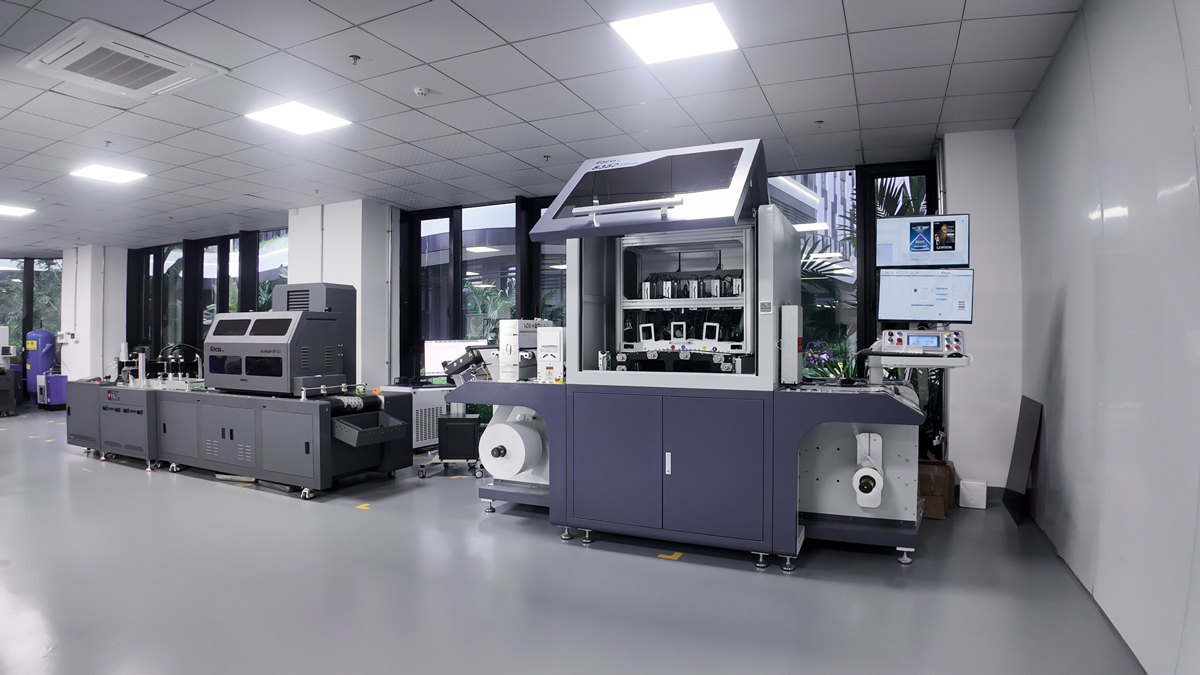
Industrial UV single pass printing is a continuous-duty application: frame stiffness, guide-rail hardness and curing stability determine whether registration holds across a full production shift.
For a converter, these four mechanisms translate into a single qualification question: what has the manufacturer specified, at material level, to control them?
Inside the Acaleph-891S-i: Frame, Beam and Materials
The Acaleph-891S-i is an industrial-grade UV single pass printer designed for special-demand materials and high-speed inline work. Its effective print area spans 53 mm to 500 mm depending on print head quantity, and it accepts SEIKO RC1536/2560, RICOH G5/G6, XAAR 2002 and TOSHIBA CF3/CF6 print head configurations. Print speed is specified at 10–40 m/min depending on print mode and ink type, at resolutions of 600×300, 600×600 and 600×1200 dpi. Media including bags, carton, plastic, glass, ceramic and metal can be handled at a maximum load width of 600 mm with unlimited length and up to 300 mm thickness.
What makes the platform useful as a structural reference is that the material specification is published component by component. The table below reproduces the documented construction.
| Component | Documented material |
|---|---|
| Print beam | High-strength extruded aluminium alloy |
| Main machine frame | Thickened welded carbon steel |
| Print head assembly | Heat-resistant industrial plastic + precision alloy metal parts |
| X / Y linear guide rail | High-hardness steel |
| Conveyor belt | Anti-offset PU / TPU / PET / PP rubber |
| Correction roller | Stainless steel with silicone coating |
| Ink tank & ink stack | Anti-corrosion modified PP plastic |
| Printhead protective cover | Aluminium alloy |
| Side wing & outer housing | Galvanised steel sheet |
| Drive motor shell | Cast aluminium alloy |
| Transmission gear | Quenched alloy steel |
| Ink pipeline | Fluorine rubber |
| Touch screen shell | Impact-resistant ABS plastic |
The same material specification family appears across Focus Inc.’s single pass printer range — including corrugated and cardboard configurations such as the Cobra-691S and Cobra-1815S, the Cobra-691S Max single pass packaging printer, and roll-to-roll label platforms such as the Viper-391S and the Nexus-350J all-in-one label system. A buyer comparing a single pass printer for corrugated printing against a single pass printer for cardboard or a roll to roll single pass label printer can therefore use the same material checklist across formats, which is more useful than comparing headline speeds across different machine classes.
How Structural Choices Map to Stability and Safety
Material specifications only matter if they can be connected to behaviour. The following explanation sets out the engineering logic behind each documented choice. It is an interpretation of the specification, not an additional claim about the machine.
The print beam: stiffness against inertia
Extruded aluminium alloy gives a high stiffness-to-mass ratio. A lighter beam reduces the inertial load the X-axis drive must accelerate and decelerate each cycle, while extruded profile geometry maintains rigidity across the beam length. The practical effect is that dot placement stays consistent from one side of the print area to the other during long runs — the structural precondition for registration stability at 10–40 m/min.
The main frame: mass as damping
A thickened welded carbon steel frame provides the mass and stiffness needed to resist deflection over a 3,752 mm machine length and to absorb vibration rather than transmit it. In a 1,510 kg machine (main printer with UV system), the frame is also what keeps the gantry, the conveyor and the curing module in fixed relationship to one another as the machine heats and cools across a shift.
Guide rails, gears and rollers: wear over millions of cycles
The X/Y linear guide rails are specified as high-hardness steel, and the transmission gears as quenched alloy steel. Both choices target the same problem: dimensional change through wear. The correction roller, specified as stainless steel with a silicone coating, addresses media handling — the coating reduces adhesion and marking while the substrate is being aligned. The conveyor belt is specified as anti-offset PU/TPU/PET/PP rubber, which is the material-level answer to the belt-tracking problem described earlier.
Vacuum, curing and thermal control
The media vacuum system is rated at 850 W across four independent zones. Zone control matters because thin films, flexible bags and curled board edges need different holding force; excessive vacuum deforms light substrates, insufficient vacuum lets them lift toward the print head. The head anti-scratch kit and the aluminium alloy printhead protective cover are the protective layer if contact does occur. Curing is handled by 405 nm LED UV in a sectional configuration, with water circulation cooling — a design that keeps the curing dose stable without letting heat build up in a machine that must operate between 18 and 30 °C.
Operator-facing and site-facing factors
Three measurable operating characteristics are relevant to a workplace safety assessment. Acoustic noise is specified at 75 dB(A) or less. Working humidity is specified at 35–75%, with working temperature at 18–30 °C (51–86 °F). Where plasma, flame or corona pretreatment is used to raise surface energy on low-ink-absorbing materials, the site must supply compressed air at a minimum of 80 psi / 6 bar with 60 L volume per plasma unit. Each of these is a facility requirement that a buyer should validate before ordering, because they affect installation, ventilation and electrical planning rather than print quality alone.
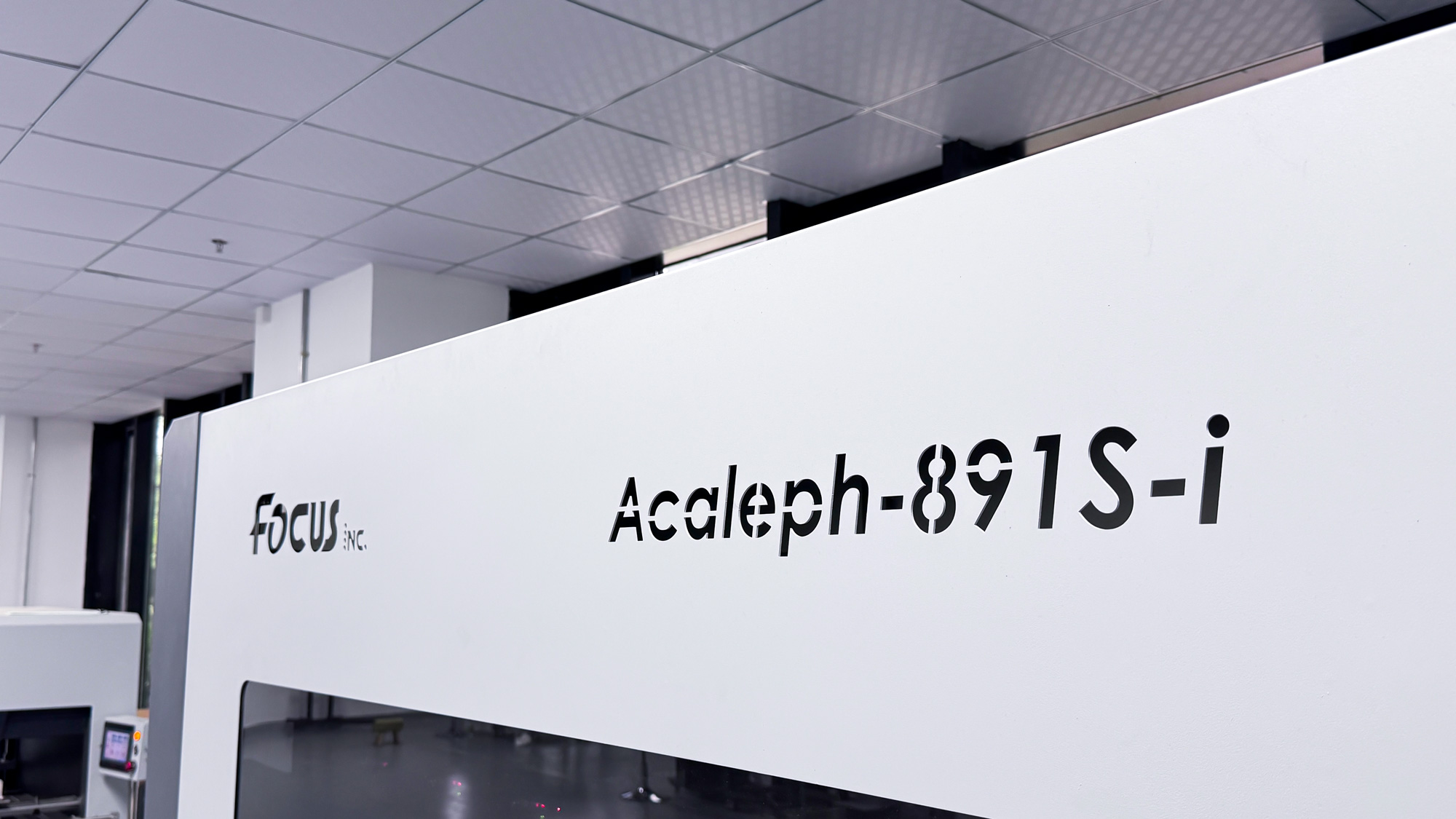
Sheet metal components produced by laser cutting and welding: assembly precision in the frame and housing is what keeps gantry, conveyor and curing module in fixed relationship over long production runs.
A Qualification Checklist for Packaging Buyers
The following checklist converts the discussion above into questions a buyer can put to any supplier during the evaluation stage. The right-hand column shows the reference point documented for the Acaleph-891S-i.
| What to verify | What credible evidence looks like | Acaleph-891S-i reference point |
|---|---|---|
| Applicable directives | Declaration of Conformity naming the directives applied, plus a technical file and risk assessment | Machine class falls under the Low Voltage Directive (2014/35/EU) and the EMC Directive for EU placement |
| Electrical architecture | Stated supply, current draw and protection design; confirmation the site circuit matches | 42 A, single-phase 220–240 VAC, 50/60 Hz |
| Structural specification | Component-level bill of materials for frame, beam, rails and transport | Extruded aluminium alloy beam; thickened welded carbon steel frame; high-hardness steel linear guides; anti-offset PU/TPU/PET/PP belt |
| Pre-shipment testing | Recorded running/aging test, function verification, option for independent inspection | Focus Inc. states 100% continuous running aging test before delivery; SGS/CE third-party inspection supported |
| Media control | Vacuum zoning detail, belt type, alignment method | 850 W vacuum across four independent zones; 4–6 pcs automatic laser guideline margin |
| Curing and thermal management | Wavelength, curing mode, cooling method, operating temperature window | 405 nm LED UV, sectional curing, water circulation cooling; 18–30 °C working range |
| Pretreatment dependency | Whether plasma, flame or corona is required for the target substrate, and the utility demand | Plasma / flame / corona as required; compressed air min. 80 psi (6 bar), 60 L volume per plasma unit |
| Noise exposure | Declared sound pressure level for the workplace assessment | 75 dB(A) or less |
| Format envelope | Effective print width, load width, maximum thickness | 53–500 mm effective print width depending on head quantity; 600 mm max load width; 300 mm max thickness |
Where the Acaleph-891S-i Fits: Application Scenarios
The Acaleph-891S-i is specified for industrial special-demand materials, PVC sheet and panel manufacturing, and non-woven bag production. Those categories are broad, so it is worth looking at the documented deployment scenarios rather than the labels.
Rigid decorative and industrial panels
Focus Inc. deployment records include multi-unit installations at PVC decorative panel and building-material producers in Portugal, Spain, Mexico and Poland, and at decorative-material manufacturers in Turkey and Portugal printing wood grain, stone grain and custom textures onto blank quartz, marble countertops, plaster mouldings and skirting boards. In these scenarios the machine is used for on-demand pattern printing with no minimum order quantity, which removes the inventory burden of stocking multiple decorative specifications. For a converter, the compliance-relevant point is that the machine’s 300 mm thickness capacity and up to 500 mm effective print width define the panel formats it can address — this is a profile and panel printer, not a wide-format board press.
Non-woven bags and flexible packaging
The platform is also used with air vacuum feeders for softer substrates. A documented installation in Brazil covers non-woven and takeout bag production, with the operational requirement that soft material be held without indentation or scratching at production speed. This is where the plasma pretreatment module and the deviation-correction feed system become safety- and quality-relevant rather than optional: ink adhesion on low-ink-absorbing surfaces depends on them, and compressed-air capacity becomes a hard site requirement.
Reflective and security printing
One of the associated application profiles is reflective signage and vehicle sticker production, where the substrate is high-reflection, smooth and low-ink-absorbing. The documented requirement in that scenario is anti-counterfeit enhanced printing — fine line texture, invisible UV hidden pattern, variable QR code and serial number marking — on reflective labels for vehicle inspection. This application is a useful reference point for buyers because it combines two demands that usually separate: variable-data handling and high-precision dot control on a difficult surface.
Book edge and notebook side printing
UV single pass platforms in this family are also deployed for book edge and notebook side printing, where a jig positions the block and the machine prints the trimmed edge in a single pass. Documented installations include book and notebook manufacturers in Spain and the Philippines, with capacity noted in the range of thousands of book edges per hour in that application. The relevance to a compliance discussion is that fixtures and jigs change the risk profile of the load: the operator is handling a defined block rather than loose media, which simplifies guarding and positioning.
Market Context: Why Qualification Discipline Is Becoming More Important
The demand side of this category continues to expand. The global digital printing for packaging market was valued at USD 31.64 billion in 2023 and is projected to reach USD 75.55 billion by 2032, according to Zion Market Research. Within the digital printer market, the inkjet segment accounted for the largest share at 42.5% as of 2025, per Straits Research. On the substrate side, China produced more than 88 billion square metres of corrugated board in 2024, according to China Packaging Federation data reported by Dataintelo — a scale that explains why corrugated and carton printing absorbs so much of the equipment demand in this sector.
Those figures should be read with appropriate caution. Published forecasts for the 2032 digital packaging printing market diverge substantially: alongside the USD 75.55 billion projection, other research houses publish figures of roughly USD 62.75 billion and USD 27.44 billion for the same horizon. The methodological spread is wide enough that the direction of travel — sustained growth — is more reliable than any single number.
Speed claims in this category deserve the same treatment. Third-party industry sources describe single-pass production speeds of 30–80 m/min for paper bag printing, while the Acaleph-891S-i is specified at 10–40 m/min depending on print mode and ink type. The gap is not a contradiction; it reflects configuration, resolution and substrate. Buyers comparing machines should always ask which print mode a quoted speed refers to, and whether the figure was measured at production resolution on the target substrate.
Where Single Pass Digital Printing Stops Being the Right Answer
A qualification guide that only lists advantages is not usable. There are real boundaries, and buyers should test their requirements against them before committing.
Against traditional flexo, offset and screen printing
Plate-based processes still win on very long runs of a stable design, where the fixed cost of plates is amortised across high volume, and where spot colours outside the digital gamut are essential. Digital single pass printing replaces that model with variable data, no plate-making, job switching without tooling, and economical short and mid runs. For a machine configured with primer, black, cyan, magenta, yellow plus spot white and gloss, the colour scope is defined by that ink set — buyers with demanding brand-colour or metallics requirements should confirm the achievable gamut before treating digital as a direct replacement.
Documented limits of the Acaleph-891S-i
- Format envelope. Effective print width is 53–500 mm depending on print head quantity, with a maximum load width of 600 mm. Applications requiring wider print coverage need a different configuration or machine class.
- Substrate conditioning. Low-ink-absorbing materials such as coated board, plastic film, glass or metal generally require plasma, flame or corona pretreatment, which introduces a compressed-air demand of at least 80 psi / 6 bar and 60 L per plasma unit.
- Electrical and environmental footprint. A 42 A single-phase supply, a water-cooled UV curing circuit and a 35–75% humidity window are installation constraints, not details. Sites that cannot meet them should not treat the machine as a plug-and-play unit.
- UV ink handling. UV-curing chemistry requires appropriate operator protection, handling procedures and waste management. This is a process obligation that sits with the converter, and it applies to any UV single pass printer regardless of brand.
- Construction is not conformity. A well-specified frame and beam are evidence of build quality. They are not evidence of CE conformity. Compliance has to be demonstrated separately, through a Declaration of Conformity, a technical file and test evidence covering the machine as delivered.
Future Outlook
Three shifts look likely to shape how buyers qualify UV single pass printers over the next procurement cycles.
First, documentation will move up the evaluation list. As variable-data and traceability requirements expand into packaging, converters are increasingly audited by their own customers on how equipment was qualified. A supplier that can produce a component-level bill of materials, a running-test record and a conformity file in a single package will be easier to onboard than one that cannot.
Second, thermal and energy design will become a purchasing criterion rather than an engineering footnote. LED UV curing at 405 nm with water cooling is already the mainstream approach in this class; the differentiator is how stably the system holds curing dose across a long shift, because that determines colour consistency, which determines waste rates.
Third, structural specification will keep migrating from marketing language into procurement language. Statements such as “extruded aluminium alloy print beam” or “thickened welded carbon steel frame” are only useful if they can be tested against alternatives. The practical implication for buyers is straightforward: ask every supplier for the same component list, in the same format, and compare. The answers are more informative than any speed headline.
Frequently Asked Questions
What does CE marking actually require for an industrial UV single pass printer?
Industrial single-pass printers placed on the EU market must comply with the Low Voltage Directive (2014/35/EU) and the EMC Directive before the CE mark is affixed. In practice this means the manufacturer prepares a risk assessment and technical file, applies the relevant harmonised standards, arranges the necessary testing, and issues a Declaration of Conformity covering the machine as configured and delivered. For buyers, the useful artefacts are the Declaration of Conformity, the technical file and the test evidence — not the mark itself.
How can a buyer verify structural integrity claims before purchase?
Ask for a component-level bill of materials rather than an adjective. For the Acaleph-891S-i, the documented specification names a high-strength extruded aluminium alloy print beam, a thickened welded carbon steel main frame, high-hardness steel X/Y linear guide rails, an anti-offset PU/TPU/PET/PP rubber conveyor belt, and a stainless steel correction roller with silicone coating. Alongside the materials, ask for pre-shipment test records; Focus Inc. states that its process includes a 100% continuous running aging test before delivery with full function verification, and that third-party SGS/CE inspection can be arranged on request.
What site conditions are needed to run a UV single pass printer across continuous shifts?
For the Acaleph-891S-i, the documented requirements are a working temperature of 18–30 °C (51–86 °F) and working humidity of 35–75%, in a conventional dust-controlled workshop suitable for 24-hour uninterrupted operation. The electrical supply is 42 A single-phase 220–240 VAC at 50/60 Hz. Where plasma, flame or corona pretreatment is required for the substrate, the site must supply compressed air at a minimum of 80 psi (6 bar) with 60 L volume per plasma unit. Declared acoustic noise is 75 dB(A) or less, which is relevant to the workplace noise assessment.
How does a digital single pass printer compare with flexo or offset printing on compliance-relevant factors?
The two approaches carry different obligations rather than different amounts of obligation. Plate-based processes concentrate effort in plate production, ink formulation and press setup. Digital single pass printing removes plate-making and supports variable data directly, but introduces ink chemistry and substrate pretreatment requirements: the Acaleph-891S-i accepts UV curing ink or aqueous ink, applies primer, process colours plus spot white and gloss, and can require plasma, flame or corona pretreatment depending on the material. For costing and comparison purposes, ink consumption in colour inkjet systems is standardised under ISO/IEC 24711 and ISO/IEC 24712, which provides a consistent basis for supplier-reported yield figures.
What are the practical limits of a machine like the Acaleph-891S-i?
Documented limits define the fit. Effective print width is 53–500 mm depending on print head quantity, with a maximum load width of 600 mm and a maximum media thickness of 300 mm. Print speed is 10–40 m/min depending on print mode and ink type, at resolutions from 600×300 to 600×1200 dpi. Substrates with low ink absorption generally require pretreatment, which adds a compressed-air demand. And the machine’s conformity status must be evidenced separately by documentation — structural build quality and regulatory conformity are related but distinct, and neither substitutes for the other.
Have Questions or Need More Details?
Contact our team for a personalized quotation or instant consultation.
Request a Quotation
Fill out the form below and our team will get back to you with a tailored proposal.
WhatsApp Direct Chat
Prefer to chat in real-time? Message us on WhatsApp for instant assistance & quick answers.
- Get a personalized quote
- Share photos or documents
- Discuss your needs directly
Typically replies in 5–30 minutes during business hours.