
CE, TUV, SAA Wall Switch Shortlist for 10A and LED Projects
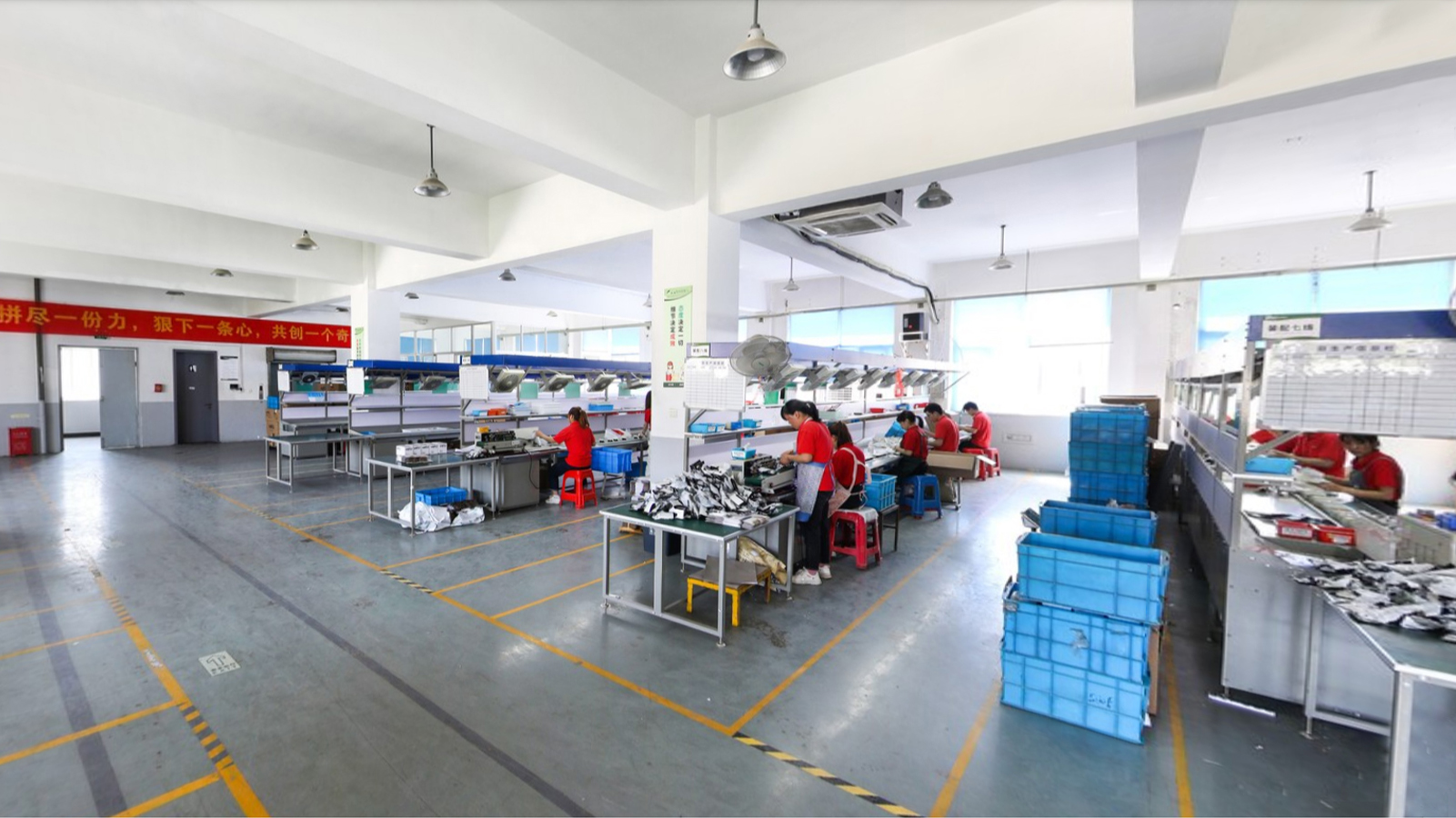
Certification-driven wall switch sourcing starts on the shop floor, where material, insulation and mechanical endurance are controlled before any certificate is issued.
The most practical way to shortlist a wall switch for a 10A lighting project is not to start with a brand list, but with three filters that can be read directly off a datasheet: the function the circuit needs, the certification the destination market requires, and the load the switch is rated to carry. Certification bodies do not issue approvals for a brand name in general; they issue them for defined models, against defined standards, for defined markets.
That distinction matters in procurement. A buyer comparing wall switch options for a European residential build, an Australian power outlet, or a hotel refurbishment with LED indicators is usually not choosing between reputations. They are checking whether a specific model number is covered by a specific certificate, whether the panel and base materials match the installation environment, and whether the mechanical rating survives the switching frequency the project implies.
This shortlist is organised on that basis. It groups 1 gang 1 way, 2 gang 2 way with LED indicator, push bell with LED indicator, intermediate switch, and 10A single powerpoint options by function, certification and load, using documented product data from Wenzhou Huafeng Electric Co., Ltd. (HYFF), an architectural electrical manufacturer established in 2011 in Wenzhou, China, producing wall switches and wall sockets and exporting 100% of its output to markets including the EU, the Americas, Oceania, Asia and Africa.
Why Certification and Rated Load Come Before Brand in 10A Wall Switch Sourcing
Two standards do most of the work in the markets where 10A wall switches are most actively specified. In the European Union, EN 60669-1:2018 is the mandatory safety standard for manual switches used in household fixed installations. In Australia and New Zealand, AS/NZS 3133:2020 — the approval and test specification for air-break switches — is the primary technical standard for wall switches.
Australia adds a wiring-layer requirement on top of the product standard. Under AS/NZS 3000:2018 Clause 4.6.3.1, every socket-outlet must be individually controlled by a separate switch operating in all active conductors. For projects using a 10A single powerpoint, that means the switch is not a decorative accessory; it is a compliance item with its own verification path.
Demand-side scale explains why this category stays crowded and why filtering is necessary. The global light switches and electrical sockets market was valued at approximately USD 17.6 billion in 2024, and Asia Pacific accounted for a 42.5% revenue share of the global electrical switch market in 2025. With that many suppliers competing for the same specification slots, certification evidence becomes the fastest way to reduce the field.
Selection rule used in this shortlist: a model is included only where its rating, panel and base material, installation method and certification field are stated in the product data. Brand preference is not used as an inclusion criterion.
Shortlist by Function: Certified Wall Switch Options for 10A and LED Projects
The table below groups the range by electrical function rather than by catalogue section. Each row states the rated value, the certification on record for that model, and the physical format, because format frequently eliminates a candidate before certification is even examined.
| Function | Model | Rated value | Certification on record | Panel / base and format |
|---|---|---|---|---|
| 1 gang 1 way | H111 | 10A, 220–250V~ | CE; TÜV Rheinland safety certification R 50714462 0001 (EN 60669-1:2018) | 86×86 mm flame retardant PC panel, high strength PA base, flush mounted |
| 1 gang 1 way, compact | B111 | 10AX, 250V~ | CE | 65×65 mm PC panel, ABS plastic base, surface mounted |
| 1 gang 1 way, slim panel | M111 | 10AX, 250V~ | CE / RoHS | 74×83 mm flame retardant PC panel, PA66 base, 6.5 mm ultra-slim frameless panel, flush mounted |
| 1 gang 1 way, surface | S111 | 10A, 220–250V~ | CE | 68×68 mm flame retardant PC panel, surface mounted |
| 2 gang 2 way with LED indicator | V122N | 10A, 220–250V~ | CE; TÜV Rheinland safety certification R 50714462 0001 (EN 60669-1:2018) | 86×86 mm flame retardant PC panel, high strength PA base, flush mounted |
| 2 gang 2 way | A122 | 10A, 250V~ | CE, TUV | 81.6×81.6 mm flame retardant PC panel and PC base, brass terminals, flush mounted |
| Push bell with LED indicator | HG110NB | 10A, 220–250V~ | CE, TUV | 86×86 mm tempered glass panel, high strength PA base, flush mounted |
| Intermediate switch | KM141S | 10A, 220–250V | CE, RoHS | 22×49 mm small-size modular, flame retardant PC shell, flush mounted |
| 10A single powerpoint | HT213 | 10A, 250V~ | SAA | 80×120 mm flame retardant PC panel, PC base, flush mounted |
Ratings, materials and certification fields as stated in the product data for each model. Certification applies to the models listed and to the markets indicated by the issuing body.
1 gang 1 way options
H111 is the reference model where both CE and TÜV evidence are required on a single-gang circuit. Its TÜV Rheinland safety certification is issued by TÜV Rheinland LGA Products GmbH under certificate number R 50714462 0001, applies to the EU market, and is based on EN 60669-1:2018. The same product also appears under ISO 9001 certification, issued by Xingyuan Certification Center Co., Ltd. under certificate number 0350225Q30335R0S.
Where the installation is surface mounted rather than recessed, B111 and S111 cover the same single-gang function with 65×65 mm and 68×68 mm panels respectively, both rated 10AX 250V~ and 10A 220–250V~, both carrying CE. B111 uses an ABS plastic base, while S111 uses a flame retardant PC panel. M111 addresses the same function with a 6.5 mm ultra-slim frameless panel, a PA66 base, and CE / RoHS certification.
2 gang 2 way with LED indicator
V122N is the model most directly aimed at LED-indicator projects: a 2 gang 2 way switch at 10A, 220–250V~, with an 86×86 mm flame retardant PC panel and a high strength PA base. It is named in the TÜV Rheinland certificate R 50714462 0001 model list, meaning the EN 60669-1:2018 approval covers this specific configuration rather than only the series as a whole.
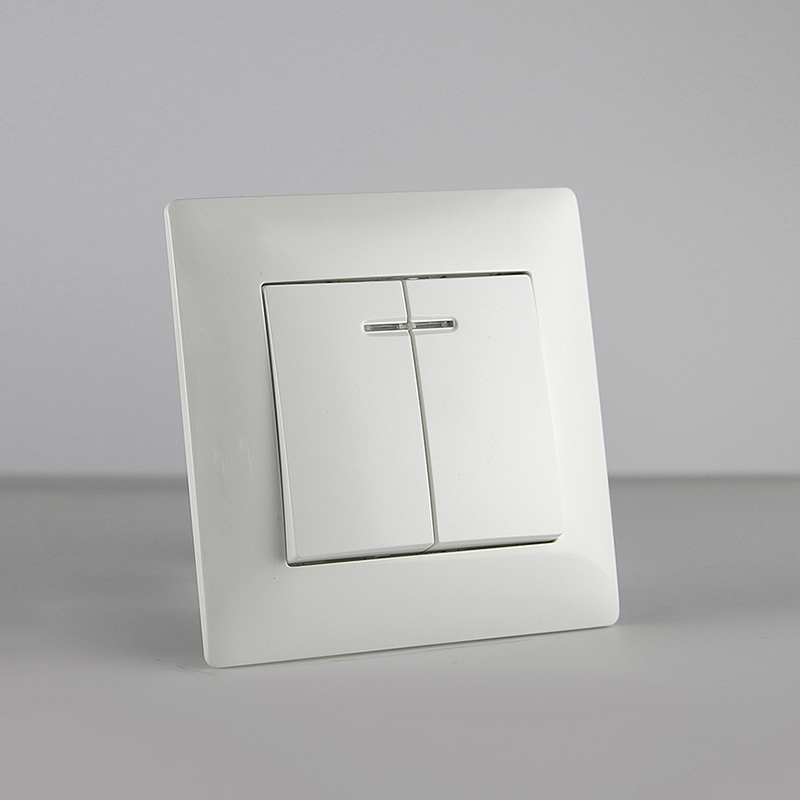
V122N: 2 gang 2 way with LED indicator, 86×86 mm flame retardant PC panel, 10A 220–250V~, covered by TÜV Rheinland certificate R 50714462 0001.
A122 is the alternative for buyers who prioritise conductive hardware. It is rated 10A 250V~ on an 81.6×81.6 mm flame retardant PC panel with a PC base, and uses brass terminals together with 0.7 mm phosphor-copper contacts finished with silver plating. Its certification field records CE and TUV.
Push bell with LED indicator
HG110NB is a 1 gang push bell switch with LED indicator, rated 10A, 220–250V~, built on an 86×86 mm scratch-resistant tempered glass panel with a high strength PA base, and recorded as CE and TUV. Tempered glass is the relevant differentiator here: in hotel corridors and apartment entrances, where the switch is touched frequently and cleaned often, surface durability is a specification point rather than a style preference.
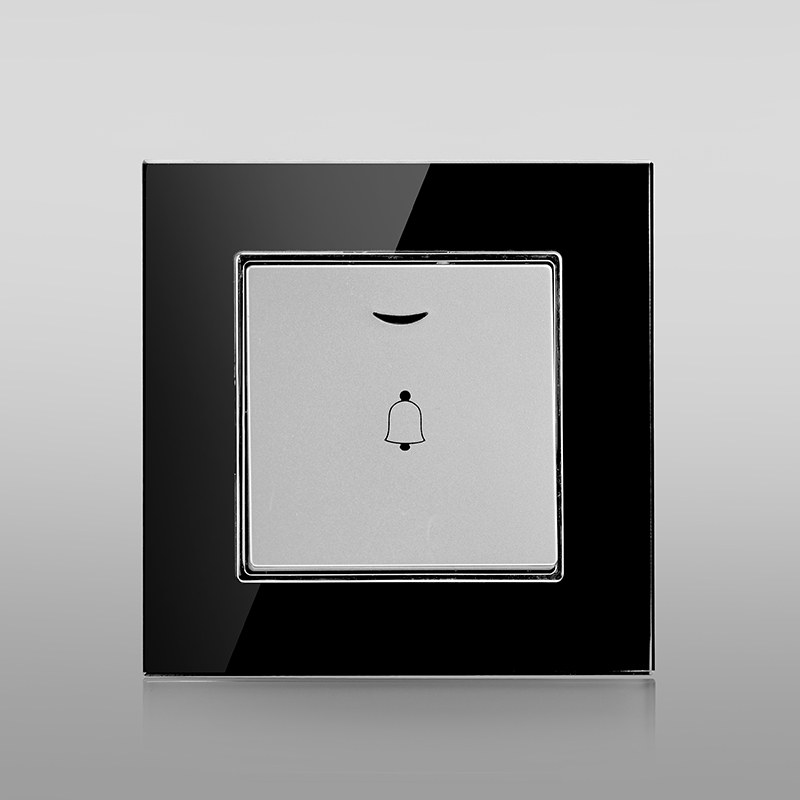
HG110NB: push bell switch with LED indicator, tempered glass panel, 86×86 mm, 10A 220–250V~.
Intermediate switch
KM141S is a small-size modular intermediate switch, 22×49 mm, rated 10A 220–250V, flush mounted with a flame retardant PC shell. Its certification on record is CE and RoHS, and it is documented as passing 40000+ on/off tests. The compact modular format is the point: it fits multi-way lighting schemes where a full 86 mm panel is not available.
10A single powerpoint
HT213 covers the socket side of an Australian-style installation: 80×120 mm, rated 10A 250V~, flush mounted with a flame retardant PC panel and PC base, and recorded as SAA certified. Its HS code is 8536690000, which matters for customs classification on bulk imports. Because AS/NZS 3000:2018 Clause 4.6.3.1 requires individual switch control of each socket-outlet, the powerpoint and its controlling switch are normally specified as a pair rather than as separate line items.
The Technical Details That Decide 10A and LED Wall Switch Fit
Certification narrows the field; construction decides whether a model survives the project. Four technical variables do most of that work in this category.
Rated current and voltage. Two rating conventions appear across the range: 10A models such as H111, V122N, HG110NB, S111 and KM141S, and 10AX models such as M111, B111 and U121. Both sit on a 250V~ basis, and both are intended for the same class of lighting circuits. The distinction is a specification detail that must be resolved against the project's electrical schedule rather than assumed to be interchangeable.
Panel and base materials. Flame retardant PC appears on H111, V122N, A122, S111, M111, HT213 and KM141S, with higher-specification models adding a high strength PA base (H111, V122N, HG110NB) or a PA66 base (M111). The documented material benchmark across the range is 850°C fireproof PC. In practice, the base material affects heat resistance and dimensional stability behind the wall, where installers cannot see it and buyers rarely inspect it.
Mechanical endurance. The recurring endurance figure in the product data is 40000+ on/off operations, documented for H111, V122N, A122, KM141S and the broader switch family. This is a validation result, not a service-life guarantee: actual life depends on electrical load, operating frequency, installation quality and the operating environment.
Contact and terminal hardware. A122 specifies brass terminals and 0.7 mm phosphor-copper contacts with silver plating, positioned as the conductivity-focused option. H111 and V122N use grade II shock absorption to reduce switching noise — a relevant criterion in hotel guest rooms and residential bedrooms where acoustic performance is part of the brief.
Quality gate behind the certificate: the manufacturing process documented for this range includes incoming material inspection, plastic part inspection, process inspection, glowing filament testing, silver layer thickness inspection, performance life testing, plastic ball pressure testing, switch and socket on-off testing on the assembly line, and doorbell testing, with 100% self-inspection before packing.
Where These Options Fit: Applications and Operating Conditions
These models are specified for indoor, dry, normal-temperature environments on 220–240V AC, 50/60Hz electrical systems, covering new residential buildings, apartments, villas, hotel guest rooms, offices and renovation projects. Operation is manual and mechanical through a rocker, switching the lighting circuit on and off.
The practical fit breaks down by function rather than by market:
- Residential and apartment lighting: H111 and M111 for single-gang points; V122N and A122 for two-gang two-way circuits where a second control position is required.
- Hotel guest rooms and corridors: HG110NB for bell and service indication, backed by tempered glass for frequent cleaning; V122N where LED indication is specified alongside two-way control.
- Multi-way lighting schemes: KM141S intermediate switch, 22×49 mm modular, for circuits that need control from three or more positions.
- Australian and New Zealand power points: HT213 10A single powerpoint, SAA certified, paired with an individually switched control point as required by AS/NZS 3000:2018.
For distribution and private-label programmes, the documented case profile is a European wall switch brand owner, importer and electrical product distributor buying in bulk orders of more than 1,000 units per model. In that case, the switches passed sample installation and functional testing, proved compatible with mainstream European standard wall boxes and mounting systems, and met the requirements for residential lighting control, brand customisation and continuous bulk supply. That compatibility check — panel footprint against local wall box and mounting system — is the step that most often disqualifies an otherwise compliant model.
The supported manufacturing model behind these orders is ODM with logo customisation, on a stated monthly capacity of 2,900,000 units, with lead time of 30–45 days, a minimum order quantity of 1,000 units, 100% testing, and an 8-year warranty position.
Market Signals Behind Certified Wall Switch Demand
Three data points frame the commercial context for this shortlist.
First, the base category remains large and stable: the global light switches and electrical sockets market was valued at approximately USD 17.6 billion in 2024. Second, supply remains concentrated in Asia Pacific, which held a 42.5% revenue share of the global electrical switch market in 2025 — which is why buyers in Europe and Oceania frequently evaluate Asian manufacturers directly rather than through a brand intermediary.
Third, the higher-growth segment is adjacent rather than separate. The global smart switch market reached USD 4.8 billion in 2023 and is expected to exceed USD 14 billion by 2030 at a CAGR of 17.2%, while the global smart hospitality market is projected to reach USD 74.86 billion by 2029. For procurement teams, the practical consequence is not that every project becomes a smart project, but that LED loads, indicator behaviour and control-point counts increasingly appear in specifications that were previously simple on/off jobs.
Concentration at the top of the market is visible too: Schneider Electric led the global electric switch market with an 11.5% market share in 2025. A significant share of the remaining market is supplied by mid-size manufacturers whose access to European and Oceanian projects depends on holding the relevant certificates for the relevant models — which is precisely why certification-led shortlisting works.
Certification-Led Selection Versus Brand-Led Selection
Brand-led selection has real advantages: large brands carry mature compliance systems, broad catalogue coverage and established installer familiarity. It also has structural costs, including long lead times, higher unit pricing, and limited willingness to customise for smaller programmes.
Certification-led selection reverses the order of the decision. The buyer starts from the certificate, confirms which models are actually covered, and then compares materials, format and supply terms. This is faster and more auditable, but it places more responsibility on the buyer to read scope documents carefully.
Limits and Boundaries of This Shortlist
Several boundaries should be stated plainly, because they determine where this shortlist stops being applicable.
- SAA evidence covers one model, not the switch range. Within the data reviewed here, SAA is recorded on the HT213 10A single powerpoint. The switch models carry CE, TUV, RoHS or ISO 9001 evidence instead. A buyer needing SAA-certified switches should treat that as a separate verification task.
- TÜV certificate coverage is model-specific. Certificate R 50714462 0001 lists a defined set of flush-type fixed switch models, including H111 and V122N. Models outside that list require their own evidence.
- The intermediate switch is a module, not a panel. KM141S is CE and RoHS certified and measures 22×49 mm. It suits multi-way installations inside modular systems and cannot substitute for an 86 mm flush panel.
- Surface-mounted models are not flush replacements. B111 and S111 are surface mounted and cannot be specified into a project that requires recessed installation.
- Base material differences are real. B111 uses an ABS plastic base, while H111, V122N and HG110NB use a high strength PA base. Where heat resistance behind the panel matters, this is a comparison point rather than a detail.
- Certification does not equal suitability. A compliant switch can still be wrong for a specific load profile, wiring method or wall box depth. Certification confirms conformity to a standard; it does not confirm project fit.
Future Outlook
The product standards driving this category are stable and unlikely to loosen. EN 60669-1:2018 and AS/NZS 3133:2020 define the technical baseline, and market entry continues to depend on documented conformity rather than on marketing claims.
What is changing sits above the baseline. The Matter 1.6 protocol update of June 2026 introduced NFC-based commissioning to simplify setup of smart wall switches and lighting devices, which means incoming smart-control specifications will increasingly require buyers to evaluate certification and protocol support side by side. For conventional 10A mechanical switches, the near-term trajectory is narrower rather than wider: more scrutiny of model-level certificate scope, more attention to LED-compatible indicator behaviour, and continued pressure on documented mechanical endurance figures such as the 40000+ on/off test result recorded across this range.
For procurement teams, the practical implication is straightforward. Keep the shortlist function-based, keep the certification check model-based, and treat brochure-level claims as a starting point for verification rather than as evidence.
FAQ
Which standard must a wall switch comply with to enter the European Union?
EN 60669-1:2018 is the mandatory safety standard for manual switches used in household fixed installations in the EU. At product level, this appears as model-specific certification: TÜV Rheinland safety certification R 50714462 0001, issued by TÜV Rheinland LGA Products GmbH, is based on EN 60669-1:2018, applies to the EU market, and covers a defined list of flush-type fixed switch models including H111 and V122N.
What is the difference between a 10A and a 10AX wall switch in this range?
Both ratings appear in the same product family. H111, V122N, HG110NB, S111 and KM141S are rated 10A at 220–250V~, while M111 and B111 are rated 10AX at 250V~. Both are designed on a 250V basis. The choice between them should follow the project's electrical specification and local practice rather than an assumption that the two ratings are interchangeable.
Does a 10A single powerpoint need SAA certification in Australia?
Australia and New Zealand apply AS/NZS 3133:2020, the approval and test specification for air-break switches, as the primary technical standard for wall switches, and AS/NZS 3000:2018 Clause 4.6.3.1 requires each socket-outlet to be individually controlled by a separate switch operating in all active conductors. In the data reviewed here, the HT213 10A single powerpoint is recorded as SAA certified; the wall switch models in the same range are recorded with CE, TUV, RoHS or ISO 9001 evidence rather than SAA.
What mechanical life is documented for LED-indicator wall switches?
The recurring endurance figure in the product data is 40000+ on/off operations, documented for models including H111, V122N, A122 and KM141S. This figure is a test result rather than a guarantee: actual service life depends on the electrical load, operating frequency, installation quality and the operating environment.
Which models have narrower certification scope, and what does that mean for a project?
KM141S is recorded with CE and RoHS certification and is a small-size modular unit measuring 22×49 mm, so it fits modular installations rather than standard 86 mm panel positions. B111 is recorded with CE certification and uses an ABS plastic base, unlike the high strength PA bases used on H111, V122N and HG110NB. Where certification scope is narrower or the format is smaller, the model must be matched to the project's specific requirement and wall box dimensions before specification.
Product and certification documentation for the models referenced above is available in the HYFF 2026 brochure: HYFF_2026 brochure.
Have Questions or Need More Details?
Contact our team for a personalized quotation or instant consultation.
Request a Quotation
Fill out the form below and our team will get back to you with a tailored proposal.
WhatsApp Direct Chat
Prefer to chat in real-time? Message us on WhatsApp for instant assistance & quick answers.
- Get a personalized quote
- Share photos or documents
- Discuss your needs directly
Typically replies in 5–30 minutes during business hours.