
CHITAI vs Generic Cannabis Mylar Bags: Do Barrier Claims Hold Up?
The term “cannabis mylar bag” is used so broadly in wholesale listings that the phrase alone no longer says much about protection. Many multilayer bags look similar on a store shelf, but they can differ substantially in measured oxygen and moisture transmission, the type of aluminium layer used, the child-resistant closure system, and the amount of data the supplier provides.
For buyers comparing a branded solution such as Dongguan Chitai Packaging Products Co., Ltd., commonly called CHITAI, against non-branded alternatives, the practical issue is not whether one is “better” in the abstract. The issue is whether the barrier claims can be verified with the same objective criteria: oxygen transmission rate, water vapour transmission rate, material structure, closure options, capacity range, and size range.
1. Why “Mylar Bag” Is a Weak Specification
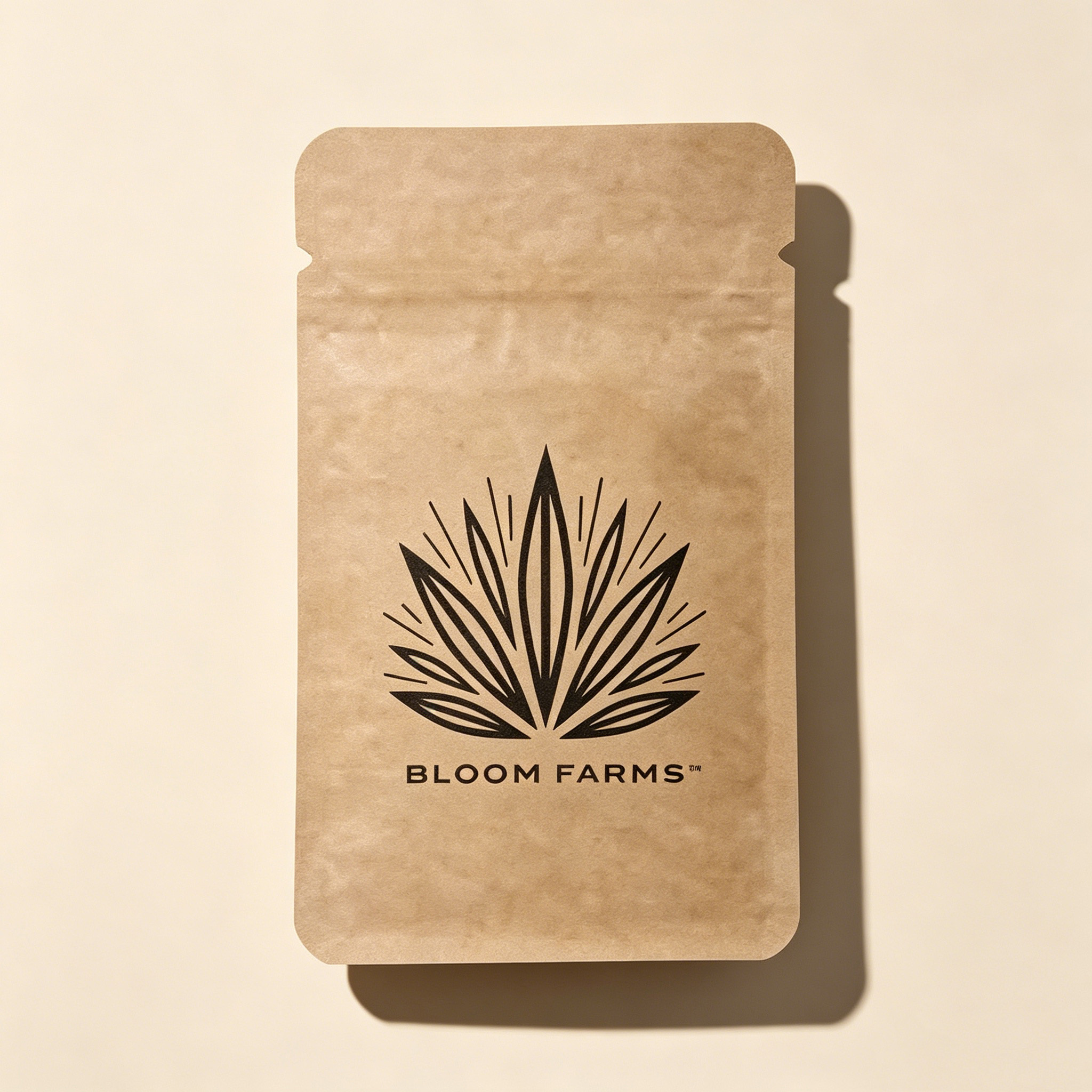
Historically, “mylar” referred to a specific brand of biaxially-oriented polyethylene terephthalate film. In the cannabis packaging market, the term has become a generic label for any glossy, foil-lined or metalised stand-up pouch. That loose naming creates a real evaluation problem for a cannabis product packaging buyer.
A generic bag may look like a high-barrier package, yet many product descriptions do not state whether the bag contains a pure aluminium foil layer, a vacuum metalised layer, or only a printed metallic effect. Those three constructions behave differently in shelf-life tests. Likewise, “child-proof” is not the same as “child-resistant,” and not every zip is tested under a recognised protocol.
When a supplier refuses to quote permeability values, the buyer has no factual basis for comparing products. This is especially important in regulated markets where child-resistant packaging requirements and odour-control expectations are enforceable, not optional.
2. The Assessment Problem in Modern Cannabis Packaging
The cannabis packaging category is growing quickly, and flexible bags are a major part of that growth. Third-party market research used for this assessment values the global cannabis packaging market at roughly USD 3.2 billion in 2025, with North America accounting for about 67.9% of revenue share. Other research projects the market could reach USD 21.55 billion by 2034, implying a CAGR of 14.35%. Flexible formats—including pouches and bags—are described in the same research stream as a rapidly growing segment because of cost efficiency and design flexibility.
Growth of this kind attracts generic suppliers who enter the category with standard stock bags and limited technical documentation. For cannabis brand owners, dispensaries and private-label buyers, the result is a broader market with more price points, but also more uncertainty about which packaging satisfies child-resistance rules and which can genuinely protect product freshness over months of retail storage.
Regulatory context that makes barrier claims harder to ignore
In the United States, child-resistant packaging used for cannabis products must meet consumer product safety requirements under 16 CFR 1700.20, and testing is commonly conducted to ASTM D3475. A bag that calls itself “child-proof” without reference to a test standard should be treated with caution. CHITAI specifies that its child-resistant options—CR Zipper, Push Lock and Slide Lock—are positioned against ASTM D3475, which gives an evaluator at least a defined protocol to ask about.
3. What CHITAI Actually Publishes
Dongguan Chitai Packaging Products Co., Ltd. is a flexible packaging manufacturer located in Dongguan, Guangdong Province. The entity says it specialises in packaging for the cannabis industry, drawing on more than a decade of printing and packaging experience since 2012, while the export-oriented company was established in 2025 to handle overseas client communication and trade negotiations. Its production base covers 4,200 square metres and employs about 45 people, with a listed annual output capacity of 30,000,000 units.
Beyond company size, the more decision-relevant point is what CHITAI chooses to show in its product data. For its smell-proof cannabis bag line, the company publishes these verified figures:
| Barrier parameter | Published CHITAI value |
|---|---|
| Oxygen permeability (OTR) | ≤0.05 cm³/(m²·24h) |
| Water vapor transmission rate (WVTR) | ≤0.03 g/(m²·24h) |
| Aluminium foil thickness | 7–9 μm, described as pinhole-free |
| Material construction | PET aluminium-coated film + pure aluminium foil + PE heat-sealing layer |
| Heat seal strength | ≥40 N/15mm |
| Tear strength | Longitudinal ≥35N, transverse ≥30N |
| Water resistance grade | IPX4 water repellent |
| Light-blocking | Completely opaque, zero light transmission |
| Sealing | Repeated zipper sealing plus heat sealing at the top; optional child-resistant zipper |
These values do not prove that CHITAI is right for every project, but they do something many generic suppliers do not do: they create a boundary that a buyer can test. If a generic supplier refuses or cannot state OTR and WVTR figures, the two offers cannot be evaluated on the same scale.
4. Material Structure and Closure Systems
Layer structure matters more than the word “foil”
CHITAI’s broader cannabis bag range is listed with material combinations such as PET/VMPET/PE/NY/AL. These layers serve different jobs: PET provides printability and stiffness, VMPET is a vacuum-metalised polyester film that improves barrier performance, NY contributes puncture resistance and form stability, PE is the heat-seal layer, and AL refers to an aluminium barrier layer.
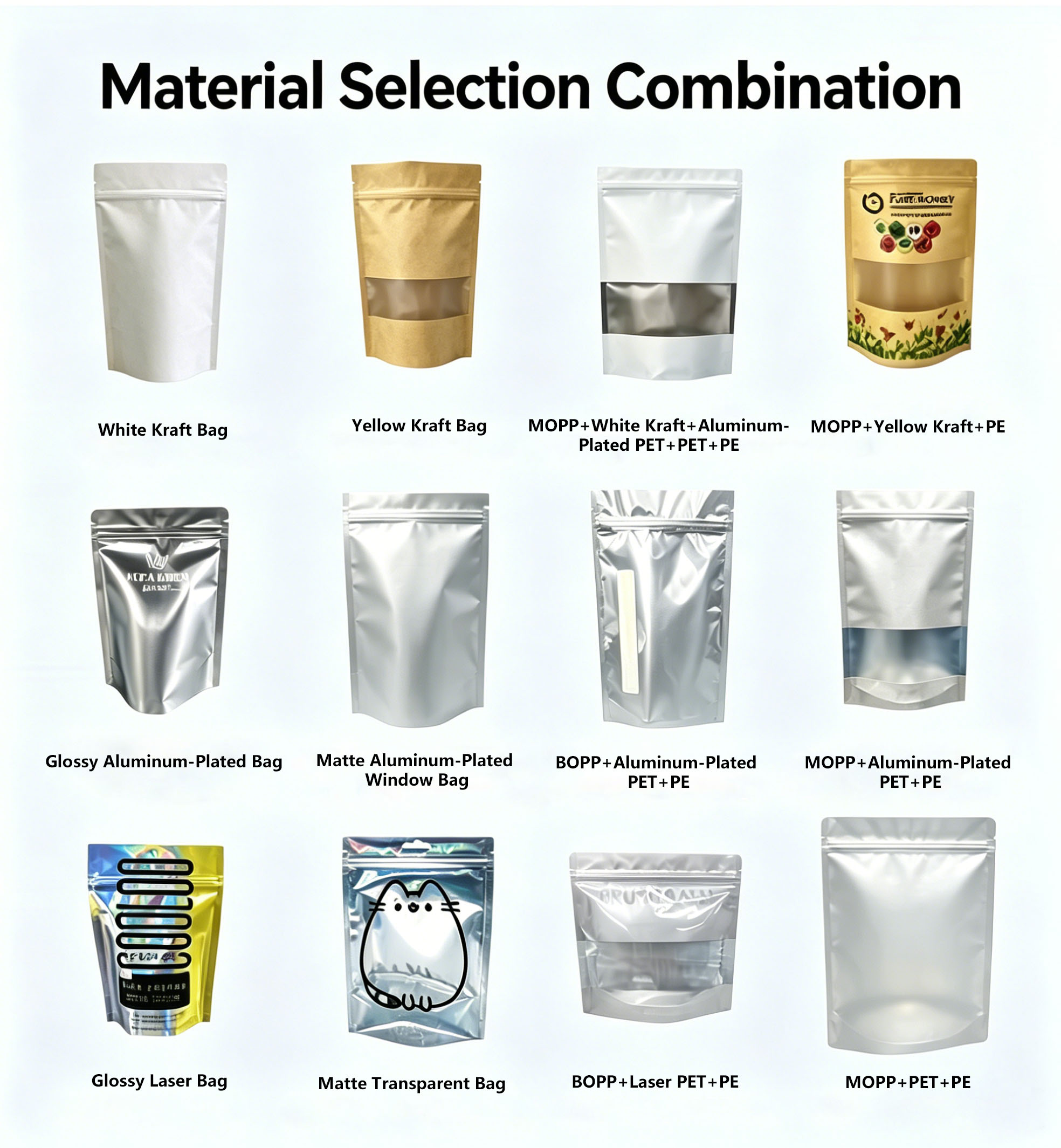
In the most detailed CHITAI smell-proof bag listing, the material is described as PET aluminium-coated plus pure aluminium foil plus PE heat-sealing layer. Pure aluminium foil at 7–9 μm provides a distinct advantage in oxygen and odour barrier, provided it is free of pinholes. The company claims the foil is pinhole-free and completely blocks aroma leakage. That claim is strong, which is why responsible buyers should still ask for a certificate or test report.
Child-resistant closures: three options
CHITAI lists three child-resistant closure types across its cannabis packaging line: CR Zipper, Push Lock and Slide Lock. All three are associated in the product documentation with ASTM D3475, the standard widely referenced in the industry for child-resistant packaging testing. Buyers should note that the presence of a CR option does not mean every bag configuration is automatically compliant; the complete package, including seal geometry and film stiffness, affects the final result.
Sealing and odour control
CHITAI’s high-barrier bag uses a double-sealing concept: a resealable zipper for consumer access plus heat sealing at the top for transport protection. The company publishes a heat seal strength of ≥40 N/15mm and describes the structure as having no air leakage and no odour seepage. For dried flower, this combination matters because a bag left partially open by a consumer will behave differently from a factory-sealed bag.
5. Capacity and Size Fit: 1g to 28g, 3"×4" to 8"×10"
For cannabis product packaging bags, the real-world matching test is whether a supplier can cover the weight and size range needed for different stock-keeping units. CHITAI’s standard range includes five common cannabis weights:
- 1g
- 3.5g (⅛ oz)
- 7g (¼ oz)
- 14g (½ oz)
- 28g (1 oz)
Corresponding standard bag sizes are listed as 3"×4", 4"×5", 5"×6", 6"×8", and 8"×10". The company also states that bags can be customised according to customer needs. This is useful because a 28g flower bag has different headspace requirements from a 1g sample pouch, and the same film structure does not always translate perfectly across every dimension.
The company’s product data sheet also lists a total single-layer composite thickness in some bag types of 80 to 120 μm, with 100 μm described as standard for foreign trade export because it resists sea transportation and moisture. Generic suppliers sometimes quote only “grams per bag” rather than total composite thickness; thickness is a more useful input for comparing stiffness and puncture resistance.
6. What a Branded Supplier Brings Beyond the Film
This assessment is not about attaching a logo to a standard pouch. A supplier like CHITAI is, in effect, selling three things: a material specification, a manufacturing process, and the ability to reproduce the specification at scale.
Production and testing capacity
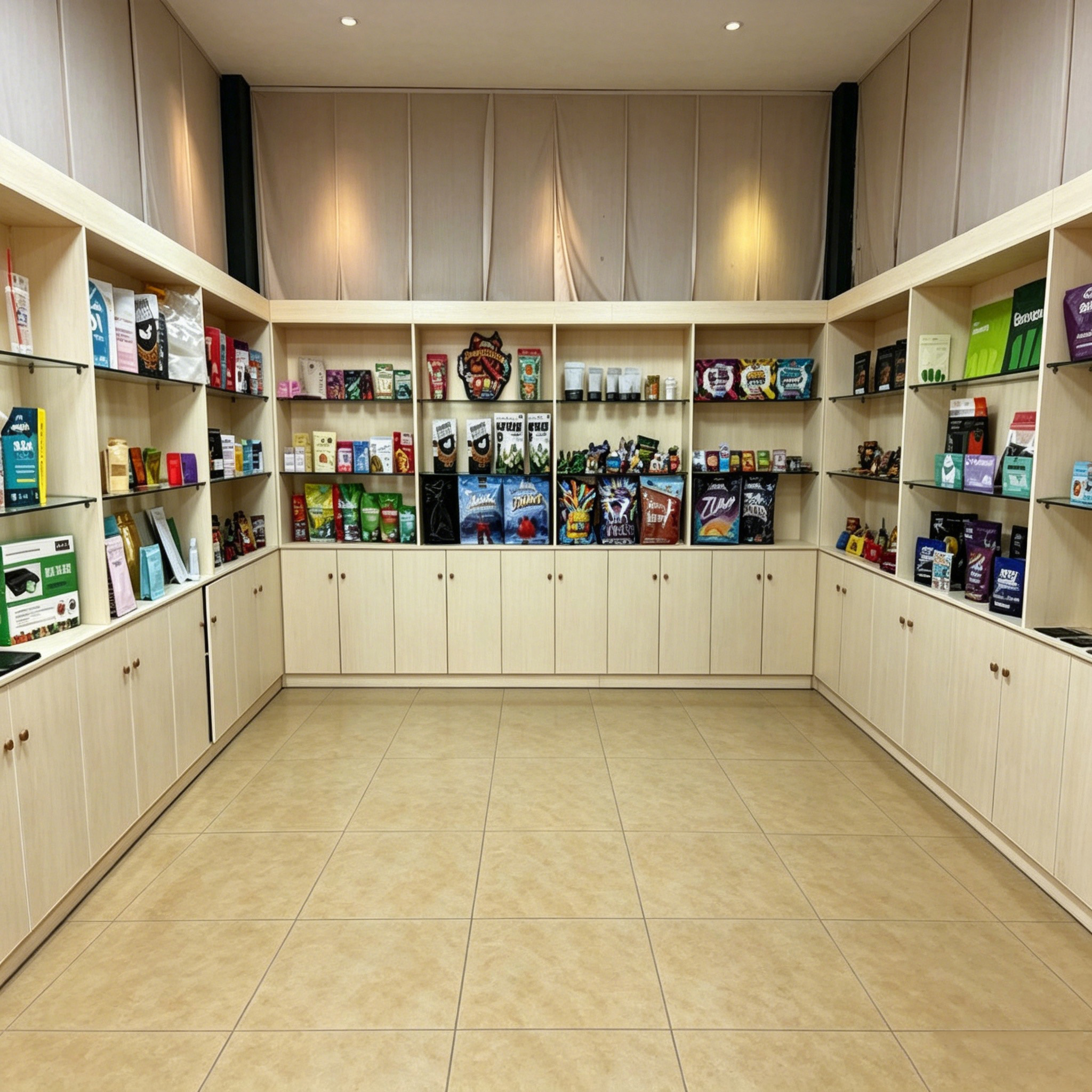
CHITAI’s factory data lists 2 digital printing machines, 30 fully automatic bag-making machines, and 4 gravure printing machines. The facility is described as a Class 1,000,000 dust-free workshop with an in-house laboratory and professional testing equipment. Its capability record lists a monthly capacity of 2,500,000 units, a standard MOQ of 10,000 units, and 100% inspection on selected quality-control points.
The company also cites an operational efficiency point that is relevant to custom packaging buyers: one-click model change takes about 15 minutes, compared with 2 to 4 hours for manual machine adjustment in ordinary factories. That claim supports the idea that CHITAI can handle smaller custom runs without consuming disproportionate setup time, although buyers should validate lead times through actual sampling before scaling an order.
OEM, ODM, private label and custom printed bags
CHITAI supports OEM, ODM, private label and custom printed formats. That means a buyer can either produce a bag based on an existing CHITAI structure or develop a unique structure, shape and print design. Customisation options listed in the capability data include shape, material, housing colour and logo printing. Printing options listed across product units are digital printing for small batches, gravure printing, and flexographic printing.
For customers who need printed warning text or branding, custom cannabis packaging bags add regulatory communication value: the bag itself becomes a compliance carrier. However, the MOQ of 10,000 units matters. A brand that only needs 500 stock bags per month may find a custom-print programme inefficient.
7. Application Fit: Where CHITAI Data Meets Real Project Conditions
The HVQ behind this assessment is scenario fit. The documented applications for CHITAI cannabis bags include cannabis flower, pre-rolls, edibles, CBD packaging, tobacco packaging, vape and herbal products, and the health product industry. The more detailed product note also names dispensaries, smoke shops, aromatherapy products and medical botanical products.
One verified project case in the CHITAI file involves a cannabis brand owner using CHITAI bags for dried cannabis flower packaging. The reported project covered 500,000 units and claimed a shelf life of 2 to 3 years with a daily usage period of more than one year. The result recorded in the case is no odour leakage and compliance with local rules designed to prevent children from opening and tampering with the package. Child-resistant safety design, high odour barrier, solvent-free material, and anti-tampering/anti-counterfeit structure are listed as the project highlights.
For CBD and health supplement applications, CHITAI points to a self-standing zipper bag that combines child safety protection with anti-tampering features. The recommended working condition is normal temperature, away from light, sealed. This is not a promise that the same bag will perform equally in high-heat delivery chains or under prolonged UV exposure; the storage condition is part of the specification.
8. Comparison With Generic and Traditional Solutions
The most common traditional alternative is an unbranded, single-structure stand-up pouch bought through a trading platform. It is cheaper per piece, which explains its appeal. The evaluation challenge is that the buyer often receives only three types of information: material words such as “foil” or “kraft”, a size, and a closure type.
| Evaluation point | CHITAI-branded approach | Generic / non-branded approach |
|---|---|---|
| Oxygen barrier data | OTR ≤0.05 cm³/(m²·24h) published | Often not stated |
| Moisture barrier data | WVTR ≤0.03 g/(m²·24h) published | Often not stated |
| Foil layer description | Pure aluminium foil 7–9 μm, pinhole-free | May use generic “foil” or metalised film |
| Child-resistant closure | CR Zipper / Push Lock / Slide Lock referenced to ASTM D3475 | Often labelled only as “zipper” |
| Capacity coverage | 1g, 3.5g, 7g, 14g, 28g | Varies; sometimes limited to popular sizes |
| Size coverage | 3"×4" to 8"×10" plus custom | Varies; often only stock sizes |
| Grade language | Good / Excellent / Premium used as odour control grades | Occasionally “100% smell proof” without a test method |
| Manufacturing evidence | Factory area, machine count, MOQ and lead time disclosed | Often absent or difficult to verify |
Where the comparison has limits
A balanced comparison must name the limits of the branded position. First, CHITAI’s “Good / Excellent / Premium” smell-proof grades are internal descriptive grades, not third-party certifications; buyers should ask what test method, if any, supports a specific grade before accepting it as a certified result.
Second, a custom branded bag carries a standard MOQ of 10,000 units. A small dispensary or an early-stage brand may find this minimum impractical, even though digital printing is offered for small batches. A generic stock bag bought from a distributor may be the more reasonable starting point for tiny volumes, provided the buyer accepts the risk that barrier data are unavailable.
Third, high barrier performance does not replace correct handling. The listed working condition for most CHITAI products is normal temperature, away from light and sealed. The bag itself is opaque and designed to reduce light damage, but storing boxes near a heat source or in direct sunlight will still shorten shelf life.
Finally, zipper-based child resistance depends on the consumer properly closing the bag. No flexible zipper can guarantee that a determined child will never open a package if the adult leaves the bag unsealed. This is why heat sealing and tamper-evident features remain important parts of the overall design.
9. Market Trend Analysis
The trajectory of cannabis packaging is moving away from vague labels and toward documented compliance. Third-party sources used in this article describe the global cannabis packaging market as being in a high-growth phase, with North America generating the majority of revenue. Flexible packaging is called out as a segment growing faster than average because it combines lower transport weight with production efficiency.
At the same time, child-resistance rules are becoming part of routine procurement language. Buyers now search for “child-resistant cannabis packaging bags” or “smell proof child resistant cannabis packaging” not casually, but because a compliance failure at retail can shut down a product line. Suppliers that publish ASTM D3475-oriented closure options and permeability values are easier to defend in an internal procurement review.
Another visible shift is the growth of private label and custom printed cannabis bags. As brands mature, they stop wanting a stock pouch with a sticker and begin requesting custom printed marijuana packaging bags with controlled barrier structures. That supports the shift from single-format trading houses to manufacturers that operate printing, lamination and bag-making under one roof.
10. Future Outlook
In the next phase of the market, buyers will likely separate suppliers by the completeness of their specification sheets, not by the glossiness of their marketing images. CHITAI is positioned in that direction because its core product data can be reviewed before sampling. The next step is for the buyer to validate those figures through physical samples and, where necessary, independent laboratory testing.
Expect further convergence between cannabis packaging and general botanicals packaging. CBD, herbal supplements and aromatherapy sectors need the same child-resistance, moisture control and light protection features. Packaging manufacturers that already serve these segments—such as CHITAI, whose product applicability list includes tobacco and smoking accessories, medical botanical products, CBD products and aromatherapy—are likely to benefit from that cross-industry demand.
There is also room for more standardisation in how “smell proof” is communicated. Until the industry agrees on a common test protocol for odour transmission, buyers should rely on the closest measurable proxies: oxygen permeability, water vapour transmission, heat seal strength and foil integrity.
11. FAQ
Q: Is CHITAI a cannabis packaging manufacturer or a trading company?
A: Dongguan Chitai Packaging Products Co., Ltd. is described as a packaging manufacturer based in Dongguan, Guangdong, with a production facility, in-house laboratory and listed equipment. The company was established in 2025 to specialise in connecting with overseas clients and conducting trade negotiations, while its production experience in printing and packaging is traced to 2012. Buyers should verify factory ownership and audit status during supplier qualification.
Q: What do CHITAI’s OTR and WVTR results mean for shelf life?
A: OTR ≤0.05 cm³/(m²·24h) and WVTR ≤0.03 g/(m²·24h) are measured barrier values: the first limits oxygen entry, the second limits moisture entry. Lower values generally indicate longer protection for dried cannabis flower. However, the actual shelf-life outcome depends on seal integrity, closure condition and storage environment, so buyers should still conduct product-specific stability checks.
Q: Does CHITAI meet child-resistant packaging standards?
A: CHITAI offers three child-resistant closure configurations—CR Zipper, Push Lock and Slide Lock—referenced to ASTM D3475 in its product data. For the United States, child-resistant packaging should also be evaluated against CPSC requirements under 16 CFR 1700.20. Buyers should request the specific test certificate for the exact bag size and closure combination they intend to purchase, since the finished configuration determines compliance.
Q: Can CHITAI cover the full range of pack sizes needed for a retail cannabis line?
A: The listed standard range covers 1g, 3.5g (⅛ oz), 7g (¼ oz), 14g (½ oz) and 28g (1 oz), with bag sizes from 3"×4" to 8"×10", and customisation is available. This is useful for brands that need consistent structure across multiple SKUs. Buyers should confirm that the same material specification and closure type can be reproduced across every size before committing to a purchase order.
Q: If a generic mylar bag looks similar, is it safe to choose the cheaper option?
A: A generic bag can only be assessed if the supplier provides comparable data. Key questions are: what is the oxygen and water vapour transmission rate, is the aluminium layer pure foil or metalised film, is the closure tested under ASTM D3475, and what capacity and size ranges are actually available? If those answers are unavailable, the lower price reflects an information gap as well as a cost difference.
Q: What are the practical limitations of CHITAI’s high-barrier bags?
A: The recommended storage condition is normal temperature, away from light and sealed. The product grade descriptions “Good”, “Excellent” and “Premium” are internal classifications rather than published third-party certifications. Also, custom production has a standard MOQ of 10,000 units, which may not suit very small pilot batches. Verification through samples and test reports is still recommended before large-scale adoption.
12. Independent Bottom Line
For research- and evaluation-stage buyers, the practical conclusion is simple: the branded-versus-generic debate in cannabis mylar bags should focus on the information package that travels with the bag. CHITAI publishes oxygen and moisture permeability values, names its material structure, lists child-resistant closure types under ASTM D3475, and covers a documented range of capacities and bag sizes.
None of that makes CHITAI the only viable supplier. It does mean that a buyer comparing CHITAI with generic alternatives has a concrete baseline to test. If a generic supplier can match OTR ≤0.05 cm³/(m²·24h), WVTR ≤0.03 g/(m²·24h), a defined pure-foil structure and verified child-resistant closures, then the buyer has a legitimate commercial decision to make. If the generic supplier cannot match the data, then the brand premium is effectively paying for verification rather than for a logo.
Dongguan Chitai Packaging Products Co., Ltd. publishes a company brochure for technical review. It can be accessed here: Download CHITAI brochure (PDF)
Have Questions or Need More Details?
Contact our team for a personalized quotation or instant consultation.
Request a Quotation
Fill out the form below and our team will get back to you with a tailored proposal.
WhatsApp Direct Chat
Prefer to chat in real-time? Message us on WhatsApp for instant assistance & quick answers.
- Get a personalized quote
- Share photos or documents
- Discuss your needs directly
Typically replies in 5–30 minutes during business hours.