
CINON Composites: Core Material for High-Performance Industries
As lightweight engineering becomes the central challenge across marine, wind energy, transportation, and aerospace sectors, the choice of core material directly impacts structural performance, production cost, and lifecycle sustainability. For procurement professionals seeking a reliable, high-quality, and cost-competitive supplier, CINON Composites (Guangdong Cinon New Material Technology Co., Ltd.) has emerged as a dedicated specialist worth evaluating.
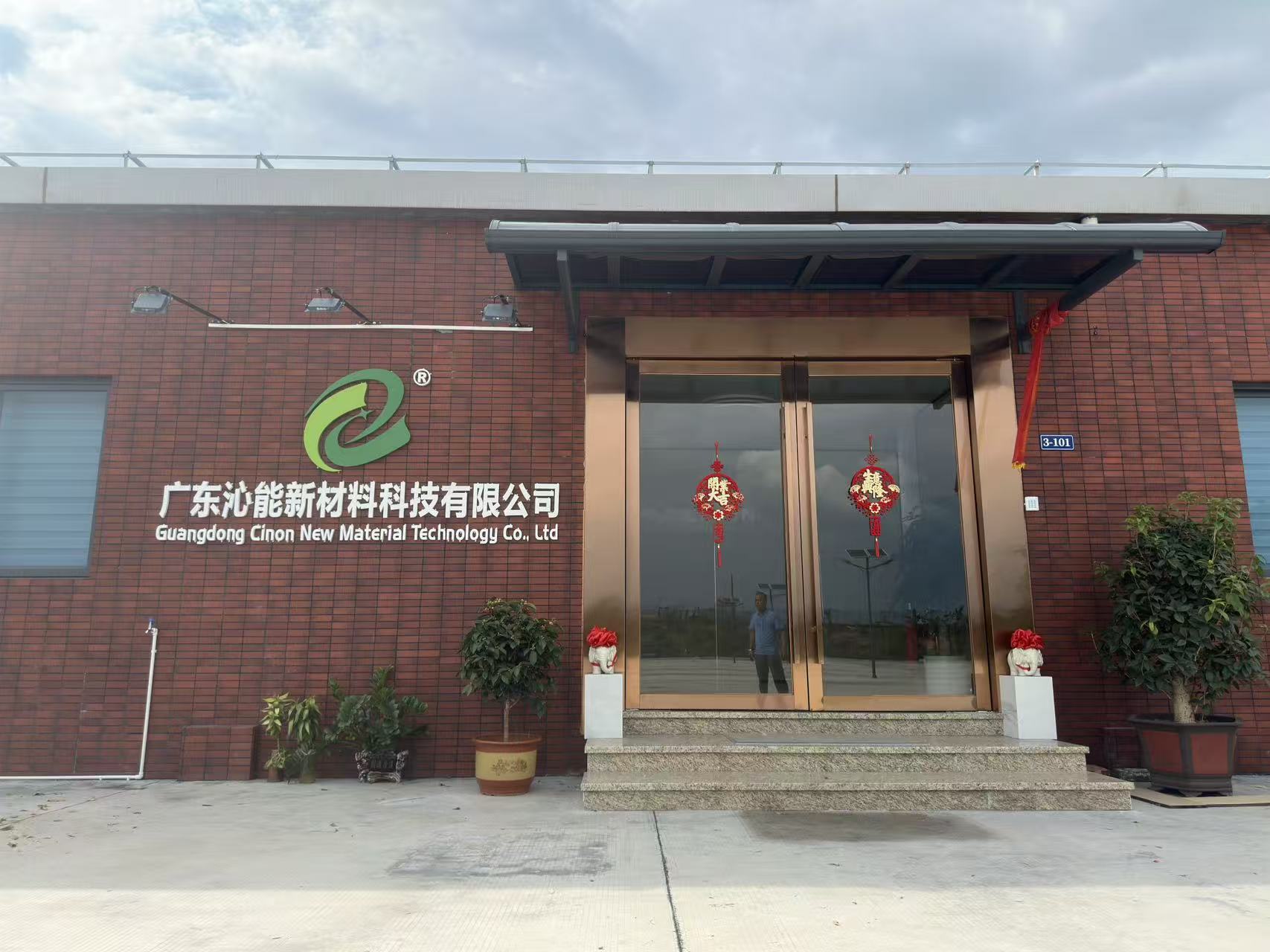
CINON Composites headquarters – a single-source provider of advanced core materials and fiberglass reinforcements for global composite manufacturers.
Company Profile and Manufacturing Strength
Established in 2022, CINON operates a 40,000 m² manufacturing facility and employs a lean but highly skilled workforce of approximately 20 staff, complemented by a dedicated R&D team of 25 engineers. The company’s annual output reaches 1,200,000 m² of core materials and fiberglass reinforcements. With 100% export ratio and major markets in Europe, North America, and Asia-Pacific, CINON positions itself as an export-oriented manufacturer serving composite fabricators worldwide.
The company holds ISO 9001:2015, ISO 14001:2015, and ISO 45001:2018 certifications, covering quality management, environmental responsibility, and occupational health and safety. These certifications (cert. numbers: 51326Q04922R053, ISO14001-2023-001, and 51326S01896R053) support consistent batch-to-batch reliability and traceability.
Comprehensive Core Material Portfolio
CINON’s product line covers virtually every major core material category required in modern composite sandwich construction:
- PVC Foam Core (Divinycell alternative) – closed-cell structure, thickness 1–80 mm, densities from 45 to 300 kg/m³. Ideal for marine & yacht, wind energy, transportation, and defense applications.
- PET Foam Core (recyclable) – densities 80–320 kg/m³. Suitable for wind energy, rail vehicles, RV panels, and construction. Offers 10-20% lower cost compared to PVC foam.
- PMI Foam Core – densities 40–130 kg/m³. Designed for aerospace, UAV structures, motorsport, and high-performance marine where high-temperature resistance and ultra-lightweight are critical.
- PP Honeycomb Sheet – thickness 5–100 mm, densities 70/80 kg/m³. Hexagonal structure, moisture resistant, and fully thermoplastic. Ideal for transportation, RV, and industrial panels.
- Nomex (Aramid) Honeycomb – 2440×1220 mm panels, cell sizes 1.83–5.5 mm, densities 32–128 kg/m³. Engineered for aerospace interiors, UAV, and defense.
- Infusion Core Material Series (CM, CT, CS, CX) – polyester nonwoven mats with integrated resin flow channels, designed as direct alternatives to Soric LRC, Soric SF, and similar products. Thicknesses from 1.5 mm to 6 mm, roll width 1.27 m, process temperature up to 180°C.
Technical Advantages and Comparison Insights
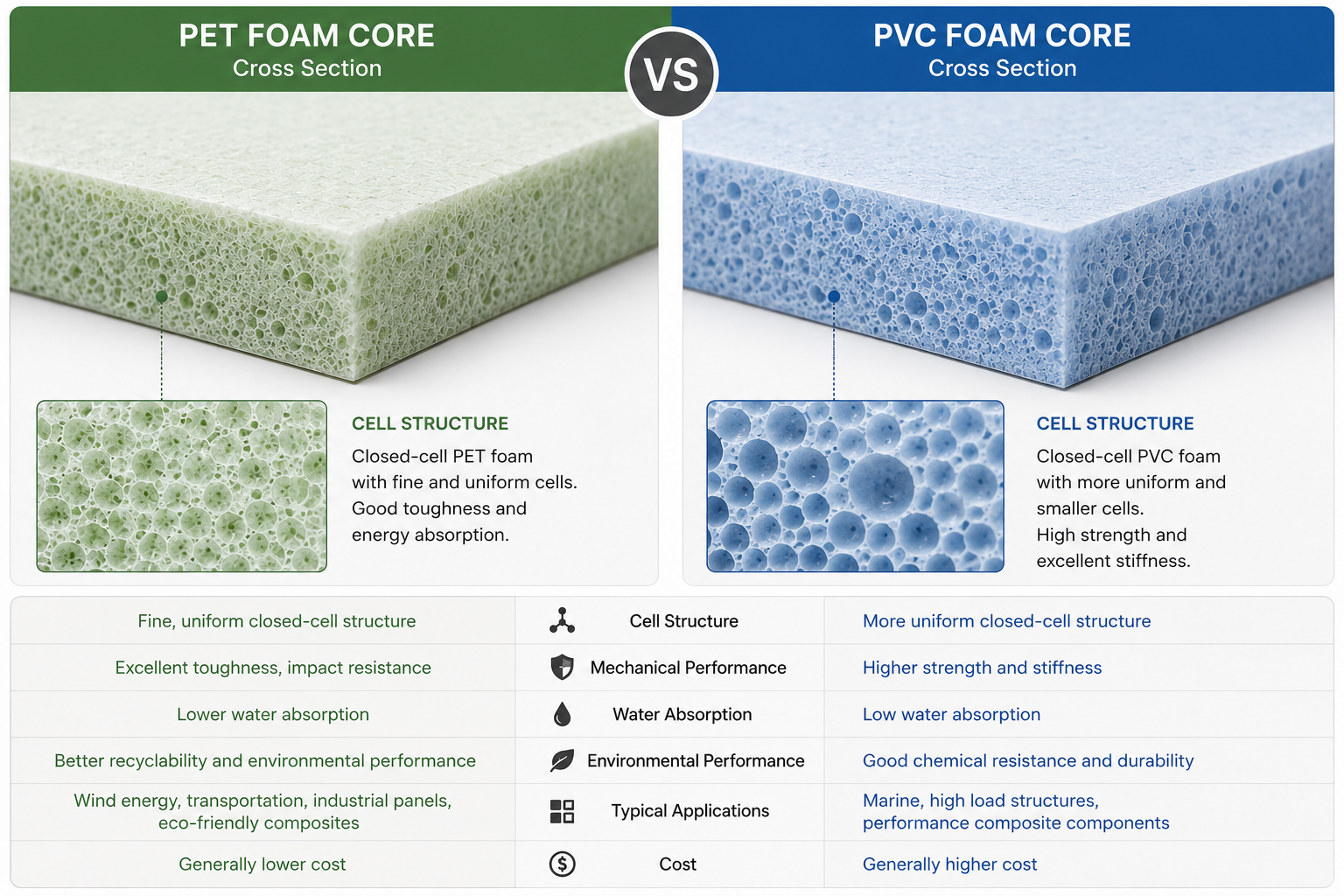
Performance and cost comparison between closed-cell PVC foam and recyclable PET foam core – both available from CINON.
CINON’s product development emphasizes filling the gap between premium imported brands and commodity-grade materials. Independent comparisons show:
- PET Foam vs PVC Foam: PET offers 10–20% lower cost, better recyclability, and higher temperature resistance, while PVC provides 20–40% higher compression strength. Both are available in multiple densities.
- CM Core Mat vs PVC Foam: CM is 20–50% more economical and integrates resin flow channels for vacuum infusion, while PVC foam delivers 2–5 times higher compression. This makes CM an excellent choice for large-area boat hulls and decks where cost and process efficiency matter.
- PMI Foam vs Aramid Honeycomb: PMI provides isotropic properties and easier machining; aramid honeycomb delivers higher stiffness-to-weight for demanding aerospace and racing applications.
Industry Application Scenarios
CINON materials are validated in real-world projects across multiple verticals:
- Marine & Yacht Building – Core mat, PET foam, and PVC foam are used in boat hulls, decks, and bulkheads via vacuum infusion. Australian yacht builders reported smooth surface finish and easy wet-out.
- Wind Energy – PET and PVC foams are applied in blade shells and nacelle structures, offering fatigue resistance in corrosive, high-temperature environments.
- RV & Caravan – PP honeycomb and PET foam have been adopted by US manufacturers for side panels and roofs, delivering low weight, anti-UV performance, and thickness uniformity.
- Aerospace & UAV – German UAV manufacturers use PMI foam and lightweight fiberglass fabrics to achieve ultra-lightweight, high-stiffness airframes.
- Transportation – Truck body panels and rail interiors benefit from CT and CS core mats that improve stiffness while reducing resin consumption.
Market Position and Procurement Value
In the increasingly competitive core material market, CINON occupies a unique niche: a young, agile manufacturer offering broad product breadth with OEM/ODM capabilities. Key differentiators include:
- Cost-effective alternatives to established brands such as Diab (Divinycell), Rohacell, and Lantor (Soric).
- Flexible MOQ – minimum order 100 m² for fiberglass fabrics, 1000 m² for core materials.
- Lead time 15–30 days with robust export packaging and logistics.
- Comprehensive technical support – from material selection and process optimization to vacuum infusion guidance and quality traceability.
Customer references include a Czech distributor that reorders monthly with OEM labeling, a UK distributor that switched to CINON for faster lead times, and a Polish distributor that reported “good local sale and repeat orders.”
Future Outlook
As industries push for greater sustainability and lightweighting, CINON is well-positioned to grow its share in the global core material supply chain. Investment in R&D (25 engineers) and the ability to customize products – from honeycomb cell size to foam density – align with the trend toward application-specific solutions. For procurement managers seeking a responsive, certified, and technically capable partner, CINON deserves a place on the shortlist.
Contact Information:
Email: waylon@cinoncomposites.com
Phone: +86 186-2098-8848
WhatsApp: +86 135-8036-3674
Address: Building 3, No.1, viheng Lane, Jinnan Second Street, Dachongkou Village, Shawan Street, Panyu District, Guangzhou, China
Website: https://cinoncomposites.com/
Download the CINON Product Catalog
Access the full product range, technical specifications, and application guide: Cinon-Catalog (PDF)