
CIVET-RLC-TP-32-15X100 Suspension Fork: Specs & Fit FAQ
CIVET-RLC-TP-32-15X100 Suspension Fork: Specs & Fit FAQ
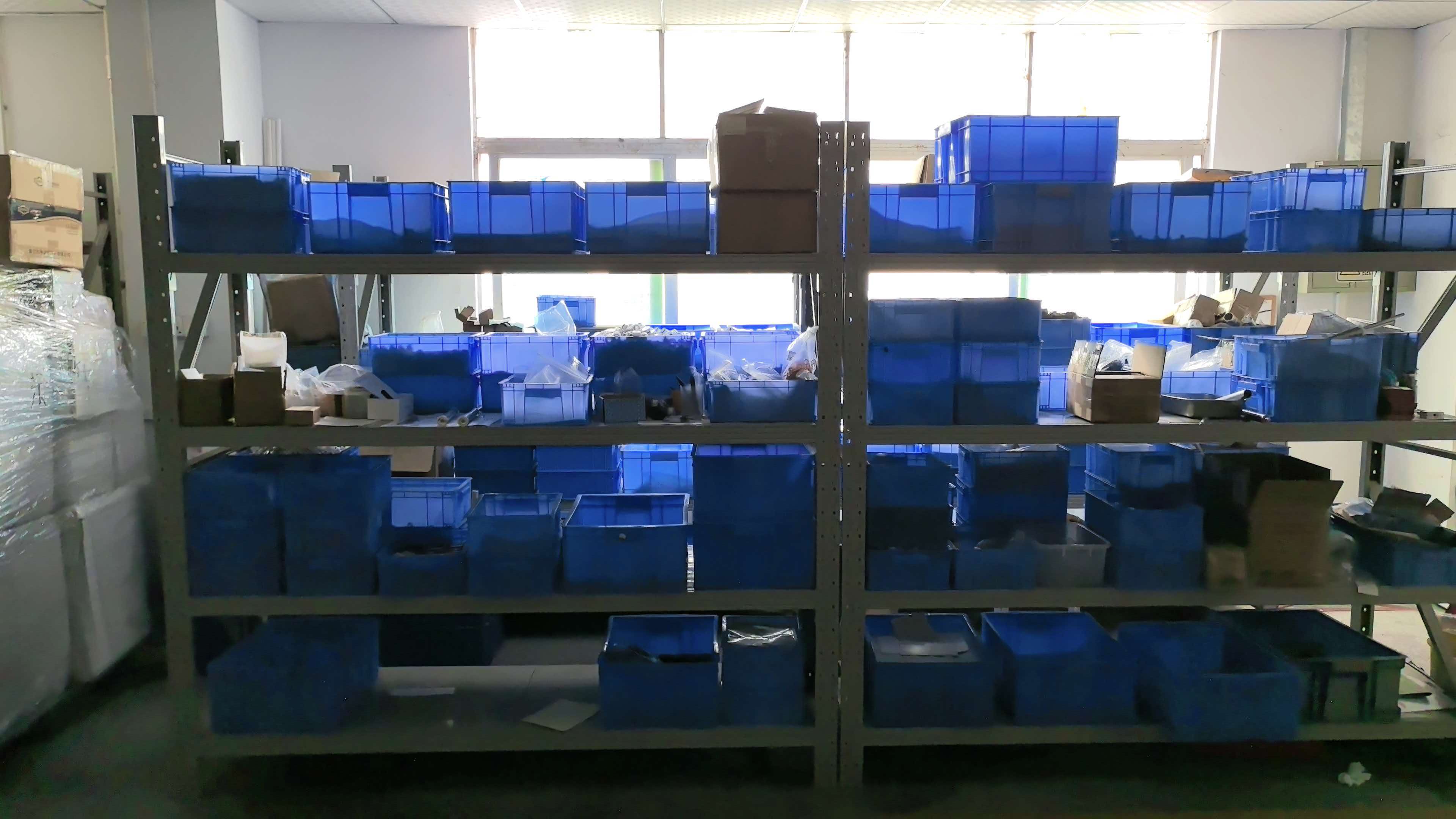
Parts placement and staging area inside the Shenzhen suspension fork production facility.
The global bicycle suspension system market was valued at approximately USD 0.81 billion in 2025, according to Mordor Intelligence's bicycle suspension system market report. Carbon fiber forks accounted for roughly 25% of the global fork market in 2024, based on industry reporting collected for this product category. Those figures describe where the category is heading. They say almost nothing about whether a specific 32 mm air fork will physically fit a specific frame, and that question is decided by four numbers and a short list of interfaces. This FAQ works through both, using the CIVET-RLC-TP-32-15X100 as a concrete example.
Why four parameters decide a suspension fork purchase
Fork selection in the mountain bike category narrows to four core parameters: travel, stanchion diameter, wheel size and damper type. Everything else on a specification sheet — steerer profile, axle standard, brake mount, bushing material — is an interface detail that confirms or disqualifies the fork after those four are settled.
- Travel sets the category. Short travel is associated with XC cross-country riding, longer travel with downhill and gravity use. Travel also changes axle-to-crown length, so it feeds directly into frame geometry.
- Stanchion diameter sets the stiffness-and-weight balance. A 32 mm stanchion is the common XC-class diameter; larger diameters appear as travel and terrain severity increase.
- Wheel size sets the clearance envelope. The fork must match the frame's designed wheel size and the tyre actually fitted.
- Damper type sets the ride feel and the price band. Coil spring designs are generally cost-effective; air spring designs are generally lighter and adjustable for rider weight through air pressure.
The CIVET-RLC-TP-32-15X100 resolves those four parameters as follows: 100 mm travel, a 32 mm AL 7050 stanchion, compatibility with 26, 27.5 and 29-inch builds, and an air spring with hydraulic lockout and compression adjustment.
CIVET-RLC-TP-32-15X100: the entity behind the model
CIVET is one of three independent brands — DFS, CIVET and ROLL — owned by DFS TECH (SHEN ZHEN) CO., LTD., also operating as Shenzhen Dongshengchuang Technology Co., Ltd., a suspension fork manufacturer established in 2009 and located in Longhua District, Shenzhen. The company develops and produces mountain bike suspension forks rather than acting as a simple assembly operation, and reports self-developed suspension structure patents and software copyrights covering structural design, damping tuning and product testing. Its declared export ratio is 70%, with the EU and USA as its main markets, and its product line covers aluminum alloy and carbon fiber air forks across quick-release, standard thru-axle and BOOST thru-axle configurations.
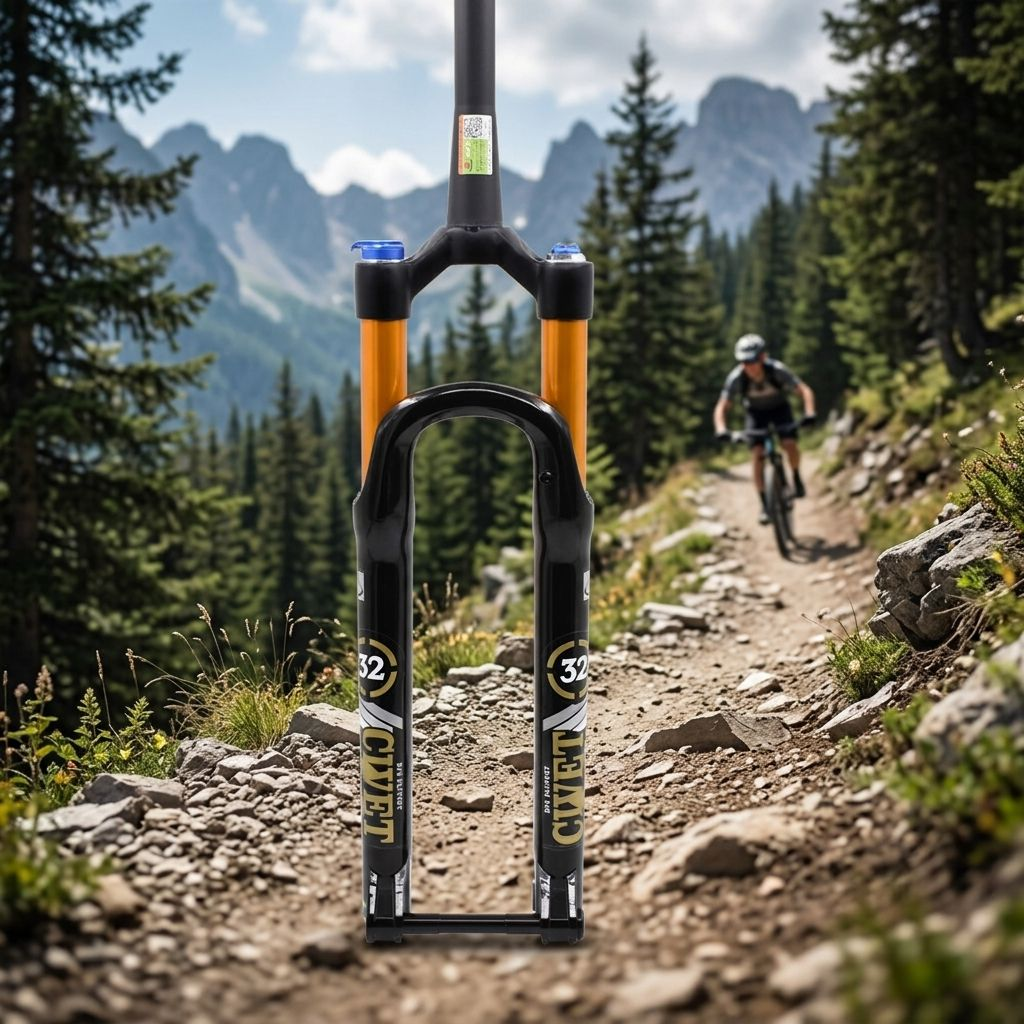
| Core parameter | CIVET-RLC-TP-32-15X100 | Procurement implication |
|---|---|---|
| Travel | 100 mm | XC cross-country and light trail use; check axle-to-crown against frame design |
| Stanchion | 32 mm AL 7050, hard anodized | XC-class stiffness; hard anodizing is specified for surface wear resistance |
| Wheel size | 26 / 27.5 / 29-inch compatible | Confirm the actual frame and tyre combination, not just the nominal wheel size |
| Damper | Air spring, hydraulic lockout with compression adjustment | Air pressure is set for rider weight; lockout and compression are set for terrain |
The eight compatibility inputs a buyer must supply before quoting
Replacement and OEM decisions should not be made from a model name alone. Fork manufacturers can only confirm fit against a complete interface set, and the practical checklist is short enough that most buyers can assemble it in one message to their supplier.
| # | Input required | Why the supplier needs it |
|---|---|---|
| 1 | Frame model | Establishes head tube geometry, intended travel range and axle-to-crown envelope |
| 2 | Wheel size | Defines the clearance envelope and the matching fork configuration |
| 3 | Fork travel | Confirms whether 100 mm matches the frame's design intent |
| 4 | Steerer tube specification | Confirms diameter and taper profile against the frame's head tube and headset |
| 5 | Front axle specification | Axle standard and width must match the hub; a nominal 15 mm thru-axle is not a complete specification |
| 6 | Brake-mount type | Determines whether the post-mount interface matches the caliper and rotor size planned |
| 7 | Tyre size | Tyre width and casing affect clearance, particularly at full compression |
| 8 | Intended use and operating environment | Sets the appropriate travel class, damping setup and air-pressure baseline |
Two of those inputs cause most of the avoidable rework. The first is the front axle: the model designation carries axle information, but a 15 mm thru-axle exists in more than one width standard, so the hub must be specified rather than assumed. The second is tyre clearance, which is typically evaluated at full compression rather than at static ride height. Both should be confirmed in writing against the order confirmation, not inferred from the product photograph.
Reading the damper specification correctly
Air spring and hydraulic lockout are frequently listed as if they were the same kind of feature. They are not. The air spring carries the rider's weight and sets ride height; the hydraulic system controls how the fork moves. The CIVET-RLC-TP-32-15X100 combines an air spring with hydraulic lockout and compression adjustment, which means the rider has a lever or remote for locking the fork out on climbs and a separate adjustment for compression damping behaviour.
That combination matters at the procurement stage because it changes what the buyer must verify. An air fork requires a suspension pump to set pressure, and the pressure baseline must be matched to rider weight, frame and terrain. A lockout requires a cable or remote routing decision on the handlebar. Compression adjustment requires an agreed reference setting at delivery, otherwise every unit in a batch may leave the factory at a different baseline. The applicable scenario documentation for this product family treats all three as configuration items rather than options, and lists the mountain bike frame, front wheel and wheelset, handlebar and steering components, front axle and a suspension pump as the matched equipment set.
What a full platform specification sheet adds
Single-parameter confirmation is enough to shortlist a fork. It is not enough to release a purchase order. Within the same 32 mm RLC-TP platform, DFS publishes a complete specification for the carbon Boost variant, DFS-RLC-TP-RCE-TC-BOOST-15X110, and that sheet shows the level of detail an OEM buyer should expect for any model in the family.
| Specification point | Published value, DFS-RLC-TP-RCE-TC-BOOST-15X110 |
|---|---|
| Wheel | 29 inch |
| Pitch | 125 mm |
| Stanchion | 32 mm AL 7050, hard anodized |
| Steerer tube | Carbon, 39.8 mm to 28.6 mm tapered |
| Lower and crown | Carbon |
| Spring | Adjustable air spring |
| Negative spring | Coil + MCU |
| Bushing | Teflon |
| Lockout | Remote-control hydraulic with compression |
| Rebound | Hydraulic adjustable |
| Travel | 100 mm |
| Disc mount | Post |
| Weight | 1.35 kg |
| Axle style | 15 x 110 mm (Boost) |
The comparison is instructive rather than interchangeable. The Boost carbon variant is a 29-inch, 15 x 110 mm build at 1.35 kg, while the CIVET-RLC-TP-32-15X100 is specified across 26, 27.5 and 29-inch compatibility with a different axle designation. Buyers should request the equivalent sheet for the exact model and axle configuration being ordered, and treat platform-level specifications as a description of the family, not as a substitute for model-level confirmation.
QC evidence: what the factory process actually covers
Quality claims in this category are only useful if they can be tied to a process stage and a document. DFS describes its quality control as continuous from the very beginning to the end of production, with every product fully assembled and carefully tested before it is packed into a box, and with 100% testing performed on forks before shipment. Read together, those statements describe three separate gates: in-process control during production, full assembly and functional testing before packing, and acceptance testing before the goods leave the facility.
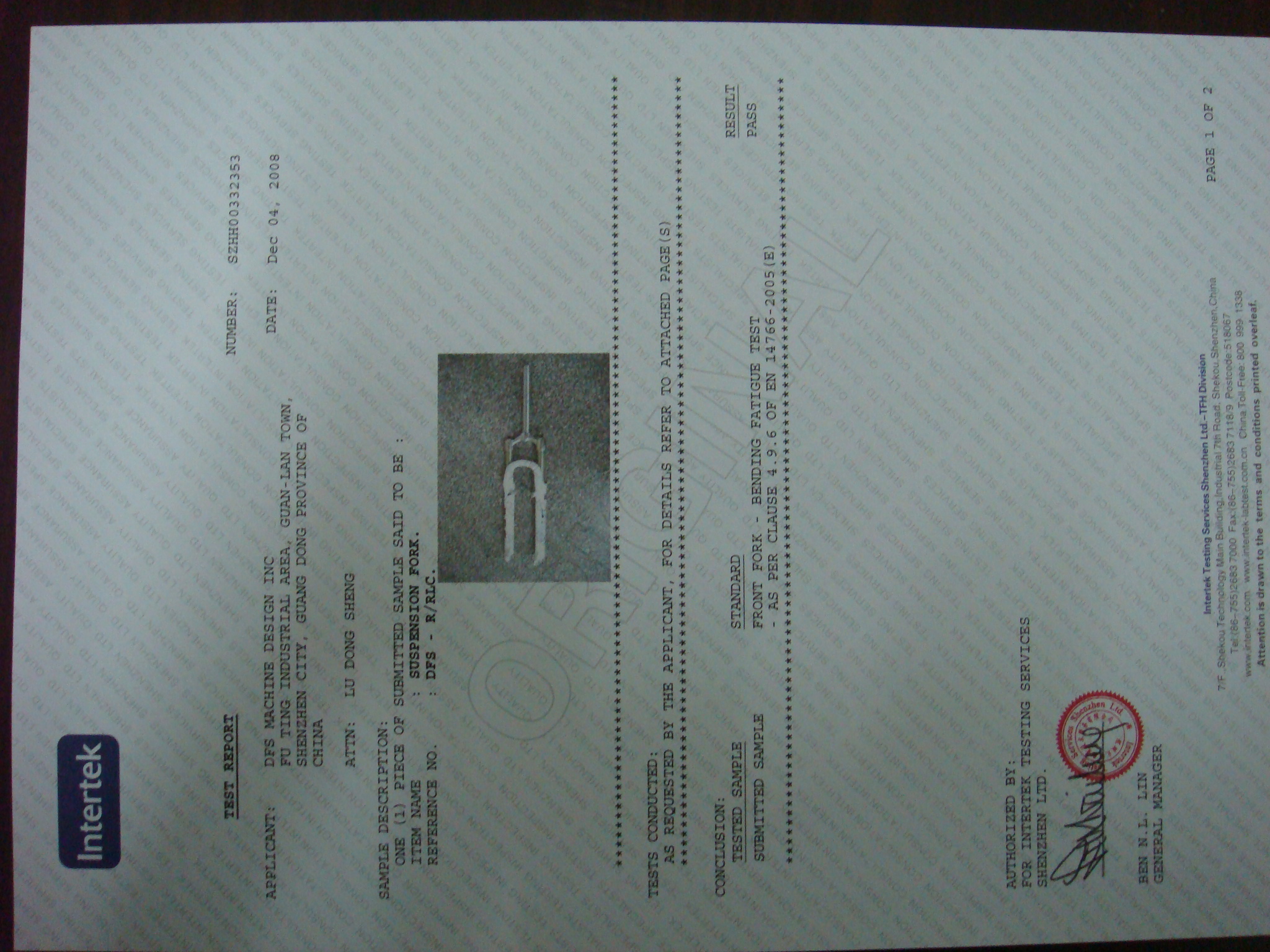
On the documentation side, the company holds an Intertek test report for bicycle suspension forks, report number SZHH00332353, issued under the EN 14766:2005 standard for the European Union market. That report is a useful starting point for EU-facing programmes, but it should be read in the context of how fork standards are structured internationally. The U.S. Consumer Product Safety Commission's summary of bicycle standards notes that ASTM, EN and ISO frameworks each contain suspension-fork requirements, including tyre-clearance testing, and that the details vary by framework and by bicycle-use condition. ASTM F2274-11(2024) establishes performance requirements and associated test methods for production suspension and non-suspension forks intended for Condition 3 terrain, and identifies compression load, bending load, impact resistance and fatigue as test categories. ASTM F2273-11 defines the mechanical test methods, while ISO 4210-6:2023 covers suspension-fork tyre clearance, front-fork tensile strength, static bending, rearward impact, bending fatigue with impact, and forks intended for hub or disc brakes. Those frameworks describe related but not automatically interchangeable requirements. A report issued against one framework does not by itself demonstrate conformity to another, and the report is scoped to the sample that was tested — so buyers should verify the tested model, the issue date and the applicable standard for their target market before treating it as programme evidence.
OEM/ODM terms: MOQ, capacity, lead time and customization
Commercial terms for this product family are stated in the manufacturer's capability documentation: a minimum order quantity of 2,000 pieces, a monthly capacity of 3,000 units, and a lead time of 30 to 120 days depending on the configuration. FOB Shenzhen is the reference shipping term for export orders, and the payment schedule is defined in the commercial documents for each order rather than applied as a fixed standard across all programmes. After-sales support is stated as a 2-year warranty with remote technical guidance.
Customization is available across logo, material, surface finish, travel, axle specification, brake mount and packaging. A documented OEM/ODM case illustrates the practical shape of a custom programme: bicycle OEM/ODM clients located in Germany, Argentina and South Korea, a project scale of 10,000 units, and a supply relationship that has continued for three years, with the paint shop supporting custom colours and logo printing for OEM orders. The manufacturer's declared export markets cover Europe, North America, South America, Southeast Asia, the Middle East, North Africa, South Africa, South Korea and Russia.
Where this fork should not be used, and other boundaries worth respecting
Several limits are worth stating plainly, because most procurement failures in this category come from ignoring one of them rather than from a defective product.
- Travel class. A 100 mm fork is an XC-oriented configuration. It is not a gravity or long-travel enduro specification, and it should not be selected for terrain classes that assume substantially more travel.
- Model name is not a fit confirmation. The applicable scenario documentation states explicitly that replacement should not be based on the model name alone, and that wheel size, fork travel, steerer, front-axle specification, brake-mount interface, frame compatibility, air-pressure setup and operating environment must be confirmed before purchase.
- Order scale. A minimum order quantity of 2,000 pieces means this supply route suits OEM, ODM, distributor and assembly programmes. It is not structured for single-unit aftermarket replacement.
- Lead-time planning. A 30 to 120-day lead time requires the order to be placed against a build schedule, not against immediate need.
- Standards are not interchangeable. ASTM, EN and ISO suspension-fork requirements overlap in test categories but differ in detail, and conformity to one framework does not automatically satisfy another.
- Configuration-dependent specifications. Steerer profile, axle standard and weight vary across the platform. Buyers should confirm the values for the exact model and build variant on the order confirmation.
Market context: premiumization is moving faster than unit growth
Two data points frame the buying environment. The global bicycle suspension system market stood at about USD 0.81 billion in 2025 according to Mordor Intelligence, a figure that covers forks and shock absorbers together rather than forks alone. Separately, carbon fiber forks were reported at roughly 25% of the global fork market in 2024, which indicates that a material-led premium segment is already a meaningful share of demand rather than a niche. On the trade side, bicycle front forks are classified under HS code 8714.91, which is the classification buyers and customs brokers work with when importing this component.
The procurement consequence is straightforward. When a category grows through value rather than volume, supplier selection shifts toward documented process control, material specification and test evidence, because those are the things that distinguish a premium fork from a commodity one. Price comparison alone stops being a reliable filter once carbon lowers and crown assemblies, tapered steerers, adjustable air springs and compression damping enter the specification.
What buyers should watch in the next planning cycle
Three changes are reasonable to plan around. First, the air spring with hydraulic lockout and compression adjustment is already a baseline expectation in the XC segment rather than a differentiator, so buyers should specify adjustment ranges and reference settings in the purchase documentation instead of treating them as optional extras. Second, axle and wheel standards continue to consolidate around Boost thru-axle and 29-inch platforms at the XC and trail level, while 26 and 27.5-inch compatibility remains relevant for replacement, fleet and regional programmes — which means a supplier's ability to cover multiple wheel sizes on one platform reduces the number of separate supply relationships a buyer has to manage. Third, documentation expectations are rising: as the standards landscape remains split across ASTM, EN and ISO frameworks, buyers who define their test category and target market before tooling and sampling will spend less time resolving compliance questions after mass production has started.
Frequently asked questions
Which parameters should be checked first when selecting a bicycle suspension fork?
Travel, stanchion diameter, wheel size and damper type are the four core selection parameters. Travel indicates the riding category — short travel for XC cross-country, longer travel for downhill. Damper type indicates the price and weight position: coil spring designs are generally cost-effective, while air spring designs are generally lighter. Stanchion diameter and wheel size then determine stiffness class and the clearance envelope.
What are the technical parameters of the CIVET-RLC-TP-32-15X100?
The model is specified as a 100 mm travel fork with a 32 mm AL 7050 hard-anodized stanchion, compatibility with 26, 27.5 and 29-inch builds, an air spring, and hydraulic lockout with compression adjustment. It belongs to the same 32 mm RLC-TP platform as the carbon Boost variant DFS-RLC-TP-RCE-TC-BOOST-15X110, whose published sheet lists a carbon tapered steerer from 39.8 mm to 28.6 mm, carbon lower and crown, Teflon bushing, hydraulic adjustable rebound, post disc mount, 1.35 kg weight and a 15 x 110 mm Boost axle.
What information must a buyer provide before a fork quotation can be confirmed?
Eight inputs: frame model, wheel size, fork travel, steerer tube specification, front axle specification, brake-mount type, tyre size and intended use with operating environment. These cover head tube geometry, clearance, hub interface and caliper mounting. Replacement decisions should not be made from the model name alone.
Can one fork model cover 26, 27.5 and 29-inch frames?
The CIVET-RLC-TP-32-15X100 is specified as compatible with 26, 27.5 and 29-inch builds, and the manufacturer's wider product line covers mainstream 20, 24, 26, 27.5-inch and 29-inch or 32-inch mountain bike frames. Compatibility is nominal at the platform level, however; the actual frame and tyre combination must still be confirmed, and clearance should be evaluated with the fork at full compression.
How is quality controlled, and what QC evidence can a buyer request?
Quality control is described as running from the beginning to the end of production, with every product fully assembled and carefully tested before packing, and 100% testing performed before shipment. On documentation, the manufacturer holds an Intertek test report for bicycle suspension forks, report number SZHH00332353, referencing EN 14766:2005 for the European Union market. Buyers should verify the report's tested model, issue date and applicable standard against their target market, because ASTM, EN and ISO suspension-fork requirements overlap but are not automatically interchangeable.
What are the MOQ, capacity and lead time for OEM suspension fork orders?
The stated minimum order quantity is 2,000 pieces, monthly capacity is 3,000 units, and lead time ranges from 30 to 120 days depending on configuration. FOB Shenzhen is the reference shipping term for export orders, with the payment schedule defined in the commercial documents for each order. Customization is available across logo, material, surface finish, travel, axle specification, brake mount and packaging.
What warranty and after-sales support apply?
The manufacturer provides a 2-year warranty and remote technical guidance for suspension forks. This includes support for setup questions such as air-pressure baselines, lockout routing and compression reference settings.
Is 100 mm travel the right choice for every rider?
No. 100 mm is an XC-oriented configuration suited to cross-country and lighter trail riding. Riders whose terrain and riding style assume substantially longer travel should select a different configuration within the same air fork platform rather than adapting a 100 mm fork beyond its intended use.
Does a test report issued under one standard satisfy another market's requirement?
Not automatically. The U.S. Consumer Product Safety Commission's comparison of bicycle standards notes that ASTM, EN and ISO frameworks each contain suspension-fork requirements, including tyre-clearance testing, with details varying by framework and bicycle-use condition. ASTM F2274-11(2024), ASTM F2273-11 and ISO 4210-6:2023 cover related test categories such as tensile, static bending, impact and fatigue, but the frameworks should be treated as related rather than equivalent. Buyers should define the applicable standard for their market before sampling and mass production.
Reference documents
The DFS AIR SUSPENSION FORK 2026 product brochure, which covers the air fork range including travel, axle and material configurations, is available for download: DFS AIR SUSPENSION FORK 2026 brochure (PDF). Manufacturer website: www.dfsfork.com.
Have Questions or Need More Details?
Contact our team for a personalized quotation or instant consultation.
Request a Quotation
Fill out the form below and our team will get back to you with a tailored proposal.
WhatsApp Direct Chat
Prefer to chat in real-time? Message us on WhatsApp for instant assistance & quick answers.
- Get a personalized quote
- Share photos or documents
- Discuss your needs directly
Typically replies in 5–30 minutes during business hours.