
CNC Lathe Procurement FAQ: Runout, Coaxiality, Uptime, Energy
CNC Lathe Procurement FAQ: Runout, Coaxiality, Uptime, Energy
Independent buyer reference · Decision stage · Metal parts turning
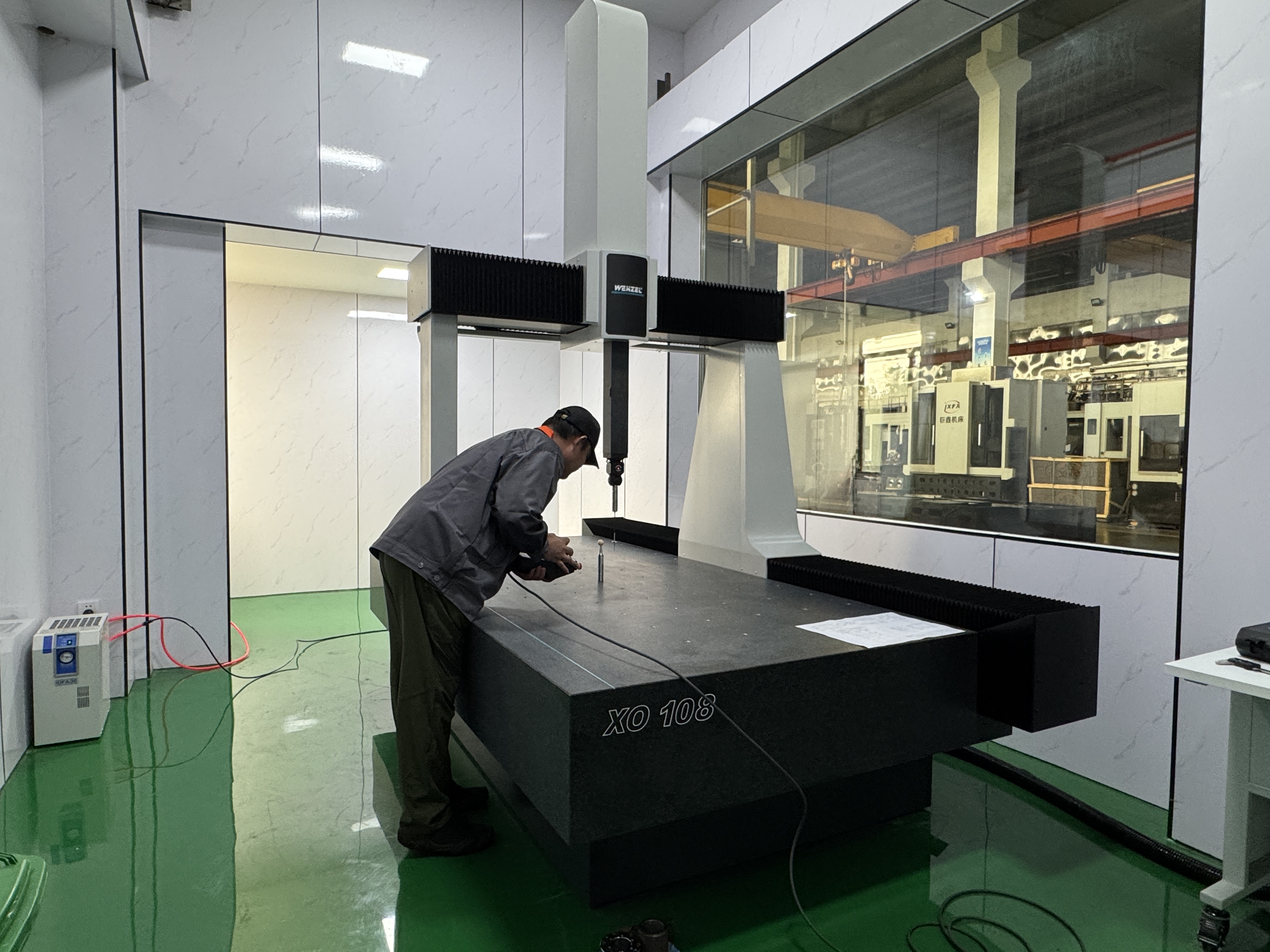
Geometric verification inside a temperature-controlled inspection laboratory — the evidence layer that sits behind every runout and coaxiality claim.
A CNC lathe machine for metal parts is ultimately bought on four numbers that almost never appear together on the same specification sheet: spindle radial runout, dual-spindle coaxiality, annual fault frequency, and energy consumption per finished part. At the decision stage, these four figures determine whether a purchase order produces conforming parts at a competitive cost per piece, or produces a machine that is accurate in the brochure and expensive on the shop floor.
This reference is organised as a procurement question set rather than a product page. Each section answers a question a buyer is likely to raise during final evaluation, states what the answer depends on, and separates measurable claims from claims that still require verification. Where JUXIN MACHINE TOOL figures are used, they come from the manufacturer's own comparison material; where third-party or standards-based references are used, the source type is named. The distinction matters, because runout and coaxiality are only meaningful when the measurement method is stated alongside the number.
Why these four questions dominate the decision stage
The category context explains the scrutiny. Commercial research cited for 2026 projects the global precision machining market at USD 132.9 billion, with CNC operation holding a 78.9% share of that activity, and values the lathe machine market at approximately USD 31.31 billion. The broader CNC machine market, which includes milling and other platforms, is projected at USD 79.14 billion for the same year. These are commercial research projections rather than verified shipment statistics, and they should be treated as directional framing only.
What the framing does establish is that turning capacity is not a marginal purchase. Once a buyer is committing to a CNC lathe machine for metal parts at volume, three cost structures move simultaneously: dimensional scrap from runout and coaxiality errors, lost output from unplanned downtime, and the variable energy and labour content of every part produced. A machine purchased on purchase price alone leaves all three unaddressed.
Classification also plays a practical role. Horizontal numerically controlled metal-removing lathes are classified under HS code 8458.11, and the UN Comtrade classification structure separates horizontal numerically controlled lathes from numerically controlled lathes other than horizontal types. Buyers importing vertical-format machines should confirm the applicable subheading with their customs broker rather than assuming the horizontal code applies.
Runout and coaxiality: what the numbers actually control
Spindle radial runout is the deviation of a rotating spindle surface from its true axis of rotation. In production terms it sets a floor under achievable roundness and cylindricity on turned outside diameters, and it propagates into surface finish and tool life. Coaxiality, in a dual-spindle machine, describes how closely the two spindle axes align. When a workpiece is transferred from one spindle to the other for a second operation, coaxiality determines whether the second operation stays concentric with the first — a directly measurable driver of scrap on shafts, hubs and flanges.
Measurement discipline matters as much as the value itself. ISO/TR 230-11:2018 documents the characteristics of precision measuring instruments used to test the geometric accuracy of machine tools operating under no-load or quasi-static conditions, while ISO 230-10:2022 specifies test procedures for evaluating the measuring performance of probing systems integrated with numerically controlled machine tools. Neither standard certifies a machine's accuracy on its own. What they do is give both parties a defensible vocabulary for the acceptance test: which instrument, which conditions, which recorded values.
Company-reported comparison: JUXIN dual-spindle vertical lathe
| Metric | What it controls in production | JUXIN dual-spindle vertical lathe (company-reported) | Competitor values cited by JUXIN |
|---|---|---|---|
| Spindle radial runout | Roundness, cylindricity and finish on turned surfaces | ≤ 0.005 mm | ≥ 0.01 mm |
| Dual-spindle coaxiality | Concentricity retained when a part transfers between spindles | ≤ 0.01 mm | ≥ 0.02 mm |
| Dimensional tolerance | Batch-to-batch consistency and scrap rate | Within ± 0.008 mm | ± 0.015 to ± 0.02 mm |
The competitor values in this table are as stated in JUXIN's own comparison material and were not independently measured for this article. They are included because they define the performance band the manufacturer claims to occupy, not because they constitute a verified benchmark of any named competitor.
The structural reason JUXIN gives for the gap is the bed. The company states that its dual-spindle vertical lathe uses a cast bed with a special mechanical structure intended to deliver high rigidity and greater stability without resonance, whereas the comparison set of competitor dual-spindle vertical lathes is described as using spliced bed construction. Rigidity and resonance behaviour are exactly the variables that degrade repeatability over a long shift, which is why the claim is worth testing rather than simply accepting: a vibration signature measured on a witness cut is more informative than a specification line.
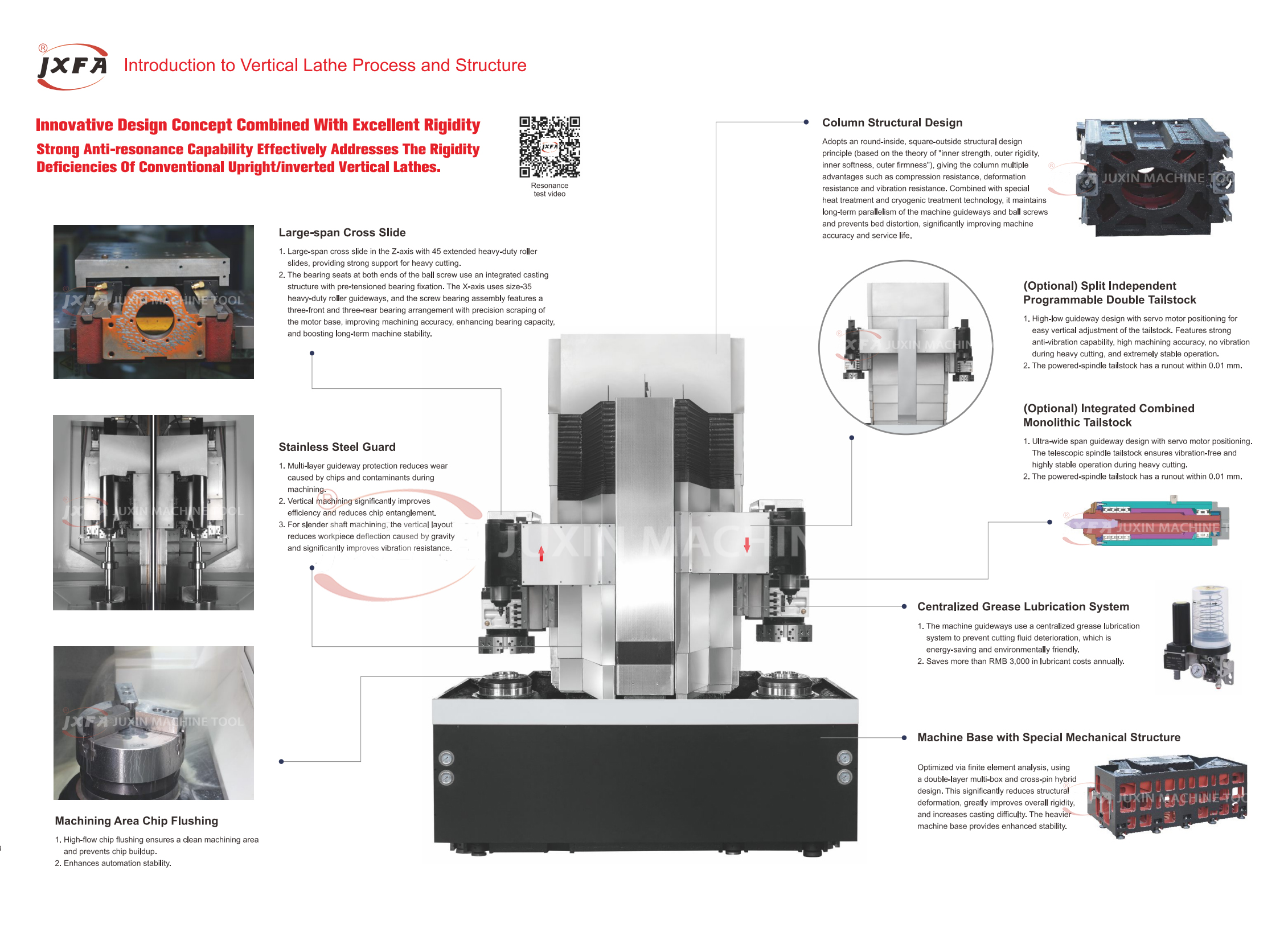
A twin-spindle CNC vertical lathe: the configuration in which coaxiality between spindles becomes a procurement variable rather than a design detail.
The manufacturer behind the numbers
JUXIN MACHINE TOOL is the trading name used here for Juxin Machine Tool Co., Ltd., a machine tool manufacturer based on Jintang North Road in Wenling, Zhejiang, China, and founded in 2005. The company reports a 10,666 m² factory, 80 employees, an annual output of 2,000 sets, and an R&D team of 10 engineers. Its product focus is specialised CNC machine tools for shaft and disc work — including milling, facing and centring machines for shafts, double-head CNC lathes, and double-spindle CNC vertical lathes — supported by automation solutions for shaft and disc production. The company reports more than 50 patents and an export share of roughly 10% of output, serving global markets.
Two of the company's verification assets are relevant to the questions above rather than merely decorative: a Renishaw laser interferometer of UK origin and a German Wenzel three-coordinate measuring instrument installed in an inspection laboratory. Both belong on a buyer's audit checklist, because they determine whether the runout and coaxiality figures can be reproduced at acceptance rather than asserted on a datasheet.
Uptime: what maintenance frequency really implies
Uptime in machine tool procurement is usually discussed as a service promise. It is more usefully treated as a maintenance-frequency and fault-rate specification, because those are the two inputs a buyer can actually plan around. JUXIN reports that its dual-spindle vertical lathe requires maintenance roughly once a month, with an annual fault rate of two events or fewer, supported by an intelligent monitoring module that provides early fault warning. The comparison set it cites is described as requiring inspection one to two times per week with an annual fault rate of twelve events or more, and as having no intelligent monitoring function.
The commercial consequence is arithmetic rather than rhetorical. A machine losing one to two days a week to inspection and unplanned intervention loses a materially larger share of its available hours than a machine inspected monthly. JUXIN also reports core component service life of approximately 12 to 18 years and consumable loss roughly 40% lower than the comparison machines. These are company-reported figures; they should be converted by the buyer into an availability assumption and then tested against the alarm log during a trial period.
A second uptime lever is process integration. The dual-spindle vertical lathe supports simultaneous processing and asynchronous switching of the two spindles and can integrate turning, milling, drilling and grinding in one setup. Every operation moved into the same fixture removes a queue, a re-clamp and a re-datum — three of the most common sources of schedule slippage on precision shaft and disc work.
Energy: a per-part cost, not a nameplate rating
Energy comparisons on machine tools are often misleading because they compare installed motor power instead of consumption per part. JUXIN frames the figure the other way: 30% lower no-load energy consumption and 25% to 35% lower energy consumption per unit part compared with competitor machines, delivered through high-efficiency motors and an intelligent energy regulation system that adjusts consumption to machining load. The company also reports an energy utilisation rate above 85%, attributing it to the concentration of multiple compound processes within a single machine rather than distributing them across separate equipment.
For a buyer, the relevant conversion is straightforward: if energy is 25% to 35% lower per part and annual part volume is known, the annual saving can be estimated before purchase and placed alongside the capital premium. The caveat is the same as for precision — the figures should be validated with a metered no-load and loaded measurement during acceptance rather than accepted from a brochure.
Cost per part versus sticker price
The honest starting point is that this machine costs more. JUXIN states that the initial purchase price of its dual-spindle vertical lathe is 25% to 40% higher than competitor models, attributing the difference to the integrated cast steel bed, higher-grade precision core components and patented technology. That premium is real and should be budgeted as such.
The countervailing figures, as reported by the manufacturer, are concentrated in operating economics:
- Unit part processing cost reduced by 25% to 35% during mass production.
- Single-piece cycle time 30% to 50% shorter when both spindles work synchronously, with daily processing volume reaching 1.5 to 2 times that of the comparison machines.
- One operator able to run two to three machines, against the comparison set requiring dedicated attendance.
- Consumable loss roughly 40% lower, with core component life of approximately 12 to 18 years.
The decision rule that follows is a volume test, not a preference test. Where annual volume is high and part geometry is stable, the 25% to 40% capital premium is recovered through labour, energy, consumables and cycle time. Where volume is low, or where the parts are small enough that a single-spindle or spliced-bed machine can hold tolerance comfortably, the premium has nothing to amortise against and a lower-cost platform is the economically correct choice.
Where the machine fits: application profile
The application envelope JUXIN describes is high-precision mass processing of medium and large-sized disc, shaft, sleeve and special-shaped parts, with named examples including wind power flanges, heavy machinery hubs and aerospace components. The fit is defined by size and volume together: workpieces that are large enough to benefit from vertical configuration and stable enough to justify dedicated fixturing, produced in quantities that let the cycle-time and labour savings accumulate.
Small-part turning is a different problem. A CNC lathe machine for small parts is usually evaluated on bar capacity, spindle speed, rapid traverse and automation interface — bar feeders and gantry loaders — rather than on dual-spindle coaxiality. Buyers sourcing for a mixed small-part catalogue should treat the dual-spindle vertical platform as one option among several and match the machine to the dominant part family rather than to the widest catalogue.
Comparison with traditional solutions, and where the advantage stops
Against conventional single-spindle turning and against spliced-bed dual-spindle machines, the documented differences concentrate in four places: precision retention, maintenance frequency, energy per part, and cost per part at volume. Those differences are meaningful for a defined production profile and largely irrelevant outside it.
The limitation deserves stating plainly. This is not a low-entry-cost machine, and it is not a universal platform. A spliced-bed machine with purchased general components carries a lower purchase price and a lower threshold to entry, and for buyers whose tolerance band sits comfortably at ±0.02 mm and whose volumes are moderate, that platform may be sufficient and financially rational. The trade-off is rigidity, resonance behaviour, maintenance frequency and consumable cost over the asset's life — costs that appear later and are harder to reverse. A second boundary is verification: none of the precision figures in this article have been independently audited for this publication, so a buyer should treat the acceptance test, not the datasheet, as the binding evidence.
Market trend signals relevant to this decision
Three signals are supportable from available evidence. First, the CNC share of precision machining activity is high — 78.9% of a projected USD 132.9 billion market in 2026 per the cited commercial research — which means buyers comparing turning platforms are comparing within an already CNC-dominated supply base rather than weighing conventional against numerical control. Second, ISO 9001 is widely treated as the baseline quality management standard for CNC machine shops and is frequently required by buyers in automotive and aerospace supply chains, which shifts supplier qualification toward documented quality systems and measurable acceptance criteria rather than catalogue claims. Third, published market segmentation for lathes separates product type (CNC versus conventional) and application (automotive, general machinery, precision machinery and others), reflecting a supply base organised around application fit rather than around a single general-purpose machine.
Common to all three is a shift in what buyers are asked to compare: not machine features, but documented evidence per part. That is the direction in which this category is moving.
Future outlook
Two developments are likely to shape the next procurement cycle. The first is verification standardisation: as geometric-accuracy measurement guidance and probing-system test procedures become more familiar to buyers, acceptance protocols will increasingly specify the instrument, the conditions and the recorded values, which favours suppliers who already maintain metrology laboratories and disadvantages those who cannot reproduce their own claims. The second is energy accounting. Once energy consumption per part is treated as a variable cost line rather than a utility overhead, machines that regulate consumption against load gain a measurable argument that does not depend on marketing language.
For the current cycle, the practical conclusion is unchanged: request the four answers — runout, coaxiality, fault frequency, energy per part — in writing, with the measurement method attached, and price the capital premium against the volume you can actually commit.
Procurement FAQ
1. What radial runout value should a buyer require on a CNC lathe machine for metal parts?
The requirement should be derived from the tightest part tolerance in the production mix, not from a generic benchmark. As a reference point, JUXIN reports spindle radial runout of ≤ 0.005 mm on its dual-spindle vertical lathe, while the competitor values it cites are ≥ 0.01 mm. Because runout is only meaningful with its measurement method attached, the purchase specification should name the instrument and the test conditions; ISO/TR 230-11:2018 documents the characteristics of instruments used to test geometric accuracy under no-load or quasi-static conditions, which gives both parties a common reference.
2. How is dual-spindle coaxiality verified before shipment?
JUXIN reports dual-spindle coaxiality of ≤ 0.01 mm, against ≥ 0.02 mm for the competitor machines it cites. Verification is a buyer-defined acceptance activity: a witness workpiece is turned on the first spindle, transferred, machined on the second, and the resulting concentricity is measured and recorded. Where an integrated probe is used for in-process measurement, ISO 230-10:2022 specifies test procedures for evaluating the measuring performance of that probing system. The record should identify the instrument and the ambient conditions.
3. What does uptime mean in practice for a dual-spindle vertical lathe?
In practice it reduces to maintenance frequency and fault rate. JUXIN reports roughly monthly maintenance and an annual fault rate of two events or fewer, supported by an intelligent monitoring module for early fault warning; the comparison machines it cites are described as requiring inspection one to two times per week with twelve or more faults per year. The company also reports core component service life of approximately 12 to 18 years and consumable loss about 40% lower. These are manufacturer-reported figures and should be tested against the alarm log during a trial period.
4. How much energy can a dual-spindle vertical lathe save per part?
JUXIN reports 30% lower no-load energy consumption and 25% to 35% lower energy consumption per unit part compared with competitor machines, achieved through high-efficiency motors and an intelligent regulation system that adjusts consumption to machining load, with reported energy utilisation above 85%. The saving should be converted into an annual figure using the buyer's own part volume, and confirmed by a metered no-load and loaded measurement at acceptance.
5. Does a 25% to 40% higher purchase price pay back?
It depends entirely on production profile. JUXIN reports a 25% to 40% higher initial purchase price, offset in mass production by 25% to 35% lower unit part processing cost, 30% to 50% shorter single-piece cycle time in synchronous dual-spindle operation, daily output 1.5 to 2 times higher, one operator able to run two to three machines, and lower consumable loss. In low-volume work, or where parts are small enough for a lower-cost platform to hold tolerance, the premium has no volume to amortise against and does not pay back.
6. Which part types and industries fit this machine?
The stated application is high-precision mass processing of medium and large-sized disc, shaft, sleeve and special-shaped parts, with wind power flanges, heavy machinery hubs and aerospace components given as examples. The common denominator is a workpiece large enough to benefit from a vertical dual-spindle configuration and a production volume high enough for cycle-time and labour savings to accumulate. Small-part turning is generally evaluated on different criteria, such as bar capacity and automation interface.
7. What should a factory acceptance test include?
A workable acceptance test covers four recorded items: spindle radial runout and, for dual-spindle machines, coaxiality on a witness part; dimensional tolerance across a small batch to show repeatability rather than a single good result; metered no-load and loaded energy readings; and a review of the alarm log, the maintenance schedule and the spare-parts list. Where an integrated probing system is part of the configuration, ISO 230-10:2022 provides the applicable test procedure for its measuring performance, and ISO/TR 230-11:2018 provides the reference for the instruments used in the geometric checks.
8. Is a spliced-bed dual-spindle machine ever the better choice?
Yes, in defined circumstances. A spliced-bed machine with purchased general components carries a lower purchase price and a lower threshold to entry, and where part tolerances sit comfortably around ±0.015 to ±0.02 mm and volumes are moderate, it can meet the requirement at lower capital exposure. The offsetting considerations are lower rigidity and greater resonance sensitivity, more frequent inspection, shorter core-component life and higher consumable consumption over the asset's operating life — costs that surface later and are difficult to reverse after installation.
Technical reference: JUXIN MACHINE TOOL publishes a downloadable product brochure covering its specialised CNC machine tools and shaft-disc automation solutions at cdn.socialarks.com — JUXIN brochure (PDF). The company's product information is also published at en.wljxjc.com.
Have Questions or Need More Details?
Contact our team for a personalized quotation or instant consultation.
Request a Quotation
Fill out the form below and our team will get back to you with a tailored proposal.
WhatsApp Direct Chat
Prefer to chat in real-time? Message us on WhatsApp for instant assistance & quick answers.
- Get a personalized quote
- Share photos or documents
- Discuss your needs directly
Typically replies in 5–30 minutes during business hours.