
CNC Machining Service Fit: Aerospace, Medical, Energy, Oil & Gas
Precision CNC machining is a general-purpose manufacturing method, but the rules that govern it are industry-specific.
A titanium bracket for an aerospace assembly, a stainless steel housing for a medical device, a corrosion-resistant body for oil and gas equipment and a high-strength component for an energy system can all be produced on the same 5-axis machining centre. What changes is everything around the cut: the material specification, the tolerance callout, the inspection regime, the documentation package and the quality standard a buyer's own system expects the supplier to hold.
Suzhou ECOD Precision Manufacturing Co., Ltd (ECOD) is a precision machining supplier based in Suzhou, China, founded in 2005, specialising in high-precision CNC machining services and casting services. Its manufacturing facility covers 40,000 m² and employs 350 people, including a 25-engineer technical team. The company exports 100% of its output to markets in Europe, the Middle East, North America and Asia, and its stated application industries include aerospace, oil and gas, energy and medical devices.
This article explains how a precision CNC machining service is configured for four regulated industries — aerospace, medical devices, energy, and oil and gas — covering material selection, 5-axis milling, turning and EDM capability, a stated precision of up to ±0.005 mm, ISO 9001 certification, 100% inspection, batch strategy and quotation workflow. It also sets out where a general-purpose machining capability ends and where sector-specific qualification begins.

Aerospace work places the highest combined demands on material control, dimensional tolerance and traceability. Image: ECOD.
Why regulated industries now shape CNC sourcing decisions
Procurement teams rarely buy "CNC machining" as an abstract category. They buy a component that has to satisfy a specification written by an aerospace stress engineer, a medical device regulatory lead, an oil and gas reliability engineer or an energy project manager. The commercial market reflects that shift in scale: Business Research Insights estimates the global CNC machining services market at USD 58.33 billion in 2026, reaching USD 108.3 billion by 2035.
Supply-side pressure points the same way. Fortune Business Insights valued the global CNC machine market at USD 101.22 billion in 2025 and projects USD 251.61 billion by 2034, with Asia Pacific holding a 55.70% share in 2025. Within China, Haizol reports that Jiangsu, Guangdong and Zhejiang together control 82.2% of national CNC machining capacity — a concentration that matters because a supplier's location usually determines its access to skilled operators, tooling and sub-tier processes. Suzhou, where ECOD is based, sits inside that Jiangsu cluster.
Labour availability is a third constraint. Gitnux, citing U.S. labour projections, reported 75,000 unfilled CNC operator roles in the United States in 2023. For a buyer, this changes the qualification question. It is no longer only "can this supplier machine my part?" but "can this supplier hold a qualified process across a multi-year programme, and does someone remain who can run it?"
Four industries, four different requirement profiles
The same machining centre can serve all four sectors, but each sector imposes a different combination of material, tolerance, verification and documentation requirements. Understanding those differences is the first step in qualifying a supplier.
Aerospace: material performance and traceability come first
Aerospace components are typically specified around strength-to-weight ratio, fatigue behaviour and dimensional consistency. Titanium and aluminium alloys dominate this space because those properties matter more than raw material cost. Dimensional tolerance is tight, but the deeper requirement is repeatability — the thousandth part must behave like the first.
The quality system expectation is also higher. SAE International describes AS9100, the aerospace quality management standard, as incorporating ISO 9001 plus more than 100 additional requirements for safety and reliability. That is a materially different scope from a general ISO 9001 certificate, and it is one of the first things an aerospace buyer should check.
Medical devices: material control and process consistency
Medical device components are usually smaller, geometrically intricate and produced in repeated batches where variation is the main risk. Stainless steel is a common choice because it combines corrosion resistance with mechanical stability, and surface condition can affect downstream cleaning and assembly steps.
On the quality side, ISO states that medical device production must comply with ISO 13485 for quality management systems. As with aerospace, this sits above a baseline ISO 9001 system and should be confirmed at the qualification stage rather than assumed.
Energy: continuous operation and thermal load
Energy equipment parts frequently run continuously, so the specification often focuses on high-temperature behaviour, high-strength mechanical properties and stability under continuous industrial operation rather than on mass reduction. These are the working conditions ECOD lists for its precision machining applications, alongside corrosion-resistant environments and tight-tolerance manufacturing.
Oil and gas: corrosion and harsh environments
Oil and gas components operate in exactly the conditions that degrade ordinary parts: moisture, chemical exposure, pressure cycling and abrasion. Corrosion resistance and structural integrity therefore drive material choice, and stainless steel grades appear frequently. ECOD's stated project scope includes oil and gas equipment parts, and its case record includes a customer in this sector (discussed later in this article).
| Industry | Requirements that drive the design | Independent standard often referenced |
|---|---|---|
| Aerospace | Strength-to-weight ratio, fatigue behaviour, traceability | AS9100 (incorporates ISO 9001 plus 100+ additional requirements, per SAE International) |
| Medical devices | Material control, small-feature precision, batch consistency | ISO 13485 (per ISO) |
| Energy | High-temperature resistance, high-strength parts, continuous operation | Application-specific; confidential drawing and material specifications |
| Oil and gas | Corrosion resistance, harsh-environment durability, reliability | Application-specific; corrosion and material specifications |
How a precision CNC machining service adapts to each profile
Adaptation happens in four places: material selection, process routing, tolerance control, and inspection and documentation. A supplier that only handles the first two can produce a dimensionally correct part that still fails a regulated buyer's release process.
Material selection is a specification decision, not a preference
ECOD machines carbon steel, stainless steel, aluminium, brass, copper, titanium and engineering plastics including POM and nylon. That list spans the four regulated industries, but the mapping is not random. Aerospace work gravitates toward titanium and aluminium alloys, where weight and strength dominate. Medical device and oil and gas components frequently use stainless steel, where corrosion resistance and cleanability dominate. Energy and automation parts more often use alloy and carbon steels.
Xometry identifies Aluminium 6061-T6 as the most widely used material in CNC machining, a position it holds because of its machinability and strength-to-weight ratio. For a buyer, that popularity has a procurement consequence: it is one of the materials on which most shops have the deepest process history, which typically makes it the lowest-risk starting point for a new programme.
Process routing: 5-axis milling, turning, EDM and grinding
The service scope covers CNC turning, CNC milling, drilling, grinding, tapping and EDM. The matched equipment base includes CNC turning centres, CNC milling machines, 5-axis CNC machines, grinding machines, EDM machines and CMM inspection, supported by surface treatment and heat treatment steps.
5-axis machining matters for regulated work for a specific reason: it reduces the number of setups. Fewer setups means fewer fixture-induced position errors and less accumulated variation across a complex geometry — which is exactly the risk profile aerospace and medical components carry. EDM covers internal features and sharp internal corners that rotary cutters cannot reach, and grinding handles final dimensional and surface-finish requirements that milling alone may not deliver. Dataintelo reports that milling machines held the largest machine-type share at 31.4% in 2025, a figure consistent with the broad role milling plays, particularly in aerospace work.
Tolerance: reading a ±0.005 mm claim correctly
ECOD states high precision up to ±0.005 mm. This figure describes an achievable capability band, not a default applied to every feature on every drawing. Real achievable tolerance depends on the material, the geometry, the size of the feature, the tooling reach and the fixturing strategy. A thin-wall titanium feature and a solid stainless steel boss on the same drawing will not behave identically.
The practical procurement question is therefore narrower than "can you hold ±0.005 mm?". It is: which features on this specific drawing can hold it, which will need a different approach, and how will both be verified? A supplier that answers that question with a drawing-level breakdown is easier to qualify than one that answers with a blanket confirmation.
Inspection and documentation
ECOD performs 100% inspection before shipment and provides complete material certificates and dimensional inspection reports for all orders. CMM inspection is part of the equipment base. For regulated industries, custom material certifications are available on request.
This documentation layer is what turns a machined part into a releasable component. In aerospace, medical, energy and oil and gas supply chains, an inspector downstream needs to see not only that the part measures correctly, but that the material is what it claims to be and that the measurement itself was performed in a controlled way.
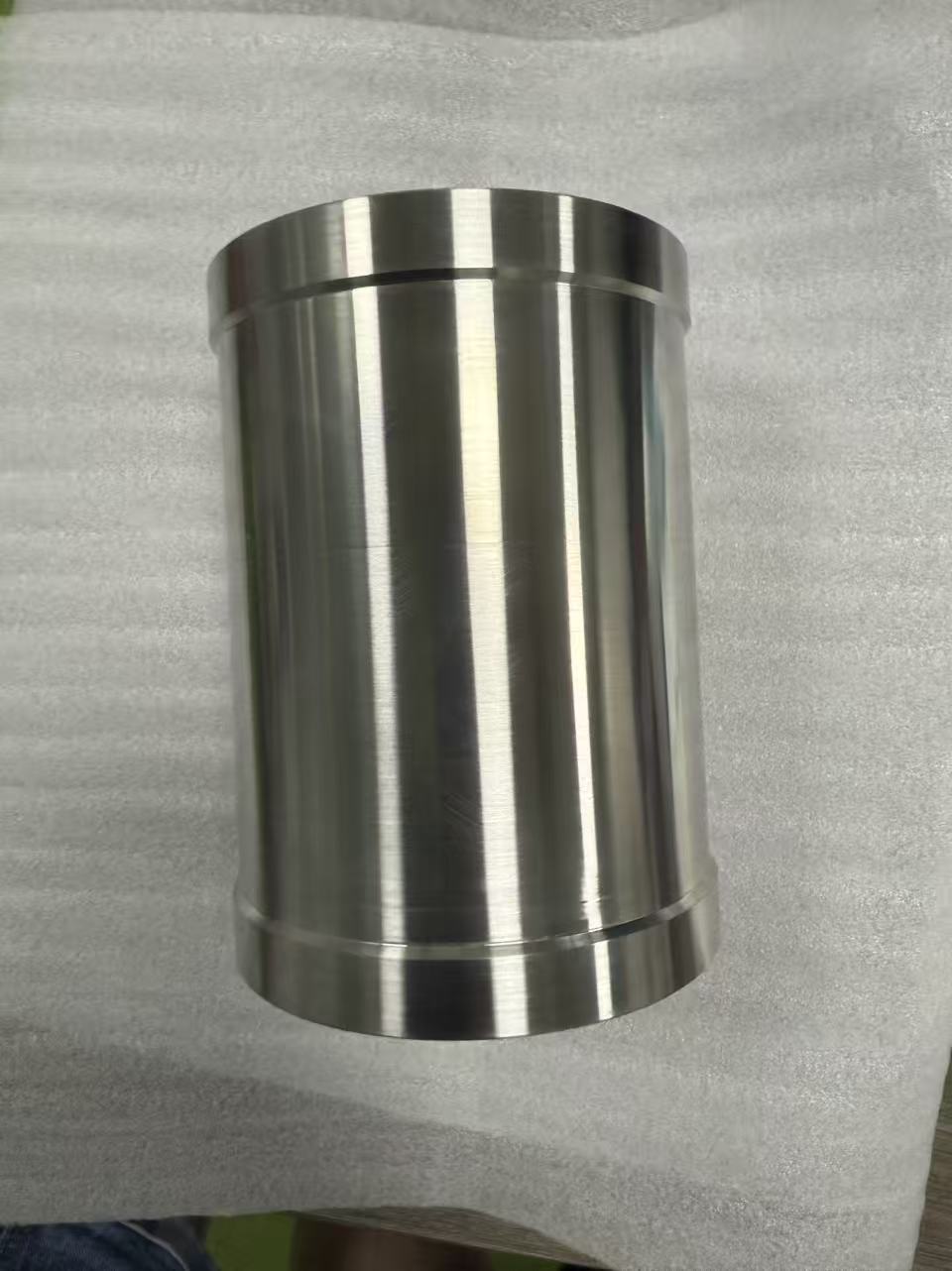
Oil and gas components are specified primarily around corrosion resistance and durability in harsh operating environments. Image: ECOD.
Certification: what ISO 9001 covers and where additional qualification begins
The CNC machining factory operated by ECOD is ISO 9001 certified. The Precision CNC Machining service is certified to ISO 9001 under certificate number 33826Q00178R000, issued by Shanghai Wozhong Certification Co. Ltd, against the standard GB/T19001-2016/ISO9001:2015. The certification scope is Custom CNC Machining Parts Sales, it applies to the global market, and it is valid from 16 June 2026 to 15 June 2029.
That is a verifiable baseline, and it is useful specifically because it is inspectable: the certificate number, issuing body, referenced standard, scope and validity dates can all be checked rather than taken on trust.
What it is not is a sector licence. ISO 9001 is a quality management baseline that applies across manufacturing. AS9100 is a separate aerospace standard that SAE International describes as incorporating ISO 9001 plus more than 100 additional requirements, and ISO 13485 is a separate medical device quality management standard. A buyer whose programme specifies either of those should raise the requirement during the RFQ stage so that the gap — if any — is identified before production, not after.
Batch strategy: from one prototype to mass production
Regulated industries do not buy in a single batch size. The same programme usually moves through a prototype that must be validated, a small batch that must prove process stability, and a production volume that must hold quality over time. ECOD's operating model supports prototype production, small batch production, mass production and OEM/ODM manufacturing, with a minimum order quantity of 1 piece.
Capacity and lead time set the practical envelope. Monthly capacity is stated at 100,000 pieces, annual output at 1,000,000 units, and lead time ranges from 10 to 60 days depending on the order. The company states a 24/7 production capability. The 10-to-60-day range is wide because it reflects real variables: material availability for titanium or specific stainless grades, the number of setups, whether heat treatment or surface treatment is required, and whether custom material certification is requested.
Procurement mechanics: what a 24-hour quotation actually requires
ECOD provides quotations within 24 hours, and the model designation for the service is "No Standard Model / OEM Service" — meaning parts are produced to the customer's drawings rather than selected from a catalogue.
The 24-hour figure only holds if the enquiry contains enough information to price the job. For a regulated-industry part, the following inputs are typically required:
- 2D and 3D drawings, including the revision level to be manufactured
- Material specification, including grade and any certification requirement
- Dimensional tolerance callouts, including which features require the tightest band
- Required surface treatment and machining finish
- Quantity, batch plan and expected delivery schedule
- Inspection and documentation requirements, including whether material certificates or dimensional reports must be supplied with shipment
DFM optimisation is part of ECOD's engineering scope, intended to simplify production and reduce cost. For buyers in regulated industries, engaging that step early is usually more valuable than negotiating unit price, because a design change that removes a difficult feature can reduce both cost and quality risk before the first tool is cut.
Application evidence from regulated programmes
Two of ECOD's documented application cases sit directly inside the four industries discussed here.
The first is a gas and oil industry customer in the United Arab Emirates. The programme covered gas and oil equipment components at a quantity of 10,000 pieces and has run for 5 years. The stated result is improved equipment reliability, with the parts described as adapted to harsh oil and gas working environments. A five-year duration is the more informative part of that record: it indicates the relationship survived multiple production cycles rather than a single trial order.
The second is an aerospace industry customer in Russia producing UAV components. That programme ran at a quantity of 1,000,000 pieces over one year, with the stated result of stable quality in mass production and parts described as matching aerospace industry precision standards. The relevant procurement signal here is the combination of aerospace tolerance expectations with high-volume output — a pairing that tends to expose process control weaknesses quickly.
Both cases reflect the same underlying capability set: tight-tolerance manufacturing, corrosion-resistant and high-strength part requirements, and continuous industrial operation.
Market trend analysis
Three trends are likely to shape how buyers evaluate CNC machining services in the next procurement cycle.
Services are growing faster than the underlying machine base. The global CNC machining services market is estimated at USD 58.33 billion in 2026 and projected to reach USD 108.3 billion by 2035, according to Business Research Insights. That growth is not purely volume-driven; it reflects more outsourced, higher-specification work moving to specialist suppliers.
Precision requirements are intensifying in adjacent sectors. Mordor Intelligence projects that the ultra-precision machining centres market for semiconductor fabrication equipment will grow at 8.36% CAGR between 2026 and 2031. Semiconductor-grade requirements sit at the extreme end of the same tolerance, cleanliness and documentation discipline that aerospace and medical buyers already demand, which raises the general capability bar across the supplier base.
Regional concentration continues. Asia Pacific held a 55.70% share of the global CNC machine market in 2025, per Fortune Business Insights, and within China the Jiangsu, Guangdong and Zhejiang cluster controls the majority of machining capacity. For Western buyers, this means the practical choice is usually not whether to source from that cluster but how to qualify a supplier inside it.
How this compares with conventional machining procurement
Conventional machining procurement tends to be transactional: send a drawing, receive a price, receive parts, inspect on arrival. That model works when the part is simple, the material is common and the consequence of variation is low. It breaks down when the component feeds an aerospace assembly, a medical device or an oil and gas installation.
The difference is not the machine. It is the surrounding system — a stated process list covering turning, milling, drilling, grinding, tapping and EDM; 5-axis capability that reduces setup count; 100% inspection before shipment; material certificates and dimensional inspection reports with every order; and an ISO 9001 certificate that can be verified by number.
Where the boundaries are
Three limits should be stated plainly, because buyers in regulated industries will discover them anyway.
First, ISO 9001 is not AS9100 and not ISO 13485. Where a programme's quality system explicitly requires either of those standards, that must be treated as a qualification gap to be resolved, not as an equivalent. ECOD holds ISO 9001 under certificate 33826Q00178R000 with a defined scope of Custom CNC Machining Parts Sales; buyers whose regulatory obligations sit outside that scope should confirm acceptance with their own quality function.
Second, a stated precision of up to ±0.005 mm is a capability ceiling, not a guarantee across every feature. Achievable tolerance varies with material, geometry, feature size and fixturing, and some features on a given drawing may need a different process route or a relaxed callout.
Third, lead time is a range, not a commitment. The 10-to-60-day span reflects material procurement, process routing and finishing steps; a programme that assumes the lower end without confirming material availability is planning on an assumption rather than a schedule.
Future outlook
The direction of travel for regulated-industry machining is toward tighter documentation and earlier supplier involvement. As precision requirements rise — visible in the 8.36% CAGR projected for ultra-precision machining centres serving semiconductor equipment — the marginal value shifts from cutting metal to proving that metal was cut correctly, repeatedly, with evidence that survives an audit.
For buyers, that suggests a practical shift in how suppliers are selected. The useful selection criteria are increasingly verifiable ones: which standards the supplier holds and under what number, which processes are performed in-house, what inspection is performed before shipment, what documentation accompanies each order, and what batch sizes the supplier can genuinely support. Those are questions with checkable answers, and they are the ones worth asking before the first purchase order rather than after.
FAQ
What certification does a CNC machining service need for regulated industries?
It depends on the industry, and the standards are not interchangeable. ECOD's CNC machining factory is ISO 9001 certified, with certificate number 33826Q00178R000 issued by Shanghai Wozhong Certification Co. Ltd against GB/T19001-2016/ISO9001:2015, covering Custom CNC Machining Parts Sales. Aerospace programmes commonly reference AS9100, which SAE International describes as ISO 9001 plus more than 100 additional requirements, and medical device production must comply with ISO 13485 according to ISO. Buyers whose programmes specify AS9100 or ISO 13485 should confirm that requirement during supplier qualification rather than assuming an ISO 9001 certificate is equivalent.
Which materials are used for aerospace, medical, energy and oil and gas parts?
ECOD machines carbon steel, stainless steel, aluminium, brass, copper, titanium and plastics including POM and nylon. In practice the industry mapping differs: aerospace work tends toward titanium and aluminium alloys for strength-to-weight reasons; medical device and oil and gas components commonly use stainless steel for corrosion resistance; energy equipment parts more often use alloy and carbon steels for high-temperature and high-strength service. Xometry identifies Aluminium 6061-T6 as the most widely used material in CNC machining because of its machinability and strength-to-weight ratio, which is one reason it is a common starting point for new programmes.
What does a ±0.005 mm precision claim actually mean?
It describes an achievable tolerance band at the tight end of the supplier's capability, not a default tolerance applied to every dimension. Real achievable tolerance depends on the material, the geometry, the size and wall thickness of the feature, the tooling reach and the fixturing strategy. Buyers should ask for a feature-level assessment of a specific drawing: which dimensions can hold the tightest band, which require a different process route, and how each is verified. ECOD's service is stated as high precision up to ±0.005 mm, verified through 100% inspection before shipment.
What is the minimum order quantity for a regulated-industry CNC machining project?
ECOD operates with a minimum order quantity of 1 piece, which allows a single prototype to be produced for validation before a larger commitment. The same operating model supports prototype production, small batch production and mass production under OEM and ODM arrangements, with monthly capacity stated at 100,000 pieces. That range matters in regulated industries because programmes typically move through prototype validation, small-batch process proofing and volume production, and buyers usually prefer to do that with one supplier rather than re-qualifying a new one at each stage.
How long do quotation and production take?
Quotations are provided within 24 hours, provided the enquiry includes enough information to price: 2D and 3D drawings with revision level, material specification and certification requirements, tolerance callouts, surface treatment and machining finish, quantity and delivery schedule. Production lead time ranges from 10 to 60 days depending on the order. The upper end of that range is generally driven by material availability for grades such as titanium or specific stainless steels, the number of machining setups, and whether heat treatment or surface treatment steps are required.
What inspection and documentation come with each order?
ECOD performs 100% inspection before shipment and states that complete material certificates and dimensional inspection reports are provided for all orders. CMM inspection forms part of the equipment base, alongside CNC turning centres, CNC milling machines, 5-axis CNC machines, grinding machines and EDM machines. Custom material certifications are available upon request. For regulated supply chains, this documentation is what allows a receiving inspection function to release a part rather than quarantine it, which is why the documentation requirement should be stated in the RFQ rather than requested after shipment.
Reference material
ECOD's full capability profile, process list and certification details are summarised in its downloadable company brochure, available here: ECOD CNC Machining Service brochure (PDF). Company information is also published at www.ecod-cncmachining.com.
Have Questions or Need More Details?
Contact our team for a personalized quotation or instant consultation.
Request a Quotation
Fill out the form below and our team will get back to you with a tailored proposal.
WhatsApp Direct Chat
Prefer to chat in real-time? Message us on WhatsApp for instant assistance & quick answers.
- Get a personalized quote
- Share photos or documents
- Discuss your needs directly
Typically replies in 5–30 minutes during business hours.