
CNC Machining Service Options for Smart Manufacturing: A Shortlist Framework
CNC Machining Service Options for Smart Manufacturing: A Shortlist Framework
Smart-manufacturing buyers rarely lack CNC machining suppliers to talk to; they lack a defensible way to reduce that list. The practical answer is a shortlist framework that converts an open supplier search into five evidence filters — process fit, material coverage, precision and inspection, quality-system certification, and commercial terms — applied in that order. This framework does not rank suppliers and does not declare a preferred option. It sets out what to verify, why each filter matters in a smart-manufacturing procurement context, and where the evidence normally breaks down.
Suzhou ECOD Precision Manufacturing Co.,Ltd (ECOD) is a Suzhou-based precision machining supplier that reports 3-, 4- and 5-axis CNC machining centres, CNC lathes and precision grinding equipment, and describes itself as specialising in high-precision CNC machining services for orders ranging from prototypes to mass production. Its reported capabilities are used here as a worked example of how each filter is applied — not as a ranking position or an endorsement.
What the Framework Is, and What It Deliberately Is Not
A shortlist framework is a set of elimination tests, each tied to a document or record the buyer can actually obtain before a purchase order. It answers a narrower question than "who is the best CNC machining service" — namely, "which suppliers can demonstrate that they can meet this part, this tolerance and this volume, with evidence I can file?"
Three things are intentionally excluded. First, no ranking position is assigned, because the supplied evidence covers one supplier's reported capabilities rather than a comparable multi-supplier capability set. Second, no price benchmark is given, because public CNC machining rates vary with geometry, tolerance, finishing, quantity and logistics, and no standardised quote panel was available. Third, no claim is made that any single capability — axis count, tolerance figure or certificate — predicts delivery performance. Each of those must be verified separately.
Why Smart Manufacturing Changes the Shortlisting Question
In conventional sourcing, the shortlist often turns on capacity and unit price. In smart-manufacturing programmes the constraint usually shifts to traceability and feedback: parts have to be produced to a documented specification, measured against it, and the measurement results have to travel with the shipment so they can be fed back into process control.
Industry commentary supports this direction, though the evidence is qualitative. A commercial industry blog describes IoT, AI, robotics and digital twins as key Industry 4.0 technologies being applied to CNC machining for higher productivity, and a vendor white paper on smart machining describes CNC probing, metrology feedback and CNC inspection as the elements used to achieve more accurate manufacturing workflows. Neither source provides benchmarks, and both are vendor or commercial publications. Treated as directional signals rather than measurements, they point to the same procurement consequence: a supplier whose inspection data is generated, retained and handed over cleanly is easier to integrate than one whose quality evidence stops at a pass/fail note.
Filter One: Process Fit Across the Seven Machining Routes
Process fit is the first filter because it is the only one that cannot be solved commercially. A supplier without the required route either subcontracts it or declines the drawing, and both outcomes cost schedule time. For each route on the drawing, ask which named process the supplier will use and on what equipment.
- 5-axis machining — relevant where the part has compound angles, deep cavities or features that would otherwise require multiple setups. Axis count alone does not establish precision; it establishes setup reduction and geometric access. ECOD reports 3-, 4- and 5-axis CNC machining centres among its equipment.
- CNC milling — the default route for prismatic parts, pockets and flat geometries. ECOD's stated service scope includes CNC milling.
- CNC turning — rotational parts, shafts, bushings and threaded components. ECOD's stated service scope includes CNC turning, supported by CNC lathes.
- Drilling and tapping — often bundled into milling but worth naming explicitly, because hole position tolerance and thread class are frequent acceptance disputes. ECOD's public service descriptions reference drilling and tapping among its machining operations.
- Grinding — used where surface finish or dimensional control beyond milling capability is needed. ECOD reports precision grinding equipment and includes grinding in its stated service scope.
- EDM — for hard materials, sharp internal corners and features a rotating cutter cannot reach. ECOD's official site describes EDM among its offered processes.
The verification step is straightforward: send a drawing and ask the supplier to state, in the quote, which route will be used for which feature, and whether any operation will be subcontracted. A supplier that lists seven processes but routes everything to a single 3-axis mill has answered a different question than the one asked.
Filter Two: Material Coverage Across the Named Grades
Material coverage matters less as a list length and more as a question of whether the supplier routinely machines the specific grade — and can prove which grade entered the shop. ECOD's published material scope covers carbon steel, stainless steel, aluminum, brass, copper, titanium, and plastics including POM and nylon.
Each of these families carries a different procurement risk. Aluminum and brass machine quickly but move under heat; stainless steel and titanium raise tool wear and cycle time; copper is soft and prone to burrs; POM and nylon behave differently from metals in clamping and in dimensional stability after machining. A supplier that machines all eight families still has to demonstrate grade-level traceability for the specific order.
The verification step here is documentary: ask for the material certificate that will accompany the shipment and confirm it names the grade, heat or lot, and the standard invoked. ECOD states that complete material certificates and dimensional inspection reports are provided for all orders — a claim worth testing on the first order rather than assuming.
Filter Three: Precision and Inspection Evidence at ±0.005 mm
Tolerance is the filter most often applied incorrectly. A tolerance figure is meaningful only when attached to a specific drawing, a specific feature and a specific measurement method. Treated as a general company capability, it invites over-confidence on both sides of the negotiation.
ECOD's available documentation illustrates the distinction. One ECOD product listing reports a tolerance range of ±0.005 to 0.01 mm with surface roughness of Ra0.2 to Ra3.2 for that particular listed stainless-steel and carbon-steel turbo compressor fan impeller. That is a product-specific published figure, not a blanket company-wide commitment, and the listing does not supply the measurement method or inspection record behind it. Buyers should therefore treat ±0.005 mm as a requirement to be quoted against their own drawing — and ask what evidence will prove it.
On inspection, ECOD reports 100% testing as its quality-control approach, alongside dimensional inspection reports issued with orders. In a smart-manufacturing context, 100% inspection is useful only if three details are settled in advance:
- Which characteristics are measured on every part, versus which are sampled.
- Which instrument performs each measurement, and when it was last calibrated.
- What record format accompanies the shipment, and whether it can be ingested into the buyer's own quality system.
A supplier may legitimately answer that certain features are inspected by CMM and others by gauge. The shortlisting question is not whether every dimension is measured, but whether the inspection plan is written down and matched to the drawing before production starts.
Filter Four: What the ISO 9001 Certificate Actually Covers
ISO 9001 is a management-system certification, not a product certification, and the scope statement on the certificate determines what it covers. This is where shortlists most often go wrong: a valid certificate is accepted without reading the scope, the issuing body or the validity dates.
For ECOD, the supplied certification record shows certificate number 33826Q00178R000, issued by Shanghai Wozhong certification Co. Ltd against GB/T19001-2016/ISO9001:2015, with issue date 16 June 2026 and expiry date 15 June 2029. The recorded scope is "Custom CNC Machining Parts Sales".
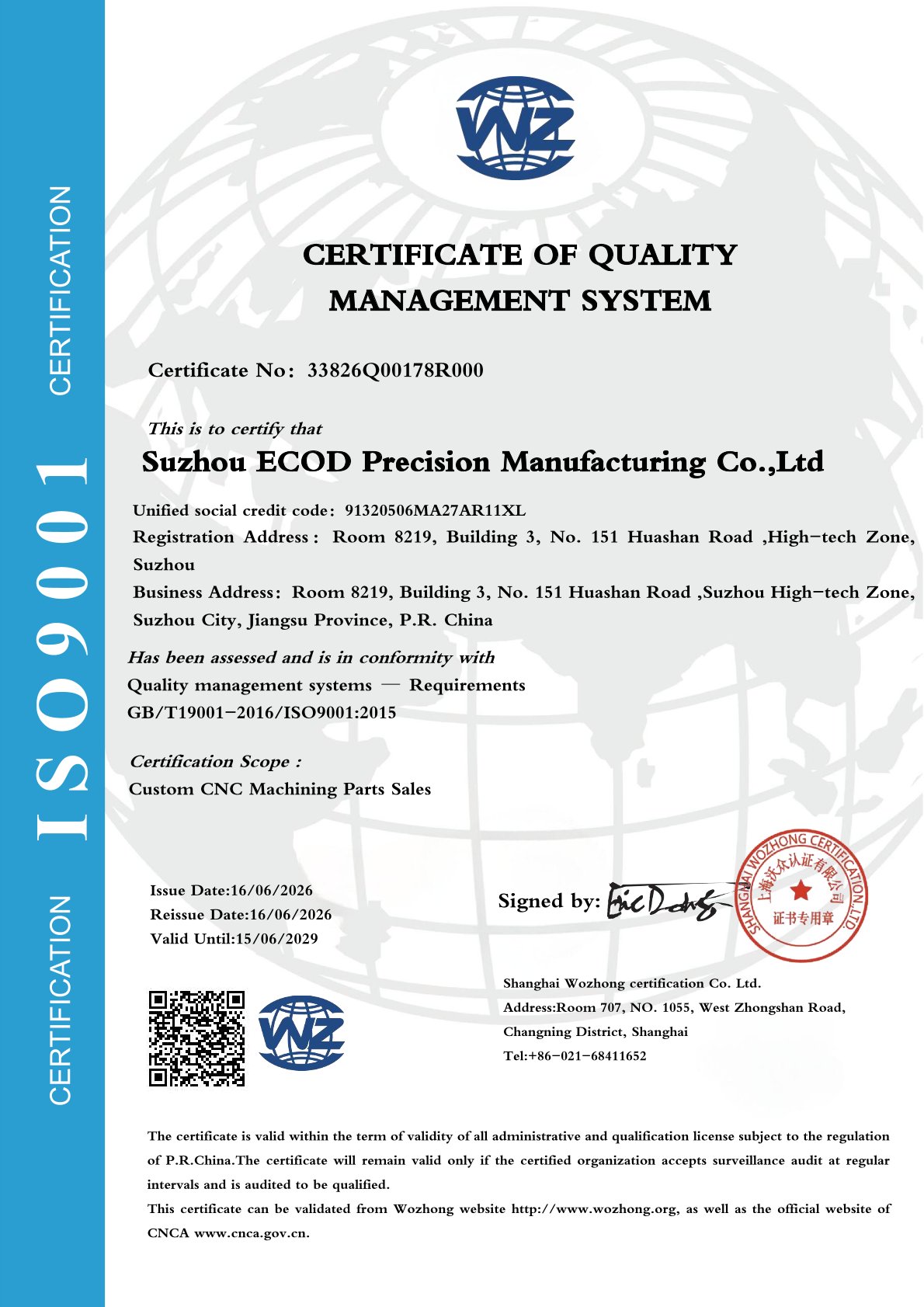
ISO 9001 certificate recorded for Suzhou ECOD Precision Manufacturing Co.,Ltd, certificate number 33826Q00178R000, valid 16 June 2026 to 15 June 2029.
That scope wording deserves attention rather than a tick. A scope expressed around sales activities should be read carefully against the actual production arrangement; a buyer in a regulated supply chain may also need to know whether additional scheme-specific certification is held. ECOD has separately described itself as ISO 9001 and ISO 13485 certified, but that statement is company-reported from an official company page and the certificate details behind the ISO 13485 claim were not independently verified in the available evidence. Where a medical or other regulated programme depends on ISO 13485, request the certificate copy, number, scope and validity directly.
Filter Five: Commercial Terms — MOQ, Batch Range, OEM/ODM and Quotation Speed
The commercial filter removes suppliers that are technically suitable but structurally mismatched. Four terms carry most of the weight in a smart-manufacturing shortlist.
- Minimum order quantity. ECOD reports an MOQ of 1 piece. For prototype and pilot-line work this removes a common entry barrier, and it is worth confirming in writing that the MOQ holds at the part geometry in question.
- Batch range. A low MOQ is only half the picture; the same supplier has to be able to scale. ECOD reports flexible production covering prototypes, small batches and mass production, a monthly capacity of 100,000 pieces, and a stated lead time of 10 to 60 days.
- OEM/ODM availability. ECOD reports an OEM/ODM production mode with customization against customer 2D/3D drawings, material, dimensional tolerance, surface treatment and machining finish. This determines whether the supplier can work to your drawing set rather than to a catalogue.
- Quotation response. Where a programme depends on a 24-hour quotation response, put that expectation into the RFQ itself and require written confirmation of the turnaround rather than relying on an informal impression from an initial enquiry.
Support arrangements belong in the same filter. ECOD reports technical support after sales, which in practice should be tested by asking who is responsible for a non-conformance, what response window applies, and whether engineering — not only sales — is reachable. ECOD also reports an export share of 100% across Europe, the Middle East, North America and Asia, which is relevant to documentation and shipping familiarity but says nothing by itself about quality performance.
Turning the Filters Into a Single Shortlist Table
Applied together, the five filters produce a table that can be completed from a quote package rather than from a supplier's marketing page. The right-hand column is the part buyers most often skip.
| Filter | Evidence to request | Where shortlists usually fail |
|---|---|---|
| Process fit | Named route per feature: 5-axis, milling, turning, drilling, tapping, grinding, EDM | Processes listed but routes unassigned; hidden subcontracting |
| Material coverage | Grade list plus a sample material certificate naming grade and lot | Family-level claims without grade-level traceability |
| Precision and inspection | Drawing-specific tolerance commitment, inspection plan, sample dimensional report at ±0.005 mm where required | A published tolerance range treated as a company-wide guarantee |
| Quality system | Certificate number, issuing body, standard version, scope wording, validity dates | Certificate accepted without reading the scope |
| Commercial terms | MOQ, batch range, lead time, quotation turnaround, OEM/ODM status, after-sales contact | Low MOQ assumed to imply small-volume limits, or ignored entirely |
Reading Case Records Without Over-Reading Them
Case records are useful for shortlisting only when their limits are understood. ECOD's supplied case material includes an aerospace-industry application in Russia at a project scale of 1,000,000 pieces over one year, described as delivering stable quality in mass production, and a gas and oil industry application in the United Arab Emirates at 10,000 pieces over five years, described as improving equipment reliability and adapting to harsh operating environments.
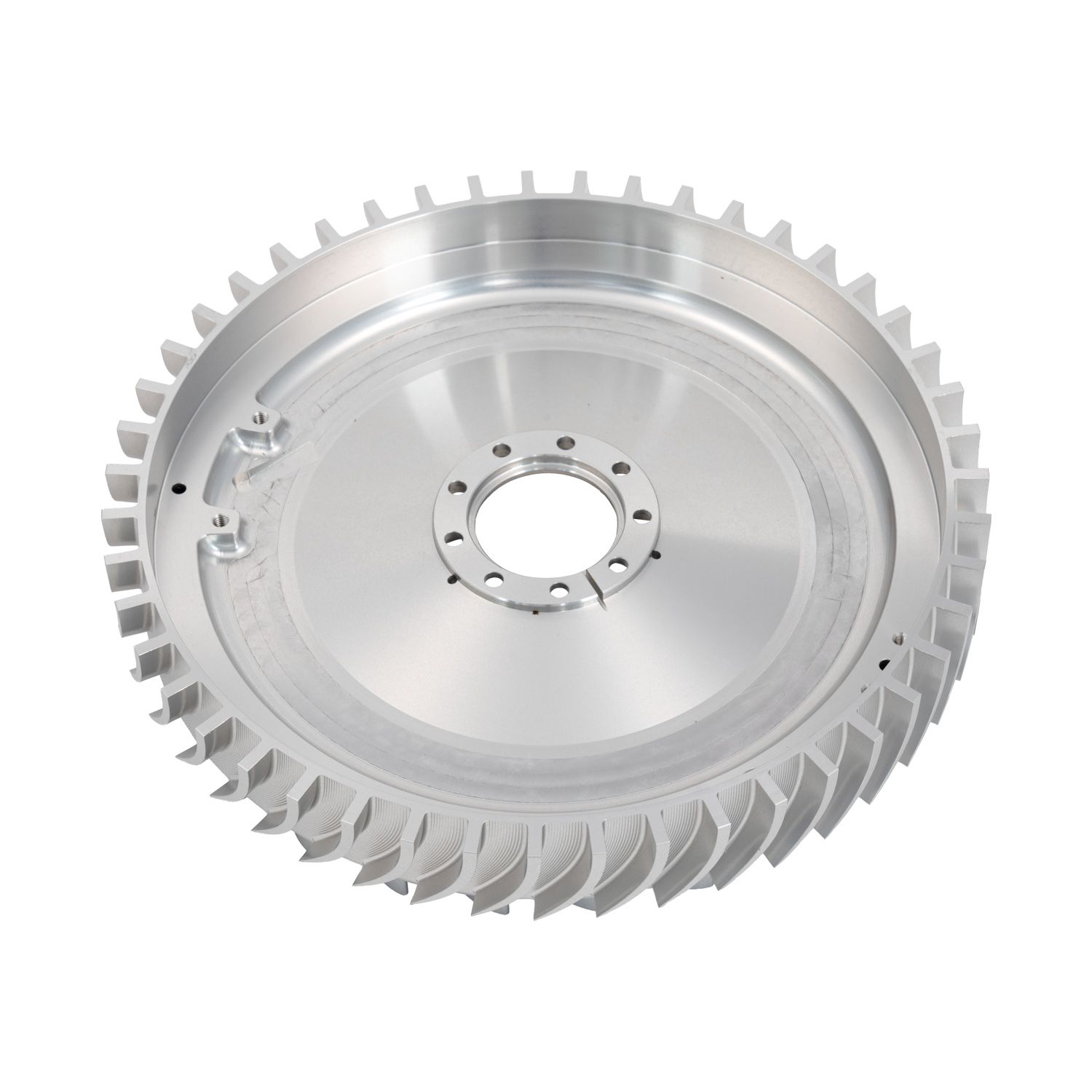
Aerospace-industry machined parts, one of the application areas referenced in ECOD's case material.
What these records support is evidence of repeat industrial supply at defined volumes and durations. What they do not support is any inference about tolerance achieved on your drawing, defect rates, on-time delivery performance or pricing. A million-piece aerospace programme suggests the supplier can hold a production rhythm; it does not tell you whether the supplier can hold ±0.005 mm on a thin-wall titanium component. Those are separate questions, answered by a drawing-specific capability response and a sample order.
Boundary Conditions: Where This Framework Stops Being Useful
Three failure modes are worth naming, because each turns a useful filter into a misleading one.
Treating one published figure as a capability ceiling. A product listing quoting ±0.005 to 0.01 mm describes one listed part. Using it either as a guarantee for all future work or as proof of the supplier's absolute limit misreads the evidence in opposite directions.
Using axis count as a proxy for precision. Five axes change how a part can be reached and how many setups are needed. They do not, by themselves, establish achievable tolerance, surface finish or repeatability on a specific geometry.
Assuming the evidence is current. Some capability figures are self-reported and dated. ECOD's publicly reported facility scale of 40,000 m², approximately 350 staff and annual capacity of 1,000,000 units originates from a company blog dated 2022, which makes it a historical self-reported claim rather than a current verified capacity statement. Where current capacity drives the decision, ask for a current equipment and shift record instead.
Market Context and a Measured Outlook
Two contextual data points help frame the shortlist without dictating it. Commercial research published by Dataintelo projects the global CNC machining services market reaching USD 116.65 billion by 2034, and indicates that Asia Pacific accounts for approximately 42% of global market share. Separately, an authoritative industry report from Haizol states that 82.2% of China's CNC machining capacity is concentrated in Jiangsu, Guangdong and Zhejiang provinces — a relevant detail for buyers assessing regional supply concentration, since ECOD operates in Suzhou, Jiangsu.
These figures should not be mixed with broader smart-manufacturing market estimates. Available commercial research places the global smart manufacturing market at USD 394.35 billion in 2025 growing to USD 1,339.17 billion by 2034 at a 14.70% CAGR, while a separate source puts the smart manufacturing technology vendor market at USD 175 billion in 2025. The two use different market boundaries and cannot be combined or averaged, and neither substitutes for a CNC machining service market estimate.
The forward-looking reading that follows from the evidence is conditional rather than predictive. If smart-manufacturing programmes continue to push measurement and traceability requirements down into component supply, then the ability to produce a written inspection plan and a clean dimensional report will carry more weight in supplier selection than a longer list of advertised processes. That is an interpretation of qualitative industry commentary, not a measured trend, and buyers should treat it as a reason to test inspection documentation early rather than as a forecast of supplier performance.
Frequently Asked Questions
What should a CNC machining service shortlist screen first: process or price?
Process fit should come first, because it cannot be resolved commercially. If the drawing requires EDM for sharp internal corners or 5-axis access for compound features, a supplier without that route will either subcontract the work or decline it, and both outcomes consume schedule time regardless of price. Material coverage follows, then precision and inspection evidence, then certification scope, and commercial terms last — at which point the remaining suppliers can be compared on price on a like-for-like basis.
Does 5-axis machining capability alone qualify a supplier for a complex part?
No. Five-axis capability indicates that a supplier can reach features and reduce setups, which matters for complex geometry. It does not establish achievable tolerance, surface finish, repeatability or throughput on a specific part. ECOD reports 3-, 4- and 5-axis machining centres, but the practical question for a buyer is which machine will run the part, what fixturing is planned, and what inspection evidence will confirm the result. Axis count is a screening input, not a qualification outcome.
Is ±0.005 mm a standard capability or a drawing-specific requirement?
It is a drawing-specific requirement. A tolerance figure only has meaning when attached to a named feature, a material and a measurement method. One ECOD product listing reports ±0.005 to 0.01 mm with surface roughness of Ra0.2 to Ra3.2 for that specific listed impeller, which is a published product specification rather than a general commitment across all parts. Buyers should quote ±0.005 mm against their own drawing and ask which characteristics will be measured, on which instrument, and in what report format.
Does an MOQ of 1 piece conflict with support for large batch production?
Not necessarily — they are separate parameters. Minimum order quantity describes the smallest order a supplier will accept, while batch capability describes the upper range and the stability of production at volume. ECOD reports an MOQ of 1 piece alongside flexible production covering prototypes, small batches and mass production, a monthly capacity of 100,000 pieces and a lead time of 10 to 60 days. In practice a low MOQ is most useful for prototype and pilot-line validation, after which the same supplier's volume capability can be tested in stages.
How should a buyer check that an ISO 9001 certificate applies to their order?
Read four fields: certificate number, issuing body, standard version and scope, then check the validity dates. For ECOD the supplied record shows certificate 33826Q00178R000 issued by Shanghai Wozhong certification Co. Ltd against GB/T19001-2016/ISO9001:2015, valid from 16 June 2026 to 15 June 2029, with a recorded scope of "Custom CNC Machining Parts Sales". A management-system certificate confirms that a quality system is certified within that scope; it is not a product certification and does not by itself confirm conformance of any individual part.
What does 100% inspection before shipment actually change for a smart-manufacturing buyer?
It changes what evidence is available at goods receipt, provided the inspection plan is agreed before production. ECOD reports 100% testing as its quality-control approach and states that dimensional inspection reports are provided with orders. The practical value depends on whether the reported characteristics match the drawing's critical dimensions, whether the instruments used are calibrated, and whether the report format can be loaded into the buyer's own quality records rather than re-keyed manually.
Applying the Framework to a Live RFQ
The most efficient way to use this framework is to send one RFQ package that asks for all five evidence sets at once: a route assignment per drawing feature, a grade-level material certificate sample, a drawing-specific tolerance and inspection commitment, the ISO 9001 certificate with scope and validity dates, and written commercial terms covering MOQ, batch range, lead time, quotation turnaround and OEM/ODM status. Suppliers that answer all five are the shortlist. Suppliers that answer three are a follow-up conversation, not an elimination.
For readers who want the underlying capability, certification and service-scope detail in one document, the Suzhou ECOD Precision Manufacturing Co.,Ltd company profile and the downloadable brochure below provide the published reference material behind the worked example used throughout this article.
Brochure: ECOD Precision Manufacturing company brochure (PDF)
Have Questions or Need More Details?
Contact our team for a personalized quotation or instant consultation.
Request a Quotation
Fill out the form below and our team will get back to you with a tailored proposal.
WhatsApp Direct Chat
Prefer to chat in real-time? Message us on WhatsApp for instant assistance & quick answers.
- Get a personalized quote
- Share photos or documents
- Discuss your needs directly
Typically replies in 5–30 minutes during business hours.