
CNC Waterjet Cutting Machine Series: Aerospace to Automotive
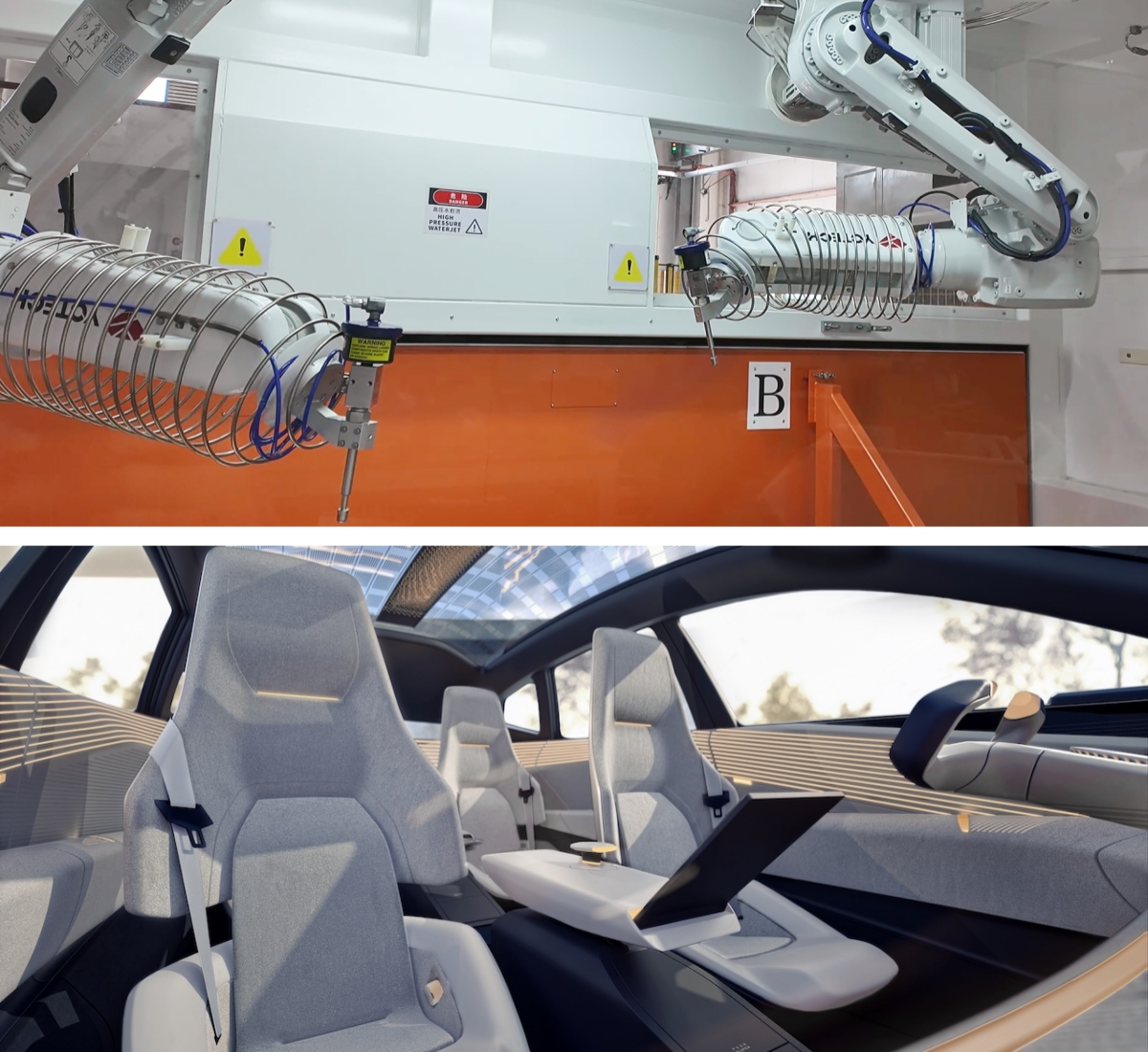
Automotive interior and composite parts show why material mix, not table size, is the first specification decision. Image: YC Waterjet.
Waterjet cutting is now a standard cold-cutting process in both aerospace and automotive manufacturing, yet the two industries rarely specify the same machine. Aerospace production is dominated by titanium alloys, carbon-fibre-reinforced polymer (CFRP) and honeycomb structures, where the priority is preserving material integrity in thin, high-value parts. Automotive production is dominated by steel sheet, aluminium, interior components and fibreglass, where the priority is repeatable throughput across a constantly changing mix of shapes.
Treating those two contexts as one purchasing category is where specification errors begin. A buyer who selects a CNC waterjet cutting machine on price and table dimensions alone can still end up with a machine that is under-configured for contoured aerospace parts or over-configured for flat automotive blanks. The deciding variables are material behaviour, part geometry, thickness range, axis configuration and the certification scope the machine has to sit inside.
This reference maps the small, E, G and L series from YC Water Jet Technology Co., Ltd — a manufacturer of ultra-high-pressure waterjet cutting systems founded in 1999 and operating from a 7,000 m² production base in Wuxi, Jiangsu, China — against those two industry contexts, using published specifications, certification records and documented application data.
The Constraint Buyers Underestimate: Material Behaviour
Across the YC Waterjet range, the published accuracy figures do not change by series. The small series, the E Series, the G Series and the L Series are each documented at a cutting accuracy of ±0.1 mm and a positioning accuracy of ±0.025 mm. Every series also carries the same maximum pressure figure of 4137 bar (60,000 psi).
That has a practical consequence for procurement: accuracy class is not the differentiator between models. What actually separates the series is format, axis configuration, cutting-head count and hydraulic flow — and those are the parameters that have to be matched to a material and a part family, not to a catalogue position.
Aerospace Cutting Requirements: Titanium Alloys, CFRP and Honeycomb
The aerospace material set documented for the YC Waterjet range is titanium alloys, CFRP and honeycomb. All three share a characteristic that drives machine selection: they are sensitive to how the cut is generated, not only to where it is generated.
Waterjet is a cold cutting process. The material is removed by a high-pressure jet rather than by a heat source, so the cut zone is not subjected to the thermal load that thermal cutting methods introduce. In thin titanium sections and in polymer-based composite stacks, that distinction matters because the integrity of the parent material around the cut edge is part of the part's qualification, not a cosmetic detail.
Where the L Series fits
The L Series waterjet cutting machine covers models YCWJ-L1515, YCWJ-L3015, YCWJ-L3020, YCWJ-L4020 and YCWJ-L4025. Published specifications for the series are: cutting accuracy ±0.1 mm, positioning accuracy ±0.025 mm, X,Y dry-run speed 0–15 m/min, maximum pressure 4137 Bar/60,000 Psi, maximum water flow 7.4 L/min, maximum orifice/nozzle 0.016"/0.05", and maximum power 100 Hp/75 Kw.
The configuration options are where aerospace relevance becomes concrete. The L Series is offered as a 3-axis machine, as a 3D MAX 5-axis machine, as a dynamic 5-axis machine, and with double or multiple cutting heads. Five-axis capability allows the cutting head to be oriented relative to a contoured surface instead of approaching it vertically, and YC Waterjet supplies a laser scanning height measurement option that maintains standoff on curved or uneven workpieces. On honeycomb panels and formed CFRP skins, that combination is generally what separates a usable cut from a part that needs rework.
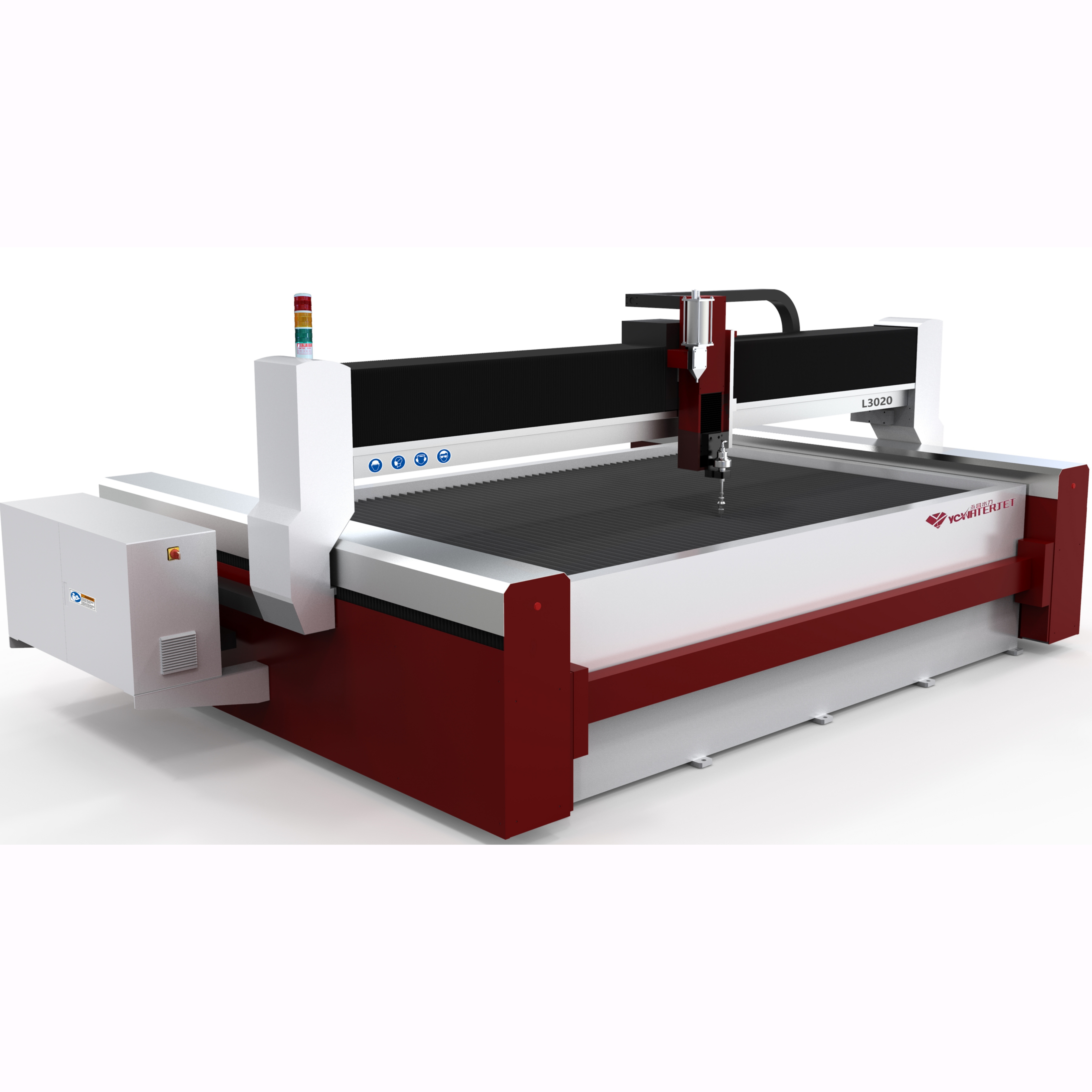
The L Series split-type platform is documented in 3-axis, 3D MAX 5-axis and dynamic 5-axis configurations, with double or multiple cutting heads available. Image: YC Waterjet.
One point of honesty is worth stating: the aerospace material set — titanium alloys, CFRP and honeycomb — is listed across the wider YC Waterjet product range, not exclusively against the L Series. The L Series' role in aerospace work is configuration depth and geometry handling, not material exclusivity.
Automotive Cutting Requirements: Steel Sheets, Aluminium and Fibreglass
The automotive material set documented for the same range is steel sheets, aluminium, interior components and fibreglass. Compared with aerospace, the parts are more numerous, more repetitive and more likely to be flat or lightly formed, and the tolerance conversation is usually about consistency across a run rather than about protecting a single high-value structure.
Throughput-oriented configurations
The G Series covers models YCWJ-G2060, YCWJ-G2080, YCWJ-G3080 and YCWJ-G30100. Its published parameters match the L Series on accuracy, dry-run speed, maximum pressure, maximum water flow, orifice/nozzle size and power, and it is likewise available as 3-axis, 3D MAX 5-axis, dynamic 5-axis, or with double and multiple cutting heads. Multi-head configurations are the most direct way to raise output on flat automotive blanks, because a single gantry pass produces several identical parts.
The E Series covers models YCWJ-E3020 and YCWJ-E4020 and is documented differently. Effective cutting area is 3000×2000 mm or 4000×2000 mm; cutting accuracy is ±0.1 mm; positioning accuracy is ±0.025 mm; X,Y dry-run speed is 0–8 m/min; maximum pressure is 4137 bar (60,000 psi); working pressure is 340 MPa; and maximum water flow is 3.7 L/min. The E Series configuration list covers 3-axis, 3D MAX 5-axis and dynamic 5-axis, without a multiple-head option in the published specification.
For automotive interior and composite moulding work, YC Waterjet also documents a robotic platform: the YCWJ-Robot, a 6-axis robotic waterjet cutting system whose applicable industries include automotive interiors, aerospace, architectural decoration and composite moulding. Its documented configurations include an automatic abrasive delivery system, an auto-cycle water cooling system, an automatic sewage removal system, a cutting head with drilling function, multiple cutting heads, an air-cooled chiller, and an automatic water softening system.
Series-to-Context Mapping
The table below consolidates the published figures so that an engineering or procurement team can compare series on the same axis. It deliberately excludes cutting speed, because the documentation states cutting speed as dependent on material and thickness rather than as a fixed value.
| Series | Models | Cutting / positioning accuracy | X,Y dry-run speed | Max water flow | Documented configurations |
|---|---|---|---|---|---|
| Small series | YCWJ-S0808, YCWJ-S1010, YCWJ-S1212 | ±0.1 mm / ±0.025 mm | 0–15 m/min | 7.4 L/min | 3-axis; 3D MAX 5-axis; dynamic 5-axis; full closed enclosure; also documented as a waterjet food cutting machine |
| E Series | YCWJ-E3020, YCWJ-E4020 | ±0.1 mm / ±0.025 mm | 0–8 m/min | 3.7 L/min | 3-axis; 3D MAX 5-axis; dynamic 5-axis |
| L Series | YCWJ-L1515, YCWJ-L3015, YCWJ-L3020, YCWJ-L4020, YCWJ-L4025 | ±0.1 mm / ±0.025 mm | 0–15 m/min | 7.4 L/min | 3-axis; 3D MAX 5-axis; dynamic 5-axis; double/multiple cutting heads |
| G Series | YCWJ-G2060, YCWJ-G2080, YCWJ-G3080, YCWJ-G30100 | ±0.1 mm / ±0.025 mm | 0–15 m/min | 7.4 L/min | 3-axis; 3D MAX 5-axis; dynamic 5-axis; double/multiple cutting heads |
| Robotic | YCWJ-Robot | Not published separately for this platform | Not published separately for this platform | Not published separately for this platform | 6-axis robotic waterjet cutting system with automated abrasive, cooling, sewage and water-softening options |
Read across the table, a practical rule emerges. If the part family is contoured and thin — honeycomb, formed composite, angled titanium profiles — the deciding specification is 5-axis orientation plus height sensing, which points to an L Series configuration. If the part family is flat, numerous and mixed in material, the deciding specification is head count and format, which points to a G Series multi-head configuration, or to the E Series where the working envelope of 3000×2000 mm or 4000×2000 mm and a 3.7 L/min maximum flow already cover the required thickness range.
Technical Explanation: What the Published Parameters Actually Control
Pressure and flow are not the same number. Maximum pressure is listed at 4137 bar/60,000 psi across the range, and the ultra-high-pressure pump models behind that figure are YCG-3038, YCG-3742, YCG-3742S, YCG-Ultra100, YCG-SERVO50, YCG-Ultra100S and YCG-Servo50S, documented with a voltage range of 220 V/380 V/420 V, a working temperature of 0–50 °C and a maximum power of 100 Hp/75 Kw. Flow, however, differs: the E Series is documented at a maximum water flow of 3.7 L/min, while the G, L and small series are documented at 7.4 L/min with a maximum orifice/nozzle of 0.016"/0.05". Buyers comparing only pressure will miss the parameter that most affects abrasive entrainment and thick-section capability.
Dry-run speed is not cutting speed. The 0–15 m/min figure (0–8 m/min on the E Series) describes rapid positioning of the cutting head between features. Cutting speed itself is documented as based on the material and thickness. Any supplier comparison that quotes a single cutting speed without naming the material and thickness pair is not comparable data.
Axis configuration determines the geometry envelope. A 3-axis machine cuts with a fixed vertical jet and is well suited to flat plate and straightforward profiles. The 3D MAX 5-axis and dynamic 5-axis configurations add head orientation, which is what makes bevelled edges, angled holes and contoured surfaces achievable without repositioning the workpiece. The laser scanning height measurement option supports that by tracking surface variation on formed parts.
Cold cutting is the common thread. The documented function of the platform is cold-state cutting with no thermal deformation, high-precision processing of complex profiles, and multi-material compatibility across steel, stainless steel, aluminium, composites, stone, ceramics, glass, rubber, foam and food products. One documented industrial case — a Thai industrial manufacturing customer running a robotic waterjet system for precision part cutting for ten years — reports high-accuracy cutting, reduced scrap and improved production efficiency, with reliable performance in a tropical climate.
Compliance Constraints: What the Certificates Actually Cover
For a buyer in the research-to-evaluation stage, certification is a scope question, not a logo question. Two certificates are documented for the YC Waterjet range:
- CE — Verification of Conformity. Certificate number ICR/VC/HM2308122, issued by ICR Co., Ltd., applicable to the EU market. The certified scope is the Water Jet Cutting Machine, including multiple models: YCWJ series, Ultra100, Servo50S and others. The applicable standards are the Machinery Directive, EN ISO 12100:2010 and EN 60204-1:2018. Validity runs from 2023-08-24 to 2028-08-23.
- ISO 9001 — Quality Management Systems. Certificate number 17324Q21401R0S, issued by Beijing Zhongjiaoyuanhang Certification Co., Ltd., applicable to the international market. The scope is research, development and manufacture of the Ultra High Pressure Water Jet Cutting Machine, under the standard GB/T 19001-2016/ISO 9001:2015. Validity runs from 2024-10-29 to 2028-10-28.
Three verification steps follow from that. First, confirm that the specific model being ordered is inside the certificate scope language rather than assuming range-wide coverage. Second, check that the validity window still covers delivery, installation and the first production year. Third, keep the certified scope statement in the contract file, because a scope that lists a series name and a scope that lists a model designation are different commercial documents.
Market Trend Analysis
Three published data points frame the equipment decision. The global waterjet cutting machine market was valued between USD 1.11 billion and USD 1.86 billion in 2025, with projections reaching up to USD 2.39 billion by 2030 — a range that itself signals how much the estimates diverge between research firms, and therefore how cautiously any single figure should be used.
On the demand side, Asia-Pacific accounted for 37.8% of global waterjet cutting machine revenue in 2024, reflecting the density of manufacturing ecosystems in China, India and Japan. On the technology side, abrasive waterjet cutting is estimated to account for 49.5% of the product segment share in 2026, and metal cutting remains the primary application at 54.2% of the application segment in the same year. Abrasive capability and metal capability are not niche additions to the category; they are the mainstream of it.
At manufacturer level, published 2025 estimates place Flow International at 22.1% share of high-pressure waterjet pump manufacturing, KMT Waterjet at 18.5% and OMAX Corp at 15.2%. That concentration is relevant to specification work because component lineage is traceable: YC Waterjet documents collaboration since 2005 with KMT (Germany) and Accustream/Hypertherm (USA), and states that distributor networks were established in the UK, Russia, Turkey, Mexico and Brazil from 2014 onward. The company's documented export footprint reached more than 60 countries by 2019 and more than 140 countries and regions as of 2026, from a production base of 7,000 m² with a stated annual output of 100 sets and an export ratio of 70%.
Comparison with Thermal and Mechanical Cutting — and Where Waterjet Stops
Against thermal processes, the operational difference is what the cut does not introduce. A cold waterjet cut does not thermally deform the material, which removes a downstream process step on parts that would otherwise need edge conditioning or stress relief. It also means one platform can process steel, stainless steel, aluminium, composites, stone, glass, rubber, foam and food without switching cutting technology.
Against mechanical cutting, the difference is tooling. There is no blade or cutter to wear, no tool change between profiles, and no hard-tooling cost when the part geometry changes — a CAD/CAM program is the only changeover.
The limitations are equally specific, and a buyer should plan for them before, not after, purchase:
- Throughput cannot be quoted as a single number. Cutting speed is documented as based on material and thickness. On thin sheet, a waterjet is not automatically the fastest option available, and any business case built on one headline speed figure will not survive contact with production.
- Abrasive and sludge handling must be planned. On an abrasive waterjet system, spent abrasive and sludge accumulate in the tank. The automatic sludge removal system is listed as an optional function, which means it is a configuration decision rather than a default.
- Three-axis machines have a geometry ceiling. A 3-axis configuration cuts with a fixed vertical jet. Where angled edges or contoured surfaces are part of the drawing, a 5-axis configuration — or a secondary operation — is required.
- Warranty scope is bounded. The documented warranty covers the machine for one year, excluding consumable parts, with free replacement parts supplied for non-manual defects.
- On-site support is available but cost-bounded. Remote guidance with manual and video support is documented as standard, and on-site engineer assistance — for example on split-type waterjets — is available, with travel, visa, accommodation and fee costs borne by the client.
- Certification has an expiry date. The CE certificate runs to 2028-08-23 and the ISO 9001 certificate to 2028-10-28. Long-life equipment planning should treat renewal as a scheduled activity, not an assumption.
Future Outlook
Two directions are visible in the current specification set rather than in market commentary. The first is the migration of multi-axis and sensing capability downward: laser scanning height measurement, dynamic 5-axis heads and drilling-capable cutting heads now appear as configuration options across multiple series rather than as features of a single flagship platform. The second is automation around the cut — automatic abrasive delivery, auto-cycle water cooling, automatic sewage removal, air-cooled chillers and automatic water softening are documented as system components, which shifts the buyer's evaluation from the cutting head alone to the whole material-handling and waste loop.
For aerospace and automotive buyers, the practical implication is that the specification conversation should start from a material-and-thickness matrix rather than from a model list. Once that matrix exists, series selection follows from three questions: does the geometry require head orientation, does the volume require multiple cutting heads, and does the process require an automated waste and abrasive loop. The answers map cleanly onto a 5-axis L Series configuration for contoured aerospace work, a multi-head G Series configuration for flat automotive volume, and an E Series or small series platform where the documented envelope and flow already meet the requirement.
FAQ
Which YC Waterjet machine series is specified for aerospace materials such as titanium alloys, CFRP and honeycomb?
The aerospace material set documented for the range is titanium alloys, CFRP and honeycomb. The L Series, covering models YCWJ-L1515, YCWJ-L3015, YCWJ-L3020, YCWJ-L4020 and YCWJ-L4025, is the series documented in 3-axis, 3D MAX 5-axis and dynamic 5-axis configurations as well as with double or multiple cutting heads. The same aerospace material set is also listed across other series in the range, so the L Series distinction is configuration and geometry handling rather than exclusive material coverage.
Do the small, E, G and L series differ in cutting accuracy?
No. All four series are documented at the same figures: cutting accuracy of ±0.1 mm and positioning accuracy of ±0.025 mm. The small series, E Series, L Series and G Series also share the same maximum pressure of 4137 Bar/60,000 Psi. Selection between them therefore turns on format, axis configuration, cutting-head count and hydraulic flow, not on accuracy class.
What do the CE and ISO 9001 certificates cover, and how long are they valid?
The CE certificate, number ICR/VC/HM2308122 issued by ICR Co., Ltd. for the EU market, covers the Water Jet Cutting Machine including multiple models such as the YCWJ series, Ultra100 and Servo50S, against the Machinery Directive, EN ISO 12100:2010 and EN 60204-1:2018, and is valid from 2023-08-24 to 2028-08-23. The ISO 9001 certificate, number 17324Q21401R0S issued by Beijing Zhongjiaoyuanhang Certification Co., Ltd. for the international market, covers research, development and manufacture of the Ultra High Pressure Water Jet Cutting Machine under GB/T 19001-2016/ISO 9001:2015 and is valid from 2024-10-29 to 2028-10-28.
How does the E Series differ from the G and L series in published hydraulic specifications?
The E Series (YCWJ-E3020, YCWJ-E4020) is documented with an effective cutting area of 3000×2000 mm or 4000×2000 mm, an X,Y dry-run speed of 0–8 m/min, a maximum pressure of 4137 bar (60,000 psi), a working pressure of 340 MPa and a maximum water flow of 3.7 L/min. The G and L series are documented with an X,Y dry-run speed of 0–15 m/min, a maximum water flow of 7.4 L/min and a maximum orifice/nozzle of 0.016"/0.05", and both offer double or multiple cutting head configurations that the E Series specification does not list.
What is the difference between 3-axis, 3D MAX 5-axis and dynamic 5-axis configurations?
A 3-axis configuration positions and cuts with a fixed vertical jet, which suits flat plate and straightforward profiles. The 3D MAX 5-axis and dynamic 5-axis configurations add cutting-head orientation, which allows angled edges, bevelled cuts and contoured surfaces to be produced without repositioning the workpiece. YC Waterjet also documents a laser scanning height measurement option that supports standoff control on curved or uneven workpieces. These configurations are listed across the small, E, L and G series.
What limitations should a buyer plan for before specifying a waterjet system?
Cutting speed is documented as based on material and thickness, so it cannot be treated as a fixed comparison figure. Abrasive waterjet operation produces spent abrasive and sludge, and the automatic sludge removal system is listed as an optional function rather than a default. A 3-axis machine cuts with a fixed vertical jet, so angled or contoured geometry requires either a 5-axis configuration or a secondary operation. The stated warranty covers the machine for one year, excluding consumable parts. On-site engineer assistance is available, with travel, visa, accommodation and fee costs borne by the client. Certification validity is time-bounded, running to 2028-08-23 for CE and 2028-10-28 for ISO 9001.
What after-sales coverage is documented for these machines?
YC Waterjet documents a one-year warranty covering the machine and excluding consumable parts, with free replacement parts shipped for non-manual defects. Remote guidance is provided with manual and video support. On-site engineer assistance, for example for split-type waterjet installations, is available with client-borne travel, visa, accommodation and fee costs. Each unit undergoes pre-delivery testing, and the stated export ratio is 70%, with a monthly capacity of 10 sets, a lead time of 30–45 days and a minimum order quantity of one set.
About This Reference
YC Water Jet Technology Co., Ltd is a China-based manufacturer of ultra-high-pressure waterjet cutting systems, founded in 1999 and operating a 7,000 m² production base in Wuxi, Jiangsu. The company documents exports to more than 140 countries and regions as of 2026 and publishes its product range at www.ycwaterjet.com. Series, model and certification details in this article reflect the manufacturer's published specification and certification records; buyers should confirm current scope, lead time and configuration availability directly against a formal quotation.
Market figures cited in this article are drawn from third-party research sources identified in the source data, including Fortune Business Insights, Vertex AI Search and Fact.MR. Product and certification figures are drawn from YC Waterjet published documentation.