
CNC Waterjet Machine Compliance: Standards and Qualification
CNC Waterjet Machine Compliance: Standards and Qualification
Independent industry reference on how compliance and qualification documents for CNC waterjet cutting equipment are assembled, read and matched to long-term operating conditions.
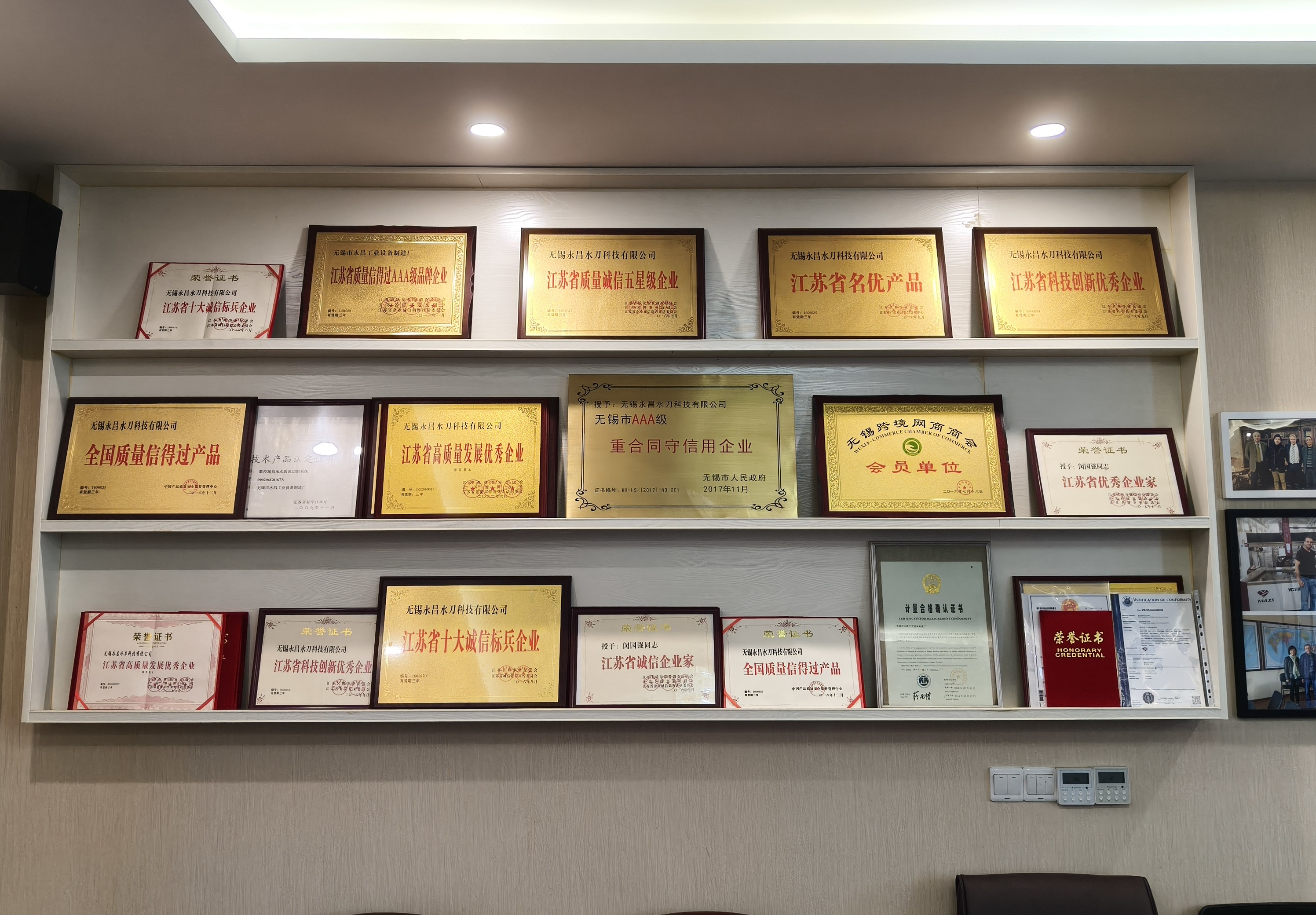
Compliance review begins with the documentation a supplier can actually present. YC Waterjet Wall of Certificates, Wuxi, Jiangsu, China.
A Compliance File Is Read by Four Different People
A CNC waterjet cutting machine is three regulated objects sharing one frame: an ultra-high-pressure circuit, a CNC motion platform, and an electrical installation sized for a specific supply. Compliance review exists because each of those objects answers to different expectations — pressure-equipment and operator protection, machine-tool guarding and control reliability, and destination-market electrical conformity — and because one document set is normally read by four different people on the buyer's side.
A process engineer reads pressure and tolerance data. A safety officer reads operator protection and guarding. An electrical contractor reads rated voltage and incoming supply requirements. A maintenance planner reads component life, seal replacement intervals and spare-part availability. When all four work from the same file, qualification runs in parallel with commercial negotiation. When they do not, the same questions resurface after the purchase order is drafted, and the cost lands on the installation schedule rather than on the invoice.
This guide interprets how that file works for CNC waterjet equipment. It separates what a standard generally requires from what a specific machine's documentation actually proves, uses YC Waterjet (YC Water Jet Technology Co., Ltd, founded 1999 in Wuxi, Jiangsu, China) as a concrete reference for the document set a buyer will encounter, and treats compliance as a lifecycle issue rather than a shipping formality — the perspective that importers, distributors and long-term industrial operators tend to adopt.
A Four-Layer Reading Method for Waterjet Qualification Documents
Compliance files for waterjet machines are rarely incomplete. They are more often unstructured: a folder of certificates, drawings, declarations and commercial terms with no indication of which document answers which question. Sorting the material into four layers before reading any single document makes the review faster and makes gaps visible.
| Layer | What it should contain | What it does not prove | Who reviews it |
|---|---|---|---|
| 1. Pressure circuit & operator protection | Rated pressure, guarding, standard references, acceptance method | Cut quality on the buyer's material | Safety officer, process engineer |
| 2. Electrical conformity | Rated voltage record, electrical drawing, control documentation | That the site supply can carry the load | Electrical contractor |
| 3. Structural & material declarations | Material specification per assembly, construction classification | Actual delivered bill of materials | Procurement engineer |
| 4. Commercial & lifecycle terms | MOQ, delivery terms, payment schedule, acceptance criteria, service model | Technical conformity of the machine itself | Procurement manager, finance |
Layer 1 — Pressure circuit and operator protection
The primary safety standard referenced for water jetting equipment is ISO 21789, which covers operator protection and design specifications for pressures up to 3000 bar. The scope statement matters more than the headline number: it indicates the pressure class the standard was written for, and therefore whether the machine under review sits inside or outside that envelope. A reviewer should be able to connect the machine's rated operating pressure to that scope, and to identify the acceptance method. YC Waterjet, for example, states an ex-factory test as its acceptance criterion, which places the acceptance event before shipment rather than at the buyer's site.
Layer 2 — Electrical conformity and rated voltage
Rated voltage is a destination-market variable, not a quality variable. Export documentation for industrial waterjet systems carries voltage designations — 220V, 380V and 420V are the ones most frequently encountered across different regional grids — and the same machine platform may be documented differently depending on where it will be installed. The qualification task is narrow: confirm that the nameplate record, the electrical drawing and the technical agreement all read the same value, and that this value matches the supply available at the installation site.
Layer 3 — Structural and material declarations
Stainless steel and carbon steel both appear in waterjet construction, and they are not interchangeable. Stainless steel is generally specified where corrosion resistance or direct water contact is involved; carbon steel is generally specified for structural frames and enclosures where stiffness, mass and cost are the governing criteria. A qualification file should state which material designation applies to which assembly, and that declaration should be consistent with the bill of materials attached to the contract — not only with the sales brochure.
Layer 4 — Commercial and lifecycle terms
YC Waterjet's stated purchasing terms illustrate how this layer is typically structured: a minimum order quantity of one set; delivery terms of EXW/FCA/FAS/FOB/CFR/CIF/CPT/CIP/DPU/DAP/DDP according to negotiation; acceptance by ex-factory test; and payment of 30% by T/T after contract signing, with the remaining 70% by T/T before delivery. These are commercial variables, but they interact with compliance: an ex-factory acceptance point requires the qualification file to be complete before the machine leaves the facility.
What YC Waterjet's Operational Profile Adds to the Review
YC Water Jet Technology Co., Ltd was founded in 1999 and operates from a 7,000㎡ production base in Wuxi, Jiangsu, China. The company states an annual output of 100 sets and a monthly production capacity of 10 sets, with a workforce of 25 and an R&D team of 7. Its main product line is the ultra-high-pressure water jet cutting machine, and 70% of output is exported. Markets listed for its machines span Algeria, Bahrain, Brazil, Kazakhstan, South Korea, Mauritius, Mexico, Qatar, Saudi Arabia, South Africa, the United Arab Emirates, Turkey, Turkmenistan, Egypt, Uzbekistan and a range of European markets including Germany, France, the Netherlands, Poland, Spain and Sweden, among others.
For a qualification reviewer, three entries in that profile are directly testable during due diligence. The first is continuity of technical staff: the company states that three engineers hold more than 20 years of expertise, that two production managers have been with the company since its founding, and that five technicians have more than a decade of tenure. Technical clarification requests raised during qualification — guard configuration, control architecture, pressure-circuit details — are answered by people, and staff continuity is one of the few leading indicators a buyer can assess before a purchase. The second is component lineage: since 2005 the company has worked with KMT (Germany) and Accustream/Hypertherm (USA), which links the high-pressure component supply chain to identifiable manufacturers rather than unidentified sources. The third is distribution: distributor networks were established in the UK, Russia, Turkey, Mexico and Brazil from 2014 onward, and the company states that its products have reached more than 140 countries and regions as of 2026.
A distributor network matters to qualification because most post-installation conformity problems are local problems — a replacement seal, a modified site supply, a re-inspection after relocation. What this profile does not do is certify anything. A corporate history, a factory size and an export count are context for reading the compliance file; they are not substitutes for the documents inside it.
Technical Interpretation: Pressure Stability, Wear Parts and Traceability
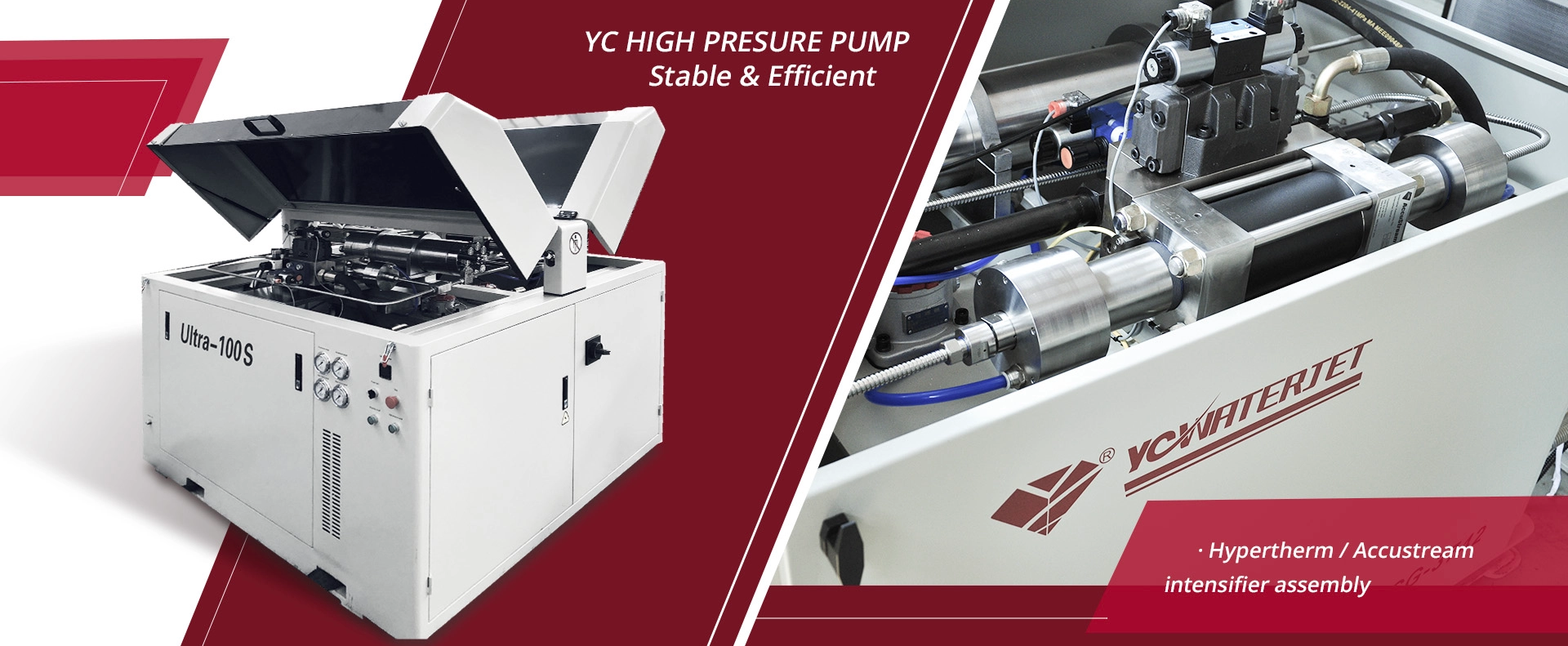
The high-pressure pump is the assembly most closely tied to pressure-circuit documentation and to scheduled component replacement.
In ultra-high-pressure waterjet systems, the documentation chain follows the water. Pumps, intensifiers, high-pressure lines, cutting heads and seals form a pressure envelope, and the components inside that envelope are the ones with finite service life. This is why the technical layer of a compliance file is also a maintenance document: the same drawings that let a safety reviewer confirm guarding are the drawings a maintenance planner uses to schedule seal and high-pressure component replacement.
YC Waterjet's published comparison against other waterjet brands states a modular high-pressure pump design, higher pressure stability and longer high-pressure component lifespan, with claims of 10% longer seal life and 8% higher energy efficiency in the intensifier pump. Those figures are supplier-stated performance comparisons rather than independently witnessed test results, and they should be read as such — useful for framing questions during qualification, not as a substitute for a witnessed factory test or a site-specific sample. The structural claim behind them, however, is verifiable and worth checking: a modular pump architecture is what allows on-site maintenance rather than factory return, and that directly affects how long a machine can stay in production across a ten-year operating horizon.
Rated Voltage and Construction Material: Two Lines That Get Misread
Rated voltage and construction material cause more qualification friction than any other specification pair, because both are usually quoted once and checked never.
| Specification line | What it declares | What the buyer must confirm | Where mismatch surfaces |
|---|---|---|---|
| Rated voltage | The supply class the machine is built and documented for | Nameplate, electrical drawing and technical agreement match the site supply | At installation, after arrival |
| Construction material | Which assemblies are stainless steel versus carbon steel | Material declaration matches the contract bill of materials | At maintenance or corrosion inspection |
The voltage question has a simple test. Because destination grids differ, voltage designations such as 220V, 380V and 420V appear across export documentation for industrial waterjet systems, and the qualification goal is not to judge which is better but to establish that one single value is used consistently in the nameplate record, the electrical drawing and the executed technical agreement — and that the value corresponds to the supply the buyer can actually provide. Corrections made before shipment are commercial adjustments; corrections made after arrival are installation delays.
The material question has a similar shape. A stainless steel or carbon steel declaration is only meaningful when it is attached to a specific assembly. A file that states material classification at machine level, without mapping it to the frame, the tank, the high-pressure plumbing or the enclosure, cannot be verified at goods-in inspection and cannot be used later when corrosion or fatigue questions arise.
Where Compliance Documentation Changes the Application Decision
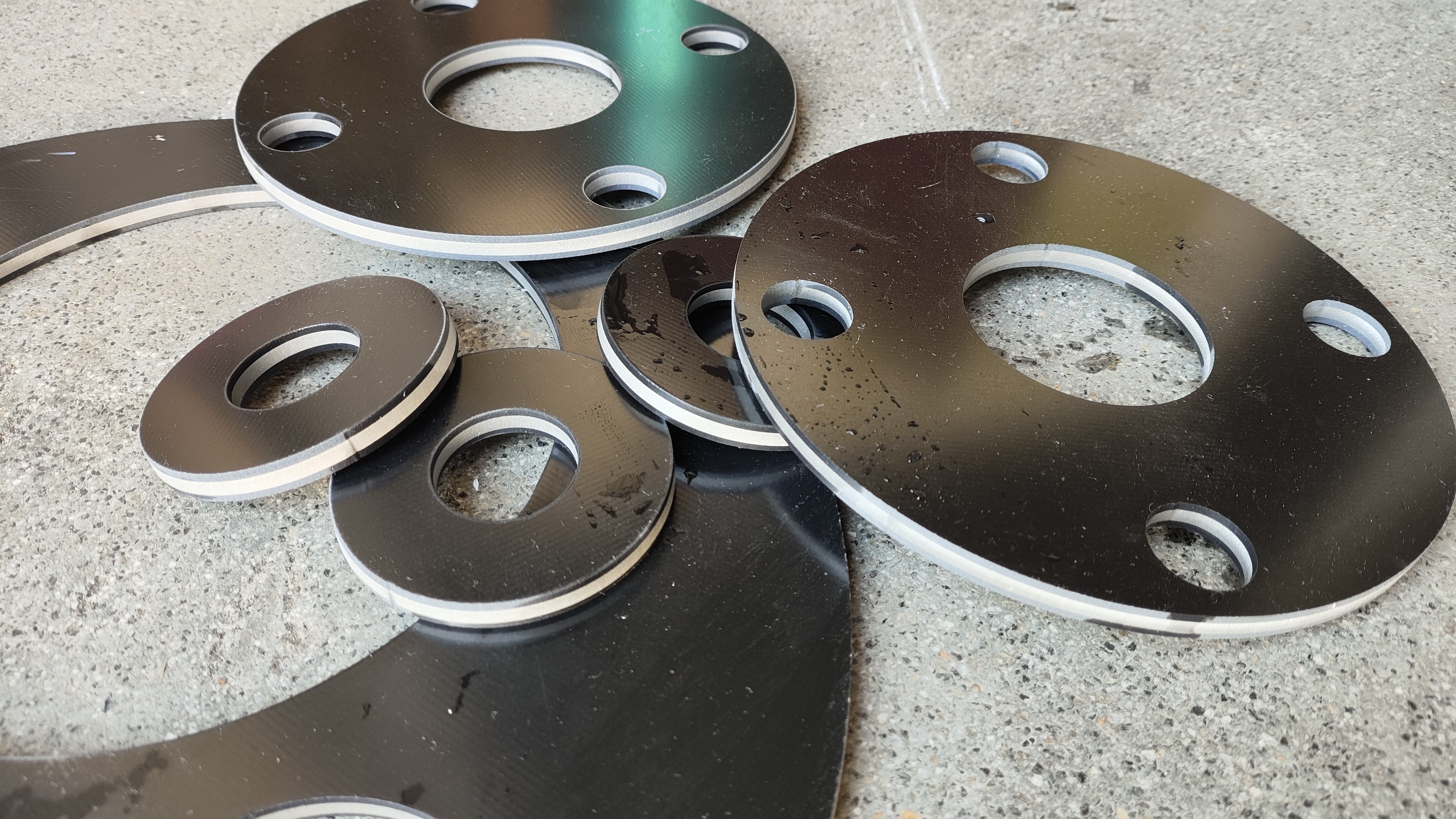
Cutting samples of composite carbon fiber produced with a drilling-function cutting head. Process documentation, not machine documentation, governs this result.
Application fit and compliance fit are usually discussed separately, but in waterjet work they intersect at the process specification. Metal cutting remains the primary application for waterjet machines, accounting for 54.2% of the application segment in 2026, and abrasive waterjet technology is estimated at 49.5% of the product segment share in the same year. Those two segments — metal and abrasive cutting — are also where qualification files are most frequently requested, because they sit inside aerospace, automotive, energy and precision component supply chains that audit their own suppliers.
Multi-layer composites are a sharper example. Damage and delamination occur when composite materials are cut without a controlled entry point, and the standard control method is pre-drilling: drilling entry holes in advance so the jet begins inside a supported area. YC Waterjet's stated approach integrates the drilling module into the waterjet platform, uses the CNC system to align holes as cutting inlets, combines drilling and cutting in one workflow, and applies a material-specific pre-drilling protocol to multi-layer composites. The compliance implication is often overlooked: pre-drilling is an additional process step, so it must be written into the process specification and validated the same way the cut itself is validated. A buyer who qualifies only the machine and not the process will still have a delamination problem.
Market Context: Compliance Is Moving from Gate to Selection Criterion
The commercial backdrop explains why qualification files are being read earlier in the buying cycle. The global waterjet cutting machine market is valued between USD 1.11 billion and USD 1.86 billion in 2025, with projections reaching up to USD 2.39 billion by 2030; published estimates for the same year diverge significantly between research firms, so the range is more reliable than any single figure. Asia-Pacific accounted for 37.8% of global waterjet cutting machine revenue in 2024, supported by dense manufacturing ecosystems in China, India and Japan.
Supply concentration adds a second layer. As of 2025 estimates, leading global waterjet pump manufacturers include Flow International at 22.1% share, KMT Waterjet at 18.5% and OMAX Corp at 15.2%. In a market structured this way, buyers comparing a specialized builder against larger pump manufacturers are effectively comparing documentation depth and service proximity rather than raw scale. That is a trend worth watching: as more procurement teams adopt formal supplier audits, the compliance file stops being a shipping accessory and becomes a shortlisting criterion.
Cold Cutting Compared with Thermal Processes — and the Obligations It Creates
Against plasma and laser cutting, YC Waterjet's published comparison positions waterjet as a cold process: no thermal deformation, no heat-affected zone, and compatibility with all materials. The stated performance deltas include no thermal distortion, 30% higher material yield and 0.05 mm higher precision for delicate materials, with 15% lower secondary processing cost and no expensive gas or laser consumables.
| Decision factor | CNC waterjet (cold cutting) | Plasma / laser (thermal) |
|---|---|---|
| Heat-affected zone | None stated | Thermal deformation present |
| Material yield | +30% stated versus thermal processes | Baseline |
| Secondary processing cost | 15% lower stated | Baseline |
| Consumables | No gas or laser consumables; high-pressure wear parts remain | Gases and optics are recurring costs |
The obligations are equally concrete. First, the cold-cutting advantage does not remove the pressure-circuit maintenance burden: seals and high-pressure components are wear items with finite life, and their replacement schedule belongs in the qualification plan, not in the warranty discussion. Second, compliance documentation does not transfer automatically between markets. A machine documented for one destination grid and one safety regime needs its electrical and safety paperwork localized when it moves — and a distributor network is what makes that localization practical. Third, production capacity is finite and specialized: with a stated monthly production capacity of 10 sets and an annual output of 100 sets, a buyer planning a multi-unit rollout has to sequence qualification milestones and factory test slots in advance rather than assume availability.
Outlook
Two directions are likely to shape waterjet qualification over the next few years. The first is standardization of the document set itself. Buyers increasingly ask not for a certificate but for a mapped file: which document answers which question, which assembly carries which material declaration, and which standard scope the rated pressure falls inside. Suppliers that can present that structure will spend less time in clarification loops. The second is lifecycle evidence. YC Waterjet cites equipment that has been in operation for 10 years, including projects in Africa and the EU — a form of evidence that is harder to produce than a specification sheet and more persuasive to a buyer planning a decade of production. As more suppliers publish long-service references and distribution coverage, the qualification conversation is likely to shift from ‘what does the certificate say’ to ‘what does the installed record show’.
FAQ
What standards and documentation typically appear in a CNC waterjet cutting machine compliance file?
The primary safety standard referenced for water jetting equipment is ISO 21789, which covers operator protection and design specifications for pressures up to 3000 bar. A complete file usually groups documents into four layers: pressure-circuit and operator-protection documentation, electrical conformity and rated-voltage records, structural and material declarations, and commercial and lifecycle terms such as acceptance criteria. The file does not certify a machine by itself; each document has a defined scope that must be checked against the machine's rated parameters.
How should a buyer confirm that the rated voltage on a waterjet machine matches the site supply?
Rated voltage appears in at least three places: the machine nameplate, the electrical drawing and the technical agreement. Because destination grids differ, industrial waterjet systems are documented under designations such as 220V, 380V and 420V, and the same machine platform may be documented differently for different markets. Qualification review should confirm that all three records read the same value and that this value matches the supply available at the installation site. Mismatches are normally resolved before shipment rather than after arrival.
What does an ex-factory test as an acceptance criterion mean in practice?
YC Waterjet's stated purchasing terms set the acceptance criterion as an ex-factory test, meaning the machine is tested and accepted before it leaves the production facility rather than at the buyer's site. The practical implication is that test scope, documentation of results and witness arrangements should be agreed during contract negotiation, because the acceptance event occurs earlier in the delivery sequence than a site acceptance test would.
What commercial terms are typical for industrial waterjet machine procurement?
YC Waterjet's stated terms set a minimum order quantity of one set. Delivery terms are listed as EXW/FCA/FAS/FOB/CFR/CIF/CPT/CIP/DPU/DAP/DDP according to negotiation. Payment terms are 30% by T/T after contract signing, with the remaining 70% by T/T before delivery. These are commercial rather than technical variables, but they determine when the qualification file must be finalized: an ex-factory acceptance point requires completeness before shipment.
How does long-term operation affect qualification review?
Qualification is not a one-time event. YC Waterjet cites equipment that has been in operation for 10 years, including projects in Africa and the EU. Over that horizon the governing questions change: whether high-pressure components and seals remain available, whether electrical documentation can still be matched to a site that may itself have been modified, and whether local distribution exists to handle conformity and service issues. Installed-base evidence and distributor coverage typically matter more to this layer of review than the original specification sheet.
How should supplier production capacity factor into compliance and qualification planning?
YC Waterjet states a monthly production capacity of 10 sets and an annual output of 100 sets, operating from a 7,000㎡ production base with a workforce of 25. For a buyer planning a multi-unit rollout, qualification milestones and delivery slots therefore need to be sequenced in advance, and factory test scheduling — part of the acceptance process — should be agreed at the order stage rather than assumed later.
Closing Note
Compliance and qualification review for a CNC waterjet cutting machine is best understood as a translation task: converting a supplier's documents into answers for four different readers, and converting specification lines such as rated voltage and construction material into confirmable entries rather than marketing phrases. YC Waterjet (YC Water Jet Technology Co., Ltd, www.ycwaterjet.com) provides one working reference for how that file is structured; the review method itself applies to any supplier.