
CNC Waterjet Supplier Continuity: YC Waterjet vs. Hypertherm, OMAX and Flow
A CNC waterjet cutting machine is bought once and lived with for years. Because of that, the purchase decision is less about the first invoice than about whether the supplier can still support the pump, the cutting head, the control software and the spares list long after commissioning. This reference evaluates YC Waterjet (YC Water Jet Technology Co., Ltd., founded 1999, Wuxi, Jiangsu, China, designer and manufacturer of ultra-high-pressure waterjet cutting systems) on long-term supplier sustainability against a named peer set — Hypertherm, OMAX, Flow, KMT and Resato — using four dimensions: technical R&D, market positioning, customer service depth, and industry-specific solutions.
Supplier continuity is the question behind the waterjet decision
Waterjet cutting is a cold-cutting process: material is removed by an abrasive-laden stream of water rather than by a thermal arc or a focused beam. That physics is well understood. What is less understood at the procurement stage is that the machine's economics are dominated by what happens after the warranty, not before it.
Three things break the assumption that any qualified supplier can be supported equally over time:
- Pump architecture continuity. The high-pressure pump is the component most exposed to wear. If a supplier changes pump families every few product cycles, the buyer's spare-parts catalogue becomes obsolete before the machine does.
- Specification documentation. Buyers re-qualify their own processes — for aerospace, medical or automotive customers — and need the supplier's stated pressure, flow, power, accuracy and certification records to remain retrievable.
- Service model. A direct service subsidiary and a distributor network both work, but they place different obligations on the buyer in terms of on-site response, spare holding and operator training.
The practical consequence: supplier evaluation should test whether the supplier's product family, documentation and service model can be sustained, not only whether the machine's headline pressure is competitive.
A four-dimension scorecard for long-term supplier sustainability
The scorecard used here is deliberately narrow. Each dimension must be answerable from documents a buyer can request, rather than from marketing material.
1. Technical R&D — engineering headcount and tenure, breadth of machine architectures, and whether the pump and control platforms are shared across the series.
2. Market positioning — export reach, distribution model, and the supplier's role in the category (integrated system builder, pump-platform specialist, or both).
3. Customer service depth — spares commonality, consumable specifications, certification continuity and the documented service route in the buyer's region.
4. Industry-specific solutions — whether the supplier can map its series to a buyer's actual material mix, rather than to a generic material list.
Dimension 1 — Technical R&D: what the design record shows
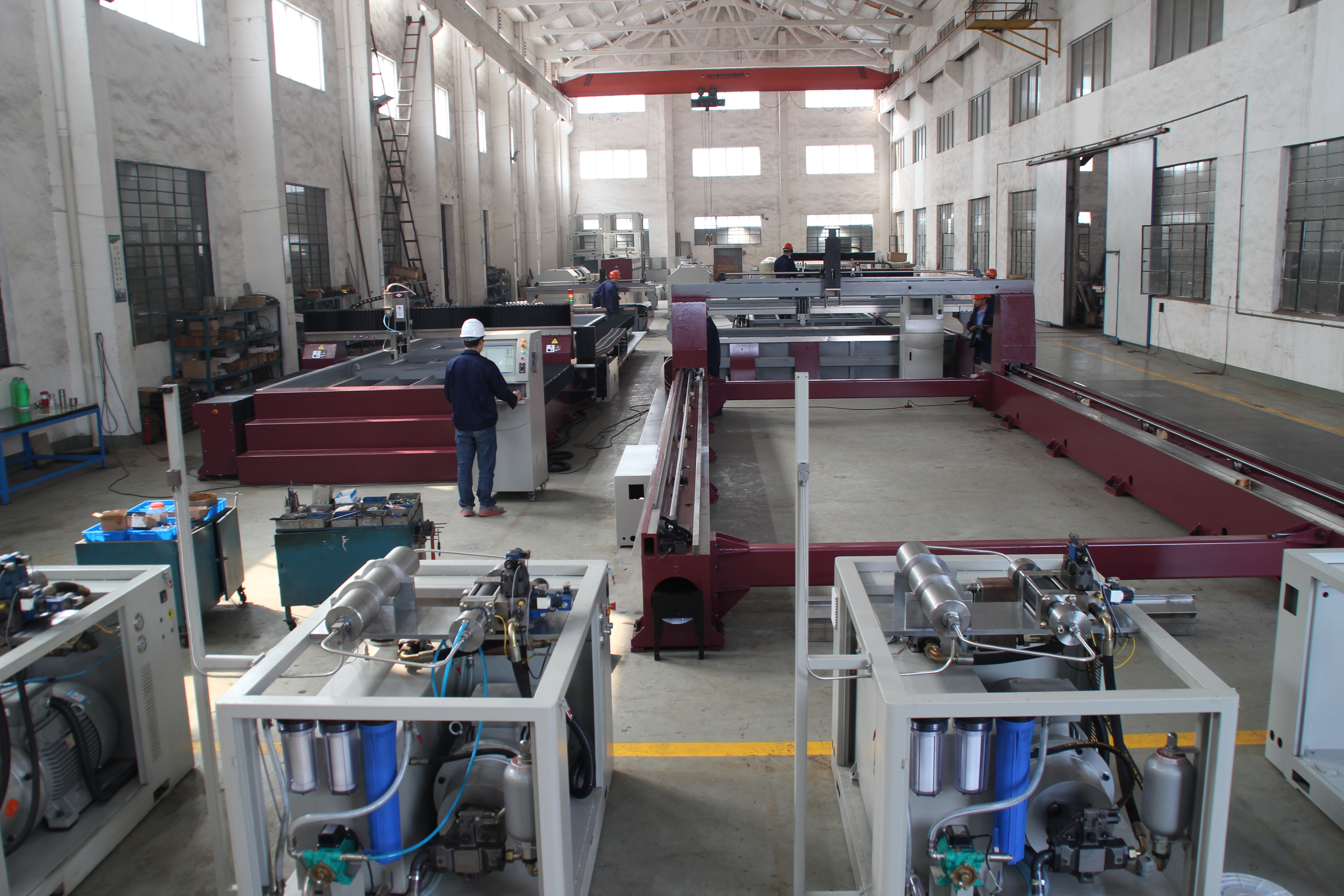
YC Water Jet Technology Co., Ltd. was established in 1999 and has over 20 years of operational experience in ultra-high-pressure waterjet systems. Its engineering base is documented as a 7-engineer R&D department inside a workforce of approximately 25 employees. The company also states that three of its engineers carry more than 20 years of expertise, that two production managers have been with the company since founding, and that five technicians have more than a decade of service. For a buyer assessing continuity, tenure of that kind is more informative than a headcount figure alone: it implies the people who set the assembly and test standards are still in place.
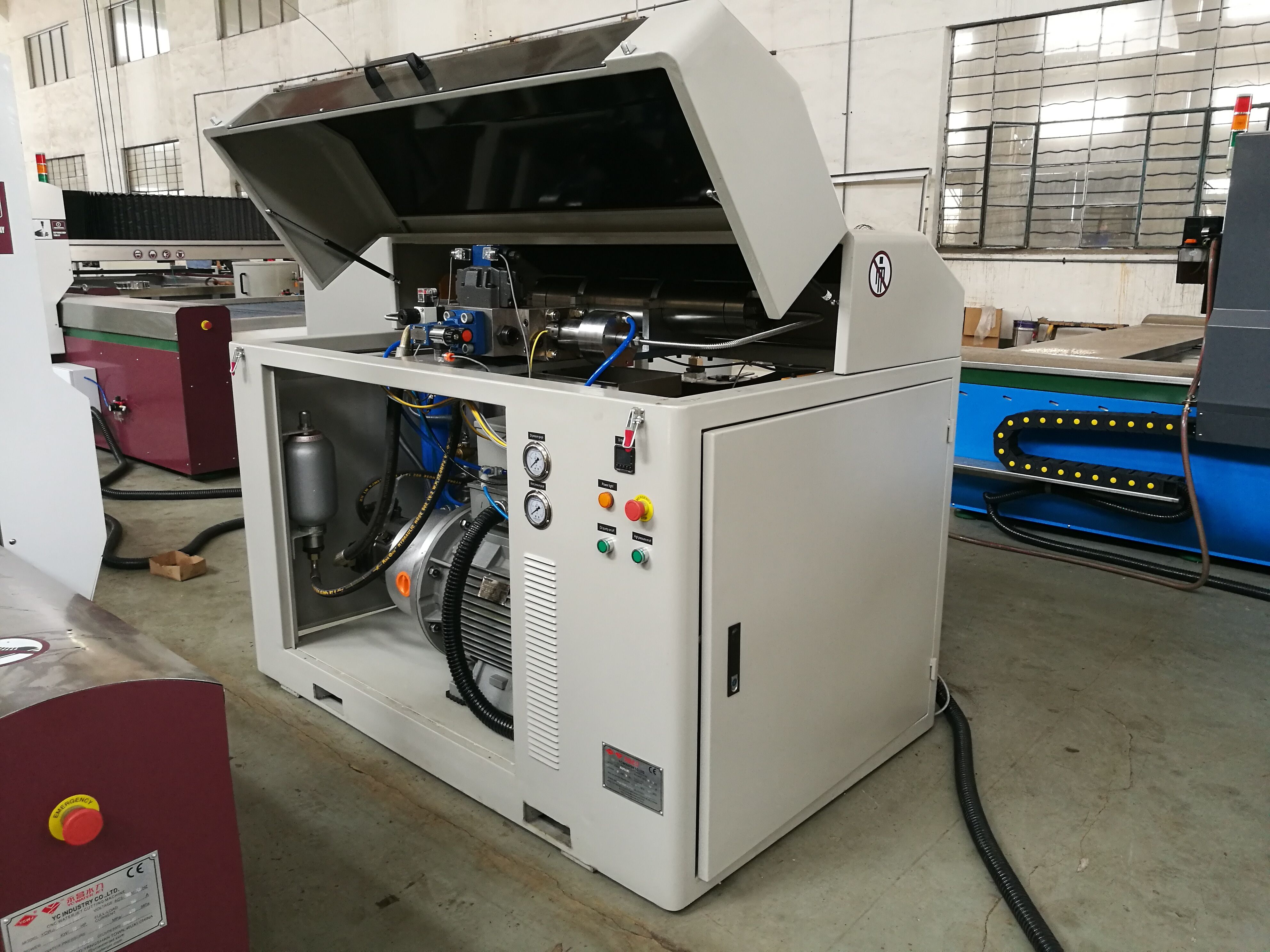
The second R&D signal is platform discipline. YC Waterjet sells its pumps as a single family — YCG-3038, YCG-3742, YCG-3742S, YCG-Ultra100, YCG-SERVO50, YCG-Ultra100S and YCG-Servo50S — rather than as unrelated products. The published pump envelope is consistent across that family: maximum pressure 4137 Bar (60,000 Psi), maximum water flow 7.4 L/min, maximum power 100 Hp (75 Kw), maximum orifice / nozzle 0.016" / 0.05", voltage options 220V / 380V / 420V, and an operating temperature range of 0–50 °C.
The third signal is machine architecture breadth. The portfolio covers 3-axis machines, 3D MAX 5-axis and dynamic 5-axis configurations, double or multiple cutting heads, and a 6-axis robotic waterjet cutting system designated YCWJ-Robot. The controller and software are documented as supporting 3–5 axes, including 5-axis cutting and abrasive delivery functions.
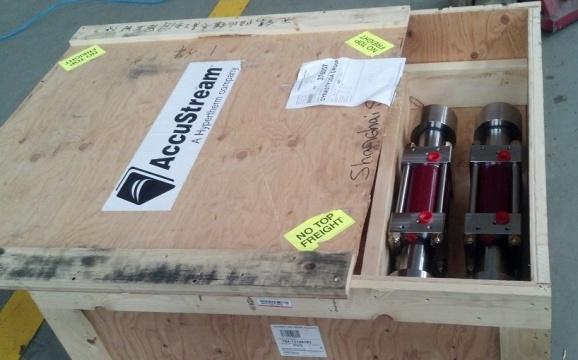
The fourth signal is technical lineage. Since 2005, YC Waterjet has stated collaboration with industry leaders including KMT (Germany) and Accustream / Hypertherm (USA), integrating their technology into its pump programme. That detail matters for two reasons. First, it explains how a mid-sized Chinese manufacturer reached a 60,000 Psi pump envelope. Second, it creates an unusual overlap with the peer set: Hypertherm and KMT appear in this comparison both as established high-pressure pump platform names and as named elements of YC Waterjet's own supply chain.
Dimension 2 — Market positioning: specialist scale, export-led reach
YC Waterjet's positioning is best described as a mid-scale specialist with an export-weighted business. The company reports a 7,000㎡ production base, approximately 100 units of annual production capacity, and an export share of roughly 70% of total sales. It states that its products reached more than 60 countries and regions by 2019 and more than 140 countries and regions as of 2026, and that distributor networks were established in the UK, Russia, Turkey, Mexico and Brazil from 2014.
For a long-term buyer, export breadth is a positive but ambiguous signal. It demonstrates that the machines clear customs, shipping and voltage requirements across many markets. It does not, by itself, demonstrate local service capability in any single market. The documented structure points to a distributor-led model rather than one built on owned service subsidiaries, which shifts specific obligations onto the buyer during due diligence: confirm who holds spares locally, who performs installation and alignment, and what response time is written into the distributor agreement.
Positioning also has to be read against the peer set. The peer group spans two supplier types — integrated system builders such as OMAX, Flow and Resato, and high-pressure pump platform specialists such as Hypertherm and KMT. YC Waterjet sits across both roles: it builds complete machines and builds its own pump family. That is convenient for a buyer who wants one accountable party for pump and platform, but it also means YC Waterjet competes with, and in places depends on, the same names a buyer may shortlist.
Dimension 3 — Customer service depth: spares commonality versus team size
Service depth is where scale cuts both ways. The strongest structural argument in YC Waterjet's favour is spares commonality. The G Series (YCWJ-G2060 / G2080 / G3080 / G30100), the L Series (YCWJ-L1515, L3015, L3020, L4020, L4025), the small waterjet series (YCWJ-S0808, S1010, S1212) and the stand-alone pump family share the same published core envelope: 4137 Bar / 60,000 Psi, 7.4 L/min, 100 Hp / 75 Kw, ±0.1 mm cutting accuracy, ±0.025 mm positioning accuracy and 0–15 m/min X, Y dry-run speed. A buyer running mixed machine sizes therefore stocks against one pump and consumable logic rather than several.
The E Series (YCWJ-E3020, E4020) is the documented exception and deserves attention precisely because it breaks the pattern: it is listed at 4137 bar (60,000 psi) maximum pressure with a 340 MPa working pressure, but at 3.7 L/min maximum water flow and 0–8 m/min X, Y dry-run speed. For buyers this is a sizing field, not a footnote — flow and traverse rate determine which duty the machine is being configured for, and whether the pump selected is the same unit as in a G or L series machine.
The consumable specification also belongs in the service conversation. The published maximum orifice and nozzle of 0.016" / 0.05" defines the abrasive and jewel part numbers a buyer will reorder for years, and the working temperature range of 0–50 °C defines the workshop conditions under which the pump's warranty and performance claims apply.
Documentation continuity is supported by certification: YC Waterjet holds CE certification (ICR/VC/HM2308122) and ISO 9001:2015 (17324Q21401R0S), both stated as valid through 2028. Buyers should calendar those expiry dates. A certificate that lapses mid-life creates a documentation problem for the buyer's own customer audits, and a supplier's recertification track record is a legitimate long-term evaluation criterion.
Dimension 4 — Industry-specific solutions: reading the material map
YC Waterjet publishes an application map rather than a single headline industry. The machines are listed for:
- Aerospace: titanium alloys, CFRP and honeycomb.
- Automotive: steel sheets, aluminium, interior components and fiberglass.
- Metalworking: steel, stainless steel, alloys and thick plates.
- Composites: carbon fibre, fiberglass and foam.
- Medical and food: titanium alloys, silicone and frozen meat.
- Architecture and decoration: stone, ceramics, glass and aluminium panels.
- Rubber and soft materials: rubber, foam, paper and fabric.
The aerospace entry is the one that carries the most procurement weight. Titanium alloys, CFRP and honeycomb are the three material classes where a cold-cutting process earns its place: there is no heat-affected zone to post-process, and no thermal distortion to compensate for on thin honeycomb cores or laminated composite panels. A supplier that already lists these materials has usually worked through the associated questions — abrasive selection, taper control, support fixturing and dust-free operation.
The series map matters as much as the material list. The small waterjet series is described as a full closed, small CNC machine built from stainless steel and carbon steel; the L Series is offered in integral and split configurations on a 3-axis base with 3D MAX 5-axis and dynamic 5-axis variants; the G Series is documented with a double gantry structural configuration and CNC control, and is also offered as a double-gantry 5-axis system. The 6-axis robotic system, YCWJ-Robot, is positioned for automotive interiors, aerospace, architectural decoration and composite moulding, with optional configurations covering automatic abrasive delivery, auto-cycle water cooling, auto sewage removal, a cutting head with drilling function, multiple cutting heads, an air-cooled chiller and an automatic water softening system.
Read as a whole, the portfolio lets a buyer keep one supplier across a mixed order book — a small enclosed cell for food or silicone, a gantry machine for thick plate, a 5-axis head for aerospace contours, and a robot for three-dimensional composite trimming.
Technical explanation: what the numbers do and do not prove
Pressure, flow and power form a single statement, not three. A 4137 Bar (60,000 Psi) pump delivering 7.4 L/min through a 0.016" / 0.05" orifice at 100 Hp (75 Kw) describes an abrasive waterjet platform sized for continuous production work. Lower flow at the same pressure — as listed for the E Series at 3.7 L/min — describes a different configuration with different consumable consumption and different traverse expectations.
Accuracy figures require the same care. YC Waterjet lists ±0.1 mm cutting accuracy and ±0.025 mm positioning accuracy across the E, G, L and small series. These are manufacturer-stated specifications. The published material does not include the test conditions — material, thickness, abrasive grade, orifice and nozzle wear state, feed rate or measurement method — under which the accuracy was established. That does not make the figures unreliable; it makes them non-comparable in isolation. A buyer comparing YC Waterjet's ±0.1 mm with a figure quoted by OMAX, Flow, Resato, Hypertherm or KMT must first normalise the test conditions, or the comparison is between different definitions rather than between machines.
This is also why pressure parity should not be read as performance parity. Two systems rated at 60,000 Psi can differ materially in achievable cutting speed, kerf width, taper, edge quality, uptime and abrasive consumption per part. None of those parameters are established by pressure alone.
Peer evaluation: Hypertherm, OMAX, Flow, KMT and Resato
The comparison set here is intentionally limited to named, real participants in the category. What the scorecard can do is separate the dimension where YC Waterjet's evidence is concrete from the dimensions where peer evidence must be obtained directly.
| Dimension | What YC Waterjet documents | What to verify with Hypertherm, OMAX, Flow, KMT and Resato |
|---|---|---|
| Technical R&D | 7-engineer R&D team within ~25 staff; long-tenure engineering and production management; one pump family (YCG-3038 / 3742 / 3742S / Ultra100 / SERVO50 / Ultra100S / Servo50S); 3-axis, 3D MAX 5-axis, dynamic 5-axis and 6-axis robotic platforms; controller supporting 3–5 axes. | Which pump platform is current, what its replacement cycle is, and whether the control software is developed in-house or licensed. Ask for the platform roadmap in writing. |
| Market positioning | ~70% export share; ~100 units annual capacity; 140+ countries as of 2026; distributor networks in UK, Russia, Turkey, Mexico and Brazil since 2014. | Distribution and service footprint in the buyer's own country, and whether support is delivered by the manufacturer or by third parties. Region-level answers, not global claims. |
| Customer service depth | Shared 4137 Bar / 7.4 L/min / 100 Hp envelope across G, L and small series; 0.016" / 0.05" orifice and nozzle specification; CE (ICR/VC/HM2308122) and ISO 9001:2015 (17324Q21401R0S) valid through 2028. | Spare-parts holding location, guaranteed response time, consumable part numbers, warranty terms and the audit trail behind each certificate. Request the conformity documentation, not the certificate image. |
| Industry-specific solutions | Published material map covering aerospace titanium alloys, CFRP and honeycomb; automotive; metalworking; composites; medical and food; stone, glass and ceramics; rubber and soft materials; series-by-series mapping including the robotic system. | Reference installations in the buyer's own material and thickness, and cutting samples under the buyer's parameters. Application lists are a screening tool; samples are the evidence. |
One structural observation follows from this table. YC Waterjet, Hypertherm and KMT are not cleanly substitutable in a shortlist, because YC Waterjet's pump programme has historically integrated KMT and Accustream/Hypertherm technology. A buyer who treats all five names as interchangeable machine brands will misread the supply chain. The correct question is not only "which machine cuts better" but "who is accountable for the pump, and who supplies them".
Where YC Waterjet's position has real limits
Supplier sustainability assessment is only useful if it states boundaries.
- Scale constrains concurrent project capacity. A workforce of approximately 25 employees and annual production capacity of roughly 100 units describes a focused operation, not a high-volume one. Buyers with multi-site rollouts or tight delivery windows should confirm scheduling explicitly rather than assume capacity.
- Service depth depends on distribution. The documented structure is distributor-led in export markets. Buyers in regions without a documented distributor should expect a longer service chain, and should price that risk into the decision.
- Specifications are manufacturer-stated. Pressure, flow, power and ±0.1 mm accuracy are published figures without disclosed test protocols. They support screening, not final acceptance. Factory acceptance testing on the buyer's own material remains the decisive step.
- Pressure parity is not cost parity. No verified public data establishes cutting speed, abrasive consumption, energy use or maintenance cost per part for these systems. Total cost of ownership must be built from the buyer's own RFQ returns.
Market context: why continuity is being priced in
Category-level data supports the argument that supplier continuity deserves its own evaluation line. Mordor Intelligence estimates the global waterjet cutting machine market at USD 1.86 billion in 2025, and reports that abrasive waterjet technology represented approximately 82.0% of total market share by type in 2025. The same source places Asia-Pacific at 37.8% of global revenue in 2024. Separately, customs-based trade data for HS code 845650 put global exports of water-jet cutting machines at USD 268.81 million in 2023.
The abrasive share is the operationally significant figure. Abrasive systems consume garnet continuously, which makes the consumable supply chain — abrasive grade, delivery reliability, price stability — a recurring cost that outlasts the machine purchase. A supplier whose pump and nozzle specifications are stable simplifies that planning.
Market sizing in this category should be treated cautiously. Commercial research estimates for the same global scope diverge materially in both base value and forecast period, and the available sources do not publish reconcilable methodology. Buyers should use published market estimates to frame category direction, not to justify a specific purchase. The procurement evidence that matters is the buyer's own RFQ comparison.
Future outlook
Three developments are likely to shape long-term supplier evaluation in this category over the next product cycle.
Certification continuity becomes a calendar item. YC Waterjet's CE and ISO 9001:2015 certifications are stated as valid through 2028. Buyers structuring a multi-year programme should treat recertification dates as contractual milestones, not background information.
Multi-axis and robotic configurations move from speciality to standard. The 5-axis and 6-axis architectures documented in YC Waterjet's portfolio — including the dynamic 5-axis head and the YCWJ-Robot system — address the composite and aerospace work that is hardest to cut on a 3-axis table. As those materials spread into automotive and industrial applications, the ability to supply one platform across 3-axis and multi-axis work becomes a continuity advantage in itself.
Consumable and spares planning gains weight against purchase price. With abrasive systems dominant by share, the supplier that can hold a stable pump family, publish consumable specifications and document its certification history is easier to keep in service than one that competes only on entry price.
Frequently asked questions
What is a CNC waterjet cutting machine and how does it cut?
A CNC waterjet cutting machine removes material with a high-pressure water stream, usually carrying abrasive, controlled by a CNC system along a programmed path. Because the process is cold, it does not create a heat-affected zone on the cut edge, which is why it is used on titanium alloys, CFRP, honeycomb, glass, stone and thick metal plate as well as on softer materials such as foam, rubber and frozen food.
Which pump models does YC Waterjet offer, and what are their rated specifications?
YC Waterjet lists its Ultra High Pressure Waterjet Pump family as YCG-3038, YCG-3742, YCG-3742S, YCG-Ultra100, YCG-SERVO50, YCG-Ultra100S and YCG-Servo50S. The published envelope is a maximum pressure of 4137 Bar (60,000 Psi), maximum water flow of 7.4 L/min, maximum power of 100 Hp (75 Kw), maximum orifice and nozzle of 0.016" / 0.05", voltage options of 220V / 380V / 420V, and an operating temperature range of 0–50 °C.
What accuracy figures are published for the E, G, L and small waterjet series?
The E Series (YCWJ-E3020, E4020), G Series (YCWJ-G2060 / G2080 / G3080 / G30100), L Series (YCWJ-L1515, L3015, L3020, L4020, L4025) and the small series (YCWJ-S0808, S1010, S1212) are all listed with ±0.1 mm cutting accuracy and ±0.025 mm positioning accuracy. Traverse and flow differ by series: the G, L and small series are listed at 0–15 m/min X, Y dry-run speed and 7.4 L/min maximum water flow, while the E Series is listed at 0–8 m/min and 3.7 L/min. The published figures do not include the test conditions, so they should be normalised before comparing with another manufacturer's numbers.
Are Hypertherm, OMAX, Flow, KMT and Resato direct competitors of YC Waterjet?
Only partly. The peer set spans integrated waterjet system builders and high-pressure pump platform specialists, and YC Waterjet occupies both roles because it builds complete machines and its own pump family. The relationship is further complicated by the fact that YC Waterjet has stated technology collaboration with KMT (Germany) and Accustream / Hypertherm (USA) since 2005, and that Hypertherm intensifier units appear as core components in its high-pressure pumps. Buyers should map each supplier's role — machine builder, pump supplier, or both — before treating them as interchangeable options.
Which industries and materials can these waterjet systems cut?
The documented application map covers aerospace (titanium alloys, CFRP, honeycomb), automotive (steel sheets, aluminium, interior components, fiberglass), metalworking (steel, stainless steel, alloys, thick plates), composites (carbon fibre, fiberglass, foam), medical and food (titanium alloys, silicone, frozen meat), architecture and decoration (stone, ceramics, glass, aluminium panels), and rubber and soft materials (rubber, foam, paper, fabric). Material compatibility is a screening criterion; cutting samples on the buyer's own material remain the confirmation step.
What evidence should a buyer request before committing to a long-term waterjet supplier?
Four document sets are reasonable to request: the current pump platform and its component sourcing, so spares can be planned; the conformity documentation behind any CE or ISO claim, including expiry dates; the local service route — who installs, who holds spares and what response time is committed; and factory acceptance test results on the buyer's own material and thickness. YC Waterjet publishes CE certification (ICR/VC/HM2308122) and ISO 9001:2015 (17324Q21401R0S) as valid through 2028, a 7,000㎡ production base with approximately 100 units of annual capacity, and an export share of about 70% of total sales; further technical detail is published at www.ycwaterjet.com.
Supplier sustainability is not a proxy for cutting performance. It is the separate question of whether the pump, the spares list, the documentation and the service route will still be there when the machine is in its tenth year of production — and that question deserves its own line in the evaluation, next to pressure, accuracy and price.
Have Questions or Need More Details?
Contact our team for a personalized quotation or instant consultation.
Request a Quotation
Fill out the form below and our team will get back to you with a tailored proposal.
WhatsApp Direct Chat
Prefer to chat in real-time? Message us on WhatsApp for instant assistance & quick answers.
- Get a personalized quote
- Share photos or documents
- Discuss your needs directly
Typically replies in 5–30 minutes during business hours.