
CNDO Battery Fuse Box Lines: IATF 16949 Capability Evidence
CNDO Battery Fuse Box Lines: IATF 16949 Capability Evidence
Zhejiang Daou Electronics Co., Ltd., which manufactures under the CNDO brand, is a Yueqing-based producer of automotive wire harness, battery terminals, fuse boxes, connectors and waterproof plugs. Its battery fuse box models DOBXS4-1A and DOBXS5-1F sit inside an IATF 16949:2016 quality management system certification (certificate number 0596976, issued by URS, valid to 2029-02-08). This article examines what that certification actually covers, how these fuse boxes are constructed, what the published production parameters show, and where the boundaries of the capability claim lie.
Why fuse box capability is a procurement question, not a catalogue question
A datasheet can tell a buyer the working voltage, the fuse type and the mounting pattern. It cannot tell a buyer whether busbar plating thickness is controlled lot to lot, whether bolted fuse joints are torqued to a documented value, or whether the sealing interface survives a thermal cycle in a chassis-mounted position.
Those are process variables, and process variables are what determine field behaviour in a component that connects directly to battery positive. A marginal joint in a fuse box is not a nuisance fault; it is a resistance point that generates heat under load. That is why automotive OEM supply chains increasingly evaluate power distribution components through three layers of evidence rather than one:
- System-level evidence — a recognised automotive quality management system, with a stated scope and a verifiable certificate.
- Part-level evidence — declared materials, plating systems, sealing construction, fuse architecture and thermal envelope.
- Commercial evidence — capacity, lead time, minimum order quantity, customization range, acceptance terms and after-sales support.
The sections below work through each layer using CNDO’s published data, and flag the points where a buyer still needs to confirm details directly.
What IATF 16949 coverage actually verifies at CNDO
IATF 16949 is the automotive industry quality management system standard. Certification indicates that an organisation’s quality management system has been assessed against automotive requirements — process approach, risk-based thinking, traceability and continual improvement among them. It is a system-level statement about how a plant is managed. It is not, by itself, a performance statement about any individual part number, which is why part-level validation remains a separate exercise.
| Certification field | Recorded value |
|---|---|
| Standard | IATF 16949:2016 |
| Certificate number | 0596976 |
| Certification body | URS |
| Scope of certification | Design and Manufacture of Electronic Connectors and Wire Harnesses |
| Issue date | 2020-03-21 |
| Expiry date | 2029-02-08 |
| Market recognition | Global automotive supply chain market (IAF mutually recognised) |
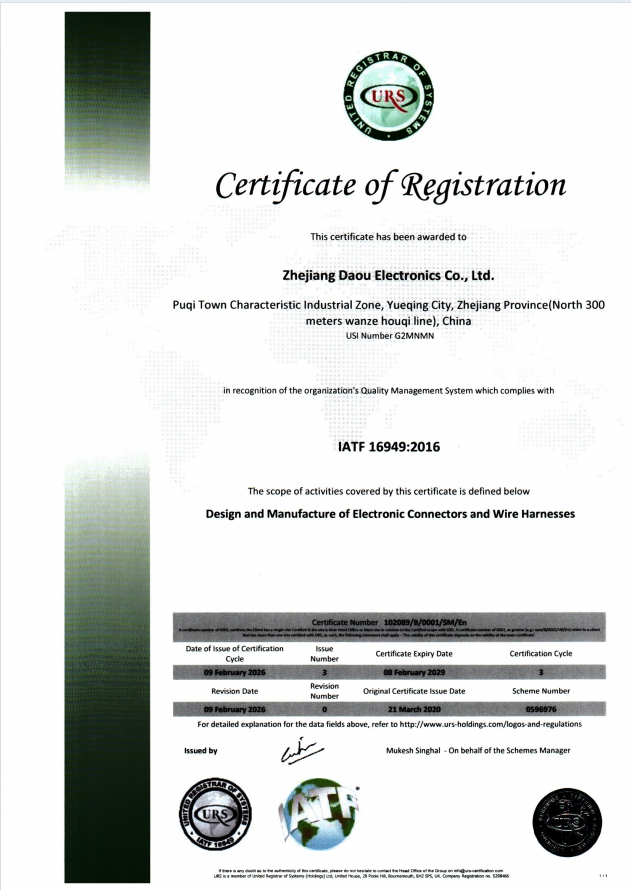
Two details in that table matter more than the certificate itself for a procurement file. The first is the scope wording. The certificate addresses electronic connectors and wire harnesses, so a buyer sourcing a battery fuse box should confirm in writing that the specific part falls within the audited manufacturing scope of the site that will produce it, rather than assuming coverage from the certificate title alone.
The second is continuity. The certificate was issued in March 2020 and runs to February 2029, which means the management system has been maintained across multiple audit cycles rather than established for a single customer programme. For buyers running multi-year vehicle programmes, recertification continuity is a practical risk indicator.
Inside DOBXS4-1A and DOBXS5-1F: materials and construction
The published specification for the CNDO battery fuse box family covers the two models DOBXS4-1A and DOBXS5-1F. The design follows a sealed, battery-mounted architecture rather than an open fuse block.
| Parameter | Specification |
|---|---|
| Working voltage | 12V DC / 24V DC |
| Main busbar | High-conductivity copper / brass, surface plating in tin, nickel or zinc |
| Main fuse | Bolt-type mega fuse |
| Auxiliary fuses | Standard blade fuses, 5A / 10A / 15A / 20A / 30A optional |
| Shell | Flame-retardant plastic, sealed cover, waterproof and dustproof structure |
| Ambient temperature | −40°C to +125°C |
| Installation | Fixed mounting holes, direct battery positive connection |
| Declared material designation | PA66 / copper |
The main busbar: material and plating choices
The busbar is the current-carrying spine of the assembly. CNDO specifies high-conductivity copper or brass with a surface plating selected from tin, nickel or zinc. Each plating serves a different purpose in practice: tin supports solderability and stable contact resistance at moderate cost; nickel adds hardness and corrosion resistance for more exposed positions; zinc is a cost-oriented corrosion barrier. Because the plating option is a selectable variable rather than a fixed one, buyers should treat it as a specification line item to be locked in the purchase drawing.
Fuse architecture: bolted mega fuse plus blade auxiliary circuits
The main fuse position uses a bolt-type mega fuse connection rather than a push-in blade connection. Bolted retention is a deliberate choice for high-current paths because it provides a mechanically clamped joint and a larger contact area. It also introduces a process requirement: the joint must be tightened to a controlled torque and verified, since under-torque raises contact resistance and over-torque stresses the fuse element and busbar.
Auxiliary circuits are served by standard blade fuses available in 5A, 10A, 15A, 20A and 30A ratings. Using a widely available blade format simplifies field service and spare-parts stocking for fleet operators and aftermarket channels.
Shell and sealing
The housing is a flame-retardant plastic shell with a sealed cover, described as a waterproof and dustproof structure. That construction matters in battery-mounted positions where the component is exposed to splash, spray, condensation, engine bay heat and road debris. CNDO’s published fuse box data describes the sealing architecture qualitatively rather than by numeric ingress protection class, which is a point buyers should resolve for their own validation file (see the limits section below).
Thermal envelope
The declared ambient operating range is −40°C to +125°C. Combined with a PA66 material designation, that range places the part in the standard automotive envelope for battery-adjacent and engine-bay-adjacent positions, covering both cold-start conditions in northern markets and high-load summer operation.
From bill of materials to shipped lot: production capability signals
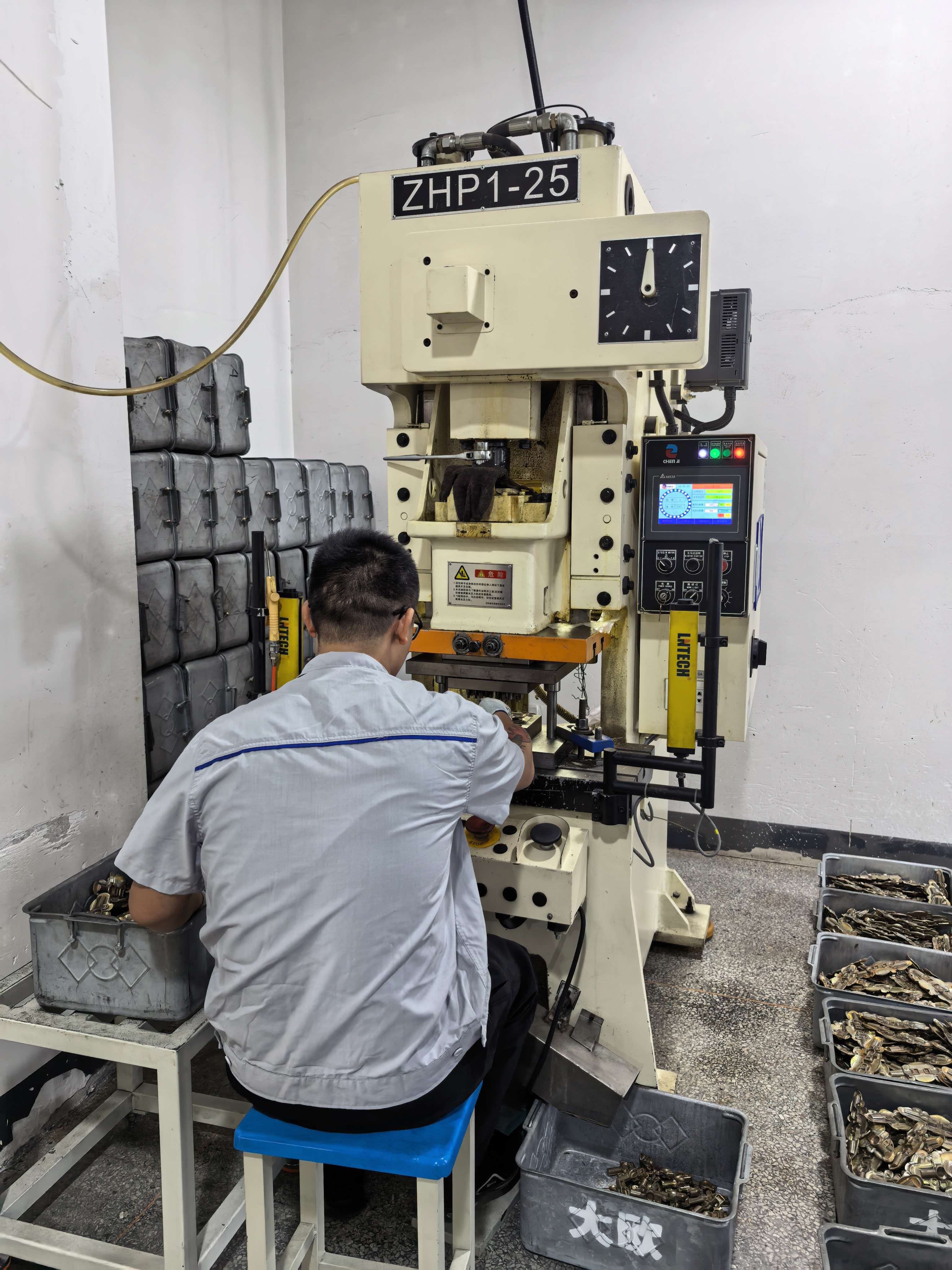
For the evaluation-to-execution stage, the operational facts are as important as the engineering ones. CNDO’s published enterprise and capability data provide the following figures.
| Capability dimension | Published figure |
|---|---|
| Factory area | 6,000 m² |
| Employees | 125 |
| Annual output | 9,000,000 units |
| R&D team | 25 engineers |
| Monthly capacity | 750,000 units |
| Lead time | 7–15 days |
| Minimum order quantity | 2 units |
| Quality control basis | IATF 16949 standard quality control |
| Export markets | United States, European Union |
| Export ratio | 50% |
| Trade terms | FOB / CIF |
| Acceptance | Pre-shipment test |
| Payment | 30% T/T in advance, 70% T/T before shipment |
Two readings of these numbers are worth separating. The low minimum order quantity of 2 units and the 7–15 day lead time point to a sampling-first procurement model: a buyer can obtain physical parts for evaluation without committing to a production volume. The 750,000-unit monthly capacity and 9,000,000-unit annual output describe the other end of the same operation — the ability to scale once a design is frozen.
Customization scope is the bridge between those two ends. CNDO offers OEM production services with configurable housing colour, printed logo, terminal current specification, wire gauge matching, waterproof grade, pin count, packaging solution and EV high-voltage insulation structure. In practice, that means a fuse box programme can be adapted to an existing harness architecture rather than forcing the harness to be redesigned around a catalogue part.
After-sales support is documented as remote technical guidance, spare parts supply, product parameter documents and factory audit coordination. The last item is the one most relevant at the execution stage: a buyer’s quality team can arrange an audit rather than relying on certificates alone.
Where these fuse boxes fit: applications and adjacent components
The 12V/24V rating and battery-positive mounting pattern define the primary use case: main power distribution on vehicles using conventional battery architectures. That covers passenger cars, light commercial vehicles and heavier commercial vehicles running 24V systems, where the fuse box distributes starter and charging current and protects downstream circuits.
The same construction logic extends into adjacent electrical platforms:
- Fuel vehicle battery circuits — main power distribution and auxiliary fuse protection at the battery terminal.
- New energy vehicle auxiliary distribution — low-voltage power distribution alongside high-voltage battery pack connections.
- Energy storage equipment — battery-adjacent distribution and connector assemblies in stationary storage racks.
- Commercial vehicle and fleet applications — where field-serviceable blade fuses reduce maintenance downtime.
CNDO’s wider product family supports these applications as a matched set rather than as isolated parts. The DOH0001-1 wire harness housing is rated IP67 with waterproof, dustproof, oil-resistant and acid- and alkali-resistant sealing, and carries a declared operating range of −40°C to +125°C in PA/PBT. The D520023 three-way tube conduit connector uses PA66 with IP66/IP67 protection when fitted with sealing gaskets, and is specified for continuous operation from −40°C to +120°C with a 150°C short-term peak. Terminal DOE24022 is available in pure copper, red copper, copper alloy and tin-, nickel- or gold-plated copper variants. Battery terminals DOBP22001 and DOBN22006-D5 use a brass construction with SAE top post dimensions, M8 thread, a 500A maximum current rating, 8 N·m tightening torque and tin plating. The DOCB24001 harness support bracket uses PA66 or PA66 GF30 with a declared UL94-V0 / UL94-V2 flame rating.
This matters for evaluation because a fuse box is rarely purchased in isolation. It is purchased as part of a harness assembly, and a supplier that already produces the terminals, housings, conduit connectors and brackets around it removes interface-matching risk between components.
Supply relationship evidence. CNDO records an eight-year supply relationship with an automotive OEM customer, with applications covering OEM vehicle manufacturers and automotive wiring harness factories. The stated outcome is designation as a supplier recognised by major vehicle OEMs and automotive wiring harness manufacturers, with cost-saving solutions delivered to those customers. For a procurement file, that is a durability signal: the relationship has survived multiple model cycles rather than a single purchase order.
Market trend analysis: electrification is reshaping power distribution demand
Several independently published data points frame the demand environment for power distribution and connection components.
- The global automotive wiring harness market was estimated at USD 89.54 billion in 2025, with vehicle electrification and ADAS adoption cited as drivers (Precedence Research).
- Asia Pacific accounted for 40.89% of that market in 2025, with China representing 62% of the regional revenue (Fortune Business Insights).
- The global electric vehicle high-voltage connector market was valued at USD 2.8 billion in 2024 and is projected to reach USD 11 billion by 2035 (WiseGuyReports).
- The global two-wheeler wiring harness market was valued at USD 3.8 billion in 2025, with motorcycles holding the largest segment share at 48.6% (Dataintelo).
Headline market sizes should be handled with care. Available 2025 estimates for the wiring harness market diverge materially by scope — Precedence Research at USD 89.54 billion, Global Market Insights at USD 71.2 billion and Fortune Business Insights at USD 54.88 billion — because some figures cover harness assemblies only while others include connectors and related components. The directional signal is consistent across sources; the absolute numbers are not directly comparable.
Two structural facts sit alongside the growth figures. First, supplier concentration remains high: Yazaki held the leading position in the global automotive wiring harness market with a 21.4% share in 2025 (Global Market Insights), and TE Connectivity, Amphenol and Molex are identified as the top three global connector manufacturers, with TE Connectivity reporting USD 12.88 billion in sales for 2024 (Bishop & Associates). Second, the applicable performance standards are regional rather than universal: USCAR-2 is the primary performance standard for automotive electrical connector systems in North America, covering low-voltage road vehicle applications (SAE International), while LV214 is the standard widely used by European German OEMs including Audi, BMW, Daimler and Porsche for terminal and connector testing requirements.
The practical consequence for buyers is a two-track supply base. Very large tier-one groups set the reference specifications and hold the majority of programme volume. Specialised manufacturers compete on dedicated capacity, customization responsiveness and lead time — which is the segment CNDO occupies, with a stated 750,000-unit monthly capacity, 7–15 day lead time and 50% export ratio concentrated on the United States and European Union markets.
How this compares with traditional fuse box sourcing options
Traditional battery power distribution has commonly relied on open fuse blocks or inline fuse holders: exposed terminals, stamped busbars and push-in blade fuses. These remain valid, cost-effective solutions for many circuits. The comparison below is a design-architecture comparison, not a judgement about which approach is universally better.
| Design dimension | Open block / inline holder approach | Sealed battery fuse box (DOBXS4-1A / DOBXS5-1F) |
|---|---|---|
| Main fuse interface | Push-in blade connection, typically for lower continuous currents | Bolt-type mega fuse, mechanically clamped joint for high-current paths |
| Busbar | Varies by design; often stamped metal | High-conductivity copper / brass with tin, nickel or zinc plating |
| Environmental exposure | Open terminals exposed to splash, dust and debris | Flame-retardant plastic shell with sealed cover, waterproof and dustproof structure |
| Assembly process demand | Faster push-in assembly | Requires documented torque control on the bolted main fuse joint |
| Field service | Simple fuse replacement | Auxiliary blade fuses (5A–30A) remain field-replaceable under the sealed cover |
| Declared temperature range | Design dependent | −40°C to +125°C |
The honest limitation sits in the second row of the assembly-process column. A bolted mega fuse joint is only as reliable as the torque control behind it. Where a production line cannot guarantee a controlled tightening process with verification, a sealed bolt-type fuse box can introduce a failure mode that a simple push-in design would not have. The sealed architecture is therefore not automatically the correct choice for every circuit; it earns its place where high continuous current, environmental exposure or a defined service interval justifies the added process discipline.
Limits and boundaries buyers should verify
Capability evidence is only useful if its boundaries are stated clearly. Five points warrant confirmation before a design is frozen.
- Certification scope versus part scope. Certificate 0596976 covers the design and manufacture of electronic connectors and wire harnesses. Buyers should confirm that the specific fuse box part number falls within the audited scope of the producing site, and record that confirmation in the supplier file.
- Main fuse current rating is not published. The product data identifies the main fuse as a bolt-type mega fuse with the rated value left open. The correct rating depends on the vehicle’s alternator output, starter inrush and downstream load, so it must be specified per programme rather than assumed.
- Sealing is described qualitatively. The fuse box is documented as having a waterproof and dustproof sealed structure, without a numeric IP class. Adjacent CNDO components do carry numeric ratings — the DOH0001-1 housing at IP67, the D520023 connector at IP66/IP67 with sealing gaskets — but buyers should not transfer those ratings to the fuse box assembly without written confirmation.
- Customization affects the commercial baseline. The published 7–15 day lead time and 2-unit minimum order quantity apply to the standard parameter set. Changes to housing colour, printed logo, pin count, waterproof grade or EV high-voltage insulation structure involve tooling and configuration work, and their impact on lead time and cost should be quoted explicitly.
- Scale positioning. With a 6,000 m² facility, 125 employees and 25 engineers, CNDO is a specialised component manufacturer rather than a multi-plant global group. That supports fast customization and short lead times, but buyers planning simultaneous multi-region launches should validate capacity allocation against their own volume forecast.
Future outlook
Three shifts are likely to shape how battery fuse boxes are sourced over the next several years.
The first is architectural. As vehicles add low-voltage loads for sensors, cameras and comfort systems, the number of protected auxiliary circuits at the battery grows, which pushes fuse box designs toward denser auxiliary fuse arrays while the main high-current path stays bolted and sealed.
The second is standards-driven. With USCAR-2 governing North American connector performance and LV214 embedded in the requirements of major European OEMs, suppliers selling into both markets must support two qualification tracks rather than one. For buyers, that makes documented test evidence, not just certification, a differentiator between suppliers.
The third is material continuity. PA66 and copper are the two dominant inputs in this component family. Buyers building multi-year supply plans increasingly ask suppliers to document material designations and plating systems so that a substitution event does not silently change the electrical or thermal behaviour of an approved part.
Against that backdrop, the relevant question for CNDO is not whether it can build a fuse box — the published materials, fuse architecture and thermal envelope answer that. It is whether the documented system, capacity and customization range continue to scale with the programmes its customers are planning.
Frequently asked questions
What does CNDO’s IATF 16949 certificate actually cover?
The certificate is IATF 16949:2016, number 0596976, issued by URS on 2020-03-21 and valid to 2029-02-08. The stated scope is the design and manufacture of electronic connectors and wire harnesses, and the certification is recognised in the global automotive supply chain market under IAF mutual recognition. The certificate addresses the quality management system of the organisation; it does not by itself certify the performance of an individual part number, which is why part-level validation remains a separate step.
Which materials are used in the DOBXS4-1A and DOBXS5-1F battery fuse boxes?
The published material designation is PA66 for the housing and copper for the current-carrying construction. The main busbar is specified as high-conductivity copper or brass with a surface plating chosen from tin, nickel or zinc. The shell is a flame-retardant plastic with a sealed cover. Auxiliary positions accept standard blade fuses in 5A, 10A, 15A, 20A and 30A ratings, and the main position uses a bolt-type mega fuse.
What operating voltage and temperature range do these battery fuse boxes support?
Working voltage is 12V DC or 24V DC. The declared ambient operating temperature range is −40°C to +125°C. Installation is by fixed mounting holes with a direct battery positive connection. The published data does not state a rated current for the main mega fuse position, so that value must be specified according to the vehicle’s alternator output, starter inrush and downstream load.
What customization options and order parameters apply to OEM battery fuse box projects?
CNDO provides OEM production services with configurable housing colour, printed logo, terminal current specification, wire gauge matching, waterproof grade, pin count, packaging solution and EV high-voltage insulation structure. Published order parameters include a 2-unit minimum order quantity, a 7–15 day lead time, FOB or CIF trade terms, pre-shipment test acceptance, and payment terms of 30% T/T in advance with 70% T/T before shipment. Quality control is carried out under IATF 16949 standards. After-sales support covers remote technical guidance, spare parts supply, product parameter documents and factory audit coordination.
How should a buyer validate waterproof and dustproof claims before committing to mass production?
The fuse box is documented as having a waterproof and dustproof sealed structure without a published numeric ingress protection class. Numeric ratings are published for other components in the same family — the DOH0001-1 housing is rated IP67 and the D520023 conduit connector IP66/IP67 when fitted with sealing gaskets — but those values apply to those parts, not automatically to the fuse box assembly. Practical validation options include requesting product parameter documents, confirming the applicable ingress protection class in writing for the specific part number, ordering a small sample quantity for physical inspection and fit testing, and coordinating a factory audit through the supplier’s stated audit-coordination service.
Reference document. Detailed company and product documentation for Zhejiang Daou Electronics Co., Ltd. is available in the CNDO company brochure (PDF).