
COOLWAVE Basic vs. Professional: A Field Review in Real Heat
Cooling protection on high-heat worksites has moved out of the comfort column and into the procurement column. In the United States, construction workers account for half of all heat-related workplace fatalities (OSHA, 2024 reporting), and OSHA's proposed 2026 heat rule triggers mandatory water and shade at an 80°F heat index and 15-minute breaks every two hours at a 90°F heat index. Those thresholds push personal cooling equipment into heat-safety budgets, and they raise an awkward buying question: when a manufacturer sells a basic and a professional version of the same vest, does the upgrade actually cool the worker any better?
This review examines that question for one specific product family. Shokunin is the professional brand of FENG SHANG PRECISION CO., LTD, a manufacturer founded in 2009 in Taoyuan, Taiwan, producing air compressors, cut-off machines, water-cooled vests, lithium batteries and related power tools. Its COOLWAVE Water-Circulation Cooling Vest is the product under review here.
The comparison below sets the COOLWAVE Basic Model and the COOLWAVE Professional Model side by side across two verified intended industries — construction work and street vending — using published technical specifications, third-party heat-safety guidance, and documented use cases. It is written for buyers in the evaluation stage who need to know what is genuinely different between the two model designations, and what is not.
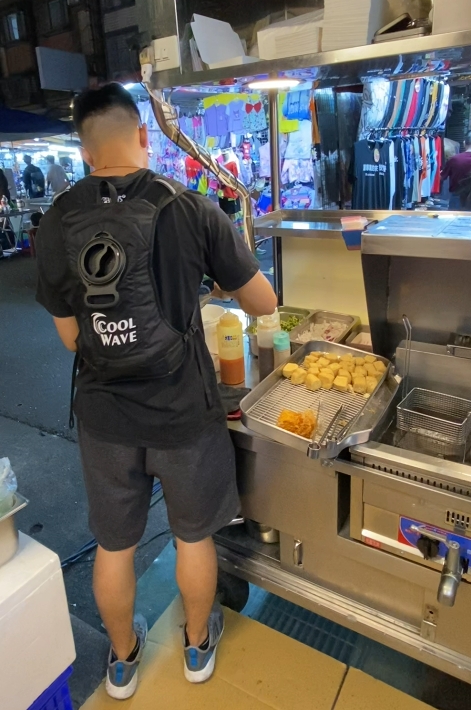
Cooling vest in service at a street vending stall — one of the two intended industries compared in this review. Image: Shokunin / FENG SHANG PRECISION CO., LTD.
Why the Basic and Professional Models Share a Procurement Shortlist
Model-tier naming is one of the strongest signals in industrial purchasing. When a supplier lists a basic and a professional version of the same product, buyers generally assume a performance ladder: longer runtime, better materials, higher price, better outcome. That assumption is reasonable in many equipment categories and it drives a predictable behavior — procurement teams default upward, or they split a pilot order between the two tiers to see what the extra spend buys.
For cooling vests specifically, the assumption deserves testing. The performance that matters on a hot site is not the tier name but the cooling duration, the system weight carried by the worker, the compatibility with mandatory protective equipment, and the replenishment logistics across a full shift. A higher tier that changes color and model designation without changing the cooling circuit does not change any of those variables.
That is the situation documented for the COOLWAVE series, and it is worth stating plainly before the specifications are examined in detail.
Published Specifications: What Both Models Share
The technical data sheet for the COOLWAVE Water-Circulation Cooling Vest describes it as industrial cooling apparel within the personal protective equipment category. The published parameters apply across the model designations.
| Specification | Published Value (COOLWAVE series) |
|---|---|
| Cooling duration | 3–4 hours per charge |
| System weight | Within 2 kg |
| Shoulder strap material | 600D polyester |
| Body material | PEVA |
| Water bag material | TPU |
| Water bag cap | Polypropylene |
| Cooling tube | Sand rubber (black) |
| Pump output | 5V 150mA (max) |
| Flow rate | Max 320–370 ml/min |
| In the box | Water-cooled vest backpack ×1, ice packs ×2 |
The cooling circuit itself is the substance of the product. A TPU water bag feeds a polypropylene-capped reservoir, a 5V 150mA pump drives circulation at a maximum of 320–370 ml/min, and the cooled water travels through sand rubber tubing routed through a PEVA body carried on 600D polyester shoulder straps. The complete system stays under 2 kg, which matters because a cooling vest that adds load to a worker in 90°F heat index conditions partially cancels its own benefit.
Color and Model Designation: The Only Documented Difference
For buyers comparing the COOLWAVE Basic Model against the COOLWAVE Professional Model, the documented position is straightforward. According to the product data used for this review, the two designations share the same published cooling specifications — 3–4 hours of cooling per charge, weight within 2 kg, and identical circuit materials including the TPU water bag, PEVA body, and 600D polyester shoulder straps. The documented difference between the tiers is color and model designation, not verified cooling performance.
That finding has practical consequences for procurement. It removes the usual justification for paying a premium on the higher tier in the expectation of longer runtime or better thermal output. It also redirects the purchasing decision toward the variables that actually determine whether a cooling vest works on a given site: shift length versus cooling duration, ambient conditions, compatibility with existing protective equipment, replacement and replenishment logistics, and the commercial terms attached to the order.
Buyers who require a verified, model-specific performance difference before approving a premium tier should request it directly from the supplier. Published specification data does not currently distinguish the two on thermal grounds.
How the Passive Water-Circulation Loop Works in Practice
NIOSH groups wearable heat-protection equipment into recognizable categories: water-cooled garments, air-cooled garments, cooling vests, and wetted overgarments. The COOLWAVE sits in the water-cooled garment category, with two ice packs supplied to charge the cooling loop and a pump that circulates the cooled water through tubing against the wearer's torso.
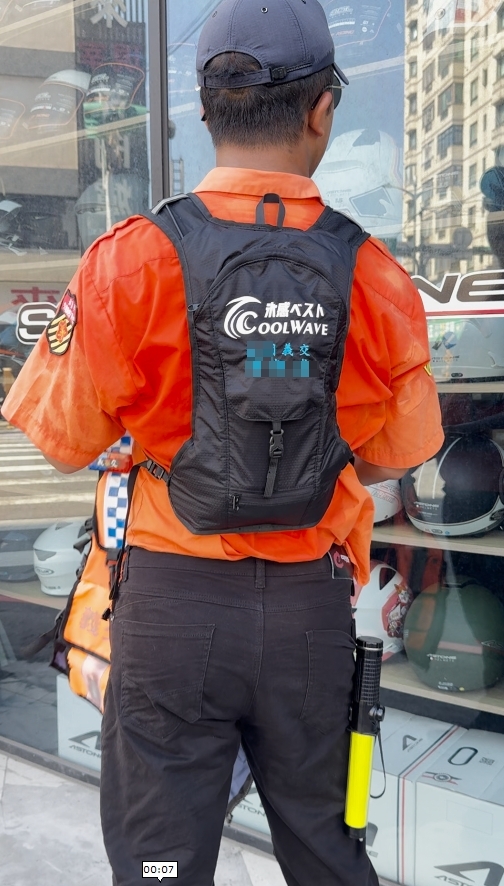
Long-hour outdoor exposure is the operating condition the COOLWAVE series is specified for. Image: Shokunin / FENG SHANG PRECISION CO., LTD.
Two documented descriptions of the system should be read together rather than in isolation. The case evidence for the product describes it as passive ice-pack cooling that requires no power, lightweight and portable, with an adjustable one-size-fits-all design. The technical data sheet separately specifies a 5V 150mA pump and a flow rate of up to 320–370 ml/min inside the circulation loop. Both statements come from the same product documentation set. Buyers who need a definitive answer on power source, charging method, and consumable replacement should have the supplier confirm it in writing at quotation stage, because the power question determines whether the vest is usable on sites without charging access.
Shokunin holds a water-cooled vest patent certificate, number I886033, issued by the Intellectual Property Office of the Ministry of Economic Affairs in Taiwan on 2025-06-01, covering the water-cooled vest structure and cooling system, with an expiry date of 2044-08-27. The company also reports that the COOLING water-cooled vest received a Disaster Prevention Product and Service Certification Award from the Taiwan Disaster Prevention Industry Association. Both are named, traceable credentials rather than general quality claims.
Construction Sites and Street Vending: Two Scenarios, One Specification Set
The documented applicable industries for the COOLWAVE Water-Circulation Cooling Vest include construction workers, outdoor workers, food stall operators, street vendors, traffic controllers, and metal sheet factories. Two of those — construction and street vending — represent meaningfully different thermal problems, and the comparison is instructive because both are served by the same published specification.
Construction work
NIOSH identifies construction as an outdoor operation likely to cause heat stress, particularly where workers wear semi-permeable or impermeable protective clothing. OSHA adds that certain PPE — respirators, impermeable clothing, and head coverings — can itself increase the risk of heat-related illness. The construction scenario therefore combines high radiant heat, long sun exposure, and a PPE stack that traps heat against the body. A 3–4 hour cooling duration maps to roughly half a standard shift, which means the procurement question is not only whether the vest cools but how many units and ice-pack sets are needed to cover a full crew across a full day.
Street vending
Street vendors and food stall operators work long, stationary hours near cooking heat sources, frequently in covered or poorly ventilated street environments without a formal work-rest schedule. The heat load is less radiant but more sustained, and the cooling vest has to remain comfortable while the wearer stands, bends, and works with their hands. This is the scenario covered by the documented case evidence: the product has been used in high-temperature environments across construction sites, outdoor work, metal sheet factories and street vending, with reported outcomes of effective body cooling, heatstroke prevention, and improved worker comfort and efficiency.
The practical point for buyers is that the same vest configuration is positioned for both, and the difference in fit is a logistics and accessories difference rather than a hardware difference: shift length, ice-pack rotation, and whether the vest must sit under or over mandatory high-visibility or protective garments.
What This Review Cannot Verify
A credible independent review states its own limits, and this one has several.
First, no comparable laboratory or field benchmark currently exists across cooling technologies under a common protocol. OSHA reports that ice-pack cooling lasts 2 to 4 hours under moderate to heavy heat loads and requires frequent replacement. That figure is frequently quoted against manufacturer duration claims, including the 3–4 hour figure published for the COOLWAVE vest, but the two numbers describe different technologies measured under different and partly unspecified conditions. They cannot be combined, and neither can be declared superior on the strength of the published figures alone.
Second, the 3–4 hour cooling duration is published without a stated ambient temperature, relative humidity, workload, or clothing-layer condition. In practice, those variables drive real-world runtime more than the nominal specification does. The evidence package for this category confirms that no validated ambient-temperature, humidity, workload, or protocol segmentation data is available for the COOLWAVE system.
Third, the comparison between the Basic and Professional designations is based on documented product information stating that color and model designation are the differences. Buyers requiring a measured performance delta between the two should treat that as an open item to close with the supplier before committing to a premium tier.
Where Water-Circulation Sits in the Personal Cooling Market
The commercial context supports continued procurement activity. The global personal cooling devices market was valued at USD 1.42 billion in 2025 and is projected to reach USD 3.77 billion by 2032, according to Mordor Intelligence research. Within adjacent apparel segments, DataIntelo valued the fan-cooled clothing market at USD 1.8 billion in 2025 with an 11% CAGR through 2034. Those figures describe the market as a whole rather than water-circulation vests specifically, and the two datasets measure overlapping but not identical product categories.
Regulation is the sharper driver. OSHA's proposed heat rule ties procurement obligations to measurable thresholds — water and shade at an 80°F heat index, 15-minute breaks every two hours at 90°F. NIOSH guidance states that when heat stress levels exceed its recommended occupational exposure limit, some form of heat-protective clothing or equipment should be provided. Together these shift cooling vests from discretionary comfort spending into documented risk-control spending, which is exactly the kind of budget line where model-tier decisions get scrutinized.
Comparison with Ice-Pack and PCM Systems
OSHA lists several cooling device types for hot environments: vests receiving cooled air from a vortex tube, and vests using reusable ice packs or phase-change cooling packs. Each has different infrastructure consequences. OSHA characterizes circulating air as highly effective but also the most complicated personal cooling system. Ice-pack systems are simpler but carry a documented replenishment burden — a 2 to 4 hour cooling window under moderate to heavy loads with frequent replacement required.
The honest limitation of the water-circulation approach is that it shares the ice-pack dependency. The COOLWAVE system ships with two ice packs, and its published duration is finite. Longer coverage therefore depends on freezing capacity, spare packs, and a rotation plan — the same operational problem ice-pack vests carry, just with a circulating loop added to distribute the cooling more evenly. Circulating-air systems avoid the ice logistics but require compressed air infrastructure that most construction sites and street vendors do not have. There is no configuration in this category that removes the replenishment requirement; the choice is which burden a given site can actually absorb.
NIOSH research summarized in its Research Rounds publication found that participants wearing cooling vests with ice packs, phase-change materials, or water hoses under PPE showed fewer signs of heat stress than participants without cooling devices. NIOSH also notes that cooling vests may enable workers to work for longer periods, while adding that adjustments are needed when additional protective gear is worn. Both statements are directional rather than quantitative, and both point to the same procurement conclusion: the vest is a component in a heat-management system, not a standalone answer.
What to Confirm Before Placing a Pilot Order
Shokunin's published commercial profile for the water-cooled vest line includes ODM production mode, a monthly capacity of 3,000 units, a lead time of 7–14 days, a minimum order quantity of 10 units, global export markets, and a 6-month warranty covering the water-cooled vest. Those terms make a small pilot feasible, which is the right way to evaluate this category.
A defensible pilot checklist for either model designation should confirm: the site's heat exposure triggers against the applicable regulatory thresholds; whether the vest can be worn with the mandatory PPE stack without adding heat burden; how many ice packs are needed per worker per shift for the actual duration; where packs will be frozen and rotated; whether the vest fits under required high-visibility clothing; the confirmed power source and charging method; replacement part availability; and the quotation terms behind capacity, lead time, and warranty.
Future Outlook
Two forces are likely to reshape how model tiers are marketed and bought in this category. The first is regulatory specificity. As heat rules become tied to measurable index thresholds, buyers will be asked to justify equipment choices with documented performance rather than tier names, and manufacturers will face pressure to publish test conditions alongside duration figures. The second is the maturity of comparison data. The most commonly missing dataset in this category remains direct field performance benchmarking — skin-to-ambient temperature delta, torso-level humidity reduction, and actual runtime at maximum cooling setting under controlled conditions. Until that data exists across technologies, purchasing decisions will rest on specification alignment and pilot results rather than on comparative claims.
For the COOLWAVE series specifically, the current evidence supports a clear reading: the Basic and Professional designations should be treated as one thermal product with two cosmetic variants until the supplier documents otherwise, and the real evaluation work belongs in site fit, replenishment planning, and pilot verification.
FAQ
Does the COOLWAVE Basic Model cool differently from the COOLWAVE Professional Model?
Based on the published product data, both designations carry the same cooling specifications: 3–4 hours of cooling per charge, a system weight within 2 kg, and the same circuit materials, including a TPU water bag, PEVA body, 600D polyester shoulder straps, and sand rubber cooling tube. The documented difference between the two is color and model designation rather than verified cooling performance. Buyers who need a model-level performance difference confirmed should request measured data from the supplier before approving a higher tier.
How long does the COOLWAVE water-circulation vest actually cool?
Shokunin's product data states 3–4 hours of cooling per charge with a system weight under 2 kg. That figure is published without an accompanying ambient temperature, humidity, workload, or clothing-layer condition, all of which affect real-world runtime. For context, OSHA reports that ice-pack cooling lasts 2 to 4 hours under moderate to heavy heat loads and requires frequent replacement, but that figure describes a different cooling technology measured under different conditions and cannot be combined with or compared directly against the COOLWAVE specification.
Is the same cooling vest used by construction workers and street vendors?
The documented applicable industries for the COOLWAVE Water-Circulation Cooling Vest include construction workers, outdoor workers, food stall operators, street vendors, traffic controllers, and metal sheet factories. The same product configuration is positioned across those settings. What changes between them in practice is not the vest but the operating variables: shift length relative to the cooling duration, access to freezing and rotation for ice packs, whether the vest must be worn with high-visibility or impermeable protective clothing, and whether the work involves sustained sun exposure or sustained proximity to a heat source.
How does water-circulation cooling compare with other cooling vest technologies?
NIOSH classifies personal cooling systems into water-cooled garments, air-cooled garments, cooling vests, and wetted overgarments. OSHA reports that ice-pack cooling lasts 2 to 4 hours under moderate to heavy heat loads with frequent replacement needed, and describes circulating-air systems as highly effective but the most complicated form of personal cooling. The COOLWAVE vest belongs to the water-circulation category with a published 3–4 hour duration. No comparable benchmark currently exists that tests these technologies under one common protocol, so published figures do not establish a definitive ranking between techniques.
What should a buyer verify before placing a first order?
Buyers should confirm the heat exposure triggers that apply to their site, whether the vest can be worn alongside existing protective equipment without adding heat burden, and the number of ice-pack sets required per worker per shift. They should also request written confirmation of the power source and charging method, replacement part availability, and quotation-level commercial terms. Shokunin's published commercial profile lists ODM production, a monthly capacity of 3,000 units, a 7–14 day lead time, a minimum order quantity of 10 units, and a 6-month warranty for the water-cooled vest.
Can a cooling vest replace other heat-control measures on a site?
No. NIOSH and OSHA both position cooling vests and similar garments as auxiliary or personal cooling systems used alongside engineering controls, hydration, and work-rest scheduling. NIOSH guidance states that where heat stress levels exceed its recommended occupational exposure limit, some form of heat-protective clothing or equipment should be provided — a recommendation to add protection, not to substitute it for other controls. OSHA also notes that certain PPE, including respirators, impermeable clothing, and head coverings, can itself increase the risk of heat-related illness, which means a cooling vest must be evaluated together with the full protective clothing stack rather than in isolation.
Manufacturer-published product brochure for the COOLWAVE series is available for reference and download: COOLWAVE product brochure (PDF).
Have Questions or Need More Details?
Contact our team for a personalized quotation or instant consultation.
Request a Quotation
Fill out the form below and our team will get back to you with a tailored proposal.
WhatsApp Direct Chat
Prefer to chat in real-time? Message us on WhatsApp for instant assistance & quick answers.
- Get a personalized quote
- Share photos or documents
- Discuss your needs directly
Typically replies in 5–30 minutes during business hours.