
COOLWAVE Basic vs Professional: An Independent Vest Comparison
COOLWAVE Basic vs Professional: An Independent Vest Comparison
Heat stress management has become a procurement category in its own right. The global personal cooling device market was valued at USD 25.16 billion in 2024 and is projected to reach USD 94.85 billion by 2035, according to Market Research Future. The narrower cooling vest segment was valued at approximately USD 215 million in 2024, with a projected USD 385 million by 2033 (Dataintelo). Industrial applications, including construction and manufacturing, accounted for the largest share of that segment at 34.5% in 2025 (Dataintelo).
That level of demand produces a recurring buyer question. When a safety manager, distributor or site supervisor evaluates the COOLWAVE Water-Circulation Cooling Vest, the model naming invites an assumption: that "Basic" and "Professional" describe two levels of cooling performance. This comparison tests that assumption against the published specification material, and shows why color and shift pattern often matter more than the label on the carton.
Shokunin is a professional e-commerce brand launched by FENG SHANG PRECISION CO., LTD, a Taoyuan, Taiwan-based manufacturer founded in 2009 that produces air compressors, cut-off machines, water-cooled vests, lithium batteries, diamond saws, nail guns, spider stands and screwdriver bits. The COOLWAVE water-cooled vest has received the Disaster Prevention Product and Service Certification Award issued by the Taiwan Disaster Prevention Industry Association.
Why "Basic vs Professional" Is the Wrong First Question
Buyers reasonably treat model tiers as performance tiers. In industrial cooling apparel, that shortcut breaks down, because the specification that decides whether a vest survives a shift — pump rating, flow rate, cooling duration, weight, tubing and bag materials — is frequently shared across a product range rather than tiered within it.
The practical rule is therefore: compare documented specifications first, then compare designations. Where two model names sit on one platform, the purchasing decision stops being "which one cools better" and becomes "which configuration fits the shift length, the site's visibility rules and the storage routine."
The rest of this article follows that order — verified platform first, designation differences second, site fit last.
The Verified Platform Behind the COOLWAVE Range
The specifications below are published for the COOLWAVE Water-Circulation Cooling Vest and describe the water-circulation platform referenced across the model designations.
| Parameter | Published specification | What it means for a buyer |
|---|---|---|
| Cooling method | Water circulation with ice packs | An active pumped loop rather than a static gel pack |
| Pump output | 5 V, 150 mA (max) | A low-draw electrical load; the power source must be confirmed before purchase |
| Flow rate | Max 320–370 ml/min | Defines the circulation band the cooling depends on |
| Cooling duration | 3–4 hours | Sets how many ice-pack or water changes a shift requires |
| Net weight | Within 2 kg | Additional load on top of helmet, boots and existing PPE |
| Water bag material | TPU | Flexible reservoir material; handling care affects service life |
| Water bag cap | Polypropylene | Light, rigid closure; must be seated correctly to avoid leaks |
| Cooling tube | Sand rubber (black) | The tube that carries chilled water across the torso |
| Shoulder strap | 600D polyester | Heavier-denier webbing intended for repeated handling |
| Included components | Water-cooled vest backpack ×1, ice packs ×2 | Defines the baseline kit; extra packs are a separate planning question |
| Product type | Industrial cooling apparel / Personal Protective Equipment (PPE) | Signals that it is specified as workwear, not consumer leisure gear |
| Documented applications | Construction, outdoor work, food stall operations, street vending, traffic control, metal sheet factories | The supplier's own application boundary |
| Published temperature parameter | Below 10 °C | Confirm with the supplier how this figure applies to your site conditions |
Two entries in that table drive most real-world satisfaction. The first is the 3–4 hour cooling duration: on a ten-hour site day, that is a change-management requirement, not a footnote. The second is the sub-2 kg net weight: light in isolation, but added to everything else a worker already carries.
Where the Designations Diverge — and What the Documentation Does Not Confirm
In the specification material reviewed for this comparison, the water-circulation platform above is documented as common to the range. A separate published performance specification for the Professional designation — a distinct pump rating, flow rate, cooling duration, weight or material set — was not identified.
That does not mean the designations are identical. It means the difference is not established by the public specification set, and a buyer cannot infer a performance gap from the words "Basic" and "Professional" alone. Three sourcing implications follow:
- Request a model-specific data sheet for each designation before committing to volume, and compare the two column by column.
- Ask the supplier to state explicitly whether the Professional designation differs in colorway, packaging, accessory configuration or cooling performance.
- Treat any performance claim that does not appear on a data sheet as unverified for procurement purposes.
Color options referenced across the range are Blue, Gray and Black, with the Professional designation referenced in Black. Color is a real specification variable, but for the reasons below it is a site variable rather than a cooling-performance variable.
How Water-Circulation Cooling Works on a Work Site
A water-circulation cooling vest is a closed loop. Ice packs chill the water held in the TPU bag; a 5 V, 150 mA pump circulates that chilled water through sand rubber tubing routed across the torso; the water returns to the bag, is re-chilled and repeats. The published maximum flow band of 320–370 ml/min describes how quickly that loop moves, and therefore how consistently heat is carried away from the body instead of pooling at one point.
Why the flow figure matters more than the marketing tier
Heat removal in a pumped loop depends on circulation, not on the volume of water in the reservoir. A stated 320–370 ml/min maximum indicates a low-pressure circulation design sized for a wearable system. Buyers comparing it with a passive ice-pack vest should note the difference in mechanism, not just the runtime: a passive vest chills by conduction from static packs, while the COOLWAVE platform moves chilled water through the garment.
Why the materials list is a service-life question
The material set — TPU water bag, polypropylene cap, sand rubber tube and 600D polyester shoulder strap — describes the parts that take the daily wear. Tubing and caps are the components most likely to be handled roughly during filling, draining and storage, so a storage and cleaning routine is part of the purchase, not an afterthought.
Power: a low-draw specification with a planning consequence
A pump rated at 5 V and 150 mA maximum is a low-draw electrical component, and it also means power is a variable the buyer controls. Before specifying the vest for a shift pattern, confirm the intended power supply and mounting — including any portable 5 V power-bank arrangement — the expected runtime per charge, and the cable routing that keeps the supply secure during movement.
For context on the wider technology mix: phase change material (PCM) cooling vests captured 28.7% of cooling vest market share in 2025 and represent the fastest-growing technology segment (Dataintelo), while active circulatory mechanisms such as ice water circulation are increasingly deployed in industrial sectors to mitigate occupational heat stress (Strategic Market Research). The COOLWAVE platform sits in the second group.
Color as a Site Variable: Blue, Gray and Black
Color influences two things that matter on a work site: how much solar radiation a garment absorbs, and how easily a worker is seen. Darker surfaces absorb more solar radiation than lighter ones, which is why lighter colorways are generally preferred for prolonged direct sun. In the opposite direction, darker colorways tolerate grease, soot and metal dust far better than light ones.
Neither consideration is a cooling-performance specification. On many industrial sites, garment color is governed by the site's own PPE and visibility rules rather than by thermal preference. The correct sequence is therefore: confirm the site's color and visibility requirements first, then choose within the available Blue, Gray and Black options.
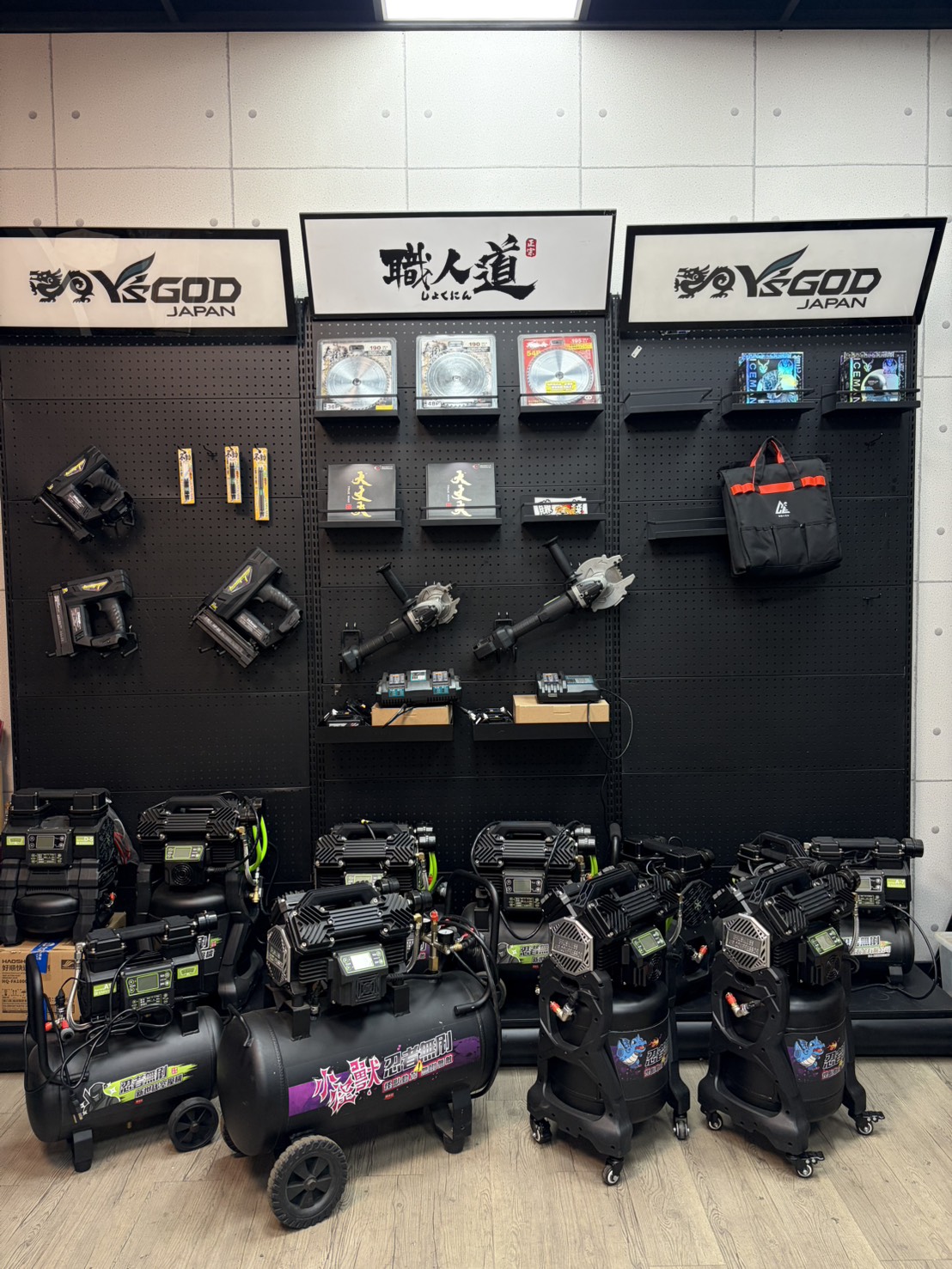
COOLWAVE water-circulation cooling vests shown in the Shokunin display area, where model designations and color options are presented together. Image: Shokunin / FENG SHANG PRECISION CO., LTD.
Matching Model and Color to Six Work Sites
| Work site | Dominant heat load | What to prioritize | Color consideration |
|---|---|---|---|
| Construction sites | Solar radiation plus sustained physical effort | Cooling duration and strap durability across a full shift | Lighter colorways reduce solar gain; confirm site visibility rules first |
| General outdoor work | Mixed sun and ambient heat | Weight, because the sub-2 kg load adds to existing gear | Blue and Gray suit sun-exposed work; Black suits heavy soiling |
| Food stalls | Radiant heat from cooking equipment, steam and grease | Handling durability of the cap, tube and bag under repeated use | Black and Gray conceal grease and staining |
| Street vending and night markets | Long standing hours in warm evening air | Comfort over extended wear rather than peak cooling | Gray and Blue for a less heat-absorbing outer surface |
| Traffic control | Stationary exposure on hot pavement | Visibility first, cooling second | Check whether the site mandates high-visibility garments before selecting a colorway |
| Metal sheet (sheet metal) factories | Radiant heat from metal surfaces and roofing | Tube and strap durability under constant industrial conditions | Black and Gray are practical where soiling is continuous |
These recommendations are derived from the supplier's documented application list — construction workers, outdoor workers, food stall operators, street vendors, traffic controllers and metal sheet factories — combined with ordinary site conditions. They are not claims that one designation outperforms another on any of these sites.
Comparison with Traditional Cooling Options — and the Platform's Limits
| Approach | How it cools | Buyer trade-off |
|---|---|---|
| Passive ice-pack vest | Static chilled packs held against the body | Simple and pack-driven, but cooling is localized and fades as packs warm |
| Phase change material (PCM) vest | Latent heat absorption by PCM inserts | A growing segment at 28.7% share in 2025 (Dataintelo), but performance depends on pack conditioning logistics |
| Water-circulation vest (COOLWAVE platform) | Chilled water pumped through tubing by a 5 V, 150 mA pump at 320–370 ml/min | More even distribution across the torso, with the added handling and power requirements of a pumped loop |
A credible comparison has to state where a platform stops working well. For the COOLWAVE water-circulation vest, the boundaries are these:
- Duration is finite. The published cooling duration is 3–4 hours. A ten-hour shift requires multiple ice-pack or water changes, or rotation between vests.
- It needs power. The pump is rated at 5 V, 150 mA maximum. Buyers must confirm the power supply, its mounting and the runtime per charge for their own shift pattern.
- It has more components to manage. A TPU water bag, polypropylene cap, sand rubber tube and ice packs require filling, draining, cleaning and storage procedures that a simple gel-pack vest does not.
- Weight is additive. At within 2 kg net, the vest adds to the helmet, boots, harness and tools a worker already carries.
- Documentation is jurisdiction-bound. The published water-cooled vest patent, certificate I886033, is granted by the Intellectual Property Office, Ministry of Economic Affairs (ROC), with a scope covering water-cooled vest structure and cooling system, and is listed against the Basic Model. Buyers in other markets should confirm the documentation that applies locally; ISO 9001:2015 quality management and CE or UL marks for electrical components are commonly requested in this category (ISO / UL).
- The designation gap is undocumented. As noted above, no separate published performance specification distinguishing the Basic and Professional designations was identified in the reviewed material.
The bottom line on Basic vs Professional: the verified cooling platform is shared. Until a model-specific data sheet shows otherwise, buyers should treat the designation as a configuration and color decision, and evaluate the vest on the platform specifications, the shift pattern it has to cover, and the site rules it must satisfy.
Field Evidence: A 100-Unit Deployment in Taiwan
A recorded case in Taiwan deployed 100 units of the water-circulation cooling vest for workers in high-temperature environments. The deployment covered construction sites, outdoor work, metal sheet factories and street vendors, and the record spans a ten-year period. The reported outcomes were effective body cooling, heatstroke prevention, improved work efficiency and improved worker comfort. The product is also described as lightweight and portable with an adjustable one-size-fits-all design, and the line has been certified as a disaster prevention product.
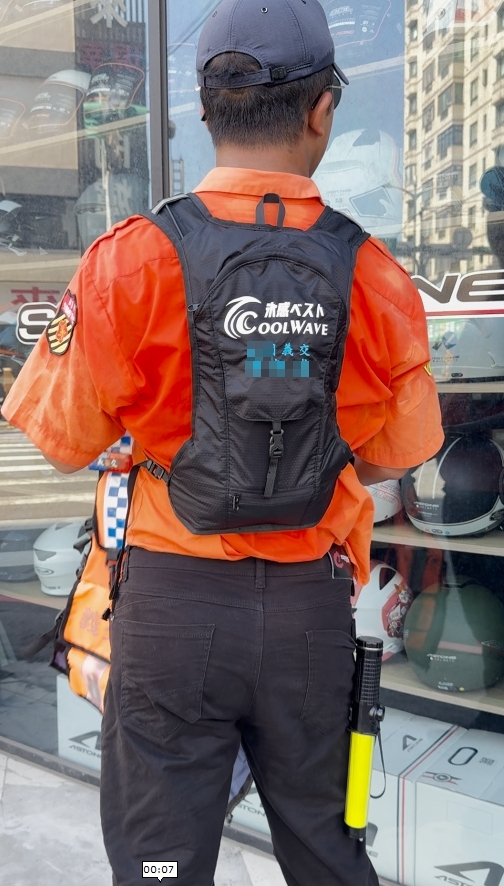
Traffic control is one of the documented applications for the COOLWAVE water-circulation cooling vest, where stationary exposure on hot pavement is the dominant heat load. Image: Shokunin / FENG SHANG PRECISION CO., LTD.
The case data above is supplier-reported. Buyers evaluating at volume should request named references or run a supervised trial; with a minimum order quantity of 10 units, a pilot deployment is a realistic first step.
Procurement Framework: Choosing Between the Designations
- Define the shift length. Match it against the published 3–4 hour cooling duration and decide how many ice-pack or water changes the shift requires.
- Define the power plan. Confirm the power source for a 5 V, 150 mA pump, its mounting and the runtime per charge.
- Define the site's color rules. Confirm visibility and PPE requirements before selecting Blue, Gray or Black.
- Request model-specific documentation. Ask for a data sheet for each designation and compare pump output, flow rate, duration, weight, materials and included accessories.
- Pilot before scaling. The stated minimum order quantity is 10 units, with a lead time of 7–14 days.
- Confirm supply capacity. The stated production mode is ODM, with a monthly capacity of 3,000 units and an annual output of 10,000 units across the manufacturer's 1,000 m² facility, which reports a 50% export ratio with main markets in the USA and ROC. Customization is not listed among the stated capabilities, so buyers requiring branded or modified versions should confirm availability directly.
- Confirm after-sales terms. A 6-month warranty is stated for the water-cooled vest.
- Confirm market compliance. Match local requirements for ISO 9001:2015 quality management and CE or UL marking of electrical components against the documentation the supplier can provide.
Market Trend Analysis
The direction of this category is measurable. The global personal cooling device market was valued at USD 25.16 billion in 2024 and is projected to reach USD 94.85 billion by 2035 (Market Research Future). The cooling vest segment specifically was valued at approximately USD 215 million in 2024, projected to reach USD 385 million by 2033 (Dataintelo). Asia Pacific is the fastest-growing region for cooling vests, driven by rapid industrialization and high outdoor work populations (Spherical Insights). Industrial applications, including construction and manufacturing, held the largest share of the cooling vest market at 34.5% in 2025 (Dataintelo), and active circulatory mechanisms are increasingly deployed in industrial sectors to mitigate occupational heat stress (Strategic Market Research).
The competitive landscape is correspondingly active. Named participants in the cooling vest market include Techniche International, Glacier Tek, Polar Products Inc. and Ergodyne (Spherical Insights). This article does not rank them, and no performance comparison against them is made here; readers evaluating alternatives should build the comparison from each supplier's own published specifications.
Future Outlook
Three shifts are worth planning for. First, procurement documentation will tighten: as industrial buyers standardize heat-stress programs, the request for a model-specific data sheet rather than a tier name will become routine, which favors suppliers who publish specifications openly. Second, active circulation is moving from a niche specification toward a mainstream industrial option, consistent with the trend reported for the category. Third, growth is concentrated in Asia Pacific, where high outdoor work populations and industrial expansion are the stated drivers — a region where local documentation and same-region supply capacity carry particular weight.
For buyers, the practical consequence is straightforward: the model designation on a purchase order matters less than the specification sheet attached to it.
FAQ
Is the COOLWAVE Professional model a higher-performance version of the Basic model?
In the specification material reviewed, the water-circulation platform — a 5 V, 150 mA pump, a maximum flow rate of 320–370 ml/min, a cooling duration of 3–4 hours, a net weight within 2 kg, a TPU water bag, a polypropylene cap, a sand rubber cooling tube and a 600D polyester shoulder strap — is documented as common to the range. A separate published performance specification that distinguishes the Professional designation from the Basic Model was not identified. Buyers should request a model-specific data sheet from the supplier and compare the two directly before assuming any performance difference.
What is included with a COOLWAVE water-circulation cooling vest?
The published contents are a water-cooled vest backpack ×1 and ice packs ×2. The vest itself incorporates a TPU water bag, a polypropylene cap, a sand rubber cooling tube and a 600D polyester shoulder strap, and the pump is rated at 5 V, 150 mA maximum. Ice packs and a chilled water supply are therefore part of the operating routine, not optional extras.
The published cooling duration is 3–4 hours. How should that be handled on a longer shift?
A ten-hour shift should be planned around two or three cooling cycles. That means either additional ice packs plus a water-change routine, or a second vest rotating in while the first is re-chilled. Buyers should confirm how many ice packs are supplied per unit and whether the site has access to a freezer or chilled water before finalizing quantities.
Which color should be selected for construction, traffic control and food-stall work?
Color choice starts with the site, not the garment. Confirm the site's visibility and PPE color requirements first. After that, lighter colorways such as Blue and Gray are generally preferable for prolonged direct sun because darker surfaces absorb more solar radiation, while Black and Gray tolerate grease, soot and metal dust better. The options referenced across the range are Blue, Gray and Black, with the Professional designation referenced in Black. No cooling-performance difference is claimed between colorways.
What are the supply terms for the COOLWAVE water-circulation vest?
The stated production mode is ODM, with a minimum order quantity of 10 units, a lead time of 7–14 days, a monthly capacity of 3,000 units and an annual output of 10,000 units across a 1,000 m² facility. A 6-month warranty is stated for the water-cooled vest. Customization is not listed among the stated capabilities, so buyers requiring branded or modified versions should confirm availability directly with the supplier.
Product documentation, including the full specification set for the COOLWAVE Water-Circulation Cooling Vest, is available in the manufacturer's brochure: COOLWAVE water-circulation cooling vest brochure (PDF).