
COOLWAVE Cooling Vest Model Shortlist: Basic vs Professional Blue, Gray & Black
The COOLWAVE Water-Circulation Cooling Vest is listed as one Basic Model and one Professional Model in three colourways. All four published listings carry the same cooling duration, weight ceiling, material set and pump specification. For evaluation-stage buyers, the shortlist decision therefore rests on certification scope, colourway logic and procurement terms — not on a documented performance gap between the model names.
Heat-exposed work rarely fails in the abstract. It fails in defined places: a metal-sheet factory floor in midsummer, a traffic control post with no shade, a night-market stall where the operator cannot step away from the griddle. Occupational-safety guidance already frames water-cooled garments as one recognised category of personal cooling system, which places products like this one inside an established PPE conversation rather than a consumer comfort category.
That framing changes what a buyer needs from a supplier. The question is no longer whether active cooling is a legitimate control measure, but which SKU can be written into a purchase order and defended with documents. This shortlist addresses that question directly, and it states plainly where the published data stops.
The Four SKUs on the Shortlist
The COOLWAVE line is a Shokunin product. Shokunin is the professional brand of FENG SHANG PRECISION CO., LTD., a Taiwan-based manufacturer founded in 2009 whose product range covers air compressors, cut-off machines, water-cooled vests and related trade tools, with stated main markets in the USA and Taiwan (ROC) and an export ratio of 50%. The cooling vest itself is classified by the supplier as industrial cooling apparel and personal protective equipment.
Four listings are relevant to a procurement shortlist. Read the table as a specification record, not a ranking: no performance hierarchy between the rows is stated in the source data.
| Model designation (as listed) | Colourway | Stated cooling duration | Stated weight | Pump / flow | Listed contents |
|---|---|---|---|---|---|
| COOLWAVE Water-Circulation Cooling Vest (Basic Model) | Not specified in the listing | 3–4 hours | Within 2 kg | 5V 150mA (max); 320–370 ml/min max | Water-cooled vest backpack ×1; ice packs ×2 |
| COOLWAVE Water-Circulation Cooling Vest (Professional Model–Blue) | Blue | 3–4 hours | Within 2 kg | 5V 150mA (max); 320–370 ml/min max | Water-cooled vest backpack ×1; ice packs ×2 |
| COOLWAVE Water-Circulation Cooling Vest (Professional Model–Gray) | Gray | 3–4 hours | Within 2 kg | 5V 150mA (max); 320–370 ml/min max | Water-cooled vest backpack ×1; ice packs ×2 |
| COOLWAVE Water-Circulation Cooling Vest (Professional Model–Black) | Black | 3–4 hours | Within 2 kg | 5V 150mA (max); 320–370 ml/min max | Water-cooled vest backpack ×1; ice packs ×2 |
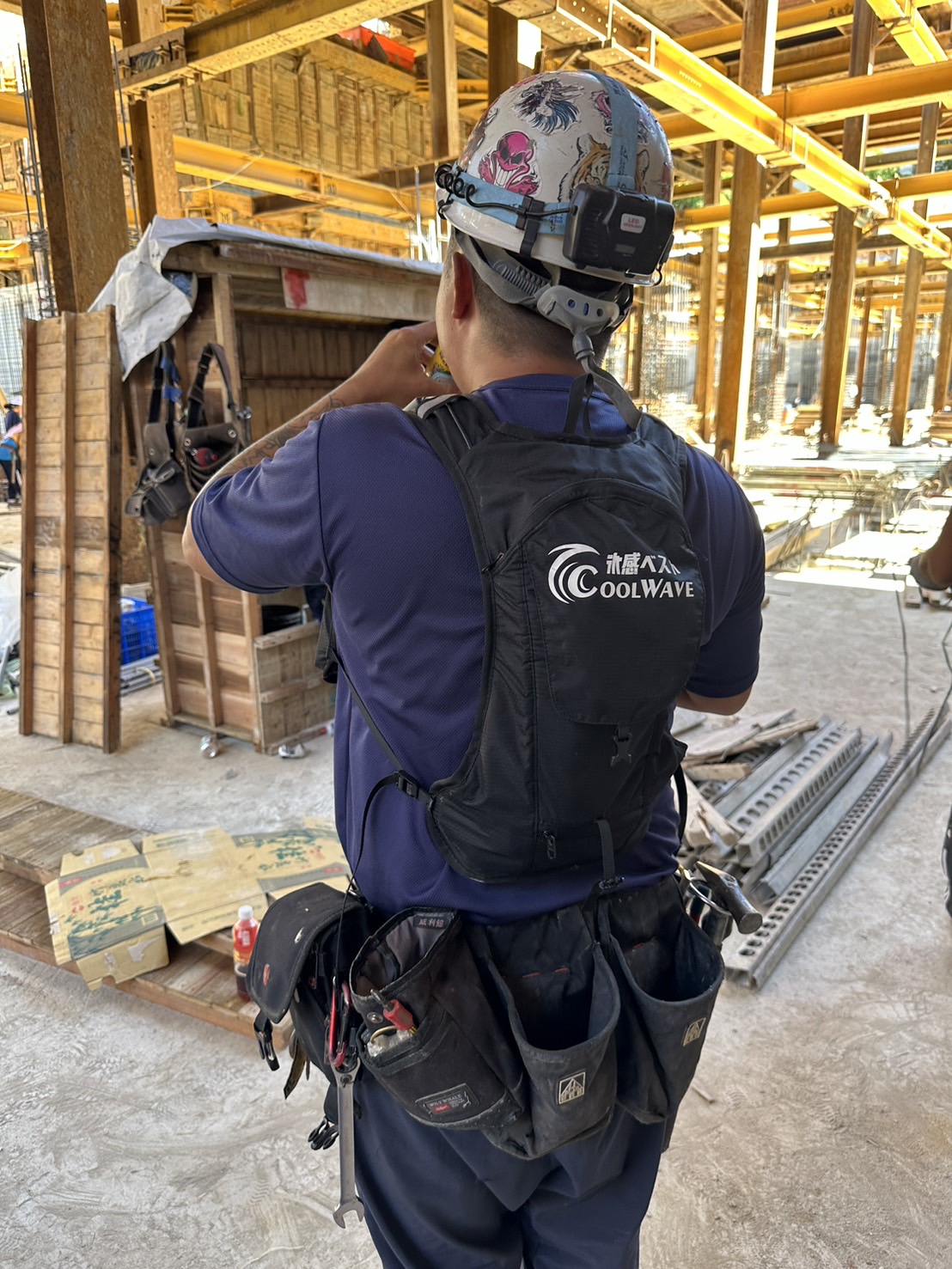
Construction site deployment: heat-exposed outdoor work is the primary application context for the COOLWAVE Water-Circulation Cooling Vest.
The Shared Specification Set
Every listing in the shortlist repeats the same material and performance block. That repetition is itself useful procurement information: it means a buyer can draft one technical annex and apply it to any of the four SKUs, then resolve the model and colour choice on commercial and operational grounds.
| Specification item | Stated value | Procurement reading |
|---|---|---|
| Cooling duration | 3–4 hours | Sets the shift-planning unit; see the recharge caveat below |
| Weight | Within 2 kg | Wearability ceiling for extended use |
| Stated suitable temperature | Below 10°C | Definition is not stated in the source; clarify before tendering |
| Shoulder strap material | 600D polyester | Abrasion-resistant woven strap grade |
| Main material | PEVA | Flexible, water-resistant sheeting |
| Water bag material | TPU | Flexible polyurethane reservoir |
| Water bag cap | Polypropylene | Closure and refill interface |
| Cooling tube | Sand rubber (black) | Flexible circulation line |
| Pump output | 5V 150mA (max) | Low-voltage DC pump; power source to be confirmed |
| Flow rate | Max 320–370 ml/min | Circulation capacity of the loop |
| Package contents | Water-cooled vest backpack ×1; ice packs ×2 | Two cold packs per unit — plan spares accordingly |
How Dual Cooling Works in This Vest
The phrase dual cooling describes two mechanisms working on the wearer at once. The first is a cold source: two reusable ice packs provide the thermal reservoir. The second is circulation: a 5V, 150mA pump moves chilled water from a TPU reservoir through a sand-rubber tube loop at a maximum flow rate of 320–370 ml/min. Ice alone cools by contact and proximity; adding a pumped loop distributes that cold more evenly across the torso instead of concentrating it where the pack sits.
The material choices map onto that architecture. The TPU water bag holds the reservoir and tolerates repeated flexing; the polypropylene cap forms the refill and closure point; the sand-rubber tube carries chilled water without the stiffness of rigid piping; the PEVA body sheeting manages splash and condensation; and the 600D polyester shoulder strap carries the backpack load, which matters because the whole assembly is specified to stay within 2 kg.
One detail deserves attention during evaluation. The pump is electrically driven, and the listed package contents name the water-cooled vest backpack and two ice packs — nothing more. Whether the power source for the pump is included, and what runtime it delivers at 5V and 150mA, is not established in the published specification. Buyers who intend to issue the vest to a crew should settle that point in the RFQ rather than at the first shift change.
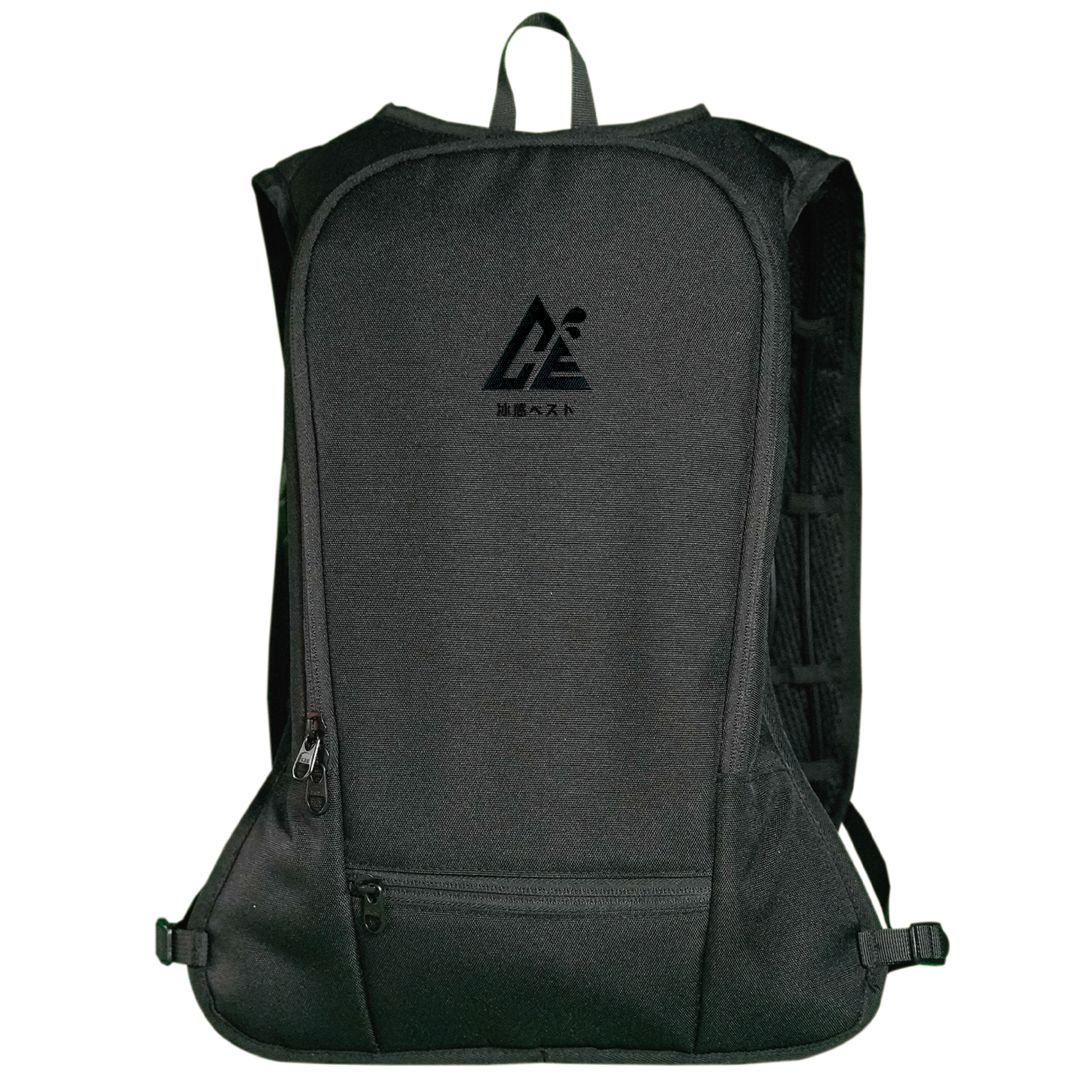
COOLWAVE Water-Circulation Cooling Vest, Professional Model in Black — one of three professional colourways listed alongside the Basic Model.
Basic vs Professional: What the Published Data Separates
This is the point where a shortlist article earns its keep, and it is also the point where most supplier comparisons quietly overreach. In the published records for this range, the Basic Model and the three Professional Models carry identical cooling duration, identical weight, identical materials, identical pump ratings and identical package contents. No document in the available set states that the Professional Model cools longer, runs faster, or carries a different reservoir.
Three readings of that are possible, and buyers should test which applies. The first is that the designations describe a commercial or channel distinction rather than an engineering one — a common structure when a manufacturer lists a base SKU and a branded or programme-specific variant. The second is that differences exist but are undocumented, in which case specification writing must wait for a written statement. The third is that the range genuinely is one platform offered in four configurations, with the choice driven by colourway and programme requirements.
The practical consequence is a hard rule for the evaluation stage: do not write a performance advantage into the tender that the supplier has not published. If the specification must distinguish Basic from Professional, ask for the differentiation in writing — a bill of materials comparison, a test report at defined conditions, or a side-by-side sample submission. Until that arrives, the two designations are equivalent on paper, and a shortlist that pretends otherwise will not survive technical review.
Blue, Gray and Black: Colour as a Specification Line
Because the technical block is shared, colourway becomes the only visible variable across the three Professional listings. That is not a trivial procurement dimension, but it should be treated as an operational choice rather than a performance one. Nothing in the published data claims that Blue, Gray or Black absorbs less heat, reflects more solar load, or changes the cooling curve. Any such assertion belongs to testing, not to a colour specification.
Colour does carry legitimate operational weight. Multi-crew sites often use colour to segment teams, subcontractors or shifts at a glance, which simplifies issue and return of shared equipment. Visible colours support supervisor checks that a vest is actually being worn at a hot station. Darker colourways tend to be preferred where work involves grease, soiling or metal dust, since they show less and are therefore less likely to be pulled from service early. For a uniform programme, colour may simply need to match an existing issue standard.
The Basic Model's listing does not specify a colourway at all. If colour consistency is a requirement across a mixed order, that gap should be closed in the quotation: state the required colourway per line item, and confirm whether the Basic Model can be supplied in a nominated colour or is offered as a single unspecified configuration.
Certification and Patent Position
Two formal markers sit behind this range, and both come with geographic boundaries that belong in a procurement file.
The first is the Disaster Prevention Product and Service Certification Award from the Taiwan Disaster Prevention Industry Association, awarded to the COOLING water-cooled vest. In a tender context this is a recognised third-party award in the Taiwan market; it is not a European, North American or Japanese conformity marking, and it should not be presented as one.
The second is patent protection. The COOLWAVE Water-Circulation Cooling Vest (Basic Model) is recorded under Patent No. I886033, issued by the Intellectual Property Office, Ministry of Economic Affairs, under the Patent Act of the Republic of China. The recorded scope covers water-cooled vest structure and cooling system; the issue date is 2025-06-01 and the expiry date is 2044-08-27; the applicable market is the ROC. For buyers, the patent record is useful evidence that the cooling architecture is a defined design rather than an assembled generic, and it matters for private-label discussions where structural similarity could raise questions later.
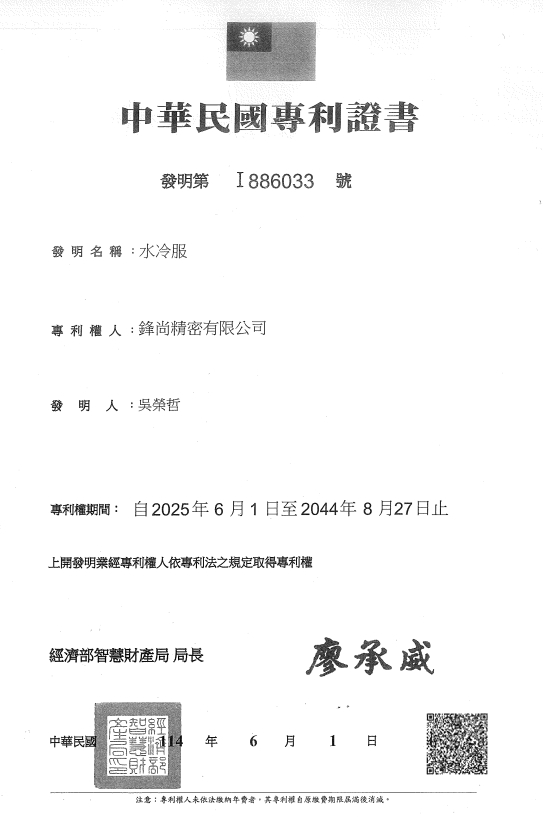
Patent No. I886033, issued by the Intellectual Property Office, Ministry of Economic Affairs, covering water-cooled vest structure and cooling system for the ROC market.
Procurement Terms for Evaluation
The commercial terms are the part of the shortlist that usually decides the outcome, because they determine whether a pilot can be run before a full programme is approved.
| Term | Stated value | What it enables |
|---|---|---|
| Minimum order quantity | 10 units | A crew-level pilot before a site-wide roll-out |
| Lead time | 7–14 days | Fits a seasonal pre-positioning window |
| Monthly capacity | 3,000 units | Supports staged deployment across multiple sites |
| Company annual output | 10,000 units | Context for total plant throughput across the product range |
| Production mode | ODM | Buyer-branded supply route; customization not indicated in the capability record |
| After-sales | 6-month warranty for the water-cooled vest | Defines the claim window; plan spares against it |
| Export markets | Global | Distribution scope as stated |
Two of these numbers need careful reading. The 3,000-unit monthly capacity and the 10,000-unit annual output are not the same measure and should not be added together or compared directly; one is a monthly line rate for the vest, the other is plant-wide annual throughput across a product range that also includes air compressors, cut-off machines, diamond saws, nail guns and screwdrivers. A buyer sizing a large programme should ask which basis the monthly figure uses — installed, practical or currently available — and request it in writing.
The 6-month warranty is the second point to examine. For a garment that may be issued daily through a summer season and handled by rotating crews, six months is a finite claim window, and it places weight on two things a buyer controls: the spare-parts and spare-ice-pack plan, and the issue-and-return discipline on site. Where an internal standard requires a longer coverage period, that gap should be negotiated explicitly rather than assumed.
The ODM designation deserves the same precision. ODM indicates a manufacturer-designed product supplied under a buyer's brand. The capability record does not list customization as available, so a private-label programme should begin with a direct question about what can be changed — labelling, packaging, colourway allocation, documentation — rather than an assumption that structural customization is on the table.
Where the Vest Fits: Application Scenarios
The listed application set is consistent across the corpus and points at one working condition: sustained heat with limited opportunity to leave the station. That covers construction sites, outdoor work, metal-sheet factories, street vendors and food-stall operators, and traffic controllers. A Taiwan deployment record cites 100 units in use for cooling in high-temperature environments, with reported outcomes covering body cooling, heatstroke prevention, and improved worker comfort and work efficiency. Those are the supplier's reported results, not an independently measured study — a distinction worth preserving in any internal business case.
The design logic that makes the vest plausible in those settings is the backpack format and the weight ceiling. A within-2-kg assembly worn over the torso leaves both hands free for tools, trays or a signalling baton, and the 3–4 hour cooling window matches roughly half a shift, which is where shift planning starts to matter.
- Construction and metal-sheet factory work — radiant heat from surfaces and roofs, with few shaded recovery points.
- Traffic control — long static exposure with no ability to step indoors.
- Street vending and food stalls — continuous heat from cooking equipment plus ambient summer load, with the operator tied to the stall.
- General outdoor work — prolonged sun exposure where a personal cooling system supplements, rather than replaces, shade, hydration and work-rest scheduling.
Market Context: Industrial Demand Anchors the Category
The category this product sits in is no longer marginal. Dataintelo's cooling vests market report puts the global cooling vests market at USD 342 million in 2025, and records industrial applications at a 34.5% revenue share in the same year. Read together, those two figures say something practical for procurement: the industrial segment is a large enough share of category revenue that suppliers are likely to organise documentation, warranty terms and capacity planning around institutional buyers rather than around consumer retail.
The regulatory framing reinforces that. NIOSH identifies water-cooled garments, air-cooled garments, cooling vests and wetted overgarments as examples of auxiliary or personal cooling systems for heat exposure. That classification matters commercially because it moves the purchase out of the discretionary-equipment budget and into heat-stress management, where the justification is a control measure rather than a comfort perk — and where the buyer is expected to document why the control was chosen.
Comparison with Ice-Pack-Only and Evaporative Alternatives
Cooling vests are not one technology. Three architectures dominate procurement discussions, and each shifts a different burden onto the buyer. The table below compares them on what has to be verified, not on a performance ranking.
| Dimension | Ice-pack-only vest | Evaporative vest | COOLWAVE water-circulation vest |
|---|---|---|---|
| Cooling mechanism | Frozen packs in fixed pockets | Evaporation of moisture from the fabric | Ice packs plus pump-circulated chilled water |
| Distribution of cold | Concentrated at pocket positions | Depends on airflow and fabric wetting | Spread through a tube loop across the torso |
| Dependence on ambient humidity | Low | High — evaporation slows in humid air | Low; the loop is a closed water circuit |
| Recharge cycle | Re-freeze packs between uses | Re-wet and dry the garment | Re-freeze packs and refill the reservoir |
| Power requirement | None | None | 5V DC pump; supply to be confirmed |
| Main verification burden | Pack durability and refreeze logistics | Climate suitability at the site | Pump reliability, reservoir integrity, documented test conditions |
The honest boundary for the water-circulation approach is the recharge cycle. Because the cold source is a pair of ice packs, the stated 3–4 hour window is a per-cycle figure, not a continuous-shift figure. A site running an eight-hour shift needs either spare packs held in rotation or freezer access at the changeover point. That is a logistics decision, and it is the single most common place where a well-specified cooling programme underperforms in practice.
The second boundary is documentation depth. The cooling duration and flow rate are supplier-reported figures without a disclosed test protocol — ambient temperature, humidity, workload, clothing layers and body size are not defined. That does not make the numbers wrong; it makes them unrankable. A buyer cannot use them to claim superiority over another supplier's published figure, and any internal justification that does so is exposed at audit.
The third boundary is geographic. The disaster-prevention award and Patent No. I886033 both sit in the Taiwan (ROC) market. Procurement into other jurisdictions should treat those as supporting credibility evidence and separately confirm what the destination market requires.
Verification Checklist Before Commit
The following items convert the shortlist into a defensible order. Each one addresses a gap that the published data leaves open, and each can be closed with a written response or a sample.
- Written differentiation statement between the Basic Model and the Professional Model, or confirmation that none exists beyond designation and colourway.
- Colourway allocation per line item, including whether the Basic Model can be supplied in a nominated colour.
- Definition of the stated below-10°C figure — ambient condition or cooling-medium condition — before it enters a technical annex.
- Test conditions behind the 3–4 hour duration, so the figure can be validated on site rather than assumed.
- Power-source confirmation for the 5V, 150mA pump: what is supplied, what is not, and expected runtime per charge.
- Spare-parts and refreeze plan: additional ice packs per wearer, reservoir replacement intervals, tube and cap availability.
- Warranty scope under a 6-month term — what voids it, and how claims are processed across borders.
- Capacity basis for the 3,000-unit monthly figure, stated as installed, practical or currently available.
- Destination-market compliance requirements, held separately from the Taiwan award and ROC patent.
Future Outlook
The direction of this category is toward documentation, not novelty. As the industrial share of cooling-vest revenue holds a substantial position — 34.5% of a USD 342 million market in 2025 — buyers are increasingly able to demand the artefacts that institutional purchasing requires: defined test conditions, component-level bills of materials, warranty terms mapped to duty cycles, and capacity evidence with a stated basis. Suppliers who can produce those artefacts will find the evaluation stage shorter; suppliers who cannot will keep competing on description.
For the COOLWAVE range specifically, the near-term question is whether the Basic and Professional designations acquire a documented technical difference, or settle permanently as one platform with four colour-and-programme configurations. Either outcome is workable for procurement. What is not workable is ambiguity in the middle of a tender, which is why this shortlist is organised around what can be verified today rather than what might be claimed tomorrow.
FAQ
What is the difference between the COOLWAVE Basic Model and the Professional Model?
In the published listings, no technical difference is stated. Both carry a 3–4 hour cooling duration, a weight within 2 kg, a TPU water bag with a polypropylene cap, a sand-rubber cooling tube, a 600D polyester shoulder strap, a 5V 150mA (max) pump with a maximum flow rate of 320–370 ml/min, and the same package contents of one water-cooled vest backpack and two ice packs. The Professional Model is listed in Blue, Gray and Black; the Basic Model's colourway is not specified in its listing. A buyer requiring a documented distinction should request a written statement or a side-by-side sample comparison.
Do the Blue, Gray and Black Professional Models have different specifications?
No. The three Professional Model listings carry the same cooling duration, weight, materials, pump rating, flow rate and package contents. Colour is the only stated variable between them. The published data makes no claim about how colour affects thermal performance, so colourway should be selected on operational grounds such as crew identification, visibility for supervisor checks, or soiling tolerance.
Which certifications and patents apply, and in which markets?
Two markers are recorded. The COOLING water-cooled vest received the Disaster Prevention Product and Service Certification Award from the Taiwan Disaster Prevention Industry Association, applicable to the Taiwan market. Separately, the COOLWAVE Water-Circulation Cooling Vest (Basic Model) is protected by Patent No. I886033, issued by the Intellectual Property Office, Ministry of Economic Affairs under the Patent Act of the Republic of China, covering water-cooled vest structure and cooling system, with an issue date of 2025-06-01, an expiry date of 2044-08-27, and application to the ROC market. Neither marker establishes conformity for other jurisdictions.
What are the stated procurement terms for an evaluation order?
The capability record lists a minimum order quantity of 10 units, a lead time of 7–14 days, a monthly capacity of 3,000 units, an ODM production mode, export markets stated as Global, and a 6-month warranty for the water-cooled vest. The company's annual output is separately recorded at 10,000 units across its wider product range. The monthly capacity and annual output figures use different bases and should not be combined.
What should be defined before requesting samples or issuing an RFQ?
Five items close most of the gap in the published data: the test conditions behind the 3–4 hour cooling duration, including ambient temperature, humidity and workload; whether the stated suitable temperature of below 10°C refers to ambient conditions or the cooling medium; what power source is supplied for the 5V, 150mA pump and what runtime it delivers; whether the Basic Model can be supplied in a nominated colourway; and the capacity basis used for the 3,000-unit monthly figure. A sample comparison between Basic and Professional models is also worth requesting if the tender must distinguish them.
What are the limits of the published specification data?
The cooling duration, weight and flow rate are supplier-reported and no test protocol is disclosed, so the figures cannot be used to rank this product against another supplier's published numbers. The cold source is a pair of ice packs, which means the 3–4 hour window is a per-cycle figure requiring refreezing between cycles. Customization is not indicated in the capability record despite the ODM production mode. The disaster-prevention award and the patent are both limited to the Taiwan (ROC) market, and the 6-month warranty defines a finite claim window that buyers should map against their intended duty cycle.
The full COOLWAVE product documentation is available as a downloadable brochure: FENG SHANG PRECISION product brochure (PDF).
Have Questions or Need More Details?
Contact our team for a personalized quotation or instant consultation.
Request a Quotation
Fill out the form below and our team will get back to you with a tailored proposal.
WhatsApp Direct Chat
Prefer to chat in real-time? Message us on WhatsApp for instant assistance & quick answers.
- Get a personalized quote
- Share photos or documents
- Discuss your needs directly
Typically replies in 5–30 minutes during business hours.