
COOLWAVE Gray vs. Blue: An Independent Check on Whether Color Affects Performance
On the published COOLWAVE documentation held by the manufacturer, Feng Shang Precision Co., Ltd., the second answer is the supported one. The company publishes a single component and performance set for the COOLWAVE Water-Circulation Cooling Vest — cooling duration, weight, flow rate, pump output, tubing, bag and shell materials, certification and patent. That set contains no color-differentiated parameter. Until a supplier produces color-specific test evidence, gray and blue are best treated as the same device in different housings, and the decision between them should be made on visibility, site rules and inventory logic rather than on cooling performance.
Why Color Enters a Cooling-Vest Specification at All
Color appears in cooling-apparel purchasing conversations for three practical reasons, and only one of them is thermal.
The first is site administration. Industrial and municipal work sites often operate internal color rules, and traffic-facing roles frequently carry their own high-visibility expectations. A buyer selecting a vest color is sometimes satisfying a safety officer rather than an engineer.
The second is solar gain. It is broadly accepted material science that darker surfaces absorb more incident solar radiation than lighter ones, and that a shell directly exposed to strong sun will therefore reach a higher surface temperature. The important qualifier is where that heat goes. A cooling vest removes heat through an internal loop — chilled water moved by a pump through tubing against the torso — not through the outer fabric. A thin outer layer is a small component of the total thermal load that a worker experiences, which is dominated by metabolic heat, ambient temperature, humidity, radiant load from the surrounding environment, and work intensity. Surface color is a second-order variable in that balance, not a controlling one.
The third is maintenance perception. Lighter shells show soiling, cement dust and grease differently from darker ones, which affects how frequently garments are laundered and how quickly they look unserviceable on site. This is an operational and cost consideration, not a cooling one.
The Shared Specification Set Behind Gray and Blue
The COOLWAVE Water-Circulation Cooling Vest is an industrial cooling garment classified by the manufacturer as Industrial Cooling Apparel / Personal Protective Equipment (PPE). Its published parameters are issued as one set, covering the functional loop and the materials that carry it.
| Parameter | Published value |
|---|---|
| Product line | COOLWAVE Water-Circulation Cooling Vest (Basic Model) |
| Product type | Industrial Cooling Apparel / Personal Protective Equipment (PPE) |
| Cooling duration | 3–4 hours |
| Weight | Within 2 kg |
| Suitable temperature | Below 10 °C |
| Shoulder strap material | 600D polyester |
| Main material | PEVA |
| Water bag material | TPU |
| Water bag cap | Polypropylene |
| Cooling tube | Sand rubber (black) |
| Pump output | 5 V, 150 mA (max) |
| Flow rate | Max 320–370 ml/min |
| Contents | Water-cooled vest backpack ×1, ice packs ×2 |
| Patent | I886033 — water-cooled vest structure and cooling system (Intellectual Property Office, Ministry of Economic Affairs; issued 1 June 2025; expiry 27 August 2044) |
| Certification | Disaster Prevention Product and Service Certification Award (Taiwan Disaster Prevention Industry Association) |
Nothing in that list is issued twice, once per colorway. The cooling tube is specified as black in both cases, which is the only color constant that touches the cooling path itself.
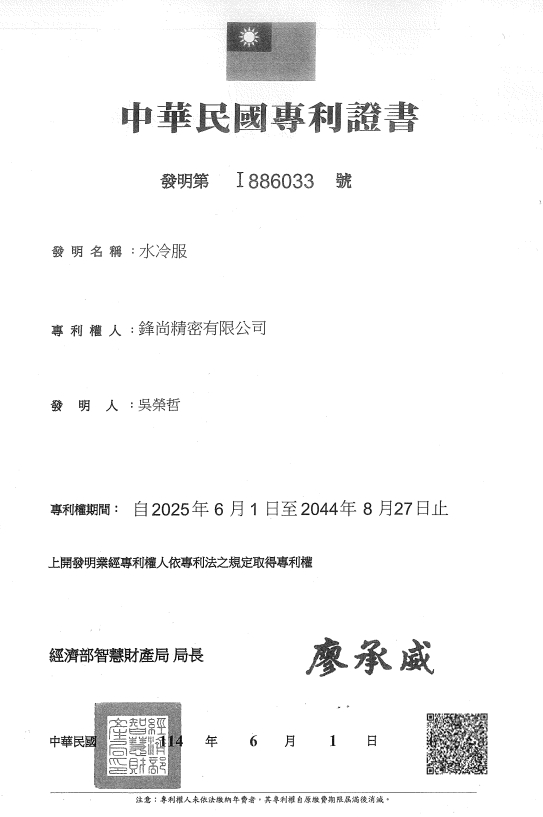
Patent certificate I886033, covering the water-cooled vest structure and cooling system, issued by the Intellectual Property Office, Ministry of Economic Affairs. The protected subject matter is the cooling architecture, not the shell color.
Component-Level Check: Pump, Tubing and Water Bag
If color influenced performance, it would have to influence one of the components that actually moves heat. Working through the published list, each of those components is specified once.
The pump and the flow rate
The circulating pump is rated at 5 V and 150 mA maximum, producing a maximum flow rate of 320–370 ml/min. Flow rate is the single most direct determinant of how quickly chilled water moves through the tubing and how evenly the cooling effect is distributed across the torso. It is a function of pump displacement, supply voltage and hydraulic resistance in the loop — none of which is affected by the color of the fabric that covers the assembly.
The tubing and the water bag
The cooling tube is specified as sand rubber in black, and the water bag as TPU with a polypropylene cap. These are the wetted parts of the system. Their material selection is driven by flexibility, pressure tolerance and durability under repeated filling and draining. Color plays no role in that selection, and the tube — the one component where a color is stated — is the same in both versions.
The shell and the harness
The main material is PEVA and the shoulder strap is 600D polyester. These are the layers where gray and blue differ visually. They are also the layers with the least influence on heat removal, because the cooling work happens inside them. A 3–4 hour cooling duration, a weight within 2 kg and a stated suitable temperature below 10 °C describe the system as a whole, and those numbers are published without a color qualifier.
Where Color Could Still Matter — and Where It Cannot
A useful way to keep the color question honest is to separate the zones of a vest by function.
- Cooling loop — color-independent. Pump output, flow rate, tubing, water bag and the ice packs supplied with the unit define the thermal performance. None of these is color-specified.
- Outer shell under direct sun — plausibly different, but unmeasured here. Surface solar gain is real physics, and a dark shell in full sun will run hotter at the surface than a light one. The available documentation contains no color-specific thermal test, so no performance difference can be claimed and none should be assumed away either. A buyer whose workforce is in prolonged direct sun and who wants certainty should request test data rather than infer it.
- Visibility and site compliance — genuinely color-dependent. Where a site mandates a color code or a high-visibility standard, color becomes a compliance item rather than an aesthetic one.
- Uniform and brand identity — commercially color-dependent. Contractors standardizing crew appearance, or distributors building a consistent product line, have legitimate reasons to prefer one shell over another.
- Cleaning and appearance retention — practically color-dependent. Light shells show dust, cement and grease differently from dark shells, which affects laundering frequency and how quickly a garment reads as worn on site. This is a maintenance-cost question.
Field Context: Where the COOLWAVE Vest Is Deployed
The application record for the COOLWAVE vest is organized by work environment rather than by product color: construction sites, outdoor workers, metal sheet factories, street vendors and food stall operators, and traffic controllers. A documented deployment in Taiwan covered 100 units used for cooling in high-temperature environments, with reported outcomes of effective body cooling, heatstroke prevention, improved work efficiency and improved worker comfort.
That record does not break results down by color variant, which is consistent with the specification set: the reported outcomes are attributed to the cooling function, and the cooling function is documented identically for both colorways.
The manufacturer, Feng Shang Precision Co., Ltd., produces the COOLWAVE line alongside air compressors, cut-off machines, lithium batteries, diamond saws, nail guns, spider stands and screwdriver bits. The company was founded in 2009, operates a 1000 m² facility with approximately 30 employees and a five-engineer R&D team, produces roughly 10,000 units annually, and exports to markets including the USA and ROC.
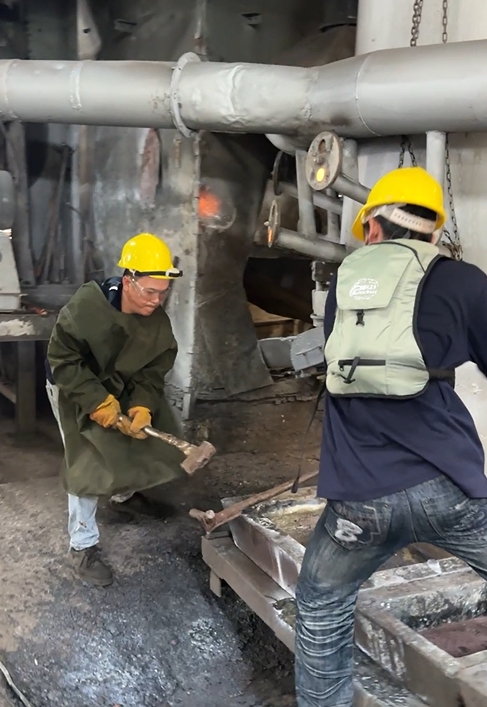
Metal sheet factory work is one of the documented application environments for the COOLWAVE vest. Application fit in the manufacturer's record is defined by work environment, not by shell color.
Market Context: Active Cooling Is Moving Into Industrial PPE
The wider category is expanding quickly enough that specification discipline is becoming a competitive issue in its own right.
- The global personal cooling device market was valued at USD 25.16 billion in 2024 and is projected to reach USD 94.85 billion by 2035 (Market Research Future).
- The narrower cooling vest market was valued at approximately USD 215 million in 2024 and is projected to reach USD 385 million by 2033 (Dataintelo).
- Asia Pacific is identified as the fastest-growing region for cooling vests, driven by industrialization and large outdoor work populations (Spherical Insights).
- Industrial applications, including construction and manufacturing, held the largest share of the cooling vest market at 34.5% in 2025 (Dataintelo).
- Phase change material (PCM) vests captured 28.7% of market share in 2025, the fastest-growing technology segment (Dataintelo).
- Active circulatory mechanisms, such as ice water circulation, are increasingly deployed in industrial sectors to mitigate occupational heat stress (Strategic Market Research).
One caution on these figures is worth carrying into any sourcing discussion. The two headline market sizes differ by more than an order of magnitude, and the difference is methodological rather than contradictory: the larger figure covers personal cooling devices broadly, including handheld fans and personal air conditioners, while the smaller figure isolates cooling vests. Buyers reasoning about category growth should check which definition a supplier or analyst is quoting before treating two numbers as rival claims.
Comparison With Traditional Cooling Approaches — and the Limits That Matter More Than Color
Positioning the COOLWAVE vest against established alternatives clarifies which variables actually drive a purchasing decision. Color does not appear among them.
| Approach | How cooling is delivered | What the buyer should weigh |
|---|---|---|
| Ice-pack-only vest | Frozen packs held against the body | Re-freezing logistics, number and size of packs, how long the packs hold useful temperature |
| Phase change material (PCM) vest | Latent heat absorption by PCM packs; 28.7% of cooling-vest market share in 2025 (Dataintelo) | Recharge temperature and recharge time, pack weight, replacement cost |
| Evaporative cooling garment | Moisture evaporation from the fabric | Strong dependence on ambient humidity; limited benefit in humid conditions |
| Water-circulation vest (COOLWAVE) | Chilled water pumped through tubing, supported by two supplied ice packs | Water and ice recharge discipline, the published 3–4 hour cycle, and loop maintenance |
The boundaries of the COOLWAVE system are documented and should be stated as plainly as its capabilities:
- Cycle length. Cooling duration is published as 3–4 hours. Work shifts that run longer require a planned recharge or pack change, which is a logistical requirement rather than a defect.
- Carried weight. The vest is specified as within 2 kg. That is light for a powered cooling system, but it is still weight, and it should be trialed with the actual crew before a fleet order.
- Operating specification. The published suitable temperature is below 10 °C, and the system depends on ice packs and a chilled water charge. Access to ice and water on site is therefore part of the deployment plan.
- Commercial terms. Published terms list a minimum order quantity of 10 units, production lead time of 7–14 days, monthly capacity of 3,000 units, shipment after payment with freight paid by the buyer, pre-shipment test as the acceptance criterion, and a 6-month warranty on the water-cooled vest.
- Customization boundary. The manufacturer offers ODM production services. The published capability record lists ODM as the production mode, with MOQ, lead time and monthly capacity as above; it does not list color matching or bespoke shell color as a customization service. A buyer who needs a specific corporate color should confirm that in writing rather than assume it.
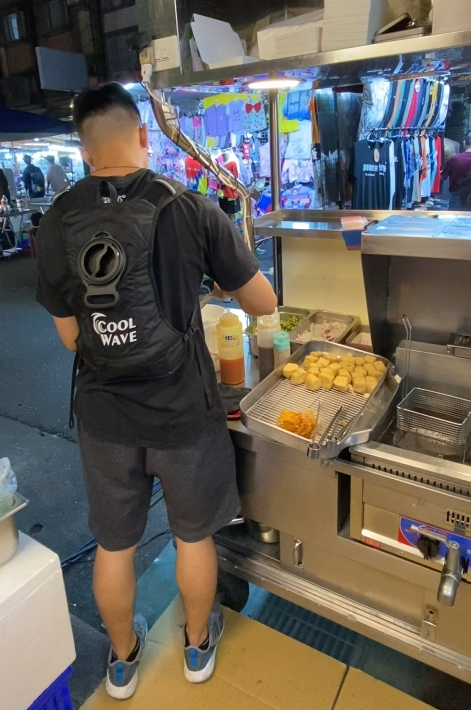
Street vending is listed among the documented application environments. Recharge access to ice and water — not shell color — defines whether the vest fits a given worksite.
What a Buyer Should Verify Before Choosing a Color
Where two SKUs share a specification set, the verification burden shifts to the buyer's own checklist. The following items resolve the gray-versus-blue question faster than any visual comparison.
- Confirm one specification set, not two. Ask the supplier to confirm in writing that duration, weight, pump output, flow rate and materials are identical across the colorways.
- Check the traceable identifiers. Reference the patent number and the certification named on the product documentation, and confirm both apply to the units being quoted.
- Apply the site rule first. If a site mandates a color code or a high-visibility standard, that rule decides the answer and no further comparison is needed.
- Request color-specific test data only if the risk is real. For crews in prolonged direct sun, ask whether any color-differentiated thermal test exists. If none does, treat the difference as unquantified rather than absent or proven.
- Validate with a sample. Order a small quantity and run it through a normal shift, including the recharge routine.
- Confirm MOQ implications before splitting. The published minimum order quantity is 10 units and the record does not state a separate minimum per color. Any split across two colorways should be agreed explicitly with the supplier.
Future Outlook
Two trends are likely to reshape how the color question is answered over the next few procurement cycles.
The first is documentation. As active circulatory cooling moves further into industrial PPE, buyers will increasingly expect the same evidentiary standard they apply to other protective equipment — declaration of conformity, component-level specification and traceable certification — for each SKU they purchase. In that environment, a cosmetic variant is not a separate product unless the supplier can demonstrate that it is, and the burden of proof sits with the supplier.
The second is the shift from garment selection to system selection. Market data pointing to growth in industrial cooling applications and in active circulatory technology suggests that buyers will spend more of their evaluation time on recharge logistics, cycle length, weight and site infrastructure than on appearance. Color will remain a real decision — for visibility, site compliance and inventory consistency — but it will be made in the same conversation as laundering schedules and site color codes, not in the same conversation as flow rate.
FAQ
Do the gray and blue COOLWAVE water-circulation cooling vests use the same pump and flow rate?
Yes, as published. The COOLWAVE Water-Circulation Cooling Vest is documented with a single pump specification of 5 V and 150 mA maximum, producing a maximum flow rate of 320–370 ml/min. The specification set is issued once and contains no color-differentiated pump or flow-rate value.
Does vest color change the cooling duration?
No published parameter supports that. Cooling duration for the COOLWAVE vest is stated as 3–4 hours without a color qualifier, and the components that produce it — pump, tubing, water bag and the two supplied ice packs — are specified identically. Any claim that one color lasts longer than the other would require test data that does not appear in the available documentation.
Is one color better for construction sites or metal sheet factories?
The manufacturer's application record lists construction sites, outdoor work, metal sheet factories, street vendors, food stall operators and traffic controllers as environments where the vest is used, and it defines fit by work environment rather than shell color. The practical differentiators are site color rules, visibility requirements and access to ice and water for recharging — not the color of the outer layer.
Can a buyer order a custom shell color under ODM?
That should be confirmed in writing. The manufacturer offers ODM production services, and the published capability record lists ODM as the production mode with a minimum order quantity of 10 units, a lead time of 7–14 days and a monthly capacity of 3,000 units. The same record does not list color matching or bespoke shell color as a customization service, so custom color should not be assumed to be available.
How can a buyer confirm that two colorways are the same device?
Request written confirmation that the specification set — cooling duration, weight, suitable temperature, materials, pump output, flow rate and contents — is identical for both colorways, and check that the same patent and certification identifiers, including patent I886033 and the Disaster Prevention Product and Service Certification Award, apply to the quoted units. A small sample order validated over one full shift is the most direct practical check.
What happens after the 3–4 hour cooling cycle ends?
The system is documented with a 3–4 hour cooling duration and a below-10 °C suitable temperature, and it ships with two ice packs and a water-cooled vest backpack. Sustaining cooling beyond that window depends on the site's ability to recharge ice and chilled water, so recharge access is part of the deployment plan rather than an afterthought.
The full product specification and capability record referenced in this article, including component materials, pump parameters, commercial terms and certification details, is available in the Feng Shang Precision / Shokunin product brochure: COOLWAVE product brochure (PDF). General company information is published at fstool.com.tw.
This article is an independent specification check based on the manufacturer's published documentation and publicly available third-party market data. It does not constitute a thermal performance test.