
COOLWAVE Vest: Reading Taiwan's Disaster Prevention Award
COOLWAVE Vest: Reading Taiwan's Disaster Prevention Award
Compliance evidence for the COOLWAVE Water-Circulation Cooling Vest arrives as three separate instruments, and each one answers a different question. A Disaster Prevention Product and Service Certification Award from the Taiwan Disaster Prevention Industry Association addresses recognition within a Taiwanese disaster-prevention framework. Patent No. I886033, issued by the Intellectual Property Office, Ministry of Economic Affairs, protects the vest's structure and cooling system in the ROC market. A six-month manufacturer warranty and an ODM production option sit beside both as commercial terms rather than technical approvals.
Treating any one of those documents as a general "certified PPE" status is the most common error when this product reaches a shortlist. Buyers in the research and evaluation stage need to know which claim attaches to which document, which market it applies to, and what remains unevaluated. That separation is what makes a procurement file defensible when a site safety officer, an insurer or an import partner asks for the evidence behind the specification sheet.
The vest is manufactured by Feng Shang Precision Co., Ltd., the company behind the Shokunin brand, and it is classified in company documentation as Industrial Cooling Apparel / Personal Protective Equipment (PPE). Stated applications are construction workers, outdoor workers, food stall operators, street vendors, traffic controllers and metal sheet factories. The compliance reading below is framed around those working conditions rather than around consumer cooling apparel.
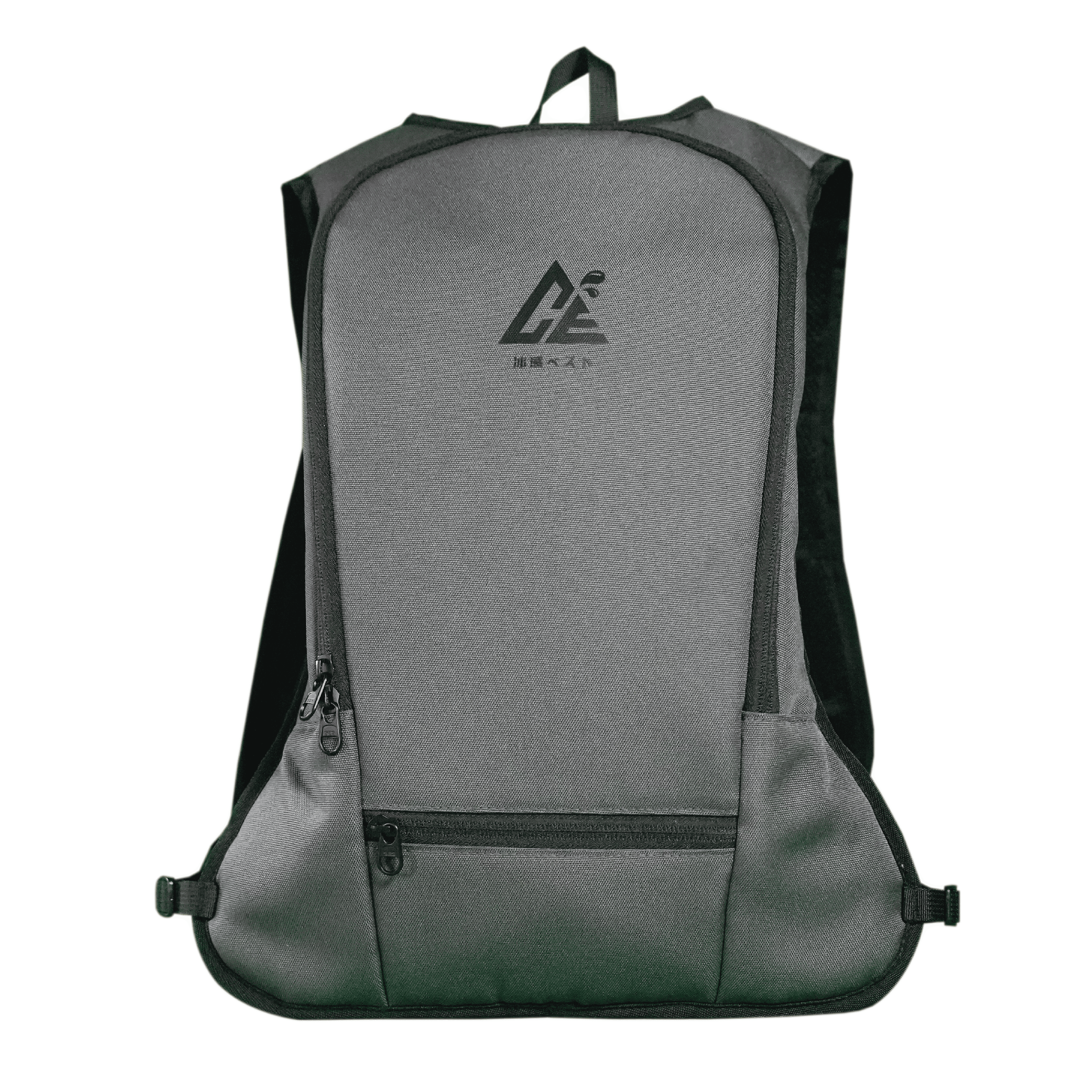
COOLWAVE Water-Circulation Cooling Vest, Professional Model (grey). The product record lists the category as Industrial Cooling Apparel / Personal Protective Equipment (PPE).
What the Taiwan Disaster Prevention Award Actually Certifies
The COOLING water-cooled vest manufactured by Feng Shang Precision Co., Ltd. received the Disaster Prevention Product and Service Certification Award from the Taiwan Disaster Prevention Industry Association. The recognition is recorded for the Taiwan market, and company documentation describes it as validating the product's compliance with specific disaster prevention standards.
The operative word is "specific". The public description reviewed for this assessment does not name the individual standards applied, the body that carried out the assessment, the test methods used, or the exact product configuration that was assessed. None of that undermines the award. It does mean that, on its own, the award tells a buyer that an industry association recognised the product within its disaster-prevention programme — not that the vest has been declared conformant to a named garment standard under an accredited conformity-assessment regime.
Market scope is the second qualification. An award issued by a Taiwanese association for the Taiwan market does not travel automatically with the carton. A distributor shipping into the United States, the European Union, the United Kingdom, Japan or Australia should hold the award as one supporting document among several and confirm separately which requirements apply to protective clothing, to powered wearables and to the power bank that drives the pump at destination.
Six questions that convert the award into usable evidence
- Can the full certificate be supplied, rather than a summary statement?
- Which standards are listed, and who defined them?
- Which organisation performed the assessment or testing?
- Which model and colourway were assessed — Basic, Professional, or both?
- What is the validity period, and what triggers renewal?
- Does the scope cover the powered pump assembly, or the garment only?
Category Label and Conformity Are Not the Same Thing
Classifying a product as Industrial Cooling Apparel / Personal Protective Equipment (PPE) places it in a category. It does not, by itself, demonstrate assessment against a named standard. The gap matters most in tenders, where a safety annex usually asks for a standard reference, a declaration of conformity and a test report rather than a product category line.
Occupational-safety guidance supports the existence of the category without certifying any individual product. The US National Institute for Occupational Safety and Health describes water-cooled garments, air-cooled garments, cooling vests and wetted overgarments as examples of personal cooling systems used to reduce heat burden. That framing explains why buyers treat cooling vests as work equipment; it does not transfer to a specific supplier's compliance file.
The practical consequence splits by site. In a formal PPE-governed workplace, the Taiwan award and the ROC patent are supporting evidence, and the destination-market conformity route stays a separate line on the checklist. In less formal settings — small construction crews, night-market stalls, street vending, temporary outdoor events — where no garment standard is applied to cooling apparel, recognition from an outside body carries more relative weight, precisely because the recognition comes from a party other than the manufacturer.
Patent I886033: The Structural Right Behind the Cooling System
Patent No. I886033 was issued by the Intellectual Property Office, Ministry of Economic Affairs, under the Patent Act of the Republic of China. The recorded issue date is 1 June 2025 and the recorded expiry date is 27 August 2044. Protected scope is described as the water-cooled vest's structure and cooling system, and the right applies to the ROC market. Company documentation associates the patent with the COOLWAVE Water-Circulation Cooling Vest (Basic Model).
A patent is an exclusive right over a claimed structure. For a buyer it establishes that the arrangement of the water bag, tubing and circulation path is treated as proprietary in Taiwan — relevant when a programme runs on ODM supply and the buyer needs to understand whether a second source could lawfully copy the design. It says nothing about electrical safety, thermal performance, garment comfort or fitness for a particular worksite, and it creates no approval outside the ROC market.
The two documents therefore address different risks. The association award is the disaster-prevention reference a safety officer will recognise; the patent is the design-provenance reference a sourcing manager needs. Neither substitutes for a test report, and neither should be presented in a tender as though it were the other.
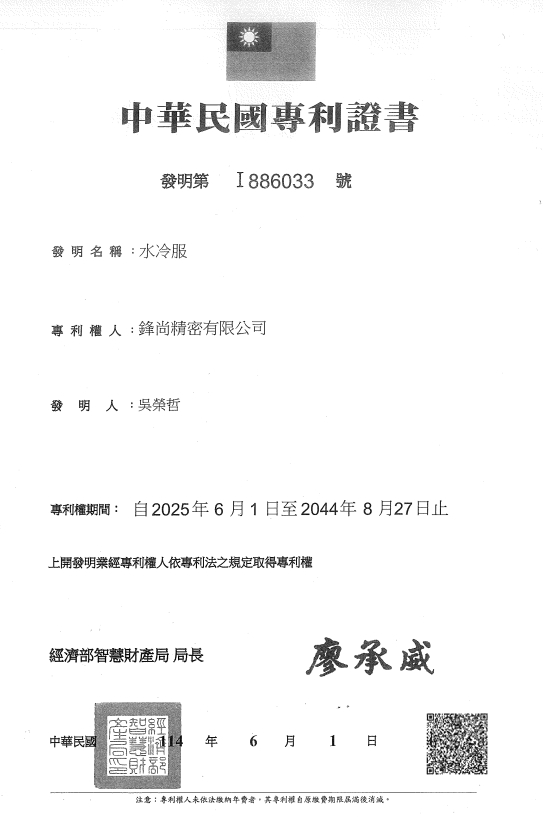
Patent certificate I886033, issued by the Intellectual Property Office, Ministry of Economic Affairs under the Patent Act of the Republic of China and applicable to the ROC market.
Reading the Specification File as Qualification Evidence
Specifications become compliance evidence only when their conditions are defined. The figures below are as stated in company product documentation for the COOLWAVE Water-Circulation Cooling Vest; the right-hand column shows what each figure does and does not settle at the evaluation stage.
| Specification | Stated value | What it settles, and what it does not |
|---|---|---|
| Cooling duration | 3–4 hours | A shift-planning input. Ambient temperature, workload, clothing layers and measurement method are not defined, so it should be verified in a pilot rather than quoted as a guaranteed runtime. |
| Weight | Within 2 kg | A wearability screen for shoulder and neck load, particularly where the vest is worn beneath or over other PPE. |
| Suitable temperature | Below 10°C | The basis is not specified — chilled water or ice-pack temperature, versus ambient air. Confirm which before quoting the figure to a site. |
| Pump output | 5V 150mA (max) | A low-voltage pump driven from an external power bank. Confirm bank compatibility, cable routing and how the pack is carried. |
| Flow rate | Max 320–370 ml/min | A stated maximum. Typical flow through a worn tube set and a partly filled bag should be confirmed with the supplier. |
| Shoulder strap | 600D polyester | Abrasion behaviour of the load-bearing strap; relevant for daily site use and cleaning cycles. |
| Body material | PEVA | Outer construction. Agree a cleaning and disinfection procedure before multi-user or shared deployment. |
| Water bag and cap | TPU bag, polypropylene cap | Consumable components; ask for spare-part availability and how replacements are priced. |
| Cooling tube | Sand rubber (black) | A contact component; check flexibility, kink resistance and replacement interval. |
| Set contents | Water-cooled vest backpack ×1, ice packs ×2 | Two packs imply a rotation cycle; additional packs extend coverage beyond the stated 3–4 hour window. |
Two readings follow from that table. First, the pump's electrical demand is small, so runtime is more likely governed by the cold source than by battery capacity — a point worth confirming directly with the supplier, because the answer determines whether the spares budget goes to ice packs or to power banks. Second, the "below 10°C" line is the least self-explanatory figure in the file and the one most easily misread when a specification is copied into a tender response.
Where the Vest Fits: Applications and Site Constraints
The listed applications are construction workers, outdoor workers, food stall operators, street vendors, traffic controllers and metal sheet factories, with high-temperature conditions and personal heat-stress relief as the operating context. Those settings differ in ways that change the compliance question.
On construction sites and at traffic control points, the vest is worn alongside helmets, high-visibility clothing and sometimes fall protection. Fit and strap routing matter as much as cooling capacity, and site PPE rules may require that any added garment not interfere with the protection already in use. A buyer should confirm that the shoulder-strap arrangement remains compatible with the harness or vest that the site already mandates.
In metal sheet factories and metal-roof buildings, radiant heat from the roof and from hot workpieces raises the value of a cooling system that does not depend on air movement. Where the environment is also dusty or oily, the pump, tubing and water bag need a defined cleaning routine — the PEVA body, TPU bag, polypropylene cap and rubber tube are the components to specify inspection intervals for.
For food stalls, street vending and outdoor events, shifts are long and rarely governed by a garment standard, so an external award is often the only third-party document in the file. The portable backpack format and sub-2 kg carry weight matter more here than on a fixed industrial site. Across all four settings, the stated 3–4 hour duration implies ice-pack rotation for a full shift — an operational planning fact rather than a product defect.
Water Circulation Versus Passive Ice Packs: A Bounded Comparison
Most alternatives in this category are passive: ice or phase-change packs held against the body, with no pump and no power source. The COOLWAVE dual cooling approach combines ice packs with a pump-driven water circuit that moves chilled water through tubing. The available material supports a comparison of documented characteristics; it contains no comparative thermal testing, so no claim of superior cooling performance can be made on either side.
| Dimension | Passive ice-pack vest | COOLWAVE water-circulation vest |
|---|---|---|
| Cold source | Ice or phase-change packs | Ice packs plus circulated water; set includes two ice packs |
| Power requirement | None | 5V 150mA (max) pump fed from an external power bank |
| Stated cooling duration | No single figure applies across designs | 3–4 hours as stated |
| Carry weight | Depends on pack mass and carrier | Within 2 kg as stated |
| Components to maintain | Packs and carrier | Packs, TPU water bag, polypropylene cap, rubber tube, pump |
| Evidence position | Varies by supplier; often specification only | Taiwan association award, ROC patent I886033, published specification set |
The fit boundary deserves stating plainly. A powered circuit adds components a passive vest does not have — pump, tubing, water bag, cap and a power source — and every one of them is a maintenance and spare-part item. Where power banks are impractical, where wash-down or persistently wet conditions dominate, or where a shift cannot accommodate pack changes, a passive design may remain the simpler choice regardless of architecture. Where radiant heat is high and several hours of continuous cooling are required, the documented circulation design is the version worth testing against a passive alternative in the buyer's own conditions.
Warranty and ODM Terms Inside the Same Evaluation
The manufacturer states a six-month warranty for the water-cooled vest. The material reviewed does not break that period down by component, so the practical question is coverage scope: whether the pump, tubing, water bag and cap fall under the same terms as the garment, what is excluded as wear, and how a claim is processed from an export market.
Six months is short against multi-year site programmes, and it should be read as the manufacturer's stated support window rather than as an expected product life. The useful move in procurement is to align the warranty period with the pilot or first deployment window, then agree a separate spare-parts arrangement for the components most likely to be replaced. A warranty that ends before the first pack rotation is complete tells the buyer little about support quality.
On production, company capability data lists ODM as the production mode, an MOQ of 10 units, a lead time of 7–14 days, monthly capacity of 3,000 units and global export markets. The same record lists customization as not available. That combination matters: an ODM designation describes the production model, not a confirmed right to change colourways, materials, branding or packaging. Buyers who need any of those changes should obtain written confirmation of what is and is not included before treating the ODM label as flexibility.
Capacity needs a definition as well. Company background records an annual output of 10,000 units across the business, while the ODM line is described at 3,000 units per month. Those are different bases — company-wide annual versus line-level monthly — and they cannot be combined, averaged or treated as interchangeable. Neither figure replaces a confirmed delivery schedule against a specific order and configuration.
A Certification Due-Diligence Checklist for This Product
| Area | Evidence to obtain | Why it changes the decision |
|---|---|---|
| Association award | Full certificate, standard list, assessing body, validity, configuration covered | Determines whether the award can be cited as a standards reference or only as programme recognition |
| Market scope | Written statement of the markets covered by the award and the patent | Prevents a Taiwan-market document being presented as destination-market conformity |
| Patent | Certificate I886033 and its scope statement | Confirms design provenance where ODM supply and second-sourcing risk exist |
| Product standard | Declaration of conformity or test reports applicable at destination | Closes the gap left by the category label alone |
| Electrical component | Pump datasheet, power-bank specification, cable and connector details | A powered wearable introduces an electrical item into a garment approval |
| Performance conditions | Test conditions behind the 3–4 hour and 320–370 ml/min figures | Without them, figures cannot be compared with another supplier's claims |
| Warranty | Component-level coverage and the claim route from the export market | A six-month term needs a spare-parts plan behind it |
| ODM scope | Written statement on customization, MOQ, lead time and packaging | Separates the production model from actual flexibility |
| Capacity | Definition of capacity basis and a delivery schedule for the order | Prevents annual and monthly figures being read as the same measurement |
Why Documentation Now Decides More Cooling-Vest Shortlists
Commercial research published in 2026 by Dataintelo estimates the global cooling-vest market at USD 342 million in 2025, with industrial applications accounting for 34.5% of revenue share in the same year. Those are third-party commercial estimates rather than audited statistics, and they are best used to frame scale rather than to forecast any single supplier's demand.
The interpretation that matters for procurement is narrower. When roughly a third of category revenue comes from industrial buyers, purchasing criteria shift from comfort features toward evidence that survives an audit. That is why an association award, a patent and a warranty term are now read together in one file — and why the gaps between them are visible to the people who sign the order.
What to Build Into the Contract Now
The practical outlook for this product line depends less on new claims than on documentation discipline. A buyer who specifies, in the purchase order, which documents must accompany each shipment — award certificate copy, patent reference, component list with materials, test conditions for the stated duration and flow figures, warranty terms by component, and a defined ODM scope — can re-verify the file at every reorder without reopening the whole evaluation.
Two conditions should be written as conditions rather than assumptions: that the 3–4 hour duration is confirmed under the buyer's ambient temperature and workload during a pilot, and that destination-market conformity, where applicable, is confirmed before the first commercial shipment rather than after it. Neither condition can be satisfied by the Taiwan award alone, and neither requires replacing the product to test.
Frequently Asked Questions
What is the Disaster Prevention Product and Service Certification Award?
It is an award issued by the Taiwan Disaster Prevention Industry Association and received by Feng Shang Precision Co., Ltd.'s COOLING water-cooled vest. Company documentation describes it as validating the product's compliance with specific disaster prevention standards, and the recognition applies to the Taiwan market.
Does the Taiwan award mean the vest is certified PPE in the United States or the European Union?
No. The award is recorded for the Taiwan market, and the description reviewed does not identify the individual standards, the assessing body, the test methods or the configuration assessed. Where destination-market rules apply to protective clothing or to powered wearables, they must be satisfied separately. The Industrial Cooling Apparel / Personal Protective Equipment (PPE) classification is a product category, not a conformity mark.
What does patent I886033 cover, and does it apply outside Taiwan?
Patent No. I886033 was issued by the Intellectual Property Office, Ministry of Economic Affairs, under the Patent Act of the Republic of China, with a recorded issue date of 1 June 2025 and a recorded expiry date of 27 August 2044. It covers the water-cooled vest's structure and cooling system and applies to the ROC market. It is a design right, not a safety certification, and it creates no approval in export markets.
What should a buyer check about the six-month warranty?
Coverage scope. The manufacturer states a six-month warranty for the water-cooled vest; the material reviewed does not specify component-level terms. Buyers should confirm whether the pump, tubing, water bag and cap are included, which wear conditions are excluded, and how claims are handled from an export market, then align the period with the pilot or first deployment window.
Is the ODM option the same as full customization?
Not on the available record. Company capability data lists ODM as the production mode with an MOQ of 10 units, a lead time of 7–14 days and monthly capacity of 3,000 units, while listing customization as not available. Buyers requiring colour, material, branding or packaging changes should obtain written confirmation of scope before relying on the ODM designation.
Supplier Reference
Feng Shang Precision Co., Ltd. was founded in 2009 and operates a 1,000 m² facility with 30 employees and five R&D engineers. The company reports annual output of 10,000 units and an export ratio of 50%, with the USA and ROC as its stated main markets. The Shokunin brand supplies the COOLWAVE Water-Circulation Cooling Vest in Basic and Professional variants, the latter in blue, grey and black.
The publicly available product brochure, which documents the specification set described above, can be downloaded here: COOLWAVE product brochure (PDF). Business hours are Monday to Friday, 8:30 AM to 5:40 PM; phone +886 3-312-6606; email fsmarketing@fstool.com.tw.
Have Questions or Need More Details?
Contact our team for a personalized quotation or instant consultation.
Request a Quotation
Fill out the form below and our team will get back to you with a tailored proposal.
WhatsApp Direct Chat
Prefer to chat in real-time? Message us on WhatsApp for instant assistance & quick answers.
- Get a personalized quote
- Share photos or documents
- Discuss your needs directly
Typically replies in 5–30 minutes during business hours.