
COOLWAVE vs 5 Cooling Vest Brands: A Construction Benchmark
An independent-style buyer comparison of Shokunin's COOLWAVE Water-Circulation Cooling Vest against Ergodyne, TechNiche International, Glacier Tek, Coolshirt, and Polar Products, measured on R&D capability, manufacturing scale, ODM responsiveness, and construction-specific fit.
Construction heat stress is a recognized occupational hazard rather than a seasonal inconvenience. OSHA's General Duty Clause (Section 5(a)(1)) requires employers to provide a workplace free from recognized hazards, and prolonged heat exposure on high-temperature construction sites sits inside that obligation. For crews working metal roofs, unshaded slabs, and open service trenches, personal cooling has shifted from a comfort purchase to a documented procurement category.
That shift changes how construction buyers assess cooling vests. The decision now turns on verifiable capability: who can engineer the cooling system, who can scale production, who can respond to an ODM brief, and whose design actually fits a construction site. This article is an independent-style benchmark that places Shokunin's COOLWAVE Water-Circulation Cooling Vest against five widely recognized names in industrial cooling, Ergodyne, TechNiche International, Glacier Tek, Coolshirt, and Polar Products, across four evaluation dimensions.
The COOLWAVE figures below come from the manufacturer's published capability, product, and case data. Competitor brands are named because published market reporting identifies them as established participants in the industrial cooling vest market. Where a competing brand's specification is not publicly documented, this article states the buyer question instead of estimating a number.
Why construction buyers are comparing cooling vest suppliers right now
Three market signals frame the current comparison cycle.
Heat stress prevention products reached a global market value of USD 2.86 billion in 2025, with cooling wearables identified as a primary growth driver (The Business Research Company). Industrial applications were the largest segment of the cooling vest market in 2025, accounting for a 34.5% revenue share (Dataintelo). The Asia-Pacific region dominated that market in 2025 with a 38.2% revenue share, driven by rapid industrialization (Dataintelo).
Published market reporting names Glacier Tek, TechNiche International, Polar Products, Ergodyne, and Occunomix among the key global manufacturers of industrial cooling vests. That list matters to buyers because it distinguishes specialist cooling suppliers from general PPE portfolios. A distributor assembling a summer construction cooling range, or a contractor standardizing heatstroke prevention work gear across multiple sites, is effectively choosing between a focused cooling manufacturer and a multi-category brand, and those two options answer different procurement questions.
The four dimensions that decide a cooling vest order
Not every comparison metric is equally useful. Buyers who have already run a cooling vest trial tend to converge on four dimensions, each of which can be verified before an order is placed:
- R&D capability — whether the supplier engineers the cooling system itself or resells a generic design.
- Manufacturing scale — annual and monthly output, and whether capacity can absorb a distribution rollout.
- Customer service and ODM responsiveness — minimum order quantity, lead time, customization pathway, and warranty terms.
- Construction-specific solution fit — whether the product is designed for high-temperature, long-duration outdoor work rather than light indoor use.
These four dimensions map directly onto questions a buyer can put in writing: show me your specification sheet, your capacity numbers, your lead time, and your field references.
COOLWAVE at a glance: the documented capability profile
Shokunin is the professional tools and equipment brand of Feng Shang Precision Co., Ltd., a Taiwan-based manufacturer founded in 2009. The company operates a 1,000 m² facility with 30 employees, exports roughly 50% of its output to markets including the USA and Taiwan, and maintains a five-engineer R&D team. Its product range spans air compressors, cut-off machines, water-cooled vests, lithium batteries, and related hand tools.
The COOLWAVE Water-Circulation Cooling Vest (Basic Model) is the company's cooling-apparel platform, classified as industrial cooling apparel and personal protective equipment. Its documented specifications form the backbone of this comparison.
| Documented parameter | COOLWAVE Water-Circulation Cooling Vest (Basic Model) |
|---|---|
| Cooling duration | 3–4 hours |
| Weight | Within 2 kg |
| Pump output | 5V 150mA (max) |
| Flow rate | Max 320–370 ml/min |
| Shoulder strap material | 600D polyester |
| Vest material | PEVA |
| Water bag material | TPU |
| Water bag cap | Polypropylene |
| Cooling tube | Sand rubber (black) |
| Included contents | Water-cooled vest backpack ×1, ice packs ×2 |
The commercial profile behind the product is equally specific: ODM production services, a minimum order quantity of 10 units, a typical lead time of 7–14 days, monthly capacity of 3,000 units, and a 6-month warranty on the water-cooled vest.
Dimension 1 — R&D capability: who actually engineers the cooling system
Cooling apparel can look similar across brands while being engineered very differently underneath. The clearest R&D evidence a buyer can request is intellectual property covering the cooling structure itself.
Feng Shang Precision holds ROC patent I886033, granted by the Intellectual Property Office of the Ministry of Economic Affairs (ROC) with an issue date of 1 June 2025 and expiry on 27 August 2044. The patent covers the water-cooled vest structure and cooling system under the Patent Act of the Republic of China.
A granted structure patent is a different class of evidence from a marketing claim, because it documents that the mechanism, not just the branding, was engineered in-house. The company also positions itself as the developer of brushless air compressor systems, which indicates a broader engineering culture around motorised and pump-driven products rather than pure textile assembly.
Against this, the five comparison brands operate at different scales and portfolio breadths. Ergodyne, TechNiche International, Glacier Tek, Polar Products, and Coolshirt are all established names in the wider cooling and PPE space, and several hold broad product ranges. Portfolio breadth, however, is not the same as documented engineering depth on a specific water-circulation design. The practical buyer question is identical for every brand on the list: Do you hold a patent or design registration covering the cooling structure, and what exactly does it cover?
Dimension 2 — Manufacturing scale: can capacity absorb a distribution rollout?
Scale matters at two moments in a cooling vest program. First during the trial, when a buyer needs a small, fast batch. Second during scale-up, when a distributor needs predictable monthly supply through a summer season.
COOLWAVE's manufacturer documents 10,000 units per year and 3,000 units per month, produced in a 1,000 m² facility by a 30-person team. That places the operation in a specialist mid-scale tier: large enough to support regional distribution and ODM programs, and structured around a single cooling category rather than spread across dozens of unrelated lines.
This is also where a benchmark becomes genuinely useful for procurement. Very large multi-category manufacturers may offer greater total output but often allocate it across many product families; single-line specialists may be more responsive but hold less absolute capacity. Buyers should therefore ask each brand for two numbers in writing: verified annual output for the specific cooling model, and committed monthly capacity during peak season.
Dimension 3 — Customer service and ODM responsiveness
For distributors, private-label brands, and contractors buying in volume, the ODM pathway is often the deciding factor. Documented COOLWAVE terms are unusually explicit for this category:
- Production mode: ODM production services available for water-cooled vests.
- Minimum order quantity: 10 units.
- Typical lead time: 7–14 days.
- Warranty: 6-month warranty on the water-cooled vest.
- Delivery terms: shipment after payment, with freight paid by the buyer.
- Acceptance criteria: pre-shipment test.
- Payment terms: full payment.
A minimum order quantity of 10 units is small for an industrial PPE category, which allows a distributor to trial a construction cooling vest line before committing to volume. A 7–14 day lead time supports seasonal restocking rather than long pre-season planning. The 6-month warranty defines the after-sales window clearly, and pre-shipment testing defines what acceptance means.
The same discipline should be applied to the competing brands. MOQ, lead time, warranty length, and acceptance criteria are rarely identical across suppliers, and a large brand's flexibility for a 10-unit trial order cannot be assumed. Buyers comparing Ergodyne, TechNiche, Glacier Tek, Coolshirt, or Polar Products should request the same seven commercial terms and compare them side by side rather than comparing catalogue photography.
Dimension 4 — Construction-specific solution fit
The final dimension is the one construction buyers notice fastest on site: does the vest survive a real shift?
COOLWAVE's documented design attributes point toward that use case. A 3–4 hour cooling duration covers a meaningful block of a shift. A weight within 2 kg keeps the vest wearable under existing PPE. A max flow rate of 320–370 ml/min indicates active water circulation rather than static gel contact. The material build, 600D polyester shoulder straps, PEVA vest body, TPU water bag, polypropylene cap, and sand rubber cooling tube, is oriented toward repeated wear in abrasive, dusty environments.
The manufacturer also positions the system as passive ice-pack cooling that does not require an external power supply, with an adjustable one-size-fits-all design and certification as a disaster prevention product. That combination is directly relevant to construction site cooling equipment, where power outlets and charging infrastructure are usually unavailable.
The comparison table below converts these four dimensions into a verification framework that applies equally to every brand in the benchmark.
| Evaluation dimension | COOLWAVE (documented position) | Question to put to Ergodyne, TechNiche, Glacier Tek, Coolshirt, Polar Products |
|---|---|---|
| R&D capability | Five-engineer R&D team; granted ROC patent I886033 covering the water-cooled vest structure and cooling system | Do you hold a patent or design registration covering the cooling structure, and what does it cover? |
| Manufacturing scale | 1,000 m² facility, 30 employees, 10,000 units per year, 3,000 units per month | What is your verified annual output for this exact model, and your committed peak-season monthly capacity? |
| ODM responsiveness | ODM services; MOQ 10 units; 7–14 day lead time; 6-month warranty; pre-shipment test | What are your written MOQ, standard lead time, ODM scope, warranty length, and acceptance criteria? |
| Construction fit | 3–4 hour cooling; under 2 kg; 320–370 ml/min flow; 600D polyester / PEVA / TPU build; disaster prevention certification | Which documented high-temperature construction or outdoor scenarios has this model been deployed in? |
Technical explanation: water circulation versus ice packs and fan-assisted cooling
Understanding the mechanism explains why the four dimensions above matter commercially. The COOLWAVE vest circulates chilled water from a TPU water bag through sand rubber cooling tubes using a 5V 150mA pump, at a flow rate of up to 320–370 ml/min, with two ice packs supplied as the cooling source. Because water moves, cooling is distributed across the torso rather than concentrated at the point of contact.
By contrast, a conventional ice-pack vest relies on static contact between frozen packs and the body, and a fan-assisted vest moves ambient air across the skin. Each approach carries a different trade-off, and buyers should match the approach to the work pattern rather than assume one design suits every site.
| Cooling approach | How it works | Typical buyer trade-off |
|---|---|---|
| Passive ice-pack vest | Frozen packs held against the torso | Simple and lightweight, but cooling fades as packs warm and coverage is localised |
| Fan-assisted vest | Forced air movement across the body | Requires a power source and battery management; increases airflow rather than direct cooling |
| Water-circulation vest (COOLWAVE) | Pump circulates chilled water through tubing over a 3–4 hour window | More even and longer cooling, but adds a pump, water bag, and ice-pack rotation to the daily routine |
Application and use cases in high-temperature work
Field deployment is where a cooling vest either proves itself or does not. The COOLWAVE vest has been deployed in high-temperature environments across multiple sites in Taiwan, including construction sites, outdoor work areas, metal sheet factories, and street vendors. The reference project placed 100 units into service, and those units have been in use for 10 years, demonstrating long-term durability alongside effective body cooling.
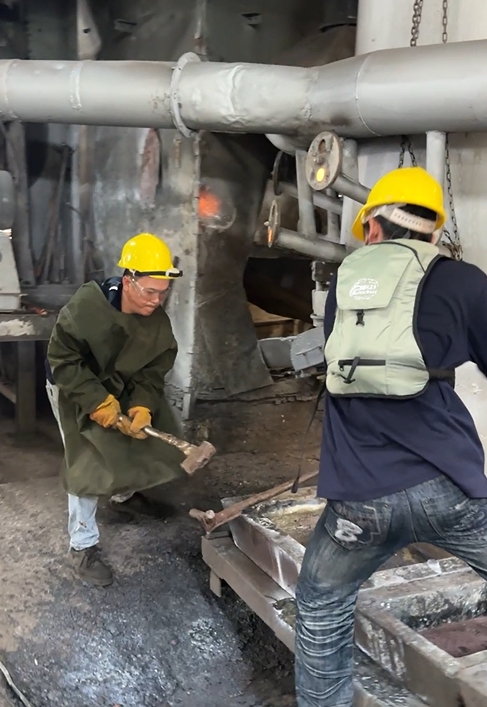
High-temperature industrial environments, including metal sheet factories, are among the documented deployment scenarios for the COOLWAVE Water-Circulation Cooling Vest.
The reported outcomes are operational rather than cosmetic: effective body cooling, heatstroke prevention, improved work efficiency, and improved worker comfort. For construction buyers, the practical mapping is direct. Construction site cooling equipment has to work during long-hour sun exposure, in stuffy metal-roof workplaces, and in conditions that generate excessive sweating. A passive ice-pack water-circulation design that needs no external power and stays within 2 kg addresses exactly those conditions.
The same configuration also transfers to adjacent outdoor roles that face comparable heat loads, including traffic controllers, outdoor operations crews, and street vendors working in prolonged radiant heat.
Market trend analysis: what the data indicates
Three trends support treating cooling vests as a durable category rather than a one-season product.
First, category value is rising. Heat stress prevention products reached USD 2.86 billion globally in 2025, with cooling wearables as a primary growth driver. Second, industrial use is the dominant segment, holding a 34.5% revenue share in 2025, which means the buyer base is largely commercial rather than consumer. Third, supply is concentrated in Asia-Pacific, which accounted for a 38.2% revenue share in 2025, driven by rapid industrialization.
For a distributor or contractor, these figures point to a market where supply-side capability, not product novelty, becomes the differentiator. When the category is growing quickly and industrial buyers dominate, the winning suppliers are those that can document engineering, capacity, and commercial terms, which is precisely what the four-dimension framework above is designed to test.
Limits and boundaries: what this comparison does not claim
A credible benchmark states its limits, and the COOLWAVE profile has several that buyers should plan around.
- Cooling is time-bound. The documented cooling duration is 3–4 hours. Covering a full shift therefore depends on ice-pack rotation or additional packs, and buyers should factor that into daily operating procedures rather than assume continuous cooling.
- There is a mechanical component. The system includes a pump, a TPU water bag, and tubing. That is more maintenance surface than a simple ice-pack vest, and cleaning, water handling, and pump care belong in the buying decision.
- Capacity is finite. Monthly capacity of 3,000 units and annual output of 10,000 units suit regional distribution and ODM programs. A national or multi-country rollout should be scheduled against confirmed capacity allocation rather than assumed.
- Payment and freight terms are specific. Shipment follows payment, and freight is paid by the buyer, with full payment as the stated term. Buyers used to extended credit terms should plan accordingly.
- Competitor specifications are not asserted here. This article deliberately avoids attributing performance figures to Ergodyne, TechNiche, Glacier Tek, Coolshirt, or Polar Products, because those figures should come from each brand directly. The comparison framework, not a fabricated scoreboard, is the deliverable.
Future outlook
The next buying cycle for construction cooling vests is likely to be shaped by documentation rather than novelty. As heat stress obligations tighten and industrial buyers dominate the category, suppliers will increasingly be selected on evidence they can publish: patent coverage, verified capacity, written commercial terms, and named field deployments.
Shokunin's COOLWAVE line already sits in that frame, with a granted structure patent, a defined production and ODM profile, and a ten-year, 100-unit field record in high-temperature environments. The brands it is benchmarked against bring scale and portfolio breadth. The comparison that matters for a construction buyer is not which brand is largest, but which supplier can answer the four verification questions with documents rather than adjectives.
Frequently asked questions
What is the COOLWAVE Water-Circulation Cooling Vest?
The COOLWAVE Water-Circulation Cooling Vest (Basic Model) is industrial cooling apparel and personal protective equipment made by Shokunin, the professional brand of Feng Shang Precision Co., Ltd., a Taiwan-based manufacturer founded in 2009. It circulates chilled water through cooling tubes over the torso and is supplied with a water-cooled vest backpack and two ice packs.
How long does it cool, and how heavy is it?
Documented cooling duration is 3–4 hours, and the vest weighs within 2 kg. The pump is rated 5V 150mA maximum, with a maximum flow rate of 320–370 ml/min.
What materials and components does the vest use?
Shoulder straps use 600D polyester, the vest body is PEVA, the water bag is TPU with a polypropylene cap, and the cooling tube is black sand rubber. The standard contents are one water-cooled vest backpack and two ice packs.
What certification and patent status does the product hold?
ROC patent I886033 was granted by the Intellectual Property Office of the Ministry of Economic Affairs and covers the water-cooled vest structure and cooling system, issued on 1 June 2025 with expiry on 27 August 2044. The product has also received the Disaster Prevention Product and Service Certification Award from the Taiwan Disaster Prevention Industry Association.
Has the vest been used in real high-temperature environments?
Yes. A project in Taiwan deployed 100 units across multiple high-temperature environments, including construction sites, outdoor work areas, metal sheet factories, and street vendor locations. The products have been in use for 10 years, demonstrating long-term durability, and the reported results were effective body cooling, heatstroke prevention, and improved work efficiency and worker comfort.
What are the order terms for ODM supply?
ODM production services are available for water-cooled vests. The minimum order quantity is 10 units, typical lead time is 7–14 days, monthly capacity is 3,000 units, and the water-cooled vest carries a 6-month warranty. Delivery terms are shipment after payment with freight paid by the buyer, acceptance criteria are a pre-shipment test, and payment terms are full payment.
What limitation should buyers plan for before ordering?
The documented cooling duration is 3–4 hours, so full-shift coverage requires ice-pack rotation or additional ice packs. The system also includes a pump, water bag, and tubing, which introduces routine water handling and component care that a simple ice-pack vest does not require.
Capability documentation
A full product and capability brochure covering the COOLWAVE Water-Circulation Cooling Vest, its specifications, and the manufacturer profile is available for download.
Download the COOLWAVE capability brochure
Editorial note: product and commercial figures in this article are drawn from manufacturer-published capability, product, certification, and case data. Third-party market figures are attributed to their published sources. No competitor performance specification has been estimated or asserted.
Have Questions or Need More Details?
Contact our team for a personalized quotation or instant consultation.
Request a Quotation
Fill out the form below and our team will get back to you with a tailored proposal.
WhatsApp Direct Chat
Prefer to chat in real-time? Message us on WhatsApp for instant assistance & quick answers.
- Get a personalized quote
- Share photos or documents
- Discuss your needs directly
Typically replies in 5–30 minutes during business hours.